
Connector Terminal Supplier Capability: 10-Year OEM Evidence
Connector Terminal Supplier Capability: 10-Year OEM Evidence
A connector terminal is one of the cheapest parts on a vehicle and one of the most expensive to get wrong. A single intermittently crimped contact can take a harness offline, trigger a warranty return and pull an entire program into containment. That asymmetry explains why procurement teams evaluating connector terminal suppliers are shifting the question they ask. The useful question is no longer "what can you make?" but "what has stayed in production, unchanged, for a decade?"
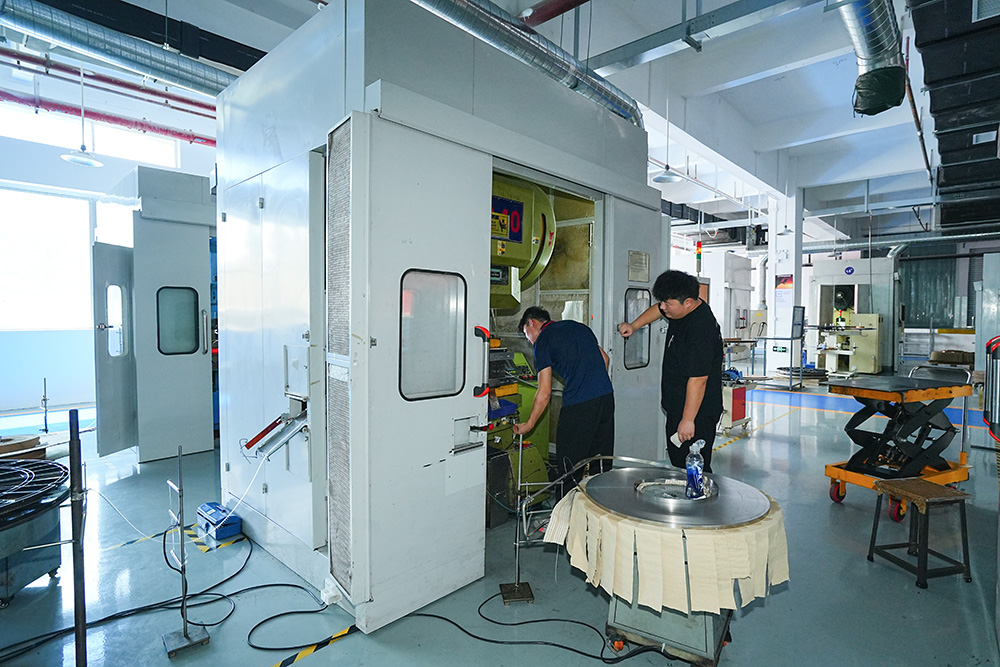
Precision stamping workshop: terminal geometry, spring force and plating continuity are set at the press, not at final inspection.
This article builds a supplier-capability evidence file around that second question, using JDE Automotive Technology Co., LTD as the reference case. JDE Automotive Technology Co., LTD is an automotive interconnect manufacturer based in Dongguan, China, producing stamping terminals, plastic injection-moulded connector housings, automotive connectors and wire harness assemblies for passenger vehicle, new energy vehicle, industrial, medical and energy-storage applications. The evidence presented here is first-party program documentation supplied by that company; it is treated as evidence to be interpreted, not as a verdict.
The Catalogue Problem in Connector Terminal Sourcing
Connector terminal catalogues are close to symmetrical. A stamped contact is a strip of copper alloy bent into a spring, a crimp barrel and a locking feature. Almost any supplier can present drawings, plating options and a housing family that look competitive on paper. What differs is what happens between lot 1 and lot 400: whether the tooling still holds the crimp barrel geometry, whether plating thickness stayed inside the window, and whether the same terminal is still being shipped into the same validated application years later.
That is the gap repeat-program records address. For a buyer at the evaluation stage, a supplier's installed base of long-running programs is one of the few capability signals that cannot be produced quickly, because it is a function of time rather than marketing budget. It does not prove that a supplier will perform on a new terminal design. It does show whether the supplier has been allowed to keep performing on an old one.
What Counts as Repeat-Program Evidence
Not all supplier claims carry equal weight in a shortlist decision. The tiers below are a practical filter for connector terminal evaluation, ordered from most to least durable.
| Evidence tier | What it looks like | What it proves |
|---|---|---|
| Program record | Named application, quantity, duration, part number | Continuity of supply and tooling |
| Process control | In-line 100% measurement, documented inspection method | Lot-to-lot consistency mechanism |
| Certification | Certificate number, issuer, scope, validity window | Audited system coverage, within a stated scope |
| Capability statement | Capacity, MOQ, lead time, customisation scope | Fit with the buyer's call-off pattern |
| Catalogue claim | Product photos, general specifications | Range, not reliability |
Five Programs That Anchor the Evidence File
The JDE evidence file is built on automotive OEM programs documented across five markets. Each entry records the application, the reported scale, the duration and, critically, what the program actually exercises in the part.
| Market | Application | Reported scale | Duration |
|---|---|---|---|
| United Kingdom | Automobile wire harness production | 1,000,000 pcs stamping terminals | 10 years |
| Canada | Car connector terminal | 1,000,000 pcs stamped connector terminals | 10 years, continuous supply |
| Italy | Car connector (JDE-1187-B stamping terminal) | 1,000,000 pcs connector terminals | 10 years |
| Australia | Automobile terminal connector | 1,000,000 pcs | 10 years |
| United States | New energy connector, high-current circuits | 1,000,000 pcs stamping terminals | 10 years |
| United States | Energy storage terminal | 1,000,000 pcs stamping terminals | 10 years |
Read together, the records cover three distinct stress profiles. The United Kingdom program is a harness-scale exercise: terminals, connectors, wires, sleeves, clips and corrugated tubes were integrated into a complete harness set combining power, signal and high-speed data circuits for the whole vehicle, which means the terminal had to survive crimping and locking inside a consolidated architecture rather than in isolated point-to-point wiring. The Canada, Italy and Australia programs are terminal-level exercises, including the JDE-1187-B stamping terminal in Italian car connector applications, where the fit between contact and housing carries the electrical outcome. The two United States programs push into higher-current territory, in new energy connectors and in energy storage terminals.
A German headlight connector harness assembly program, documented over 10 years for global market deployment, adds a fourth profile: a lighting circuit where a flickering daytime running lamp or an intermittent turn signal is an immediate, visible warranty event.
Physical Evidence: What the Terminal Itself Has to Survive
Program duration is the frame. The physics inside the frame is what a buyer actually has to validate.
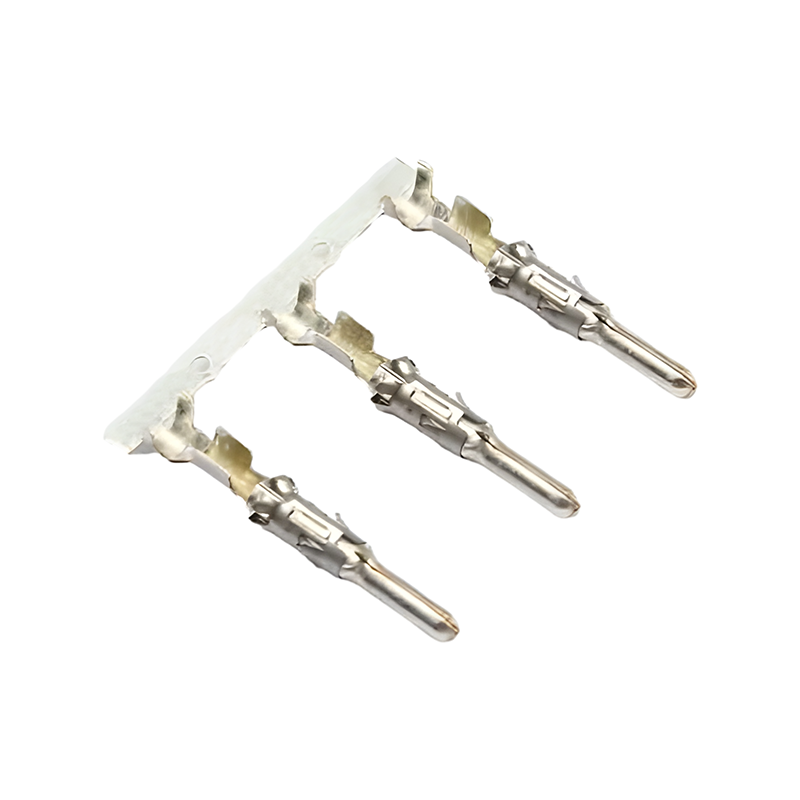
Male crimp terminals presented on carrier tape — the strip format that automated crimping equipment consumes.
Substrate and plating
JDE documents a high-conductivity copper alloy substrate with multiple plating options, including gold plating, tin plating and silver plating. In the supplier's own case language, the plated variants are described as showing lower resistance fluctuation after thermal cycling than ordinary terminals, with low and long-term stable contact resistance, minimal voltage drop and low heat generation. The purpose of the plating in a vehicle context is not cosmetic: it protects the contact point against salt spray, moisture, engine oil and coolant while holding resistance inside a narrow band.
That distinction matters at the shortlist stage. A terminal that meets resistance targets when new and drifts after thermal cycling will produce exactly the failure signature — signal drift, intermittent packet loss, sensor error — that is hardest to diagnose in the field.
Temperature, sealing and interface behaviour
Documented operating range across the sealed connector programs is -40 °C to 125 °C, with IP67/IP68 sealing options described as dustproof, waterproof and resistant to salt spray, oil and condensation. Insertion and extraction behaviour is treated as a design output rather than an operator variable: in the precision injection-moulding case documentation, uniform gaps after multi-piece assembly and insert moulding are linked to smooth insertion and extraction, precise locking, and terminals that remain vertical after encapsulation — which is what keeps contact resistance fluctuation minimal and prevents intermittent open circuits.
Housing tolerance is a terminal spec
A connector terminal performs inside a plastic cavity, so the moulded housing effectively belongs on the terminal datasheet. JDE's precision injection-moulding documentation describes tolerances typically achieving ±0.01 mm, with core electronic components reaching ±0.005 mm, and controllable warpage and shrinkage. The stated consequence is uniform gaps after assembly, smooth insertion and extraction, precise locking, and high batch consistency — addressing incorrect installation, jamming and poor electrical contact. For a buyer, this is the technical argument for evaluating terminal and housing together rather than as two unrelated line items.
The Manufacturing System Behind the Programs
Repeat programs are only credible if the production system can reproduce them. JDE operates a vertically integrated workshop covering precision stamping, precision injection moulding, in-house mould fabrication and automated assembly across a 50,000 m² facility with more than 300 employees and a 30-plus engineering team. Reported monthly capacity is 100 million pieces; third-party harvest records attribute a company-reported daily capacity of 4 million pieces to the same operation. Standard commercial terms are stated as a 500-piece MOQ and a 15–20 day lead time, with OEM/ODM customisation available for connectors, terminals and injection parts.
Quality control is stated as CCD online 100% measurement, applied to connector, terminal and injection part production and to connector and injection part quality control. That is a measurable claim in the sense that it can be audited: the buyer's question is not whether 100% measurement exists, but what happens to a rejected piece and how the measurement is calibrated.
| Certification | Certificate | Issuer | Validity |
|---|---|---|---|
| IATF 16949:2016 | LTXNCH | Quality Austria Certification GmbH | 2026-09-07 to 2029-09-06 |
| ISO 9001:2015 | 06524Q00481R0M | CFL Certification Center | 2024-03-13 to 2027-03-12 |
| ISO 14001:2015 | 06524E00220R0M | China Federation of Logistics Certification Center | 2024-03-13 to 2027-03-12 |
| ISO 45001:2018 | 06524S00209R0M | CFL Certification Center | 2024-03-13 to 2027-03-12 |
Note the scope wording. The IATF 16949:2016 certificate states a scope of automotive stamping parts, and the ISO 9001 certificate a scope of metal stamping parts processing. Those scopes are precise, and buyers should read them as precisely as they are written.
Where the Capability Fits
The applications documented across these programs map onto recognizable vehicle subsystems. Low-voltage body electronics, sensors, BMS signal acquisition and high-current power circuits are the stated fit for the Australian terminal program. Engine bay, chassis and exterior harness environments — where moisture and corrosion drive intermittent contact — are the stated fit for the sealed connector range operating from -40 °C to 125 °C. Battery pack, onboard charger and inverter circuits are the stated fit for the higher-current terminal variants, where controlled temperature rise under continuous load is the governing requirement. Lighting circuits, represented by the German headlight harness program, add a visible-failure case.
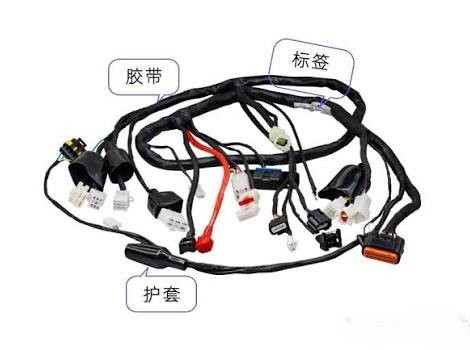
A custom harness assembly: the terminal is validated as part of a crimped, sealed, locked system rather than as a standalone part.
Beyond automotive, the same terminal and connector capability is documented against energy storage terminals, where the stated program benefits are reductions in energy loss, control of system temperature rise, and improved operational safety — with the supplier reporting energy-conversion efficiency improvements of 0.5% to 1.0% in that application.
Comparison With Traditional Sourcing Models — and the Limits of This File
The conventional alternative to a vertically integrated program supplier is catalogue or broker sourcing, where terminals and housings are bought separately against a part number. That model has real advantages: it is fast, it works well for standard parts and low volumes, and it keeps the buyer free of tooling commitments. Its weakness is interface risk. When the terminal comes from one supplier and the moulded housing from another, the insertion force, locking feel and contact resistance outcome belong to nobody in particular, and the buyer inherits the integration work.
The integrated model carries the opposite trade-off. It suits custom programs where terminal and cavity must be developed together, and it is slower and heavier for one-off purchases.
Three limits apply specifically to the evidence file presented here, and a serious evaluation should register them.
Certification scope is narrower than the product range. The IATF 16949:2016 certificate covers automotive stamping parts. A buyer sourcing injection-moulded sub-assemblies, complete harness sets or encapsulated connector bodies should confirm scope coverage separately rather than assuming the stamping scope extends to them.
Commercial terms suit programmed volumes. A 500-piece MOQ and a stated 15–20 day lead time fit scheduled call-offs. They fit urgent spot requirements less well, and a buyer whose pattern is small, irregular or emergency-driven should test that assumption before shortlisting.
The records describe the applications actually supplied. Ten-year programs in car connectors and new energy connectors say nothing about a terminal design, plating system or voltage class the supplier has not yet run. Program evidence reduces uncertainty; it does not transfer validation. PPAP documentation, material certificates and the buyer's own test plan remain the deciding instruments.
Market Context: Why Program Evidence Is Becoming a Shortlist Filter
Mordor Intelligence's 2026 outlook places the global automotive terminals market at USD 28.59 billion, covering ring, spade and connector terminals for automotive applications. That figure should be read with care: market definitions differ materially between sources, and connector market estimates typically exclude individual crimp terminals sold to harness manufacturers, while terminal market estimates include broader electrical contact components. The number signals scale; it says nothing about any individual supplier's capability.
The more useful reference point for buyers is the testing framework. USCAR2-7, the SAE International performance specification for automotive electrical connector systems, addresses testing across development, production and field analysis phases. That three-phase structure is the industry's own admission that connector performance is a lifecycle property, not a release-gate property — which is exactly why repeat-program records and in-line 100% measurement belong in a shortlist file alongside a certificate.
A Practical Scoring Framework for the Shortlist
The following framework converts the evidence above into comparable questions a buyer can put to any connector terminal supplier, not only to this one.
| Dimension | Request | Why it decides |
|---|---|---|
| Program continuity | Application, quantity, duration, part number | Shows tooling life and supply stability over time |
| Material and plating | Written substrate and plating option | Governs resistance stability and corrosion resistance |
| Interface fit | Housing tolerance and locking behaviour | Insertion and extraction outcomes live at this interface |
| Process control | Inspection method and measurement coverage | Determines lot-to-lot consistency |
| Scope and capacity | Certificate scope, MOQ, lead time, volume | Confirms fit between supplier system and buyer pattern |
Future Outlook
Two pressures are likely to harden the evidence standard. Electrification moves more terminals into higher-current duty, where temperature rise under continuous load is the binding constraint, and it widens the use of sealed, interlocked connector assemblies in which the contact is one element of a safety function. At the same time, the supplier base is broad and uneven, and the distinction between standard low-voltage terminals and high-precision, high-voltage-grade parts is not reliably visible in aggregate market reporting.
For procurement teams, the practical consequence is a shift in what a shortlist file looks like. Expect fewer catalogue pages and more of the following: named programs with quantities and durations, in-line measurement descriptions that can be audited, certificate scopes read word by word, and a clear boundary drawn around what a supplier's own records do and do not cover. Suppliers who can produce that file quickly will be easier to evaluate; buyers who ask for it systematically will make fewer decisions on symmetry alone.
FAQ
What evidence should a buyer request when shortlisting a connector terminal supplier?
Buyers should request program-level records rather than catalogue pages: the application, the quantity supplied, the duration of continuous supply and the part number involved. JDE's documentation, for example, records a 1,000,000-piece, 10-year stamping terminal program for automobile wire harness production in the United Kingdom, and a 1,000,000-piece connector terminal program running 10 years in Italy on the JDE-1187-B terminal. These records show what was supplied and for how long. They do not replace PPAP files, material certificates or test reports, which should be requested separately.
What does a 10-year, 1,000,000-piece program actually demonstrate?
It demonstrates continuity rather than peak performance. A decade of supply implies that tooling remained serviceable, that dimensional consistency held across many production lots, and that the supplier stayed operationally and commercially in the program. It does not by itself demonstrate performance on a different terminal design, a different plating system or a higher-voltage application. Those require their own validation plan.
How does vertical integration change connector terminal supply?
In a vertically integrated operation, precision stamping, precision injection moulding, in-house mould fabrication and automated assembly sit inside one production system, so terminal geometry and housing cavity can be developed together. Where terminals and housings are bought from separate suppliers, the interface risk sits with the buyer. Neither model is inherently superior: integration suits custom programs, while catalogue sourcing can be faster for standard parts and low volumes.
How can plating and material claims on automotive connector terminals be verified?
Ask for the substrate specification and the plating option in writing, then match them to the application. JDE documents a high-conductivity copper alloy substrate with gold, tin or silver plating options, and reports stable low contact resistance with reduced voltage drop in low-voltage signal and high-current circuits. Verification still depends on the buyer's test plan: contact resistance measurement, thermal cycling and salt-spray exposure against the agreed specification.
What are the limits of a supplier's own evidence file?
A first-party file is a starting point, not an audit. The JDE IATF 16949:2016 certificate, number LTXNCH, issued by Quality Austria Certification GmbH, states a scope of automotive stamping parts, so buyers sourcing injection-moulded sub-assemblies or complete harness sets should confirm scope coverage separately. Program records also reflect only the applications actually supplied. Reported commercial terms of a 500-piece MOQ and a 15–20 day lead time should be checked against the buyer's own call-off pattern.
Which connector terminal applications are documented for harsh environments?
Documented sealed connector programs state IP67/IP68 sealing options with resistance to salt spray, oil and condensation, and an operating range of -40 °C to 125 °C, described as suitable for engine bay, chassis and exterior harness environments. In a United States automotive OEM connector program, reported results include stable sealing and locking under vibration, thermal cycling and coastal salt spray, with reduced poor contact, signal dropout and random power loss.
A downloadable JDE Automotive Technology Co., LTD company brochure is available here: JDE company brochure (PDF).
Есть вопросы или нужны дополнительные детали?
Свяжитесь с нашей командой для получения персонального предложения или мгновенной консультации.
Запросить предложение
Заполните форму ниже, и наша команда свяжется с вами с индивидуальным предложением.
Прямой чат WhatsApp
Предпочитаете общаться в реальном времени? Напишите нам в WhatsApp для мгновенной помощи и быстрых ответов.
- Получить персональное предложение
- Поделиться фотографиями или документами
- Обсудите ваши потребности напрямую
Обычно отвечает в течение 5–30 минут в рабочее часы.