
Construction Cooling Vest Buyer's Framework: COOLWAVE vs. Ergodyne, TechNiche & Allegro
Construction Cooling Vest Buyer's Framework: COOLWAVE vs. Ergodyne, TechNiche & Allegro
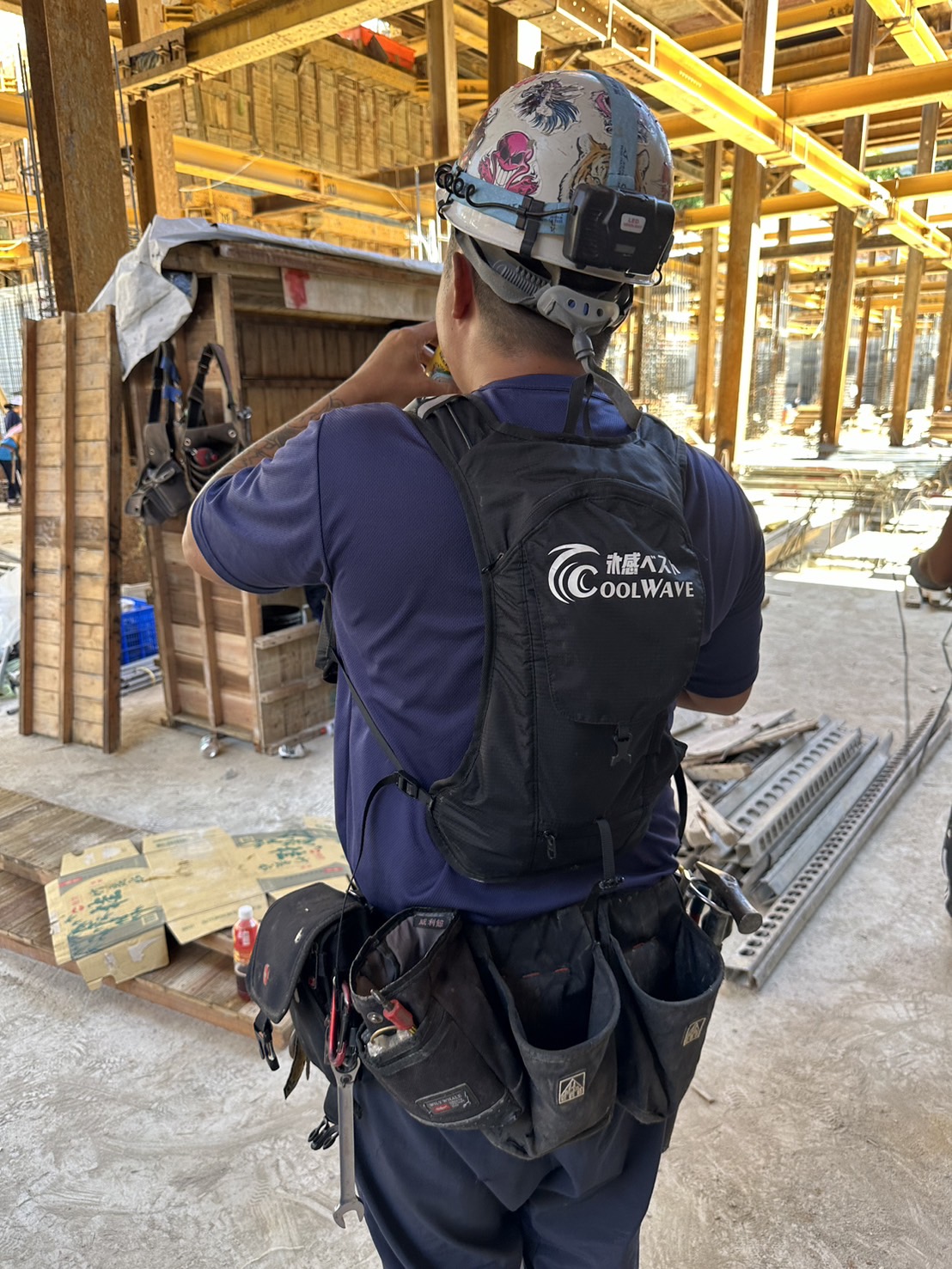
High-heat construction work — rebar, roofing, formwork and road crews — is the primary deployment scenario for water-circulation cooling vests.
In short: a construction cooling vest is a wearable heat-stress control, not a substitute for shade, hydration or rest cycles. The COOLWAVE Water-Circulation Cooling Vest series documents a pump-driven circulation system with a 320–370 ml/min flow rate, a 3–4 hour cooling duration and a net weight within 2 kg. The framework below explains what to compare across suppliers such as Ergodyne, TechNiche, Allegro, Polar Products and Steele — and where each approach stops working.
A construction cooling vest is a wearable heat-stress control: a garment that pulls heat out of a worker's body faster than a standard work shirt, so productive work can continue through the hottest part of a shift. It does not replace shade, water, rest cycles or acclimatization, and it does not replace engineering controls — but on sites where those measures are limited, it is often the most direct intervention a worker can carry.
Buying in this category is harder than the catalogue suggests. Supplier listings read almost identically — a vest, a cooling medium, a duration figure and a weight figure — while the engineering underneath differs enough to change how a shift is scheduled. The COOLWAVE Water-Circulation Cooling Vest series, produced by FENG SHANG PRECISION CO., LTD., a Taiwan-based manufacturer established in 2009 that sells professional tools under the Shokunin brand, is one specific answer to the problem. Ergodyne, TechNiche, Allegro, Polar Products and Steele represent other supplier positions that construction buyers typically place on the same shortlist.
This article sets out a buyer's framework rather than a sales comparison: the three cooling architectures in circulation, the seven criteria that decide whether a vest survives a real construction schedule, the documented COOLWAVE specification, and the boundaries that no cooling vest removes.
Heat on Site Is a Scheduling Constraint, Not a Comfort Issue
On a construction site, heat arrives in different forms at different work fronts. Rebar crews, roofers and formwork carpenters can spend a full shift in direct sun, with additional radiant load reflected off metal decking. Electricians and utility crews move between short bursts of intense exposure and long periods in equipment-filled spaces. Inside metal sheet factories and metal-roof workshops, the same heat is trapped in still air, producing the condition workers describe as oven-like: high radiant load, almost no airflow, and no meaningful shade.
This is why cooling is treated as a control rather than a perk. Under the OSHA General Duty Clause, Section 5(a)(1) of the OSH Act, US employers are required to provide a workplace free from recognized hazards, and heat stress at high-temperature construction sites falls inside that obligation (OSHA). A vest does not discharge that duty on its own, but it is one of the few controls that travels with the worker across a site where shade, scheduling and ventilation are largely outside the crew's control.
Layering is the second constraint buyers often discover late. Where site rules call for high-visibility clothing, ANSI/ISEA 107-2020 defines the reflective-material and contrast-fabric requirements for Class 1, Class 2 and Class 3 safety vests. A cooling vest is not a substitute for that garment, and the two have to work together: if the cooling layer interferes with the visibility layer, the site loses compliance; if the visibility layer traps heat, the cooling layer loses effectiveness.
Demand-side context supports the shift toward specification. Heat stress prevention products reached a global market value of USD 2.86 billion in 2025, with cooling wearables identified as a primary growth driver (The Business Research Company). That growth is not driven by novelty; it is driven by buyers who have started treating heat as a documented risk with a budget line attached.
The Three Cooling Architectures Buyers Actually Compare
Almost every industrial cooling vest on a construction shortlist belongs to one of three families. They differ in how cold is produced, how cold is delivered to the body, and — the part that matters most on site — what happens in hour four of an eight-hour shift.
1. Passive ice-pack and phase-change vests
These vests store cooling energy in frozen packs or phase-change material and hold it against the torso. There are no pumps, no batteries and no tubing, which makes them simple to issue and easy to store. Their boundary is physical: cooling output declines as the pack warms, the cooled area is limited to where the packs sit, and restoring full performance depends on swapping packs. On a hot shift, that usually means keeping a second set of packs in a cooler.
2. Evaporative cooling vests
Evaporative designs remove heat as water evaporates from a saturated fabric layer. They are light and require no ice, but their performance is a function of the environment as much as the garment: evaporation slows in humid, still air — precisely the condition found inside many metal-roof workplaces. The same vest can therefore behave very differently across two sites in the same month.
3. Pump-driven water circulation
In a water-circulation vest, a small pump moves chilled water through tubing routed against the body. Because the coolant is moving, cold is delivered continuously across a broader contact area instead of being concentrated in static packs. The COOLWAVE series uses this architecture with a 5V 150mA (max) pump and a flow rate of up to 320–370 ml/min.
A common misreading: "passive" and "pump-driven" are not opposites. In the COOLWAVE design, the cooling energy itself is stored passively in two reusable ice packs — the product's own scenario documentation describes the operating mode as ice-pack activated — while the pump's role is distribution, not refrigeration. Buyers comparing the two labels should read the coat rather than the category: COOLWAVE is a passive-coolant system with pump-driven delivery.
What the COOLWAVE Series Documents in Writing
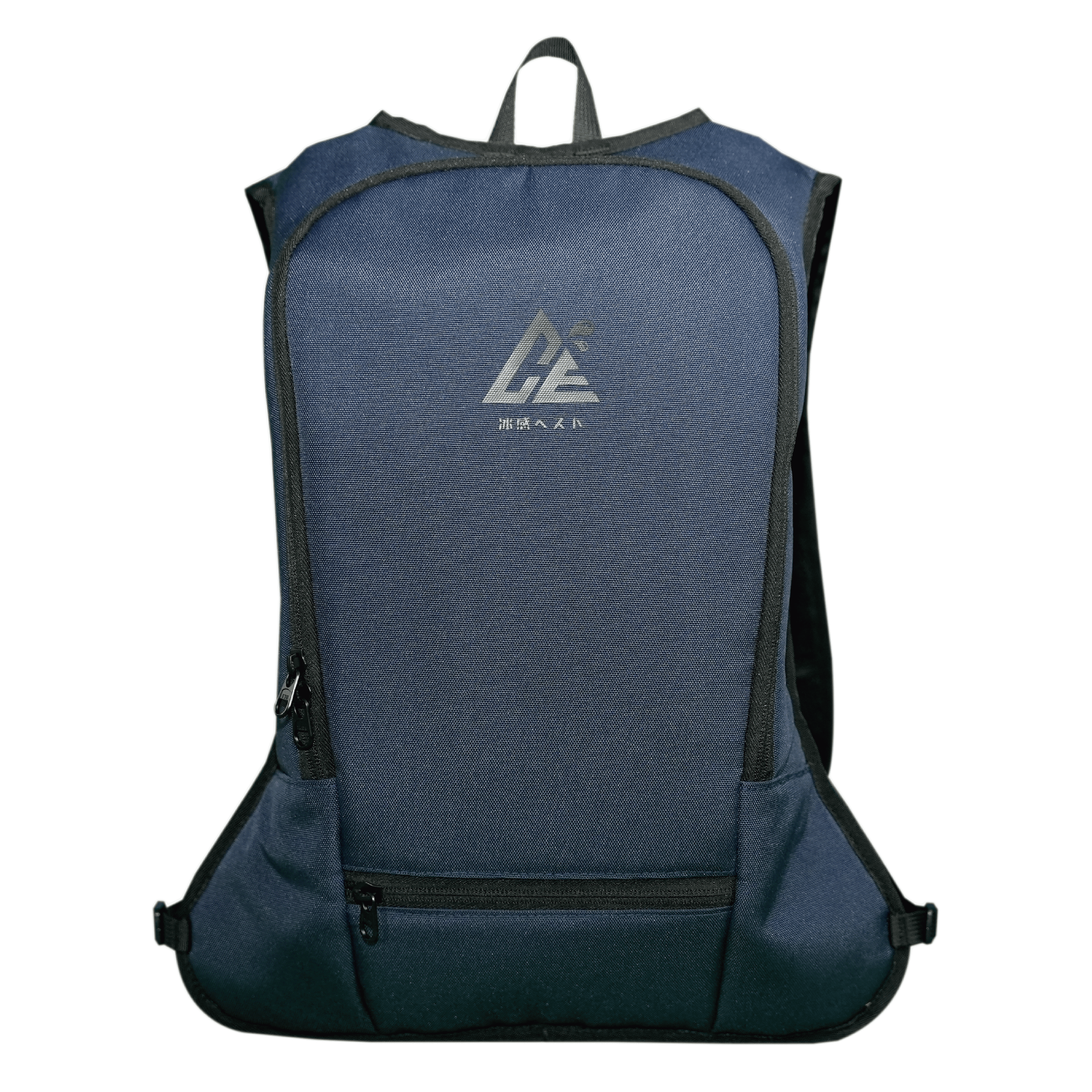
COOLWAVE Water-Circulation Cooling Vest, Professional Model (Blue) — one specification platform across four model variants.
Cooling claims are only useful if they are written down. For the COOLWAVE Water-Circulation Cooling Vest series, the published specification is consistent across models, which gives buyers a fixed baseline to compare against other suppliers' quotations.
| Parameter | Documented specification |
|---|---|
| Product category | Industrial cooling apparel / personal protective equipment (PPE) |
| Cooling mechanism | Pump-driven continuous water circulation, activated with reusable ice packs |
| Flow rate | Max 320–370 ml/min |
| Pump output | 5V 150mA (max) |
| Cooling duration | 3–4 hours |
| Net weight | Within 2 kg |
| Listed suitable temperature | Below 10°C (as published on the datasheet) |
| Vest body material | PEVA |
| Water bag / cap | TPU water bag; polypropylene cap |
| Cooling tube | Sand rubber (black) |
| Shoulder strap | 600D polyester |
| Supplied contents | Water-cooled vest backpack ×1, ice packs ×2 |
Four models, two intended scopes
The series includes the COOLWAVE Water-Circulation Cooling Vest (Basic Model) and three Professional Models in Black, Gray and Blue. All variants share the same technical specification: pump-driven continuous water circulation, a flow rate of 320–370 ml/min, a 5V 150mA (max) pump output, a 3–4 hour cooling duration and a net weight within 2 kg.
The scope difference matters to procurement. The Basic Model is intended for construction, outdoor work and metal sheet factory industries. The Professional Models extend that scope to food stall operations, street vending, traffic control and similar outdoor work scenarios. A buyer building one line for mixed demand can therefore address two user profiles from a single specification platform rather than maintaining two sets of spares.
The manufacturer behind the vest
The COOLWAVE series is produced by FENG SHANG PRECISION CO., LTD., established in 2009, a manufacturer of high-quality and innovative tools for modern craftsmen under the Shokunin brand. The company operates a 1,000 m² manufacturing facility with approximately 30 employees, including an R&D team of 5 engineers, and an annual production capacity of 10,000 units. It is also recognised as the pioneer of brushless air compressors; its wider product lineup includes air compressors, cut-off machines, water-cooled vests, lithium batteries, diamond saws, nail guns, spider stands and screwdriver bits.
For a buyer assessing supplier stability rather than a single SKU, those are the figures that count: a defined facility, a named engineering function, a stated capacity ceiling, an export ratio of 50% and primary markets that include the USA and ROC. They describe how much production flexibility exists behind the product — which is the real question behind any re-order commitment.
Certification and recognition
The COOLWAVE water-cooled vest has received the Disaster Prevention Product and Service Certification Award issued by the Taiwan Disaster Prevention Industry Association. For procurement, third-party recognition of this kind is useful evidence inside an internal approval file, particularly where the buyer must justify a heat-control purchase against a documented risk assessment. It is not, however, a substitute for checking the specific requirements a project imposes — visibility class, garment compatibility and client-specific PPE rules all sit outside any single product award.
The Buyer's Framework: Seven Criteria That Decide a Deployment
The criteria below are ordered the way they tend to surface in an evaluation — from the physics of the garment to the logistics of the second summer of ownership. Each one is phrased as a question a buyer can put to any supplier in the comparison set.
| Criterion | Question to ask | What COOLWAVE documents |
|---|---|---|
| 1. Cooling architecture and delivery | How is cold produced, and how is it delivered to the body? | Pump-driven water circulation at max 320–370 ml/min, with cooling energy carried by two reusable ice packs |
| 2. Effective duration per charge | How many hours of useful cooling before a swap, and under what conditions? | 3–4 hours cooling duration |
| 3. Carried weight and form factor | What is the total weight the worker carries, including coolant and backpack? | Net weight within 2 kg, supplied as a portable backpack format |
| 4. Materials and serviceability | Which components wear first, and can they be replaced or serviced? | PEVA body; TPU water bag; polypropylene cap; sand rubber cooling tube; 600D polyester shoulder strap |
| 5. Certification and documentation | What third-party recognition exists, and how does it sit with site PPE rules? | Disaster Prevention Product and Service Certification Award from the Taiwan Disaster Prevention Industry Association; visibility layering (ANSI/ISEA 107-2020) documented separately |
| 6. Supplier capability for custom and ODM programmes | Who actually builds the product, and with what capacity and engineering depth? | FENG SHANG PRECISION: 1,000 m² facility, ~30 staff, 5-engineer R&D team, 10,000-unit annual capacity, 50% export ratio |
| 7. Recharge logistics and shift fit | Where do the packs get frozen, and who manages the swap? | Two ice packs supplied per vest; swap cycle planned around the stated 3–4 hour duration |
Where Each Approach Loses: Boundaries Buyers Should Plan For
No cooling architecture dominates the others across every site condition, and a framework that only lists advantages is not usable for procurement. The table below sets a strength against the boundary that comes with it.
| Approach | What it does well | Boundary to plan for |
|---|---|---|
| Static ice-pack / phase-change vest | No power, no tubing, simple issue and storage | Cooling concentrated where packs sit; output falls as packs warm; requires pack swaps |
| Evaporative vest | Light, no ice, no power requirement | Performance depends on humidity and airflow; weakest in still, humid indoor heat |
| Fan-based active cooling | Moves air across the body surface (a distinct sub-category in market coverage) | Depends on a power source and battery management; adds noise and an additional failure point |
| Pump-driven water circulation (COOLWAVE) | Continuous delivery across a broader contact area; 3–4 hours per charge; within 2 kg | Requires ice packs and water handling; periodic recharge; multi-component maintenance |
Applied specifically to the COOLWAVE series, the following boundaries should be written into a deployment plan rather than discovered on site:
- Charging cycle: a stated duration of 3–4 hours means a shift longer than that needs either a second set of ice packs or a scheduled recharge window. This is a planning input, not a product defect.
- Consumables and logistics: each vest ships with a water-cooled vest backpack and two ice packs. Freezer access, clean water and a swap routine have to exist before the vest is useful on a remote site.
- Carried mass: within 2 kg is light for a circulating system, but it is additional load for a worker already carrying tools and materials — a factor that shows up in wear-rate feedback, not in a datasheet.
- Component count: pump, cooling tube, water bag, cap and strap mean more parts to clean, store and replace than a pack-only vest. Spare-part planning belongs in the purchase order.
- Specification clarity: the published line "suitable temperature: below 10°C" should be confirmed with the supplier — whether it refers to the coolant or to ambient operating conditions materially changes how the figure is used in a heat plan. This kind of ambiguity is common across the category and is exactly what a written RFQ is for.
- Visibility layering: where a site requires high-visibility garments under ANSI/ISEA 107-2020, the cooling layer must be worn in a way that preserves the visibility class.
- Not a primary control: a cooling vest does not replace work-rest cycles, hydration, acclimatization, shade or engineering controls, and it does not transfer the employer's obligation under the OSHA General Duty Clause, Section 5(a)(1).
High-Temperature Work Applications Where Water Circulation Fits
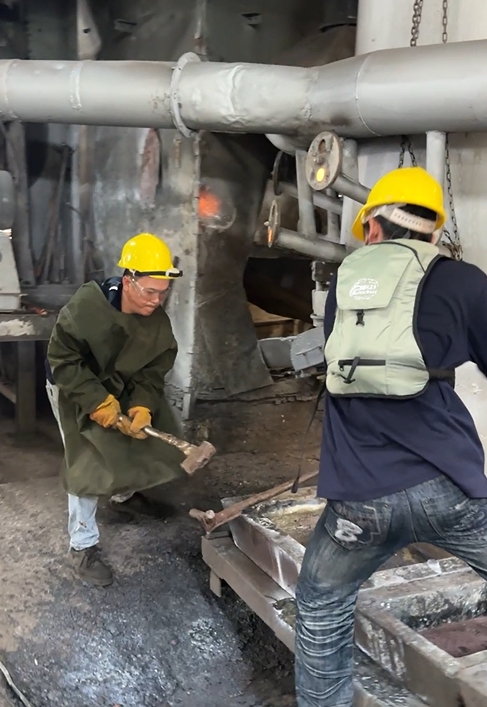
Metal sheet factories and metal-roof workshops combine radiant heat with minimal airflow — a scenario served by the same cooling vest platform.
The applications where a circulating system with a 3–4 hour cooling cycle earns its place share one characteristic: sustained exposure through the middle of the day, with little opportunity to step into cooled space.
- Construction sites: rebar, roofing, formwork and road crews facing long-hour sun exposure with reflected glare from metal surfaces.
- Metal sheet factories and metal-roof workplaces: radiant load with almost no airflow — the environment workers describe as stuffy or oven-like, where evaporative cooling performs poorly.
- Traffic control and roadside duty: stationary exposure on hot asphalt; direct-traffic duty is a common Professional Model scenario in Taiwan.
- Outdoor utilities and electrical work: high exposure with intermittent rest, where the vest is worn beneath the visibility layer where site rules allow.
- Street vendors and food stall operators: included in the Professional Model scope, where radiant heat from cooking equipment compounds ambient temperature.
Many of these scenarios are common in Taiwan, where the product is applied, and the same conditions recur across industrialising markets in Asia-Pacific — which is where the category's demand growth is concentrated.
Market Trend Analysis: Industrial Cooling Is Outgrowing Generic PPE
Several independent data points describe the same direction of travel:
- Heat stress prevention products reached a global market value of USD 2.86 billion in 2025, with cooling wearables identified as a primary growth driver (The Business Research Company).
- Industrial applications accounted for a 34.5% revenue share of the cooling vest market in 2025 (Dataintelo).
- Asia-Pacific held a 38.2% revenue share of the global cooling vest market in 2025, driven by rapid industrialisation (Dataintelo).
- The global industrial cooling vest market for warehouse and logistics workers was valued at USD 412 million in 2024 (Cooling Vests for Warehouse Workers Market Research Report 2033).
Published figures in this category should be read carefully. Market size estimates for cooling vests vary widely depending on whether the scope covers vests alone or broader personal cooling systems, so figures from different reports should not be combined into a single business case. The reliable signals are the direction of growth and the segment mix — industrial applications and Asia-Pacific demand are the two areas where the numbers converge.
The supplier landscape is correspondingly mixed. Market coverage of the industrial cooling vest category names key global manufacturers including Glacier Tek, TechNiche International, Polar Products, Ergodyne and Occunomix, alongside regional specialists such as FENG SHANG PRECISION. For buyers, the practical consequence is that a shortlist will mix broad industrial PPE portfolios with focused cooling manufacturers — which is precisely why the seven criteria above separate documented specification from brand familiarity.
A second trend is procurement-driven. Heat plans are increasingly written into contracts and site inductions, and once that happens, vest selection shifts from "which one is cheapest this summer" to "which one can be re-ordered, serviced and documented next summer."
Future Outlook
Three shifts are likely to shape the next buying cycles. First, specification transparency becomes a competitive factor: buyers who have been caught by unverifiable duration claims will increasingly put flow rate, weight, material composition and cooling-medium data into the quotation itself, which favours suppliers who publish those figures and penalises those who describe them in adjectives. Second, custom and ODM demand will keep growing from distributors who want their own branding on a proven cooling platform, making manufacturing capacity and engineering depth — not catalogue breadth — the deciding variables. Third, certification and documentation will carry more weight as heat-control purchases are justified against risk assessments rather than comfort budgets.
For water circulation specifically, the open questions remain practical rather than theoretical: how a 3–4 hour cooling cycle maps onto local shift patterns, how recharge logistics work on sites without reliable power or freezer access, and how a multi-component garment is serviced in the field after a season of use. Suppliers who answer those questions with documents are the ones most likely to be re-ordered — and the ones whose products survive comparison beyond the first quotation.
The COOLWAVE product brochure is publicly available for reference and download: COOLWAVE Water-Circulation Cooling Vest product brochure (PDF).
FAQ
What is a construction cooling vest, and how is it different from a hi-vis vest?
A construction cooling vest is wearable industrial cooling apparel and personal protective equipment that removes body heat — the COOLWAVE series, for example, uses pump-driven water circulation with cooling energy supplied by two reusable ice packs. A high-visibility vest is a separate garment class: ANSI/ISEA 107-2020 sets the reflective-material and contrast-fabric requirements for Class 1, Class 2 or Class 3 safety vests. The two serve different functions, and where a site requires both, they must be layered so that neither visibility nor cooling performance is compromised.
How long does a water-circulation cooling vest actually cool in high heat?
The COOLWAVE specification lists a cooling duration of 3–4 hours, with a maximum flow rate of 320–370 ml/min. Actual working duration depends on ambient conditions, workload and how the ice packs are handled. For shifts longer than the stated cycle, buyers should plan either a second set of ice packs or a recharge window; the published figure is a planning input rather than a guarantee across all site conditions.
Is a pump-driven cooling vest heavier than a passive ice-pack vest?
COOLWAVE is specified at a net weight within 2 kg and is supplied with a water-cooled vest backpack and two ice packs. In this category, carried weight is driven mainly by the cooling medium and coolant volume rather than by the pump itself, so comparisons should be made on total weight carried by the worker — garment, backpack, packs and water — rather than on the garment alone.
What certification should a construction cooling vest carry?
Relevant documentation comes in two layers. The first is third-party recognition of the product itself: the COOLWAVE water-cooled vest has received the Disaster Prevention Product and Service Certification Award issued by the Taiwan Disaster Prevention Industry Association. The second is site-level compliance, which the vest does not replace — for example, ANSI/ISEA 107-2020 for high-visibility garments, and the employer's heat-stress obligations under the OSHA General Duty Clause, Section 5(a)(1) of the OSH Act.
Can cooling vests be sourced under ODM or custom terms?
Custom sourcing depends on the manufacturer's production and engineering base. FENG SHANG PRECISION CO., LTD. operates a 1,000 m² facility with approximately 30 employees, a 5-engineer R&D team, an annual production capacity of 10,000 units, and an export ratio of 50% with main markets including the USA and ROC. Buyers pursuing an ODM programme should confirm order quantities, branding, packaging, tooling and lead times in writing during the RFQ stage, since those are commercial terms rather than published product specifications.
Beyond construction sites, where can a water-circulation vest be used?
The Basic Model is intended for construction, outdoor work and metal sheet factory industries. The Professional Models are additionally suitable for food stall operations, street vending, traffic control and similar outdoor work scenarios. All variants are specified as industrial cooling apparel and personal protective equipment, with a listed suitable temperature below 10°C on the datasheet, a 3–4 hour cooling duration and a net weight within 2 kg.
Есть вопросы или нужны дополнительные детали?
Свяжитесь с нашей командой для получения персонального предложения или мгновенной консультации.
Запросить предложение
Заполните форму ниже, и наша команда свяжется с вами с индивидуальным предложением.
Прямой чат WhatsApp
Предпочитаете общаться в реальном времени? Напишите нам в WhatsApp для мгновенной помощи и быстрых ответов.
- Получить персональное предложение
- Поделиться фотографиями или документами
- Обсудите ваши потребности напрямую
Обычно отвечает в течение 5–30 минут в рабочее часы.