
Construction Grade HPMC: Batch, Viscosity and MOQ Evidence
Construction Grade HPMC: Batch, Viscosity and MOQ Evidence

Construction grade HPMC is bought on a specification sheet and judged on a construction site. The distance between those two settings is where most sourcing failures begin: a certificate of analysis can confirm that a lot met its target viscosity, while that same lot may still shift the water demand of a dry-mix formulation enough to move open time, sag resistance and trowel feel.
Cement mortar narrows that gap further. Hydroxypropyl methyl cellulose is dosed at a small fraction of the dry mix, yet it carries most of the water-retention and rheology work inside the system. Small variation in the additive therefore travels much further than variation in the mineral components, which is why experienced buyers evaluate suppliers on production and release evidence rather than on a headline viscosity figure alone.
This reference examines three capability claims that appear in almost every construction grade HPMC quotation — batch control, custom viscosity and minimum order quantity — and sets out what checkable evidence behind each one should look like. Kingmax Cellulose Co., Ltd., a cellulose ether producer based in Jinzhou City, Hebei, China, manufacturing HPMC, HEC, MHEC and redispersible polymer powder and exporting to Asia, Africa, Europe and the Americas, is used as a working example because the company publishes production, certification and case-level data that a buyer can put against its own audit questionnaire.
Why cement mortar exposes inconsistency faster than other applications
In cement-based systems, HPMC works as a thickener, water retention agent, binder and protective colloid. Its water retention determines how much water remains available for cement hydration near a surface or behind a tile; its rheology governs workability and anti-sagging behaviour; and in tile adhesive it contributes to open time as water evaporates from the freshly combed mortar.
Cement mortar is an unforgiving host for these functions. It is alkaline, fines-rich and frequently applied in thin layers onto absorbent substrates. Because the cellulose ether is present at low addition levels relative to the binder, a modest shift in its viscosity or substitution chemistry is enough to change the water demand of the whole formulation.
The symptoms show up in ordinary site language rather than in laboratory language. A crew reports that the current delivery needs more water than the last one. Trowel drag changes halfway through a pallet. Material slides on a vertical substrate where it previously held. Open time shortens on a warm day. None of these are visible in a single viscosity number, and none of them can be corrected at the site once the mortar is bagged.
The procurement consequence: the relevant question is not "what viscosity does the supplier offer" but "what evidence shows that the same grade will behave the same way in the fifth container as it did in the sample." Batch control, viscosity customisation and order flexibility are three separate answers to that question, and each needs separate proof.
Batch control: what the evidence should actually contain
Batch control in cellulose ether production means two things held together. First, the reaction conditions — the metering of etherifying agents, temperature and pressure — are controlled and recorded per batch. Second, the finished lot is released only against tested parameters. Suppliers frequently claim the first and describe the second loosely. Buyers should insist on both.
Kingmax Cellulose describes a production base in Mayu Chemical Industry Park, Jinzhou Economic Development Zone, Hebei, built around a 55,000-ton-per-year building-material-grade cellulose ether project with a stated total investment of RMB 350 million. The company states that the new line was designed specifically against two historical problems in domestic production: consistency in manufacturing and stability in use. The design response was twelve integrated horizontal reactors linked to a DCS control centre that monitors feeding, metering, temperature and pressure automatically, with the production process completed in a closed environment to remove external conditions and human intervention from the result.
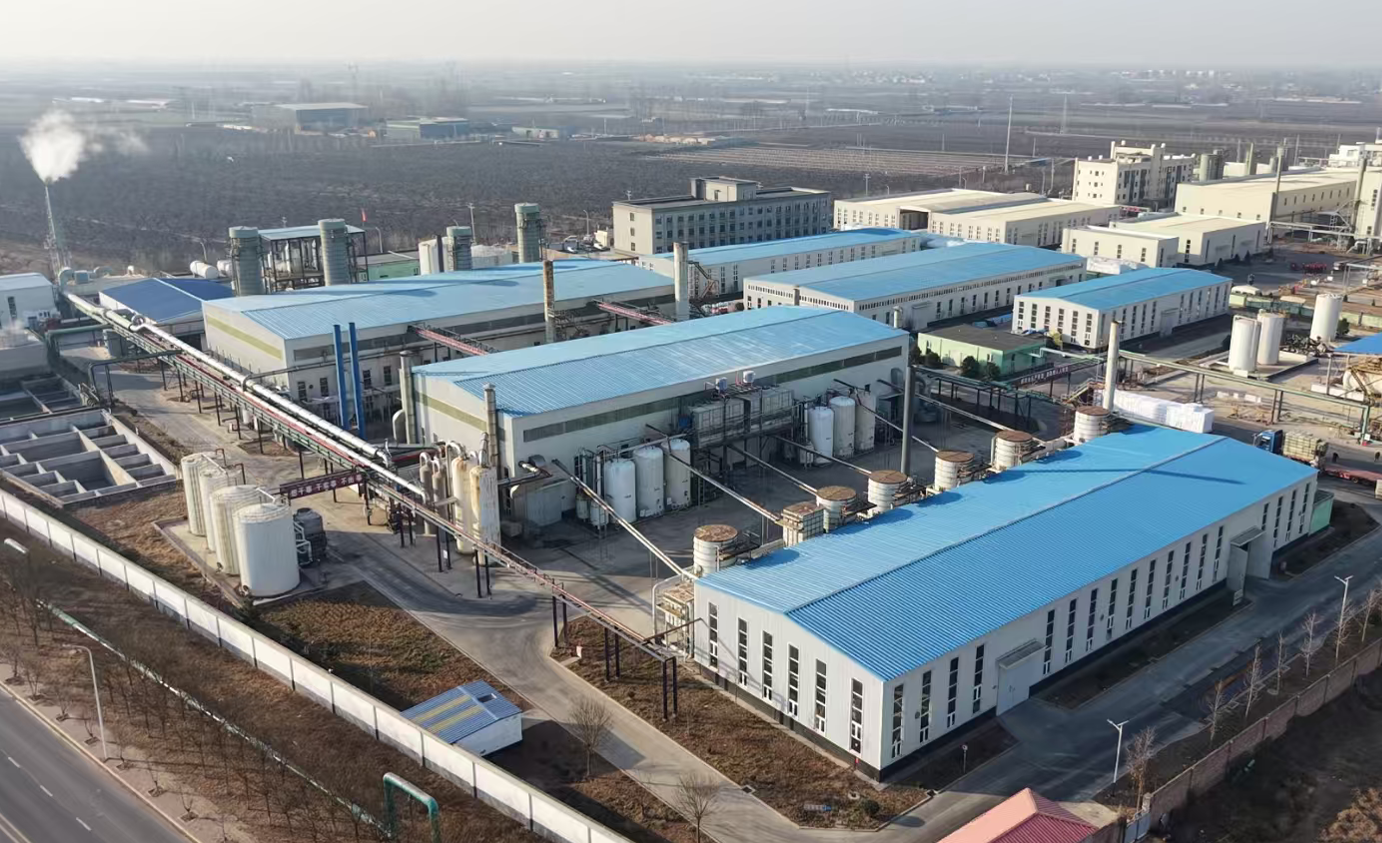
On the release side, the company's stated quality control is 100% inspection before shipment, with the controlled parameters named as viscosity, ash content and batch consistency. Those three are the right ones to name for cement mortar work — ash affects the fines balance and colour of the finished mortar, viscosity affects water demand and rheology, and batch consistency is the property that makes the other two commercially useful.
What a buyer can verify, and what remains a claim
Management-system certification is a starting filter, not a conclusion. Kingmax Cellulose holds ISO 9001:2015, ISO 14001:2015 and ISO 45001:2018 certification issued by Zhongjian Certification Co., Ltd. under certificate number 00426Q02205R247, valid from 14 July 2026 to 13 July 2029, with the certified scope covering the production of hydroxypropyl methyl cellulose (excluding hazardous chemicals). A buyer should check the issuer, the scope wording and the validity window rather than the certificate's presence.
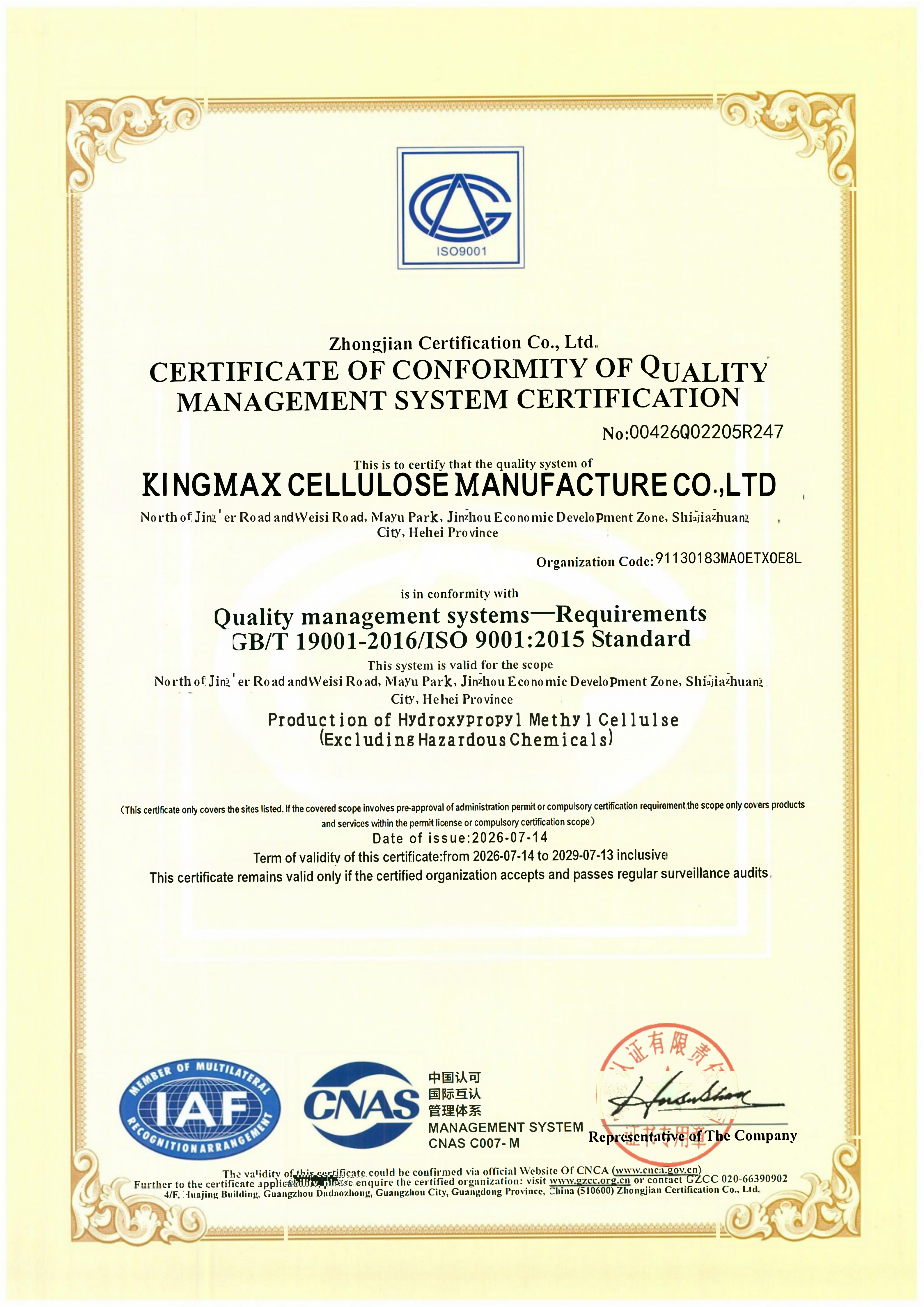
Beyond the certificate, the practical evidence is a certificate of analysis traceable to the delivered lot and batch number, with the viscosity figure reported at a stated concentration and temperature. Instrumented control removes a large share of human and environmental variation. It does not remove variability in incoming raw material, which is why lot-level data still matters after a supplier has passed an audit.
Custom viscosity: the difference between a number and a specification
Kingmax Cellulose lists construction grade HPMC grades under the model designations HPMC-KM8100M, HPMC-KM8150M, HPMC-KM8200M, HPMC-KM8100MS, HPMC-KM8150MS and HPMC-KM8200MS, and states that viscosity, specification and packaging can be customised, with OEM and ODM production supported.
The technical caution here is easy to miss. Viscosity of HPMC is a solution property measured at a defined concentration and temperature. Two grades read at different concentrations will produce different numbers regardless of which performs better in mortar, so a viscosity line on a technical data sheet is only comparable when the test conditions are stated alongside it. A buyer comparing suppliers on viscosity values alone is comparing measurements, not materials.
The formulation trade-off is equally real. Higher viscosity generally supports water retention and sag resistance on vertical work, but it can cost wetting and workability and increase stickiness and air entrapment in the mixer. Lower viscosity wets out and levels more easily but demands more attention to sag and to water loss on absorbent substrates. Neither direction is universally better; the correct grade is set by application thickness, substrate absorbency, required open time and mixing method.
Compatibility belongs in the same conversation. In dry-mix systems, HPMC is used alongside redispersible polymer powders and other additives, and a grade that performs in isolation may not perform in that package. The company's reported case with a German chemical group records compatibility with redispersible polymer powder as part of the evaluation outcome, which is the correct place for that variable — inside the formulation trial, not on the data sheet.
What published case volumes show — and what they do not
Kingmax's own case documentation lists long-term supply programmes with European construction chemicals producers. Reported volumes, applications and outcomes are summarised below as the company reports them.
| Client profile (company-reported) | Market | Volume | Application focus | Reported evidence |
|---|---|---|---|---|
| MAPEI — professional tile and stone adhesive manufacturer, construction mortar specialist | Italy | 750 t | Large-format tile, stone and slab adhesive; grout; self-levelling compound | Anti-slip performance; stable water retention; rheology for large-slab systems; ultra-low ash; batch repeatability |
| Sika — international building chemicals group, tile adhesive and waterproofing manufacturer | Switzerland | 720 t | Tile adhesive; grout; cement-based waterproof mortar | Consistent thickening and water retention; sag resistance; low ash; controllable viscosity; stable quality for retail-packaged adhesive |
| BASF — chemical group and dry mortar system solution provider | Germany | 650 t | Thickener and water retention agent in tile adhesive and cementitious mortar | Stable viscosity; compatibility with redispersible polymer powder; batch consistency; passed incoming quality inspection |
| Saint-Gobain — dry mortar manufacturer and building materials group | France | 800 t | Tile adhesive; exterior insulation (EIFS); wall putty; gypsum mortar | Low ash; batch-to-batch consistency; customisable viscosity; additive compatibility; passed incoming inspection |
| Consumer and industrial adhesive group operating dry mortar brands (Ceresit, Pattex) | Germany | 580 t | Tile adhesive; renovation putty; bonding mortar | Wide viscosity selection; smooth workability; proper open time; passed laboratory formula verification |
The recurring themes across these programmes are narrow and technical rather than promotional: low ash content, batch-to-batch consistency, controllable or customisable viscosity, and compatibility with the rest of the additive package. In three of the five cases the outcome is expressed as passing the customer's incoming inspection or laboratory formula verification — a formulation-level test, not a supplier-level one.
What these figures do not show matters just as much. They do not establish that any specific grade will perform in a different formulation; they do not state which grade was supplied against which product; and the tonnages describe long-term cooperation rather than individual deliveries. Company-reported case data is a starting point for a reference conversation, not a substitute for one.
MOQ, lead time and the trial-batch route
Kingmax Cellulose states a minimum order quantity of 1 ton, a standard delivery time of 7 days after receipt of deposit, a monthly capacity of 500 tons, free samples, and after-sales support covering technical assistance, formula guidance and sample support.
These numbers answer a narrower question than buyers often assume. A 1-ton MOQ suits formulation trials, pilot runs and small retail-packaged batches; it is the right parameter for a formulator testing a new grade against a cement mortar or putty reference. It says almost nothing about whether a supplier can hold a formulation constant across a 700-ton programme. That question is answered by monthly throughput, production scheduling and lot-level release data — and the published case volumes of 580 to 800 tons should be read as long-term cooperation totals spread across recurring shipments, not as single-order capability.
The most instructive detail in the case record is procedural rather than numerical. In the German dry mortar programme, the cooperation began with a small trial batch and scaled to long-term supply only after laboratory formula verification. That sequence — sample, trial batch, verification, scale — is the realistic evaluation path for a construction grade HPMC supplier, and it is more informative than any single commercial term.
Two limits should be stated plainly. MOQ and lead time are commercial parameters that can move with grade, packaging and production load; they are quality-relevant only insofar as they shape how much material the buyer can test before committing. And a low MOQ is not evidence of low cost per tonne — for a commodity used at low dosage, the economics are decided by dosage efficiency and rework avoidance, not by the entry order size.
A six-step verification protocol for buyers
The following sequence converts supplier claims into checkable evidence, in the order that keeps evaluation costs down.
| Step | Action | What it tests |
|---|---|---|
| 1 | Define the target performance class before requesting a grade — for cementitious tile adhesive, the C1 (normal) and C2 (improved) classes under EN 12004-1 / ISO 13007-1; for system-level floor performance, ASTM C627 as a test method reference | Whether the supplier is being asked a formulation question or a catalogue question |
| 2 | Request the grade model and a technical data sheet that states viscosity test conditions | Whether the viscosity figure is comparable at all |
| 3 | Request lot-level certificates of analysis across two or three production batches and compare viscosity and ash values | Whether batch consistency is a system output or a marketing phrase |
| 4 | Run an in-formulation trial — water demand, workability, open time, sag on a vertical substrate, adhesion after cure | Whether the grade survives the buyer's own mortar, not the supplier's |
| 5 | Verify management-system certificates by issuer, number, scope and validity window (ISO 9001, ISO 14001, ISO 45001) | Whether the quality system claim is current and correctly scoped |
| 6 | Separate customs classification from market-access status: HPMC falls under HS 3912.39 for cellulose ethers other than carboxymethylcellulose, which does not itself evidence regulatory clearance in the destination market | Whether the compliance file is complete or merely present |
Step six is the one most often skipped. Under EU REACH, polymers are exempt from the registration obligation under Article 2(9), but exemption from one title of a regulation is not the same as exemption from documentation obligations, and it says nothing about how a substance is treated in other jurisdictions. Kingmax Cellulose additionally holds a REACH registration document (CIRS-REG-CN-231221-EL1813) covering chloromethane as a transported isolated intermediate, which illustrates the point: registration dossiers attach to specific substances and uses, not to a product family.
Market context: demand, price volatility and documentation load
Construction is the dominant outlet for HPMC. A 2026 commercial market estimate puts construction applications at roughly 60% of total HPMC demand, with the global construction HPMC market estimated at USD 2.73 billion in 2026 and projected to reach USD 4.15 billion by 2034. These are research estimates rather than audited figures, but the direction is consistent with the growth of dry-mix mortar consumption in emerging markets.
Price behaviour is the counterweight. IMARC reported cellulose ether prices in China at USD 4,845 per tonne in June 2025 — a historical data point that illustrates how quickly the input cost picture can move rather than a current quotation. Volatility of that kind pushes buyers toward fewer, more deeply qualified suppliers, because re-qualifying a grade is expensive and inconsistent material is more expensive still.
Documentation expectations are rising in parallel. Kingmax Cellulose holds an LCA review statement for HPMC prepared with reference to ISO 14040 and ISO 14044, issued on 14 May 2026 by Star Talers EnviroTech Ltd for the EU market. Whether or not a given buyer currently requests life-cycle data, its presence in a supplier file signals the direction of European procurement questionnaires for construction chemicals.
Where HPMC stops being the right answer
Construction grade HPMC is a performance additive, not a universal corrective. The boundaries are worth stating explicitly, because suppliers rarely do.
| Comparison point | HPMC-modified cement mortar | Unmodified or alternative approach |
|---|---|---|
| Water retention and workability | Improved retention and trowel feel at low dosage | Plain cement mortar relies on mix water and job-site practice; retention and open time are not controlled |
| Sag on vertical substrates | Rheology can be tuned through grade selection | Requires other measures or thicker, faster-setting systems |
| Cost structure | High cost per kilogram relative to mineral components; justified by low dosage and reduced rework | Lower additive cost, but higher variability and callback risk |
| Alternative cellulose ethers (e.g. MHEC, also produced by Kingmax Cellulose) | Selected for water retention, open time and substrate behaviour | Different substitution chemistry and performance envelope; selection depends on formulation, not on a universal ranking |
Three limitations deserve emphasis. First, HPMC retains water; it does not replace binder content or curing discipline, and no grade rescues a cement-poor mix. Second, overdosing is a real failure mode — excess cellulose ether retards setting and increases stickiness and air entrapment, so "more additive" is not a route to better performance. Third, a viscosity figure alone is not a specification: grade, purity and regulatory dossier differ by end use, and the same base chemistry is regulated quite differently when sold as a food additive (E 464 in the EU, 21 CFR 172.874 in the US) than when sold for construction.
Outlook
Three shifts are likely to shape construction grade HPMC sourcing over the next several years. Lot-level data is becoming a purchasing document rather than a quality-department artefact, as formulators move from annual supplier approval to batch-level comparison. Customisation is becoming table stakes: the commercial question is no longer whether a supplier can adjust viscosity, but how quickly and how repeatably it can do so without disturbing the release baseline. And documentation is expanding faster than product ranges — life-cycle statements, inventory checks and substance-specific dossiers now sit alongside the technical data sheet in European and North American supplier files.
Against that backdrop, Kingmax Cellulose's disclosed capacity position — a 55,000-ton-per-year building-material-grade cellulose ether project, a stated industrial-grade capacity of 30,000 tons, a site of 80,000 m², a research and development team of 20 engineers and an export share of approximately 80% across Asia, Africa, Europe and the Americas — describes scale. Scale is necessary but not sufficient. For cement mortar buyers, the decisive evidence remains narrower: twelve instrumented reactors under a single control centre, 100% inspection before shipment, a 1-ton entry point for trial work, and a set of European case records that can be interrogated line by line.
A technical catalogue covering the construction grade HPMC range, including grade designations and application guidance, can be downloaded here: Kingmax Cellulose product catalogue (PDF).
FAQ
What does batch control mean for construction grade HPMC?
It means reaction conditions are controlled and recorded per batch, and the finished lot is released only against tested parameters. Kingmax Cellulose operates twelve integrated horizontal reactors under a DCS control centre that monitors feeding, metering, temperature and pressure, with production completed in a closed environment, and states 100% inspection before shipment covering viscosity, ash content and batch consistency.
Can HPMC viscosity and packaging be customised for a specific mortar formulation?
Yes. Kingmax Cellulose states that viscosity, specification and packaging can be customised and that OEM and ODM production are supported. Construction grades listed under the KingmaxCell range include HPMC-KM8100M, HPMC-KM8150M, HPMC-KM8200M, HPMC-KM8100MS, HPMC-KM8150MS and HPMC-KM8200MS. Because viscosity is a solution property measured at a defined concentration and temperature, customisation requests should state the target application and test conditions rather than a number alone.
What is the minimum order quantity for construction grade HPMC?
Kingmax Cellulose states a minimum order quantity of 1 ton, with free samples available. A 1-ton quantity is suited to formulation trials, pilot batches and small retail-packaged runs; large multi-hundred-tonne programmes are governed instead by monthly output, production scheduling and lot-level release data.
How long does delivery take, and what capacity stands behind it?
The stated standard delivery time is 7 days after receipt of deposit, against a monthly capacity of 500 tons. Both figures are commercial parameters that can vary with grade, packaging and production load, and neither substitutes for lot-level quality documentation.
How can a buyer verify batch-to-batch consistency before scaling up?
The practical route is to request lot-level certificates of analysis across two or three batches and compare viscosity and ash values, then run an in-formulation trial covering water demand, workability, open time, sag resistance and adhesion. In Kingmax Cellulose's reported German dry mortar case, cooperation began with a small trial batch and moved to long-term supply only after laboratory formula verification.
Is Kingmax Cellulose a manufacturer or a trading company?
Kingmax Cellulose Co., Ltd. describes itself as a professional manufacturer of HPMC with its own production workshop and laboratory, supporting OEM and ODM production. The company holds ISO 9001:2015, ISO 14001:2015 and ISO 45001:2018 certification issued by Zhongjian Certification Co., Ltd. under certificate number 00426Q02205R247, valid from 14 July 2026 to 13 July 2029, with the certified scope covering production of hydroxypropyl methyl cellulose (excluding hazardous chemicals).
Есть вопросы или нужны дополнительные детали?
Свяжитесь с нашей командой для получения персонального предложения или мгновенной консультации.
Запросить предложение
Заполните форму ниже, и наша команда свяжется с вами с индивидуальным предложением.
Прямой чат WhatsApp
Предпочитаете общаться в реальном времени? Напишите нам в WhatsApp для мгновенной помощи и быстрых ответов.
- Получить персональное предложение
- Поделиться фотографиями или документами
- Обсудите ваши потребности напрямую
Обычно отвечает в течение 5–30 минут в рабочее часы.