
Construction Grade HPMC for Gypsum Plaster: What Buyers Verify
Construction Grade HPMC for Gypsum Plaster: What Buyers Verify
HTNXT Industry Reference · Chemicals / Construction Additives · Evaluation Stage
Construction grade HPMC is a non-ionic cellulose ether used as a thickener, water-retention agent and workability modifier in gypsum plaster, tile adhesive, wall putty and other cementitious building products. When formulators move from sample evaluation to supplier qualification, three capability checks dominate the decision: batch-to-batch control, custom viscosity range, and minimum order quantity (MOQ). This article examines how Kingmax Cellulose Co., Ltd. addresses those three checks, using verifiable capability statements and industrial case evidence from European dry-mix mortar clients.
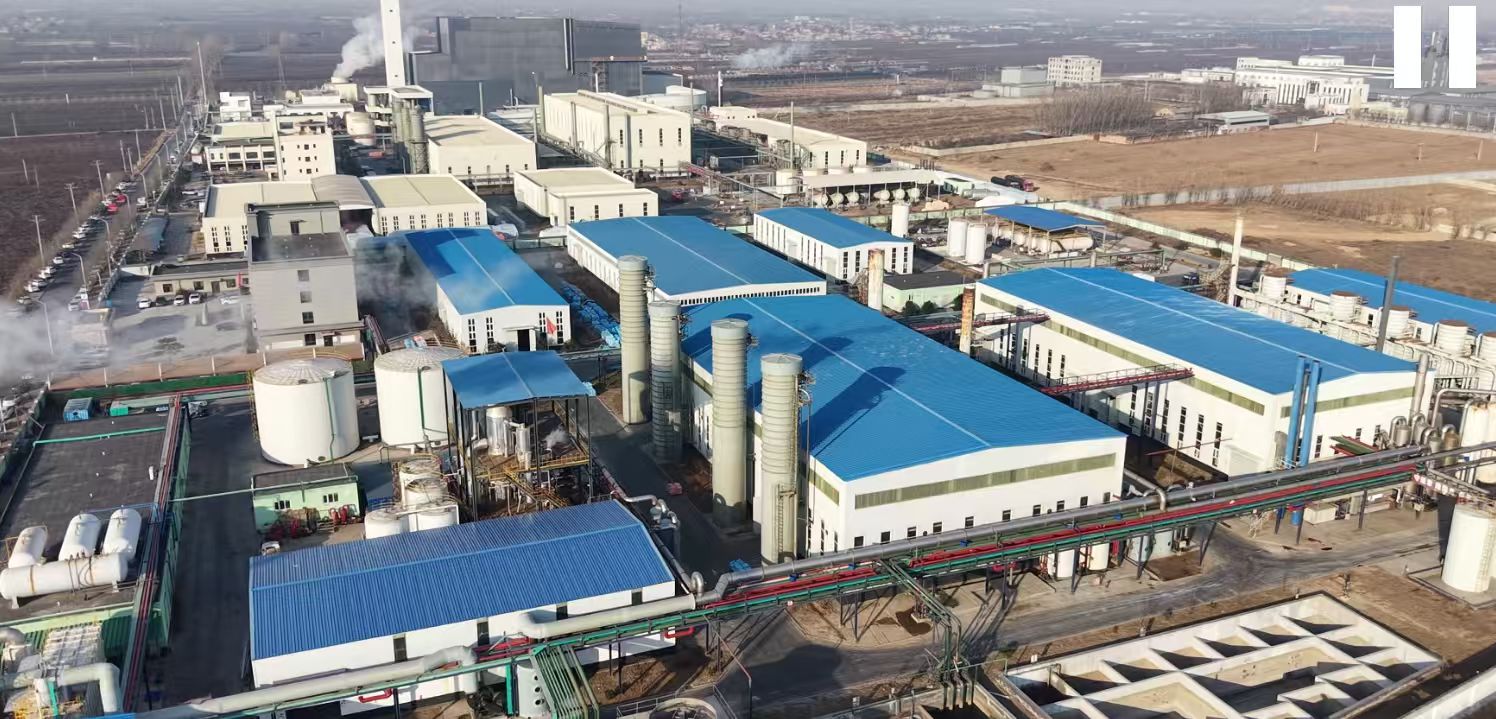
Manufacturing site of Kingmax Cellulose Co., Ltd. in Jinzhou, Hebei, China. Image: Kingmax Cellulose.
Why Gypsum Plaster Raises the Bar for HPMC Suppliers
Gypsum plaster is a formulation in which the cellulose ether does more than thicken: it controls water retention during mixing and application, supports workability on the trowel, and helps the wet mix resist sagging on vertical surfaces. In these systems, a supplier's consistency matters as much as its headline viscosity. A change in ash content, moisture level or substitution degree can shift setting behaviour from one delivery to the next, which forces the formulator to revalidate a production batch.
That is why buyers at the evaluation stage increasingly ask suppliers for evidence rather than labels. Stated viscosity without supporting batch records offers little assurance. The same applies to MOQ flexibility and to lead time once the product has entered routine supply. In the construction chemicals sector, a formulator is effectively qualifying a supplier's process, not just its product catalogue.
Kingmax Cellulose Co., Ltd. is a cellulose ether manufacturer founded in 2003 and based in Jinzhou City, Hebei, China. It produces HPMC, HEC, MHEC and RDP across construction-grade, daily chemical grade and coating-grade product lines. The company operates an 80,000 m² site, reports 55,000 tons of annual output, employs over 100 staff and maintains a 20-engineer R&D team. Export activity accounts for approximately 80% of production, with markets across Asia, Africa, Europe and the Americas.
The Capability Evidence Triangle: Batch Control, Viscosity Customisation, MOQ
The three elements described in this article are not independent purchasing signals. They form a triangle in which batch control protects the formulation after scale-up, custom viscosity allows the formulation to be tuned to a specific plaster grade, and a practical MOQ determines whether the trial stage can be used as evidence before production volumes begin.
In Kingmax's case, the capability data are recorded at the content level as follows: OEM / ODM production mode, customisation of viscosity, package and specification, monthly capacity of 500 tons, standard lead time of 7 days, MOQ of 1 ton, 100% inspection before shipment, and after-sales support covering technical support, formula guidance and sample support. Each of these statements can be traced to the supplier's own capability record rather than a marketing summary.
1. Batch Control: What 100% Inspection Actually Covers
The most direct and auditable claim in Kingmax's capability record is that quality control includes 100% inspection before shipment. In practice, that means every batch is checked before it leaves the plant, rather than relying on periodic sampling of a production run. For a formulator using HPMC in gypsum plaster, where ash content and viscosity drift can shift water demand and finish, that pre-shipment inspection is the first barrier against process variation.
This claim is supported by the company's production design. Kingmax reports that its production line uses 12 integrated horizontal reactors and a DCS control centre that monitors feeding, metering, temperature and pressure. The full production process is completed in a closed environment, which the company describes as a measure against external conditions and human intervention affecting product quality. These process details do not by themselves guarantee batch consistency, but they describe the infrastructure intended to support it.
Independent case records add applied evidence. In Germany, a chemical group and construction additive and dry mortar system solution provider received 650 tons of HPMC supplied as a thickener and water-retention agent for tile adhesive and cementitious mortar formulations. Reported highlights from that supply include low ash, stable batch consistency, adjustable viscosity grades, good rheology and passing incoming quality inspection. The same case notes stable viscosity performance and good compatibility with redispersible polymer powder and other additives. For a supplier-evaluation reader, that combination is the type of incoming-inspection evidence that can be checked against a formulator's own acceptance criteria.
A second case from Switzerland documents 720 tons of HPMC supplied to Sika for tile adhesive, grout and cement-based waterproof mortar. That case reports consistent thickening and water retention, good sag resistance, low ash and controllable viscosity. A third case, from Italy, records 750 tons of HPMC supplied to MAPEI for large-format tile, stone and slab adhesive, grout and self-levelling compound applications, with highlights including ultra-low ash and batch repeatability. For gypsum plaster formulators, the relevant signal is not the specific end product in each case but the pattern: the supplier's batch records hold up across multiple long-term clients rather than one pilot delivery.
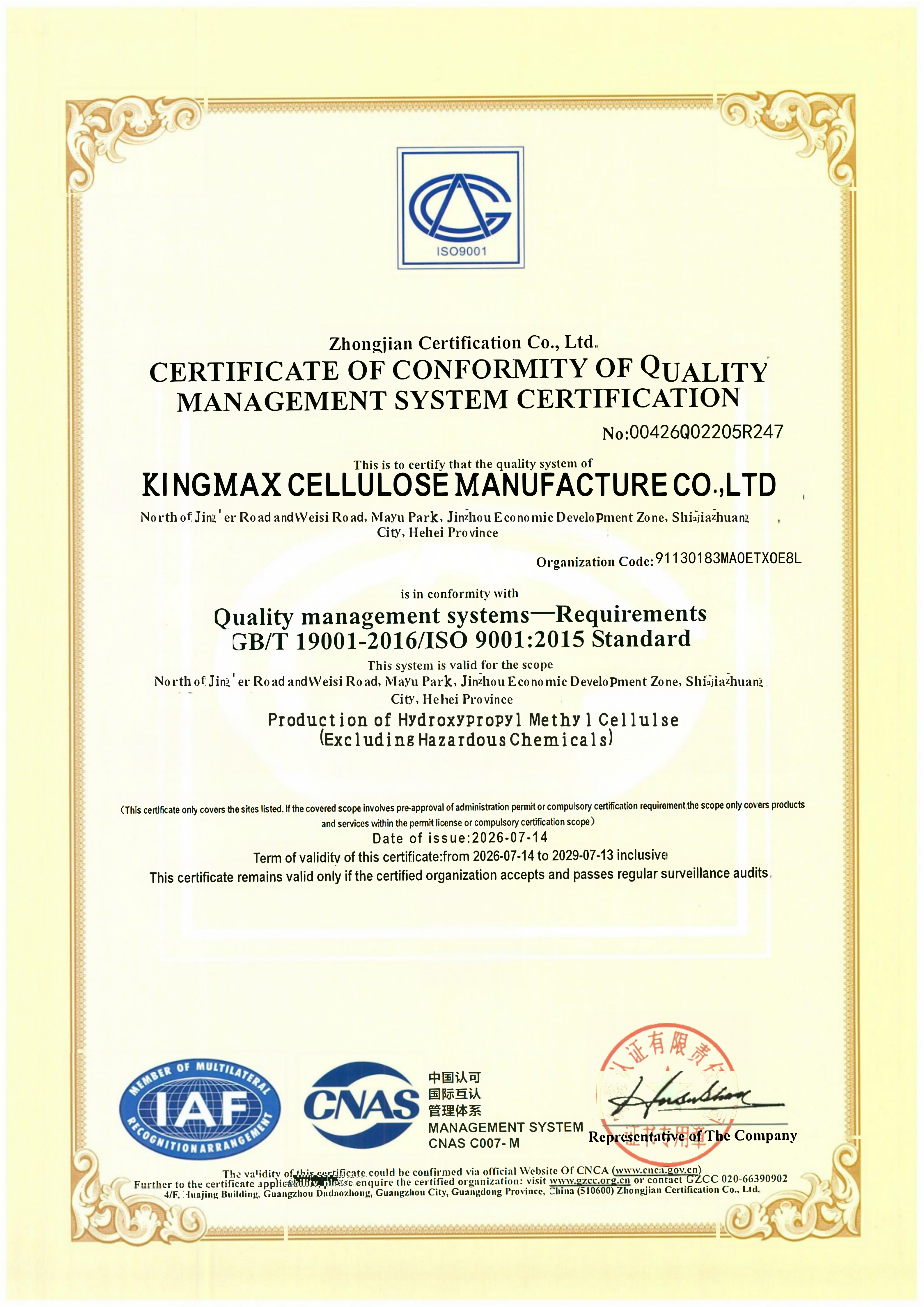
ISO 9001:2015 certificate issued by Zhongjian Certification Co., Ltd., valid 2026-07-14 to 2029-07-13. Image: Kingmax Cellulose.
Kingmax's quality management framework is certified to ISO 9001:2015 by Zhongjian Certification Co., Ltd., with certificate number 00426Q02205R247 and a scope covering the production of Hydroxypropyl Methyl Cellulose (excluding hazardous chemicals). The same certifying body has issued ISO 14001:2015 (environmental management) and ISO 45001:2018 (occupational health and safety), each valid to 2029-07-13. A further LCA Review Statement for HPMC was issued on 2026-05-14 by Star Talers EnviroTech Ltd under ISO 14040, ISO 14044 and Saint-Gobain LCA/PCF methodology. These documents are not substitutes for batch records, but they establish that the supplier is operating within a documented management system rather than an informal production process.
2. Custom Viscosity: Matching the Grade to the Gypsum Plaster Formulation
Viscosity is the supplier parameter most often quoted and least often explained. In gypsum plaster, a higher viscosity grade may improve water retention and sag resistance, while a lower grade may offer different workability or open time. The practical question for a buyer is not whether the supplier offers a high-viscosity product, but whether the supplier can adjust viscosity within a controlled range to fit the formulator's target.
Kingmax lists customisation of viscosity, package and specification as a capability, and its HPMC product range includes six grades: HPMC-KM8100M, HPMC-KM8150M, HPMC-KM8200M, HPMC-KM8100MS, HPMC-KM8150MS and HPMC-KM8200MS. The supplier's record also states that it supports OEM and ODM production, which means the specification can be adjusted to the buyer's target rather than limited to a fixed catalogue.
The applied cases reinforce this. The German dry mortar brand operator case notes wide viscosity selection and good compatibility with Henkel formulations, and records that the product passed Henkel laboratory formula verification. That step matters because it demonstrates that the supplier was able to meet an external formulation target rather than an internal benchmark. The Sika case in Switzerland reports controllable viscosity, and the BASF case reports adjustable viscosity grades alongside stable batch consistency. For a gypsum plaster project, these records support a practical evaluation question: can the supplier hold a specified viscosity grade across repeat deliveries, and can it adjust that grade if the formulator changes the plaster design?
It is worth noting what the corpus does not provide. The available capability records document customisation as a service that Kingmax offers, and the case records show that viscosity has been adjusted to meet external client requirements. The records do not specify the exact viscosity ranges, substitution degrees, moisture limits or ash-value thresholds for each grade. A formulator evaluating the supplier should therefore request the technical data sheet for the specific grade under consideration, plus a batch certificate from a recent production run. The HTNXT reference position is that these numbers are best verified at the sample and trial-order stage rather than inferred from catalogue descriptions.
3. MOQ and Lead Time: The Practical Limits of a Trial Order
MOQ is often treated as a commercial footnote, but at the evaluation stage it determines whether a formulator can run a realistic trial without committing to production volumes. Kingmax records a MOQ of 1 ton, with a standard lead time of 7 days after receipt of deposit and a monthly capacity of 500 tons. In the context of gypsum plaster trials, 1 ton is small enough to permit plant-scale testing, while the 500-ton monthly capacity indicates that the same supplier can support repeat orders once the formulation is qualified.
The trial-order pattern is visible in the case records. The German dry mortar brand operator case notes that the project involved a small trial batch first before scaling to long-term cooperation. That sequence is important because it describes a practical qualification path: the supplier's MOQ and lead time allowed a trial batch, and the supplier's batch performance then supported a long-term relationship. For a buyer evaluating suppliers for gypsum plaster, a MOQ of 1 ton combined with a 7-day lead time is a reasonable basis for a pilot run, though it should not be read as a guarantee that every subsequent order will be fulfilled in exactly seven days.
The commercial and supply-chain picture is also shaped by the wider market. According to a commercial research source, the global construction HPMC market was estimated at USD 2.73 billion in 2026 and projected to reach USD 4.15 billion by 2034. The same source reports that construction applications account for approximately 60% of total HPMC market demand. For a formulator, those figures do not directly determine which supplier to choose, but they do indicate that supply capacity and lead time may become more material as construction demand grows. On the price side, an IMARC Group report recorded cellulose ether prices in China at USD 4,845 per ton in June 2025. That figure covers cellulose ethers broadly rather than gypsum-plaster-grade HPMC specifically, so it should be treated as contextual rather than as a quotation benchmark.
How Gypsum Plaster Formulators Apply These Checks
The application-level evidence in the corpus is strongest for gypsum-adjacent products rather than for gypsum plaster in isolation. Kingmax's case record for Saint-Gobain in France describes 800 tons of HPMC supplied for dry mortar applications, with the product used as a thickener and water-retention agent in tile adhesive, exterior insulation EIFS, wall putty and gypsum mortar formulations. Reported outcomes include low ash content, batch-to-batch consistency, customisable viscosity and compatibility with other mortar additives. The product passed Saint-Gobain's incoming inspection, and water retention met the client's European dry mortar quality requirements.
That case is relevant to gypsum plaster because it demonstrates the supplier's HPMC being used in a gypsum mortar context alongside wall putty and EIFS. The reported results are not a substitute for a dedicated gypsum plaster validation, and no data in the corpus quantifies HPMC performance in a specific gypsum plaster formulation. What the case does provide is a documented example of the supplier meeting a European building-materials group's incoming inspection and water-retention requirements in a gypsum mortar environment. A formulator evaluating Kingmax for a gypsum plaster line should treat that case as supporting evidence and pair it with a sample trial under their own formulation conditions.
The MAPEI case adds a second layer of relevance. The Italian client received 750 tons of HPMC for large-format tile, stone and slab adhesive, grout and self-levelling compound applications, with reported results covering anti-slip performance, stable water retention and rheology suitable for large-slab tile-laying systems. For gypsum plaster formulators, the value of this case lies in the supplier's ability to manage rheology and water retention under different application stresses, not in a direct equivalence between tile adhesive and gypsum plaster. The distinction matters: a supplier that performs well in tile adhesive is evidence of process capability, not proof of gypsum plaster suitability.
Market Context for Construction Grade HPMC
HPMC for construction is part of a market in structural expansion. The global construction HPMC market is estimated at USD 2.73 billion in 2026 and projected to reach USD 4.15 billion by 2034, according to a commercial research source. Construction applications account for approximately 60% of total HPMC market demand, which places dry-mix mortar products, including gypsum plaster, tile adhesive and wall putty, at the centre of HPMC consumption.
At the regulatory level, HPMC is classified under HS 3912.39 for trade purposes, while its market access in the European Union is shaped by the REACH polymer exemption under Article 2(9) of Regulation (EC) No 1907/2006. The same base chemistry appears in food-additive regulations, such as E 464 under Regulation (EC) No 1333/2008 in the EU and 21 CFR 172.874 in the United States, which illustrates that "HPMC" is not a single specification: grade, purity and regulatory dossier differ by end use. For a construction buyer, the relevant point is that regulatory documentation for construction-grade HPMC should be requested separately from food or pharmaceutical grade documentation, and that trade classification alone does not establish compliance in a destination market.
On the supplier side, Kingmax also holds a REACH registration (CIRS-REG-CN-231221-EL1813) issued by Chemical Inspection and Regulation Service Limited, dated 2024-01-02, covering chloromethane as a transported isolated intermediate under Regulation (EC) No 1907/2006. That registration is a supporting document for the supplier's European market participation rather than a statement about the finished HPMC grade itself, and buyers should confirm the specific documentation for the grade they intend to import.
Comparison with Traditional Supplier Selection
Traditional supplier selection for construction grade HPMC often relies on three inputs: a product brochure, a quoted price and a sample. The brochure states a viscosity grade, the price sets a commercial target and the sample provides a single point of reference. That process can work for a short-term purchase, but it leaves the formulator without evidence of batch consistency or customisation capability.
The capability-evidence approach shifts the question. Instead of asking whether the sample performs well, the formulator asks whether the supplier can hold that performance across a production run, adjust viscosity to the target formulation, and support a trial at a practical MOQ. Kingmax's documented record addresses each of those questions: 100% inspection before shipment, customisation of viscosity and package, a MOQ of 1 ton, a 7-day standard lead time and a 500-ton monthly capacity. The case records show the same capability being tested by European dry-mix producers under their own incoming inspection regimes.
A real limit worth naming
Kingmax's capability record does not specify the measured performance of each HPMC grade in gypsum plaster, nor does it publish viscosity ranges, substitution degrees or ash thresholds per grade in the available content. A formulator should not treat the case evidence as a substitute for grade-specific data sheets and a trial batch. Buyers comparing suppliers will still need to request those documents and validate the product under their own gypsum plaster formulation. The evidence described here supports supplier qualification, not direct substitution of the qualification step.
Future Outlook
As the construction HPMC market moves from USD 2.73 billion in 2026 toward USD 4.15 billion by 2034, supplier evaluation is likely to become more evidence-driven. The reasons are structural rather than promotional. Dry-mix mortar producers face more formulation complexity, more regulatory documentation requirements and more supply-chain variability, and the cost of a failed batch increases as production volumes grow. Under those conditions, batch control, custom viscosity capability and MOQ flexibility are likely to remain the three practical pillars of supplier qualification for gypsum plaster and related products.
For suppliers, that shift means the evidence record matters as much as the product catalogue. For buyers, it means the evaluation stage should be treated as a documentation exercise: request the grade-specific technical data sheet, verify the batch records, confirm the MOQ and lead time in writing, and run a trial batch under the target gypsum plaster formulation before committing to production volumes. Kingmax's publicly stated capability record and certification set provide a starting point for that exercise; the completion of the exercise still depends on the buyer's own formulation trials.
Frequently Asked Questions
Is Kingmax Cellulose a manufacturer or a trading company?
Kingmax Cellulose Co., Ltd. is a professional manufacturer of HPMC with an independent production workshop and laboratory. The company supports OEM and ODM production and operates its own manufacturing site in Jinzhou City, Hebei, China.
What applications does Kingmax HPMC support?
Kingmax HPMC is used in dry mortar, tile adhesive, wall putty, cosmetics, personal care and pharmaceutical tablet coating. In construction applications, documented case records include tile adhesive, grout, self-levelling compound, cement-based waterproof mortar, exterior insulation EIFS, wall putty and gypsum mortar.
How is quality controlled before shipment?
Quality control includes 100% inspection before shipment. The supplier's product record cites stable viscosity, low ash content and good batch consistency as the quality objectives checked during that inspection.
Can viscosity and packaging be customised?
Yes. Kingmax states that it can customise viscosity, specifications and packaging according to buyer requirements. The HPMC range includes the HPMC-KM8100M, HPMC-KM8150M, HPMC-KM8200M, HPMC-KM8100MS, HPMC-KM8150MS and HPMC-KM8200MS grades.
What is the minimum order quantity?
The minimum order quantity is 1 ton. The standard delivery time is 7 days after receipt of deposit, and the supplier's monthly capacity is 500 tons.
Are samples available before a production order?
Free samples are available. The supplier also reports after-sales support covering technical support, formula guidance and sample support, which allows a formulator to test the grade under the intended gypsum plaster formulation before scaling.
Which certifications support supplier qualification?
Kingmax holds ISO 9001:2015, ISO 14001:2015 and ISO 45001:2018 certification issued by Zhongjian Certification Co., Ltd., with certificate number 00426Q02205R247 and validity to 2029-07-13. An LCA Review Statement for HPMC was issued on 2026-05-14 under ISO 14040 and ISO 14044, and a REACH registration (CIRS-REG-CN-231221-EL1813) covers chloromethane as a transported isolated intermediate under Regulation (EC) No 1907/2006.
Reference document
Kingmax Cellulose product catalogue (PDF, publicly accessible): download here. The catalogue covers the company's HPMC, HEC, MHEC and RDP product lines and is provided as a technical reference for buyers at the evaluation stage.
This article is an independent industry reference prepared for HTNXT. Product and capability claims are drawn from Kingmax Cellulose Co., Ltd. content units and verified third-party data. Market and regulatory statements carry the source attribution named in the text.
Есть вопросы или нужны дополнительные детали?
Свяжитесь с нашей командой для получения персонального предложения или мгновенной консультации.
Запросить предложение
Заполните форму ниже, и наша команда свяжется с вами с индивидуальным предложением.
Прямой чат WhatsApp
Предпочитаете общаться в реальном времени? Напишите нам в WhatsApp для мгновенной помощи и быстрых ответов.
- Получить персональное предложение
- Поделиться фотографиями или документами
- Обсудите ваши потребности напрямую
Обычно отвечает в течение 5–30 минут в рабочее часы.