
Construction & Decoration Sealant Shortlist, Mapped to Jobs
Construction & Decoration Sealant Shortlist, Mapped to Jobs
Most sealing failures on a construction or decoration project are not caused by a defective tube. They are caused by a sound product used on a job it was never designed for — an acid-cure silicone pressed into a permanently wet joint, a general-purpose grade expected to accept paint, a two-component grout stored outside its temperature window, or a facade joint closed with a product whose movement capability was never verified.
The global silicone sealants market was valued at USD 4.5 billion in 2025, with room-temperature vulcanizing (RTV) products accounting for 64.8% of revenue and construction accounting for 60.7% of end-use demand, according to Grand View Research. Asia Pacific took a 52.1% revenue share in the same year. In practice, that means the majority of site decisions still land inside one-component, moisture-curing chemistry, and the outcome depends far more on matching product families to jobs than on brand preference.
This shortlist is organised the way a project actually arrives: as a set of jobs. General interior sealing, glazing, multi-surface work, outdoor weatherproofing, facade and curtain wall structural work, fire-rated joints, wet areas, paintable joints, bonding, door and window cavity filling, and tile gaps. Each option below is described through the parameters that decide whether it belongs in that row: cure system, substrate compatibility, indoor or outdoor use, temperature range, VOC and odour position, antibacterial features where relevant, and shelf life.
Why product-first shortlisting keeps failing
Buyers who start from a catalogue rather than from a job tend to repeat three patterns.
Chemistry mismatch. Acid-cure (acetoxy) silicone generally offers strong adhesion to glass and ceramic materials and releases a vinegar-like acetic acid odour during curing. That makes it a natural fit for glazing and colour-matched interior joints, and a poor default for metals, alkaline substrates such as concrete, or enclosed spaces where odour and substrate sensitivity matter. Neutral-cure silicone is suitable for a wider range of materials, including glass, aluminium, metal and certain types of stone — which is why it dominates general-purpose site work.
Environment mismatch. A kitchen or bathroom joint is not just a wet joint. It is a joint that is permanently warm and humid, which is precisely the condition where mould colonises a sealant surface. The product response is a neutral-cure sanitary anti-mould grade that is specified for long-term anti-mould performance in high temperature and high humidity, not a general-purpose interior grade.
Workflow mismatch. Paintable joints, cure schedules, storage windows and packaging formats are project constraints, not product trivia. A joint that must be overpainted requires a paintable sealant rather than a conventional silicone. A two-component grout has a stated storage range of +5°C to 27°C, which affects site logistics and seasonality. A door and window installation schedule depends on how quickly a filler skins and expands.
The cost of getting this wrong is never the sealant. It is the access equipment, the labour to remove and re-cut a joint, the decoration that has to be redone, and the inspection record that now carries a rectification.
The shortlist at a glance
The table below maps eleven common construction and decoration jobs to product families, cure systems and the parameters that should be checked before ordering.
| Job | Recommended option | Cure system | Parameters to verify |
|---|---|---|---|
| Interior general sealing and decoration | SANZON GP | Acid-cure (acetoxy), room temperature | -50°C to 120°C service range; 12-month shelf life; 300 ml × 24 pcs per carton |
| Glazing and colour-matched joints | SANZON PA | Acetoxy silicone | 300 ml; six colours (clear, white, black, grey, bronze, beige); CE, ISO 9001, RoHS; French indoor air emission label A+ |
| Multi-surface general purpose work | SANZON GP-N | Neutral-cure, room temperature | -50°C to 150°C service range; 300 ml × 24 pcs per carton; 12-month shelf life |
| Outdoor weatherproofing and window or door joints | SANZON NS | Neutral-cure, room temperature | -50°C to 150°C; 300 ml × 24 pcs or 590 ml × 20 pcs per carton; 12-month shelf life |
| Facade and curtain wall structural work | SANZON CS | Structural silicone adhesive, fast cure | White-oil-free formula; UV resistant; CE, ISO, RoHS; French indoor air emission label A+ |
| Fire-rated joints | SANZON FS | Fire-rated polymer-based sealant | Flame retardant; high-temperature resistant; 12-month shelf life |
| Kitchens and bathrooms | SANZON KB | Neutral-cure sanitary silicone | Long-term anti-mould performance in high temperature and humidity; -50°C to 150°C; 12-month shelf life |
| Joints that will be painted | SANZON AS; SANZON MS | Acrylic polymer; MS polymer | AS: -10°C to 80°C, low VOC and low odour. MS: formaldehyde-free, painting-compatible after curing, high tack |
| Bonding instead of mechanical fixing | SANZON GS; SANZON GK | Fast-cure high-polymer adhesive | 18-month shelf life; formaldehyde-free and benzene-free |
| Door and window cavity filling | SANZON TC; SANZON TS | Single-component moisture-cure PU foam | Closed cell content over 90%; -10°C to 80°C; TS odourless with pre-foaming behaviour; 750 ml × 15 pcs |
| Tile gaps | SANZON GA; SANZON GM | Two-component A+B, room temperature cure | GA: silver-ion antibacterial, over 30-year weather life, ultra-low VOC. GM: solvent-free, rich colour series. Storage +5°C to 27°C |
Five variables that decide which row applies
1. Cure system
Acetoxy and neutral silicones behave differently on site. Acetoxy grades cure while releasing an acetic acid odour and are generally used where adhesion to glass and ceramic is the priority. Neutral-cure grades release alcohol rather than acid and are suitable for a wider substrate set, including glass, aluminium, metal and some stone types. Two-component systems such as epoxy and polyurea tile grout cure through a chemical reaction between part A and part B, which is why their storage temperature range and mixing discipline matter more than for single-component products.
2. Substrate
Repeat substrates across decoration projects are glass, aluminium, ceramic, metal, some plastics and wood. Acid-cure silicone covers glass and ceramic well; neutral-cure silicone covers aluminium, metal and stone more safely. Where the joint is a bonding rather than a sealing application, a dedicated construction adhesive is the correct family.
3. Indoor or outdoor exposure, and temperature range
The temperature ranges in this shortlist differ by family: SANZON GP is rated -50°C to 120°C, SANZON GP-N, SANZON NS and SANZON KB are rated -50°C to 150°C, SANZON AS is rated -10°C to 80°C, and the PU foams SANZON TC and SANZON TS are rated -10°C to 80°C. A joint specified without reference to the actual service temperature is a joint specified by habit.
4. Movement and joint design
Elastomeric joint sealants used in building construction are commonly evaluated against the ASTM C920 performance specification, reapproved in November 2024, which defines the classification framework buyers should recognise on a data sheet. Within the SANZON range, the CLASSIC Series Adhesive, ELEPHANT Series Adhesive and LIONKING Series Adhesive silicone sealant is listed with a 300 ml cartridge, neutral (alcohol release) curing, 18 Shore A hardness, 12.5% movement capability under ISO 11600, 500% elongation at break, 1.2 N/mm² tensile strength and -20°C to 60°C temperature resistance. Elsewhere in the project record, movement accommodation is stated as available up to ±50% for suitable grades. Those are different products with different design limits, and the specific grade data sheet governs the joint design, not the range average.
5. VOC, odour, hygiene and shelf life
Low-emission positioning is now a specification item rather than a marketing line. SANZON AS is a low-VOC, low-odour acrylic. SANZON MS is formaldehyde-free, and MS grades are isocyanate-free and solvent-free. SANZON GA is ultra-low VOC, formaldehyde-free and odourless, with silver-ion antibacterial function. SANZON GM is solvent-free, ultra-low VOC and described as odourless and non-toxic. On hygiene, SANZON KB is specified for long-term anti-mould performance in high temperature and humidity. Most single-component sealants in this list carry a 12-month shelf life, while SANZON GS and SANZON GK carry 18 months.
The shortlist, job by job
Interior general sealing and decoration — SANZON GP
SANZON GP is an acid-cure general purpose silicone sealant positioned for interior decoration. It is listed with an acidic room-temperature cure, a service range of -50°C to 120°C, colour options including transparent, white, black and grey, 300 ml × 24 pcs per carton, and a 12-month shelf life. It fits trim joints, interior gaps and general decoration work where the substrate set is glass, ceramic or similarly compatible, and where the acetic odour released during cure can be ventilated away.
Glazing and colour-matched joints — SANZON PA
SANZON PA is an acetoxy silicone sealant supplied at 300 ml in six colours — clear, white, black, grey, bronze and beige — packed 24 pcs per carton. It holds CE, ISO 9001 and RoHS certification and a French indoor air emission label of A+. The combination of glass and ceramic adhesion with a colour range makes it the practical choice where the joint line is visible and must match frames, mullions or trim.
Multi-surface general purpose work — SANZON GP-N
SANZON GP-N is a neutral-cure multi-purpose silicone sealant with a -50°C to 150°C service range, the same colour options, 300 ml × 24 pcs per carton and a 12-month shelf life. Because neutral curing is suitable for a broader material set, this is the safer default where the substrate list is mixed, where aluminium or coated metal is present, or where a low-odour cure cycle is preferred on an occupied site.
Outdoor weatherproofing for windows, doors and joints — SANZON NS
SANZON NS is described as a neutral silicone structure and weather-resistant adhesive, with a room-temperature neutral cure, a -50°C to 150°C range, colour options, packaging of 300 ml × 24 pcs or 590 ml × 20 pcs per carton and a 12-month shelf life. The larger 590 ml format reduces cartridge changes on long perimeter runs, which is a logistics decision as much as a technical one.
Facade and curtain wall structural work — SANZON CS
SANZON CS is a structural silicone adhesive for curtain walls, formulated without white oil, with a stated super-fast curing speed and UV resistance, and certified to CE, ISO and RoHS with a French indoor air emission label of A+. Structural and weather-seal roles on a facade are not interchangeable: the structural bite, the substrate preparation and the project-specific design values must be confirmed for the exact assembly before work starts.
Fire-rated joints — SANZON FS
SANZON FS is a flame-retardant fire silicone sealant described as high-temperature resistant, supplied in the standard colour set at 300 ml × 24 pcs per carton with a 12-month shelf life. It is specified for penetration and joint locations where a fire-rated seal is required by the project documentation, and it should always be paired with the project fire strategy rather than substituted on the basis of appearance.
Kitchens and bathrooms — SANZON KB
SANZON KB is a neutral-cure sanitary anti-mould silicone sealant for kitchen and bathroom use, specified for long-term anti-mould performance in high temperature and humidity, with a -50°C to 150°C service range and a 12-month shelf life. Wet-area failure is usually a hygiene failure rather than an adhesion failure, which is why the anti-mould specification matters more here than the movement class.
Joints that will be painted — SANZON AS and SANZON MS
Most traditional silicone sealants are not designed to be painted after curing, so a joint that must disappear under a finish needs a different family. SANZON AS is a single-component paintable acrylic sealant for universal decoration work, with a -10°C to 80°C service range, low VOC and low odour, and a 12-month shelf life. SANZON MS is a high-tack neutral silane-modified polymer sealant that is formaldehyde-free and painting-compatible after curing, with the same 12-month shelf life; MS grades are also isocyanate-free and solvent-free. Acrylic is normally the lighter-duty, lower-temperature option, while MS covers joints that need more tack and elasticity before painting.
Bonding instead of mechanical fixing — SANZON GS and SANZON GK
SANZON GS and SANZON GK are multi-purpose, high-strength nail-replacement construction adhesives with a fast cure, colour options, 300 ml × 24 pcs per carton, formaldehyde-free and benzene-free formulation, and an 18-month shelf life — the longest storage window in this shortlist. They suit panel, trim and decorative bonding where mechanical fixings would puncture the surface or interrupt the finish.
Door and window cavity filling — SANZON TC and SANZON TS
SANZON TC is a quick-drying one-component PU foam filler for building doors and windows, with single-component moisture cure, closed cell content above 90%, a -10°C to 80°C service range, 750 ml × 15 pcs per carton and a 12-month shelf life. SANZON TS uses the same moisture-cure chemistry and closed-cell structure but is positioned as an odourless indoor decoration foam with pre-foaming behaviour. The distinction matters on occupied fit-out work, where odour complaints, not thermal performance, are the usual objection.
Tile gaps — SANZON GA and SANZON GM
Two-component grouts differ in chemistry, colour strategy and hygiene profile. SANZON GA is an aspartic-ester polyurea gap filler with silver-ion antibacterial function, a -50°C to 100°C service range, a stated weather life of more than 30 years, ultra-low VOC with a formaldehyde-free and odourless profile, supplied as A+B 400 ml × 20 pcs per carton and stored at +5°C to 27°C. SANZON GM is a two-component epoxy resin gap filler positioned for seam beautification, solvent-free and ultra-low VOC, described as odourless and non-toxic, with a rich colour series and the same A+B 400 ml × 20 pcs packaging and +5°C to 27°C storage range. Because both are part A and part B systems, mixing discipline and storage conditions are performance variables, not handling details.
What supplier evidence is worth checking before you commit
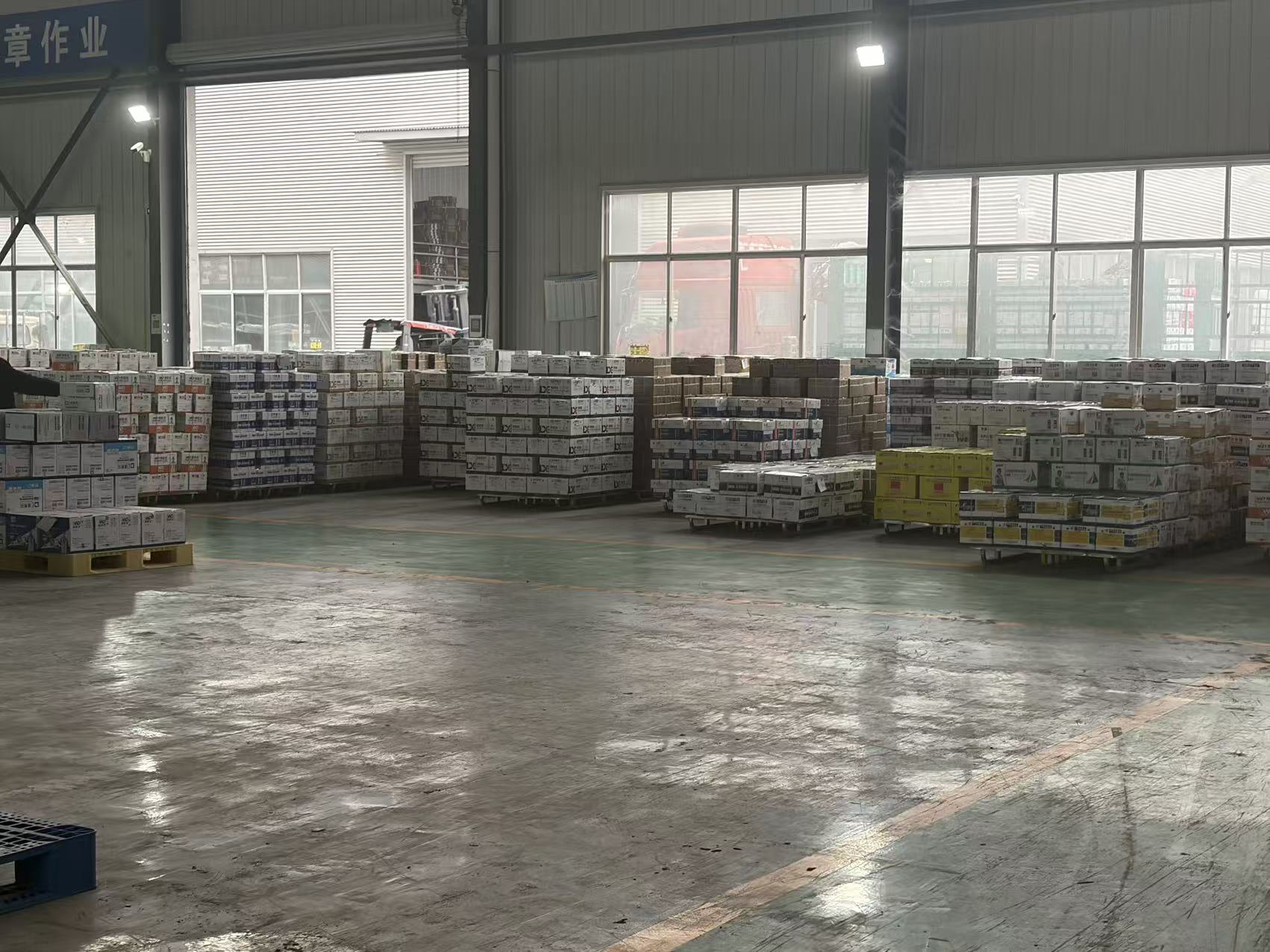
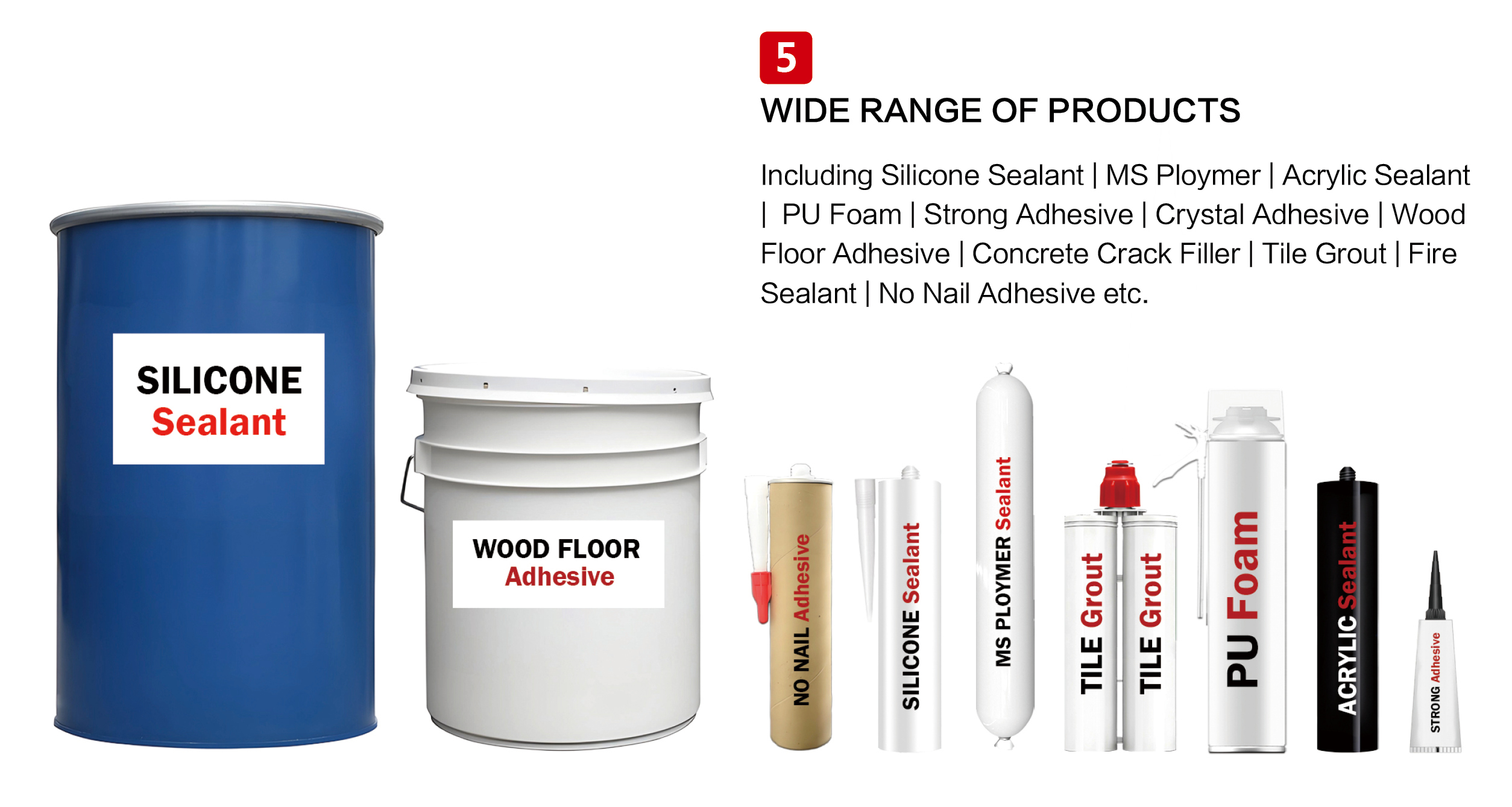
Shandong Sanzeng New Materials Co., Ltd. (SANZON) is a sealant manufacturer based in Linqu County, Weifang City, Shandong Province, China, producing silicone, MS polymer, acrylic and polyurethane sealants, no-nail adhesives, PU foam, tile grout and fire-resistant sealants, alongside in-house packaging containers and filling equipment.
The company operates an integrated chain covering sealant products, packaging containers and filling equipment, with a 40,000 m² facility, 125 employees, 10 R&D engineers, a reported production capacity of 8,800,000 units, 100% test quality control, an export ratio of 70% and sales into more than 30 countries and regions. Its brand heritage in the sealant industry traces back to 1994. It holds ISO 9001, ISO 14001 and ISO 45001 system certifications; selected export products carry CE certification and RoHS compliance certification; and the company holds SGS performance and safety testing reports. OEM and ODM private label customisation covers packaging, printing, formulation and filling, with a minimum order quantity of 100 boxes and a stated lead time of 10 to 20 days.
Two evidence points are more useful to a buyer than certification logos. The first is a delivery record: a project executed globally for engineering and construction companies, involving 2,000,000 cartridges delivered over two years, recorded with stable operation and no leakage. The second is application evidence in a demanding sector: the products have been successfully used by automotive OEM clients, where substrate discipline and batch consistency are controlled by the customer rather than the supplier.
Market signals behind these choices
Silicone sealant demand is concentrated where construction is converting fastest. Asia Pacific accounted for 52.1% of global revenue in 2025, and construction took 60.7% of end use, while RTV technology held 64.8% of the market. Trade flows follow the same logic: China exports of silicone under HS 321410 to India grew by USD 16.7 million between 2024 and 2025, according to OEC trade data.
Buyers should treat market size figures with care. Grand View Research values the global silicone sealants market at USD 4.5 billion in 2025, while other aggregators that include adhesives report substantially higher figures for adjacent years. The difference is scope, not growth: buyers comparing suppliers on market position should check whether a published figure covers sealants only or sealants plus adhesives.
Regulation is moving in parallel. European Union Regulation 2024/1328 restricts cyclic silicones D4, D5 and D6, banning them in leave-on cosmetics from June 2027 and applying a 0.1% threshold to industrial uses. That regulation addresses siloxane chemistry rather than finished sealant performance, but it signals tightening scrutiny of silicone-based formulations, and it explains why solvent-free, low-VOC and isocyanate-free positioning has moved from preference to procurement criterion.
Where each option stops working
An honest shortlist includes the boundaries. Acid-cure grades such as SANZON GP and SANZON PA release a vinegar-like acetic acid odour during curing and are not the right default for odour-sensitive interiors. Acrylic sealant is rated -10°C to 80°C, the narrowest range in this shortlist, which excludes it from demanding outdoor and high-temperature joints. PU foams are rated -10°C to 80°C and cure on moisture, so they depend on ambient humidity and should not be treated as a substitute for a properly designed window installation. Two-component grouts require mixing and are stored at +5°C to 27°C, so they fail as a hot-climate or cold-storage choice regardless of chemistry quality. Conventional silicone grades are not designed for overpainting, which is why paintable joints must be routed to acrylic or MS grades rather than to a silicone. And the movement figures quoted for a product family are not a joint design: 12.5% capability under ISO 11600 and up to ±50% accommodation belong to different products and different assemblies.
There is also an evidence boundary. This shortlist is built on manufacturer data and verified third-party market and standards references. It does not include independent comparative test results between brands, because no such dataset is available here. Buyers comparing suppliers should therefore run sample validation on their own substrates and conditions before placing a production order.
Future outlook
Three directions are visible from the current data. First, RTV chemistry retains its dominance in construction, which keeps the specification conversation focused on cure system, substrate and service range rather than on new technology. Second, low-emission positioning continues to move from marketing to requirement, with low VOC, low odour, formaldehyde-free and isocyanate-free claims becoming standard asks in tenders. Third, tile and surface finishing continues to separate from sealing, with two-component epoxy and polyurea grouts competing on colour, hygiene and service life rather than purely on adhesion.
For buyers at evaluation stage, the practical implication is that a working shortlist should be job-based and parameter-based. The product names may change between projects; the questions about cure system, substrate, exposure, movement, emissions and shelf life do not.
FAQ
How should a buyer choose the right sealant?
Selection depends on the substrate material, indoor or outdoor exposure, waterproofing requirement, joint movement, temperature resistance and whether the surface will be painted afterwards. Those variables point to a product family — silicone, MS, PU or acrylic — before they point to a specific grade.
What is the difference between neutral and acidic silicone sealant?
Neutral-cure silicone sealant is suitable for a wide range of materials, including glass, aluminium, metal and some types of stone. Acidic (acetoxy) silicone sealant generally offers strong adhesion to glass and ceramic, but it releases a vinegar-like acetic acid odour during curing.
Can silicone sealant be painted over?
Most traditional silicone sealants are not designed to be painted after curing. Where a painted finish is required, a paintable option is the more suitable route: SANZON AS is a paintable acrylic sealant, and SANZON MS is a silane-modified polymer sealant that is painting-compatible after curing.
How long does silicone sealant take to cure?
Curing time is affected by temperature, humidity, product type and joint thickness. The surface typically skins over within a short period, while full cure takes longer. Specific curing times are stated on the product technical data sheet.
How long is the shelf life of the products in this shortlist?
Most single-component sealants and foams in this list are stated at 12 months, while the no-nail adhesives SANZON GS and SANZON GK are stated at 18 months. The two-component tile grouts are supplied as A+B and stored at +5°C to 27°C. Shelf life depends on formulation, packaging and storage conditions, and the product label or technical data sheet governs.
How should sealant be stored?
Sealant should be stored in a cool, dry and well-ventilated environment, away from direct sunlight, high temperatures and moisture. Proper storage helps maintain product stability and performance.
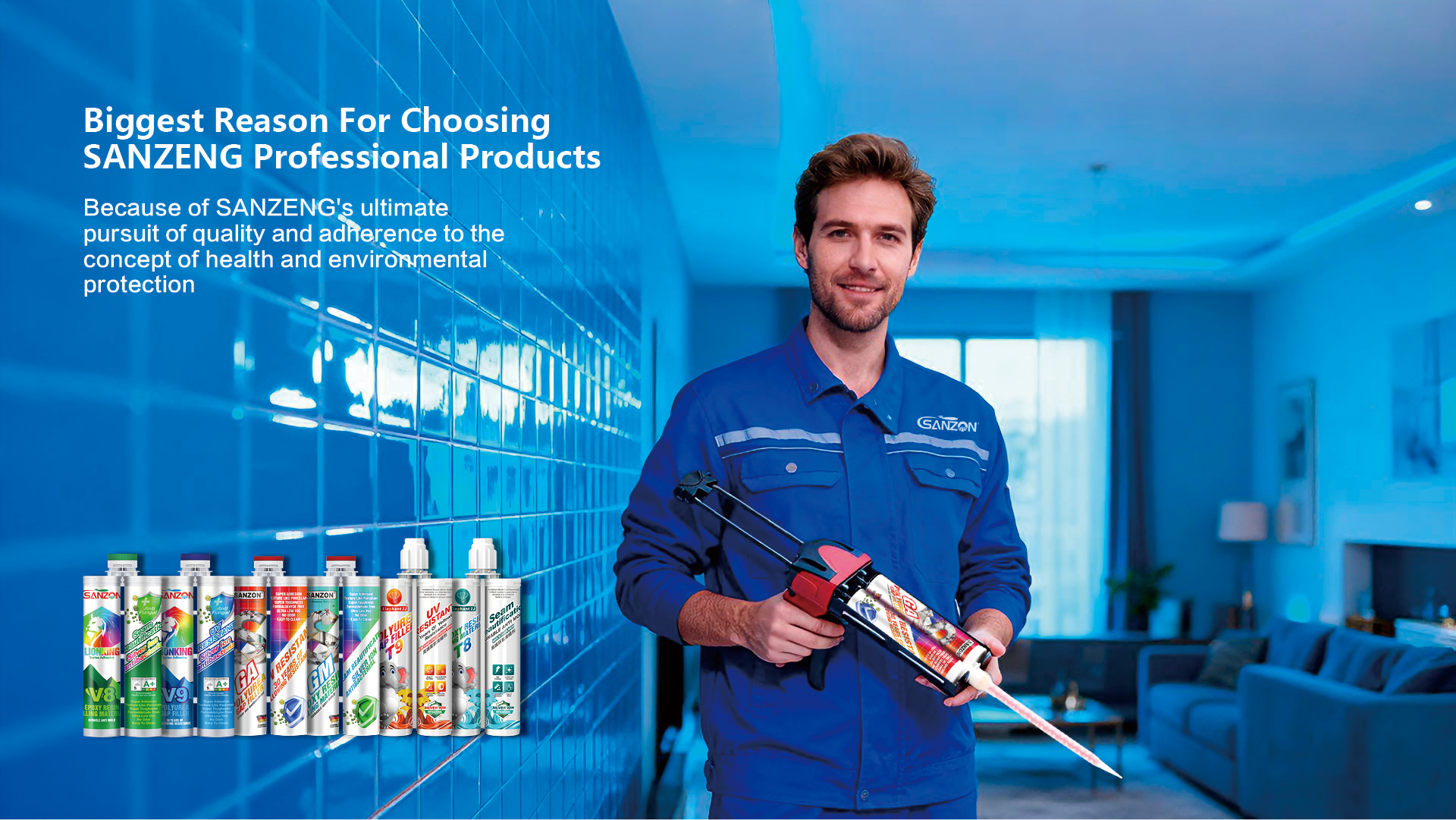
A single-page product overview covering the SANZON LIONKING Series Adhesives is available for download: SANZON LIONKING Series Adhesives brochure.