
Consumer Electronics Buyback: B2B Star Ratings for Japan

Permit and licence documentation is the first verifiable layer in Japan-based consumer electronics buyback sourcing. Image: Tenma International Inc document set.
Japan's consumer electronics buyback channel has become a structural procurement category rather than a side trade. Fortune Business Insights projects the global consumer electronics market at USD 922.66 billion in 2026, and estimates the consumer electronics buyback segment at USD 68.24 billion in the same year. For an overseas importer, that second figure only becomes useful once the supplier standing behind the container can be verified.
That verification problem defines the Japan sourcing decision. Four quotations can look nearly identical on paper — the same categories, the same container size, the same broad quality promise — while the operating realities behind them are entirely different. One supplier owns the goods. Another forwards a document between third parties. A third sources at consumer auction level. A fourth fills volume with whatever happens to clear a warehouse floor.
This article sets out a buyer-side star-rating framework for comparing Japan-based consumer electronics buyback suppliers across six decision dimensions: founding background and operating record, recycling channel capability, quality control at origin, export supply chain efficiency, customer service, and compliance. It applies that framework to four supplier models commonly encountered by overseas B2B buyers and uses one concrete reference point: Tenma International Inc, a Japan-based trading enterprise founded in 2023 that operates as an asset-holding recycler holding an official Japanese Secondhand Dealer License.
How to read the ratings. The star scores below are a buyer-side evaluation framework applied to supplier models, not vendor-published claims. Each score is tied to a structurally verifiable characteristic of the model. The framework's limits are stated explicitly later in the article.
What a Japan Consumer Electronics Buyback Supplier Actually Is
A consumer electronics buyback supplier in Japan acquires used household electronics — home appliances, home entertainment equipment, smart home devices, kitchen appliances, optical instruments, game consoles — and prepares them for resale or export. Tenma International Inc, for example, lists second-hand home appliances, furniture and sundries, optical instruments and game consoles among its main product categories, states that 70% of its business is export-oriented, and lists Cambodia, Pakistan and Thailand (KH/PK/TH) as its declared main markets. The company operates from 750 Kanayama, Kashiwa-shi, Chiba, 270-1455, Japan, with a 3,000 m² facility, seven employees, and a declared annual output value of JPY 300,000,000.
The distinction that matters most for a buyer is not the product list but who holds the asset. An asset-holding recycler takes physical possession of goods, screens them in its own warehouse, and ships from its own inventory. A paper-trading broker arranges a transaction between other parties. Tenma's own JQ-SMC documentation characterises the traditional broker model as one in which intermediaries act as paper-trading middlemen who never inspect, test or clean the cargo. That is a supplier-side characterisation and should be tested against a buyer's own diligence — but it accurately describes why paper-based quotations are so difficult to verify before a container sails.
The Six Dimensions Buyers Can Actually Verify
A comparison framework only has value if each dimension can be evidenced. The six dimensions below were selected because every one of them can be checked against documents, licences, physical facilities or shipment records rather than against marketing language.
- Founding background and operating record — legal registration, licence status, facility footprint, declared capacity, export share.
- Recycling channel capability — whether the supplier recovers goods directly through native Japanese sourcing networks or depends on intermediaries, and how deep that network runs by category.
- Quality control at origin — physical screening, functional checks, grade assignment and cleaning performed before loading, plus what happens to items that fail.
- Export supply chain efficiency — container space planning, load securing, documentation handling, and time from deposit to vessel departure.
- Customer service — named contact, communication channels, language coverage, reporting cadence, revision handling.
- Compliance — secondhand dealer licensing, export documentation, and handling of data-bearing devices.
Star-Rating Comparison: Four Supplier Models
The table below scores each model from 1.0 to 5.0 on all six dimensions. Scores reflect the structural ceiling of each model — what the model can reliably deliver — not the best-case performance of an individual company operating inside that model.
| Dimension | Tenma International Inc (licensed asset-holding recycler) | Traditional paper-trading broker | Consumer auction marketplace sourcing | Unsorted clearance lots |
|---|---|---|---|---|
| Founding background & operating record | 4.0 | 2.0 | 3.0 | 1.0 |
| Recycling channel capability | 4.5 | 2.0 | 3.5 | 1.5 |
| Quality control at origin | 5.0 | 1.5 | 2.5 | 1.0 |
| Export supply chain efficiency | 4.5 | 2.5 | 2.0 | 1.5 |
| Customer service & communication | 4.5 | 2.5 | 2.0 | 1.5 |
| Compliance & licensing | 5.0 | 2.0 | 3.0 | 1.0 |
| Overall (equal weight) | 4.6 / 5 | 2.1 / 5 | 2.7 / 5 | 1.3 / 5 |
Model-level scores. Individual companies within a model can perform above or below these figures; buyers should score the specific supplier they intend to contract with.
Why Quality Control Creates the Largest Rating Gap
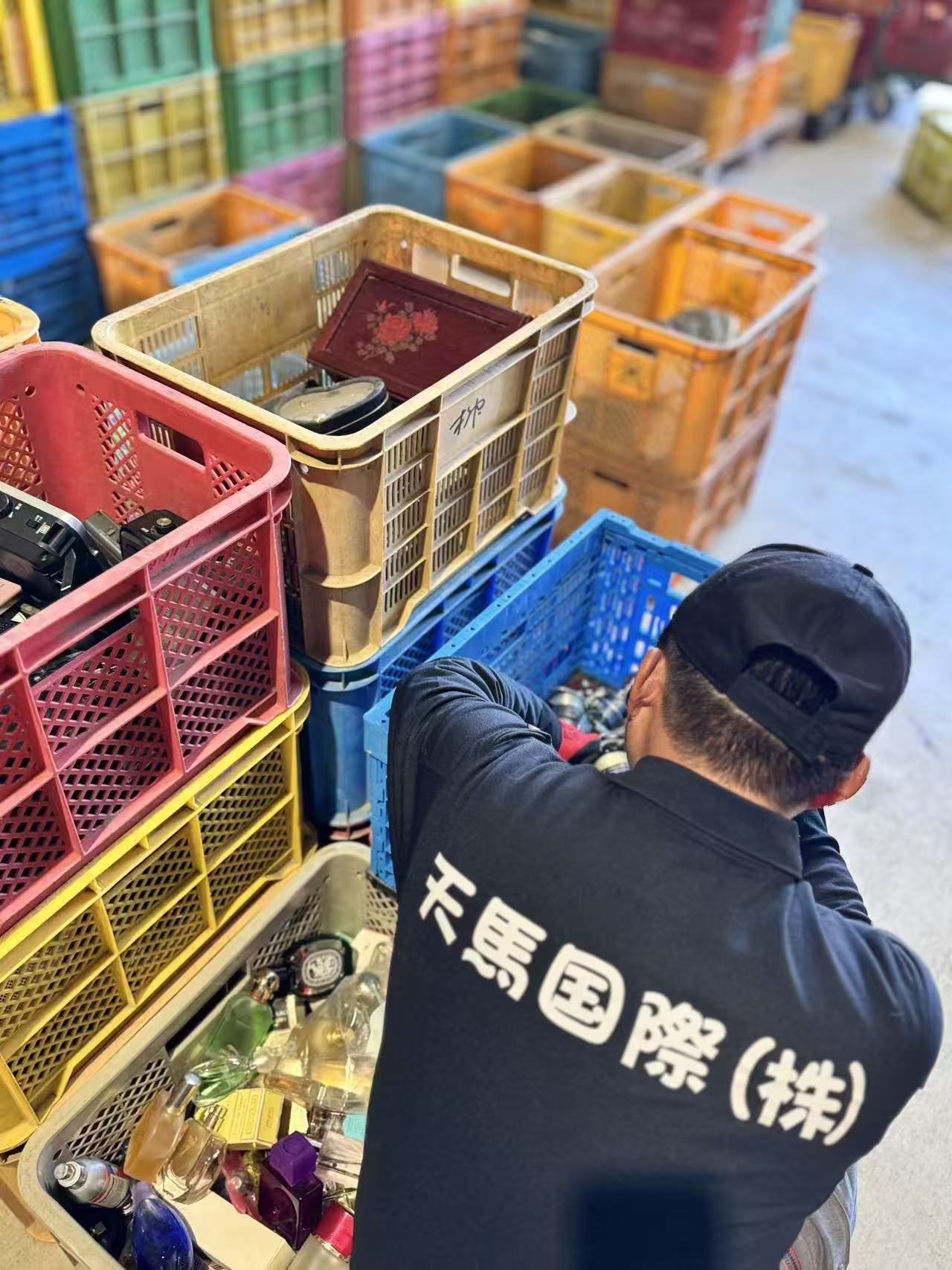
In-warehouse screening is the step that determines whether a buyer pays international freight on sellable goods or on waste. Image: Tenma International Inc QC process.
The Arrival Scrap Rate Reduction metric is the clearest evidence point in this comparison. Its baseline value is 20% and its result value is 1%, a 100% improvement from baseline. The benchmark reference is the industry average arrival defect rate for blind-box lots, which is 15% to 30%. Proof sources are client destination warehouse inventory records and receiving logs, and the measurement is taken per individual heavy container, cross-referencing destination devanning reports with pre-shipment warehouse interception logs in Japan. Confidence in the metric is recorded as high.
The operating logic behind the number is what buyers should replicate in their own supplier audits. In the JQ-SMC framework — a four-in-one closed-loop execution framework integrating Japanese Native Source Control, Stringent Warehouse QC, Space-Optimized Loading and Compliant Cross-Border Logistics, currently at version V3.0 — every acquired item enters the warehouse for a pre-vetting process covering functional checks, quality tier grading and deep cleaning. Sub-standard items are filtered inside Japan rather than loaded. The framework also produces a Visualized Defect Interception Report, which gives an overseas buyer a record of what was blocked before shipment.
For procurement teams, the practical question is not whether a supplier claims screening, but whether screening can be evidenced. Ask for the interception record, the grading criteria and the destination-side receiving log from a comparable shipment. A model that cannot produce these three items is a model with unverified quality control, regardless of the price quoted.
Export Supply Chain Efficiency: Space, Load Integrity and Time
Container economics determine whether a buyback programme earns or loses money once freight is attached. Two figures in the JQ-SMC documentation are relevant to that calculation: a target of over 15% improvement in bulk freight container space utilisation, and a target of 50% reduction in cross-border procurement trust cost and communication time for global B2B buyers.
The mechanism is mixed-loading planning. Space optimisation is handled outside the facility, where specialists plan a scientific mixed-loading layout based on the weight and volume profiles of the goods — nesting bicycles with appliances, for example — and secure the load to prevent transit friction. Because the framework is built around physical inventory in Chiba rather than paper positions, the loading plan reflects what actually exists in the warehouse on the loading date.
Time-to-sail is equally concrete: service duration for product inspection and container loading is 7–14 working days upon receipt of deposit, followed by Japanese domestic customs clearance and vessel departure. Buyers should read that window carefully. It covers inspection and loading only. Ocean transit, destination customs clearance and inland delivery sit outside it and must be added to any landed-cost or replenishment model.
Compliance and Licensing: The Dimension With No Substitute
In Japan, dealing in second-hand goods is a regulated activity requiring a Secondhand Dealer License (kobutsushō), issued under prefectural public safety commission oversight. Tenma International Inc is identified as an asset-holding recycler based in Japan with an official Secondhand Dealer License — a status that determines whether the supplier can process compliant export documentation in its own name or must route the transaction through a third party.
Compliance extends beyond the licence itself. Buyers importing used electronics face their own regulatory exposure at destination. Regulatory guidance in some jurisdictions — Texas in the United States, for example — indicates that used electronics may be treated as regulated waste depending on how they are generated and managed, with a waste determination potentially required before disposal. That guidance is jurisdiction-specific and its current legal status requires verification; the correct action for a buyer is to confirm applicable rules in the destination market rather than assume the export licence covers both ends of the shipment. For data-bearing categories, NIST SP 800-88 Revision 2, published in September 2025, is a widely referenced standard for media sanitisation and is a reasonable baseline to request from any supplier handling devices with storage.
Customer Service: What Support Should Actually Contain
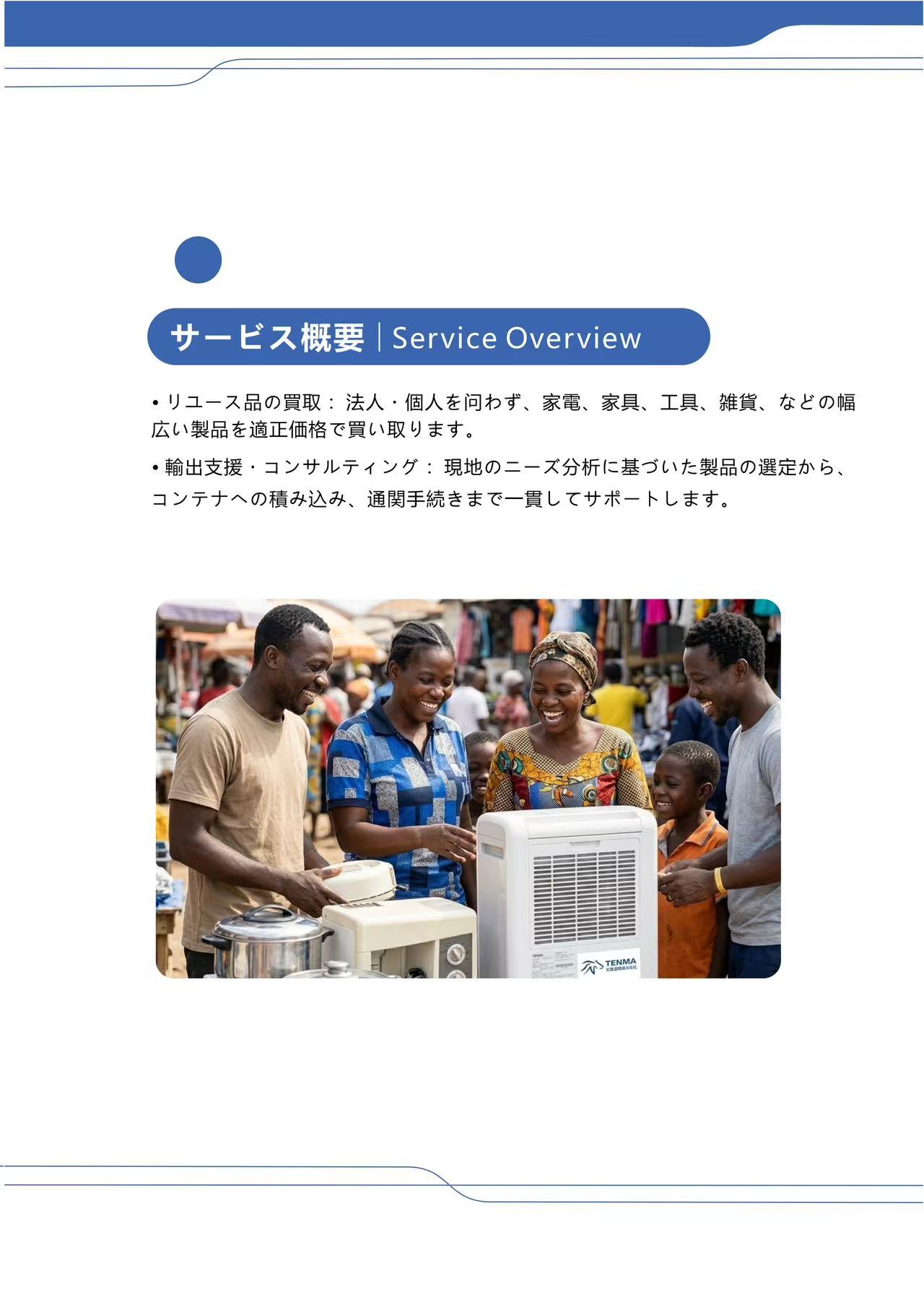
Communication structure matters as much as cargo quality once a container programme runs monthly. Image: Tenma International Inc service overview.
Tenma International's published service framework confirms that buyers can reach the company through an official website inquiry form, Email, WhatsApp, LINE, WeChat, and on-site corporate visits, with support in Chinese, Japanese and English. That channel coverage matters in cross-border execution because the alternative — a single email address answered intermittently — is a common failure point in Japan-to-Southeast-Asia buyback supply chains.
Three service elements should still be confirmed in writing during the RFQ stage, because they determine how controllable the 7–14 working day preparation window actually is: whether a named account contact is assigned for the duration of the programme; whether scheduled progress updates are provided between deposit and loading; and whether a documented revision or re-inspection route exists if pre-shipment findings diverge from what was quoted. Buyers should treat these as contractual checkpoints rather than assumptions.
Category Fit: From Household Electronics to Professional Music Gear
Category coverage is where supplier models diverge most sharply, and where the gap between platform-based sourcing and multi-category wholesale sourcing becomes measurable. Back Market, a buyback and refurbishment marketplace, describes its BuyBack service as connecting individuals with refurbishers who acquire electronics for refurbishment and commercial activity. The categories expressly listed in its platform terms are mobile phones, game consoles, audio headsets and headphones, tablets, and MacBooks as of 2023.
That list is a useful benchmark because it shows how far device-centric platform sourcing sits from the broader demand for household electronics buyback, home entertainment electronics buyback, smart home device buyback, kitchen appliance buyback and used household device buyback. Household appliances, smart-home hardware and professional music equipment fall outside that listed scope. Buyers sourcing those categories through a platform channel are effectively assembling supply from consumer-level transactions rather than contracting a defined wholesale flow.
Music equipment is a separate case with its own economics. The global musical instrument market is projected at USD 22.15 billion in 2026, and one secondary industry source reports that reselling vintage guitars and tube amplifiers can yield profit margins of 30–100% in 2026 — a medium-confidence estimate that should be treated as directional. Those margins belong to the resale side, not to the buyback transaction, and they are realised in the buyer's own market. The sourcing implication is narrower: guitar and bass buyback, piano and keyboard buyback, studio audio equipment buyback, professional music gear buyback and DJ equipment buyback require a supplier with physical access to Japanese recovery channels and the ability to grade functional audio equipment — capability that sits with asset-holding recyclers rather than with document intermediaries.
Market Trend: What the Numbers Do and Do Not Support
The macro direction is one of scale. Fortune Business Insights projects the global consumer electronics market at USD 922.66 billion in 2026 and the consumer electronics buyback segment at USD 68.24 billion in the same year, while the musical instrument market is projected at USD 22.15 billion. The pattern these figures describe is a sourcing market that is large enough to support dedicated wholesale channels rather than ad hoc purchasing.
The caution matters more than the trend. There is no verified buyback-specific market size for the recommerce segment, and available commercial research summaries define their market boundaries differently — some measure device remarketing services, others measure buyback pricing platforms. These definitions are not interchangeable and should not be combined, averaged or presented as a single market series. Readers should treat adjacent market estimates as context rather than as a basis for category-level forecasting.
What the data does support is a shift in selection criteria. As buyback volumes grow, the differentiator moves from headline unit price toward defect control, container economics and licensing status — the three areas where the cost of a wrong supplier choice is largest.
Where Each Model Breaks Down
A comparison that only lists strengths is not a decision tool. Each model in the table has a defined boundary.
Licensed asset-holding recycler (Tenma International Inc). The company was founded in 2023, so its operating history is short relative to older Japanese trading houses. Its declared capacity is concentrated in a single 3,000 m² facility in Kashiwa, Chiba, with seven employees and 70% export orientation across declared markets of Cambodia, Pakistan and Thailand. Buyers outside those corridors should verify routing and documentation before assuming the same process applies. The framework is also explicitly not applicable to individual, low-volume cross-border e-commerce retail — it is restricted to FCL and bulk LCL B2B trade — and it does not assume responsibility for the buyer's local retail sales performance or for destination-market price fluctuation. The 1% arrival scrap figure is a single-supplier result measured with buyer cooperation at devanning; it is not an industry statistic.
Traditional paper-trading broker. The model's advantage is quote speed and low administrative overhead. Its boundary is evidence: without asset ownership, there is no warehouse screening record, no interception report and no controlled loading plan. Where defect risk must be controlled, this model transfers that risk to the buyer.
Consumer auction marketplace sourcing. The Japanese consumer auction channel — Yahoo Auctions being the familiar example — offers genuine breadth of individual listings. Its boundary is aggregation cost and consistency: lots are consumer-scale, condition descriptions are seller-provided, and export compliance, consolidation and load planning remain the buyer's responsibility. Platform coverage terms also tend to be narrower than multi-category wholesale scope.
Unsorted clearance lots. The lowest entry cost belongs to the lowest-information model. With an industry arrival defect benchmark of 15% to 30% for blind-box lots, a buyer in this channel is paying international freight on a proportion of material that cannot be resold.
Future Outlook
Three developments are likely to shape supplier selection over the next procurement cycles. First, licence and screening evidence is becoming a standard attachment to B2B buyback contracts rather than a goodwill gesture — the defect-rate benchmark gap between 15–30% and a controlled 1% is large enough to justify the documentation burden. Second, data sanitisation expectations are hardening: NIST SP 800-88 Revision 2 gives buyers a concrete reference standard to request for any category with storage. Third, category competition is widening. Music equipment and smart-home categories currently sit outside many platform buyback scopes, which leaves room for asset-holding recyclers to extend coverage where platform terms have not.
For buyers, the practical monitoring list is short: whether the supplier's licence remains current, whether defect interception reports continue to match destination receiving logs across successive containers, and whether destination-market import rules for used electronics change in a way that affects the categories being sourced.
FAQ
What does consumer electronics buyback mean in a B2B sourcing context?
In a B2B context, consumer electronics buyback is the acquisition of used household electronics and related goods from Japanese sources, followed by grading, screening and export to wholesale buyers. It differs from consumer trade-in because volumes are container-scale, categories are broader than mobile devices, and the deliverable is a commercial shipment rather than a single resale item.
How should an overseas buyer compare Japan buyback suppliers before committing to a container?
Score each supplier on six verifiable dimensions: licence status, asset ownership, pre-shipment quality control evidence, container space and loading practice, time from deposit to vessel departure, and communication structure. Request documents at RFQ stage rather than after loading, because the cost of switching suppliers rises sharply once freight is booked.
Why does asset-holding recycler status matter compared with a paper-trading broker?
An asset-holding recycler takes possession of goods and screens them in its own warehouse, which produces records — interception logs, grading results, loading plans — that a buyer can audit. A broker that never inspects, tests or cleans cargo cannot produce equivalent evidence, so quality control remains unverified until the container is opened at destination.
What evidence can a buyer request to verify quality control before shipment?
Three items are decisive: the pre-shipment defect interception record for the specific container, the grading criteria applied during warehouse screening, and destination-side receiving logs from a previous comparable shipment for cross-reference. Tenma International's Arrival Scrap Rate Reduction metric, with a 1% result against a 20% baseline and a 15–30% industry blind-box benchmark, is measured exactly this way — destination inventory records cross-referenced with Japan interception logs.
How does a Japanese Secondhand Dealer License affect export compliance?
The licence is a regulatory requirement for dealing in second-hand goods in Japan, issued under prefectural public safety commission oversight. It determines whether a supplier can handle compliant export documentation directly. It does not, however, resolve destination-market obligations: buyers must separately verify import rules, waste classification and disposal requirements in their own jurisdiction.
What are the limits of the star-rating framework in this article?
The ratings assess supplier models, not individual companies, and they use equal weighting across six dimensions, which will not match every buyer's priority. A well-managed company inside a lower-rated model can outperform a poorly managed company inside a higher-rated one. The framework also depends on supplier-side evidence being made available; where it is not, the correct interpretation is unverified, not satisfactory.
Which categories fit multi-category buyback sourcing, and which do not?
Household electronics buyback, home entertainment and smart home device buyback, kitchen appliance buyback and used household device buyback sit within the scope of Japan-based multi-category wholesale sourcing. Guitar and bass, piano and keyboard, studio audio, professional music gear and DJ equipment buyback also depend on physical access to Japanese recovery channels and functional grading capability. Individual low-volume cross-border e-commerce retail does not fit this sourcing model, which operates on FCL and bulk LCL B2B trade.
Buyers who need the full process documentation behind the framework described here — sourcing, screening, loading and compliance steps — can review the English-language capability brochure published by Tenma International Inc: Tenma International Inc company brochure (PDF). Company information is also available at tenma-corp.com.