
Control Board vs. Complete Induction Heater: A Buyer Framework
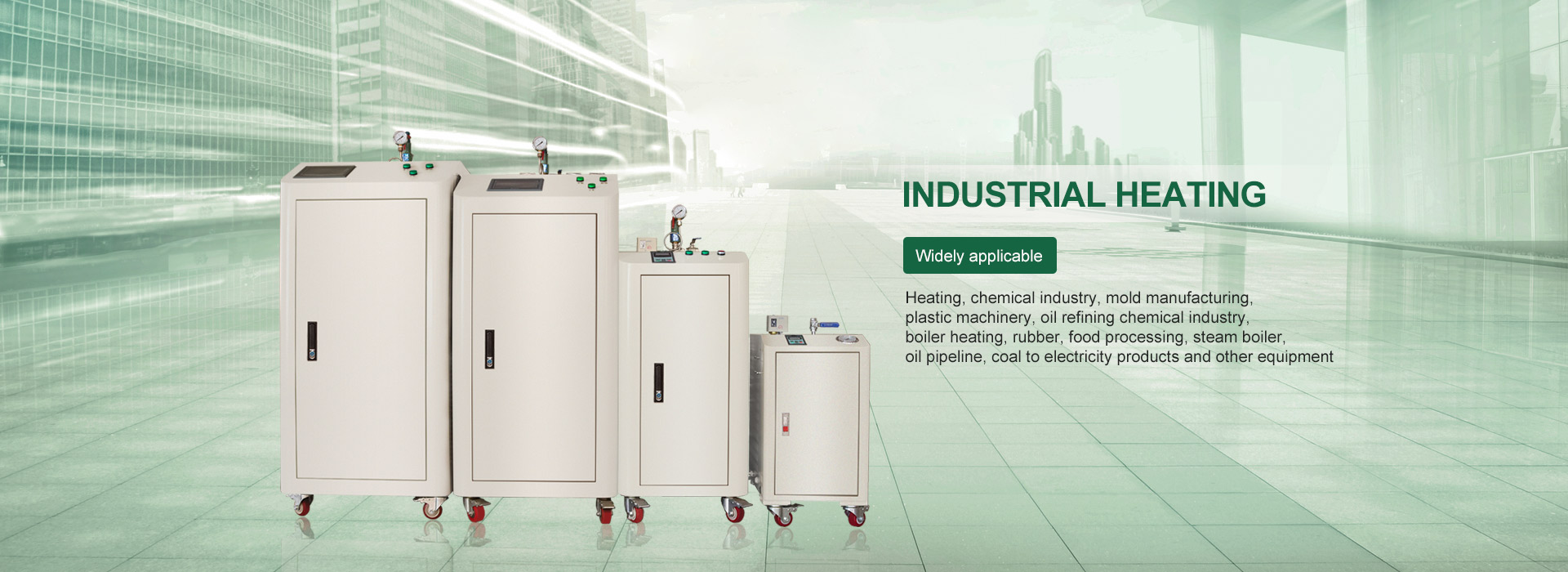
Induction heating equipment sits between power electronics and process heat — the choice between a board and a complete unit defines who owns that boundary.
Choosing between an induction heater control board and a complete induction heater is a boundary decision, not a price comparison. A control board supplies the power stage, the control loop and the protection logic that drive an induction heating coil. A complete induction heater adds the matched coil, the enclosure, the cooling path and product-level conformity documentation. The two options answer different engineering questions, and buyers who compare them purely on unit cost usually discover the difference later, during integration or commissioning.
This framework sets out the criteria that actually separate the two paths: rated power and voltage architecture, power regulation range, control and protection behaviour, thermal design, compliance scope, coil matching, and the internal engineering resource each option consumes. The reference data comes from JONSON (Guangdong Jiangxin Electronic Technology Co., Ltd.), a Foshan-based induction heating manufacturer founded in 2011, whose catalogue spans a single-phase full-bridge 8kW electromagnetic heating control board and complete induction heaters from 5kW to 100kW.
Two products, two different scopes of responsibility
An induction heater control board is a module, not an appliance. It converts incoming AC power into a high-frequency current that the work coil turns into a magnetic field, and it manages the switching, regulation and fault response of that process. The JONSON single-phase full-bridge 8kW electromagnetic heating control board, for example, is rated at 8kW on 220V/50Hz with an input voltage applicable range of 160V to 260V, a power regulation range of 20% to 100%, heat conversion efficiency of at least 98%, 100% effective power and an operating frequency of 5kHz to 40kHz. It is built from aluminium alloy and copper and is specified for ambient temperatures of -20°C to 50°C and humidity up to 95%.
What the board does not include is equally important: the work coil, the sheet-metal enclosure, the primary cooling circuit, the mains isolation and protection devices, the user interface housing, and the conformity assessment of the finished assembly. Those remain with the equipment builder.
A complete induction heater delivers the same electrical function inside a tested, enclosed, wall-mounted product. The JONSON JS1300-10/15, for instance, is a 10kW/15kW, 380V wall-mounted unit with CE, ISO and RoHS documentation, a 300V to 400V voltage adaptation range, 20% to 100% power adjustment and a net weight of 7.3kg in a 356mm x 178mm x 178mm enclosure. The buyer installs it, connects power and the coil, and commissions a product rather than a subsystem.
Why this decision is being re-examined now
Induction heating has moved from a niche retrofit technology to a mainstream electrification option, and that shift has widened the supply choices available to equipment builders. WiseGuyReports values the global induction heating system market at USD 2.39 billion in 2024 and projects USD 4.5 billion by 2035. Global Market Insights estimates that more than 550,000 induction heating systems were deployed worldwide as of mid-2024, with Asia-Pacific accounting for roughly 40% of the installed base. MarketsandMarkets notes that the 10kW to 100kW power segment dominates the market because of its versatility in hardening, forging and brazing work.
A larger installed base creates two distinct buyer populations. Plant operators replacing or adding heat capacity want a complete, commissioned unit. OEMs building induction-based products — commercial cooking equipment, process machinery, hot water and steam systems — increasingly want the control layer as a component they can design around. The same manufacturer may serve both, which is why the control board and complete unit are frequently evaluated side by side.
Criterion 1: Rated power and voltage architecture
Voltage architecture narrows the choice faster than any other criterion. The 8kW control board is a single-phase 220V/50Hz design with a 160V to 260V applicable range, which places a hard ceiling on the power a builder can extract from a single-phase supply. Every complete heater in the JONSON range above 8kW moves to three-phase 380V, because that is the architecture that supports higher current without excessive conductor sizing.
| Product | Rated power | Voltage | Form |
|---|---|---|---|
| Induction Heater Control Board (single-phase full bridge) | 8kW | 220V/50Hz, 160V–260V | Module |
| JS1300-005/008 | 5kW / 8kW | 380V ±20% | Wall-mounted unit |
| JS1300-10/15 | 10kW / 15kW | 380V, 300V–400V | Wall-mounted unit |
| JS1000-20 | 20kW | 380V, 300V–400V | Wall-mounted unit |
| JS1000-30 | 30kW | 380V | Wall-mounted unit |
| JS1000-100 | 100kW | Three-phase 380V, 50/60Hz, constant power 300V–400V | Wall-mounted unit |
For procurement, this table answers a single question: does the intended load fit inside 8kW on a single-phase supply? If it does, a board-level design is technically open. If it does not, the project moves to three-phase 380V and the complete-unit range becomes the realistic comparison set. The JS1000-100 illustrates why: at 100kW it draws a rated input current of 140A to 150A and delivers 200A to 220A output, figures that have to be reflected in switchgear, cabling and panel design well before commissioning.
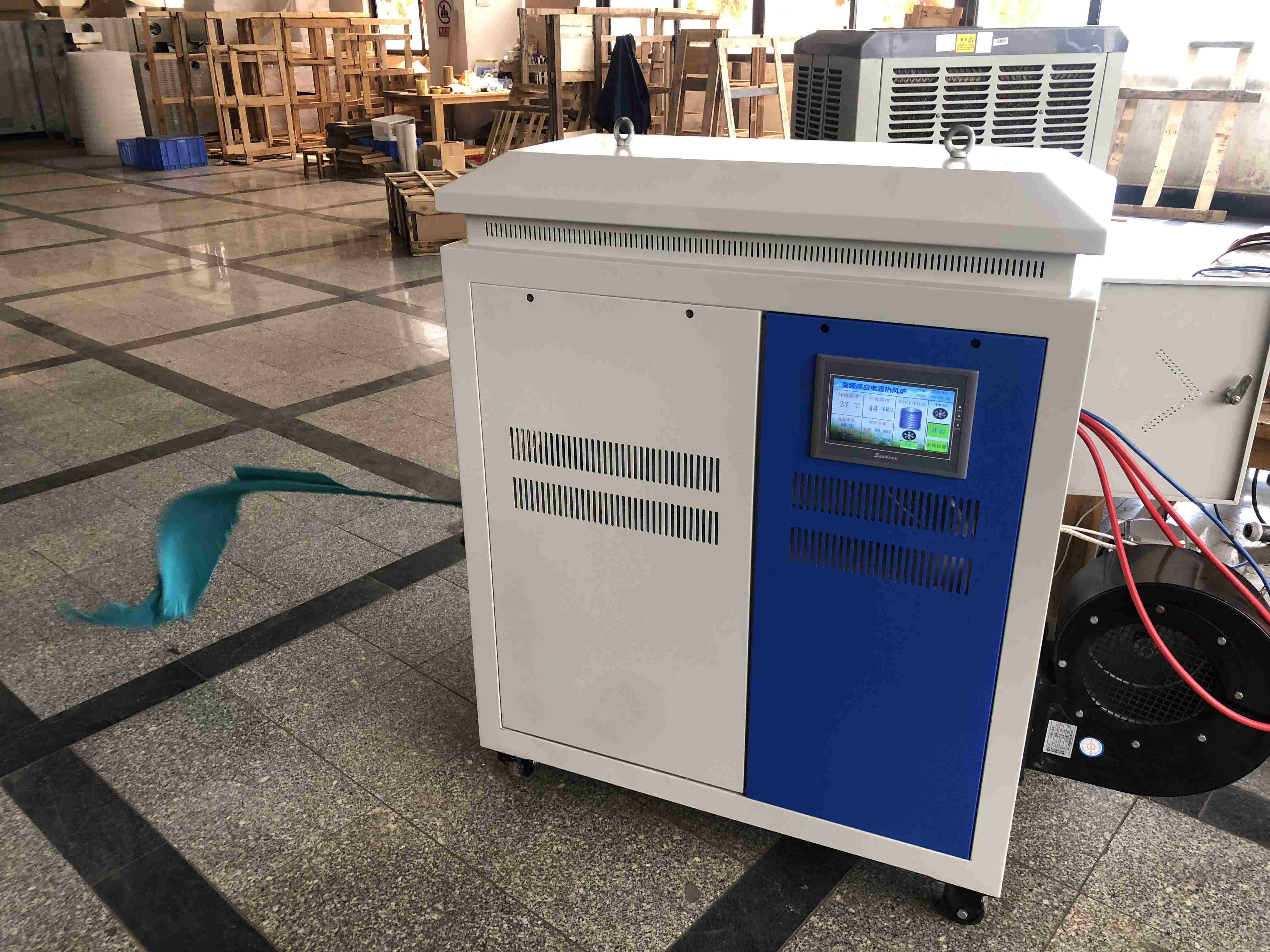
Complete cabinet-format induction heating equipment: the enclosure, cooling path and conformity documentation are supplied with the product.
Criterion 2: Power regulation range, efficiency and effective power
Regulation range determines turndown capability. A 20% to 100% stepless adjustment appears across the JONSON control board and the complete heater range, which means the same control resolution is available whether the electronics are supplied as a module or as a finished unit. For process heating, that range matters when a line runs at partial load for long periods — for example, holding a barrel, platen or tank at temperature between production cycles.
Efficiency figures need to be read model by model rather than assumed from a brochure headline. The 8kW control board is documented at heat conversion efficiency of at least 98% with 100% effective power. The JS1000-100 industrial induction heater is documented at heat conversion efficiency of at least 95% with effective power of at least 98%. Independent market analysis from Global Market Insights puts induction heating system efficiencies at up to 92%, with an average cycle time reduction of about 30% compared with gas or resistance-based heating. These numbers are not directly interchangeable — one is a component specification, one is a system-level market estimate — and buyers should record which figure they are comparing.
Criterion 3: Control and protection behaviour that changes integration risk
The control layer is where board-level and unit-level procurement diverge most in practical risk. Five documented behaviours should be checked on either path.
PID adjustment through a 0–5V input
The JONSON control board identifies a 0–5V input voltage for PID power adjustment, and the same interface is documented across the JS1300 and JS1000 ranges. The JS1000-100 industrial induction heater additionally accepts RS-485. For an equipment builder, a 0–5V interface is the simplest way to close a temperature loop with an existing PLC or controller without a proprietary protocol.
Fully electrically isolated soft start
Soft start is documented as fully electrically isolated heating and stop, with an alternative 12V and 24V input start/stop mode on several models. Electrical isolation is not a comfort feature: it prevents ground-reference conflicts when the control signal originates from a PLC cabinet that shares a different earth path from the induction power stage. In retrofit work, this is a frequent source of noise faults.
Protection timing
Instantaneous overcurrent protection is specified at 2 microseconds or less, with 130% instantaneous power overload protection. Short protection windows protect the inverter bridge during load faults and coil arcing; they also mean the protection is only as good as the surrounding installation. A board mounted without adequate clearance, fusing or coil insulation will not be rescued by a fast trip.
Start time under one second
A documented start time of less than one second applies across the JONSON range. For batch processes and multi-station machinery, start behaviour directly affects cycle time and repeatability.
Load temperature detection accuracy of ±1°C
Support for 0 to 1000°C load temperature detection with accuracy up to ±1°C is documented on the control board and the complete heaters. Accuracy at the sensor is only one part of closed-loop performance; sensor placement, thermal lag between coil and load, and the tuning of the PID loop determine what the process actually sees.
Underlying all five is a DSP-based high-speed automatic phase-locking tracking control system with a programmable digital display and an open application platform, documented across the range. Phase-locking tracking keeps the inverter resonant as coil inductance shifts with temperature, which is what allows a single control platform to serve different coil geometries.
Criterion 4: Thermal design and mechanical fit
Heat dissipation is specified at the product level, not left to interpretation. The JS1000-20, JS1000-30 and JS1000-100 are offered with air-cooled or water-cooled heat dissipation, and all three are wall-mounted. Physical envelopes differ substantially: the JS1000-20 measures 250mm x 390mm x 240mm, the JS1000-30 measures 450mm x 245mm x 261mm, and the JS1000-100 measures 635mm x 445mm x 315mm at 35kg. Retrofit projects often fail at this point — not electrically, but because the available wall space or cabinet depth does not accommodate the selected enclosure.
A control board shifts this question to the integrator. The module's documented operating envelope of -20°C to 50°C and up to 95% relative humidity has to be maintained inside whatever enclosure the builder designs, which means the airflow path, the separation between power devices and the coil, and the ambient temperature rise inside the cabinet all become design responsibilities. Buyers without in-house thermal experience should treat this as a real cost line, not a formality.
Criterion 5: Compliance scope — the asymmetry most buyers miss
Compliance does not transfer automatically from a component to the assembly built around it. Complete JONSON heaters carry declared conformity: the JS1300-10/15 is documented with CE, ISO and RoHS; the JS1300-005/008 and the JS1000 series are documented with CE and ISO. Those declarations attach to the products as supplied.
When a buyer integrates an 8kW control board into a new appliance or machine, the finished assembly is a new product and its conformity is the integrator's responsibility. That is the structural difference between the two paths, and it has a cost. Industrial induction heating equipment is commonly assessed against IEC 60519-1 for general safety requirements and IEC 60519-3 for particular requirements for induction heating and melting, as published by the International Electrotechnical Commission. Meeting those requirements at assembly level involves enclosure design, EMC performance and documentation work that a complete unit has already absorbed.
Manufacturing-side evidence is a separate layer. Guangdong Jiangxin Electronic Technology Co., Ltd. holds an ISO 9001:2015 quality management system certificate, number 02826Q00032R001, issued by Beijing Zhong An Zhi Huan Certification Center Co., Ltd. on 6 January 2026 and valid to 7 January 2029. The company also holds CE certificate of conformity KEYS23032915001EM-02, issued 7 April 2023 and valid to 7 April 2028 by Guangdong KEYS Testing Technology Co., Ltd., covering models JS1200-005, JS1200-006, JS1200-008 and JS1200-010. Buyers should map each certificate to the exact model being purchased rather than to the supplier in general.
Criterion 6: Coil matching and the load interface
The coil is the part of an induction system most often underestimated in procurement. Complete units are supplied with a defined coil specification: the JS1000-100 is documented with an adaptive coil of 95mm² line, 40m length and 80 to 100μH inductance, while a 2.5kW class heater is documented at 4mm² line, 23m length and 100 to 150μH. Coil-to-load distance is also specified in some models, for example 20mm to 25mm for a circular coil.
Board-level projects usually require a custom coil, because the geometry is dictated by the product being heated rather than by the electronics. JONSON's Induction Heating Coil range covers 1kW to 100kW at 220V or 380V, 50Hz or 60Hz, with 20% to 100% power regulation, heat conversion efficiency of at least 98% and an operating frequency of 5kHz to 40kHz. For buyers, the practical test is whether coil design and sampling are part of the supply scope or a separate engineering project.
Criterion 7: Engineering load, lead time and volume
Every criterion above converts into engineering hours, and engineering hours convert into schedule risk. A complete heater compresses the schedule: one purchase order, one test report, one installation step. A control board expands design freedom but requires schematic capture, enclosure design, thermal validation and conformity work before the first saleable unit exists.
Manufacturing support has to be assessed alongside this. JONSON provides OEM and ODM production services for induction heating equipment, with customization covering product specification customization, sample fabrication, graphic and panel customization, parameter adjustment and private logo customization. Stated monthly capacity is 10,000 units, lead time is 7 to 14 days, and the minimum order quantity is one unit. Quality control is described as 100% pre-shipment testing with product inspection by SGS, and after-sales support is provided as remote technical support. For a builder comparing a board-level route against buying a finished unit, these terms determine how much of the integration burden can be shifted back to the supplier.
Decision matrix
| Criterion | 8kW control board | Complete induction heater |
|---|---|---|
| Scope supplied | Power stage and control electronics | Electronics, coil, enclosure, cooling |
| Power ceiling | 8kW, single-phase 220V | 5kW to 100kW, three-phase 380V |
| Regulation range | 20%–100% stepless | 20%–100% stepless |
| Control interface | PID via 0–5V input | 0–5V input; RS-485 on JS1000-100 |
| Protection | ≤2μs overcurrent, 130% overload | ≤2μs overcurrent, 130% overload |
| Thermal design | Integrator-supplied enclosure and airflow | Air-cooled or water-cooled, factory-built |
| Compliance owner | Buyer, for the finished assembly | Declared by manufacturer (CE, ISO, RoHS as applicable) |
| Time to first unit | Longer — design and validation required | Shorter — install and commission |
Which option fits which project
The control board suits builders producing repeatable products around a common electrical platform: commercial induction cookers, household induction cookers, ceramic ovens and microwave ovens are the applications documented for the single-phase full-bridge 8kW board. Where a manufacturer wants a private logo, custom panel graphics, its own enclosure identity and control over the bill of materials, the module route is the only one that delivers it.
The complete heater suits process operators and machinery builders who need heat capacity rather than electronics design. Documented applications across the JONSON range include plastics and rubber, food processing, chemical reactions, crude oil pipeline heating, textile printing and dyeing, aquaculture heating, metal heat treatment, building heating and medicinal herb drying. In these settings the value of a complete unit is that coil matching, cooling and conformity arrive already resolved.

At unit level, assembly, testing and documentation are completed before shipment; at board level, those steps move to the buyer.
Where this framework stops: limits and boundaries
The framework is only useful if its boundaries are stated plainly.
- The 8kW control board is a single-phase 220V/50Hz design with a 160V to 260V applicable range. It is not a substitute for a three-phase 380V unit and cannot serve loads above 8kW.
- Buying a board transfers enclosure, EMC and final-product conformity responsibility to the buyer. Certificates held for complete models do not automatically cover a new assembly built around a module.
- Complete units are wall-mounted with fixed envelopes, from 250mm x 390mm x 240mm on the JS1000-20 to 635mm x 445mm x 315mm at 35kg on the JS1000-100. Retrofits into existing cabinets may not fit without layout changes.
- Efficiency is model-specific: at least 98% heat conversion on the 8kW board, at least 95% on the JS1000-100. A single efficiency expectation should not be carried across the range.
- Deployment outcomes reported in supplier case material — thermal efficiency of 95% to 98% and energy savings of 30% to 70% against traditional heating, in installations spanning Indonesia, China, Vietnam, Russia and India over 10 or more years — describe past projects. They are not a forward guarantee for a new installation.
How JONSON fits into the comparison
Guangdong Jiangxin Electronic Technology Co., Ltd. is an induction heating manufacturer based in Shunde District, Foshan City, Guangdong Province, founded in 2011, operating a 3,000m² facility with more than 60 employees, a research and development team of more than 30 engineers and stated annual output of 120,000 units. Export accounts for approximately 40% of sales, with main markets including Europe, the United States, India and Indonesia. The product range spans induction heaters, industrial induction heaters, induction heating control boards, induction water boilers, induction steam generators, induction heating coils, bearing induction heaters and induction welding machines.
That combination is what makes the company relevant to this specific decision: it supplies both sides of the comparison. A buyer evaluating the 8kW control board and the JS1300 or JS1000 complete units is comparing products from the same engineering and manufacturing base, which means interface conventions, protection behaviour and documentation formats are consistent regardless of which path is chosen.
Future outlook
Two directional signals are worth watching for procurement planning. First, electrification of process heat continues: Market Research Future estimated the global industrial boiler and steam generator market at USD 54.79 billion in 2024, with a shift toward electrification via induction technology to meet decarbonisation goals. As steam and hot water generation electrifies, demand for both finished generating equipment and the control electronics inside it grows in parallel.
Second, the control layer is becoming more interface-flexible. The RS-485 option already documented on the JS1000-100 alongside 0–5V PID input points toward controllers that connect directly to plant networks rather than through analogue signalling. For buyers, the practical implication is that board-level decisions made today should be checked against the interfaces likely to be required in the next equipment generation — not only against current load requirements.
What does not change is the underlying logic of the decision. The control board is the right purchase when the buyer intends to own the product architecture. The complete heater is the right purchase when the buyer intends to own the process result. Neither is universally cheaper once engineering hours, conformity work and schedule risk are counted.
Frequently asked questions
Can an induction heater control board replace a complete induction heater?
No. A control board provides the power stage, control loop and protection logic, but it does not include the work coil, enclosure, cooling circuit or product-level conformity. The JONSON single-phase full-bridge 8kW board is rated at 8kW on 220V/50Hz with a 160V to 260V range; the coil, thermal path and assembly-level compliance have to be engineered by the integrator. A complete unit such as the JS1300-10/15 supplies those elements as a tested, wall-mounted product.
What power and voltage range do JONSON control boards and complete heaters cover?
The control board is a single-phase 8kW design at 220V/50Hz. Complete heaters run from the JS1300-005/008 at 5kW and 8kW on 380V ±20%, through the JS1300-10/15 at 10kW and 15kW on 380V with a 300V to 400V adaptation range, the JS1000-20 at 20kW and JS1000-30 at 30kW on 380V, up to the JS1000-100 at 100kW on three-phase 380V, 50/60Hz, with constant power output between 300V and 400V.
Which control and protection features should be verified before ordering?
Five documented behaviours are worth confirming: PID power adjustment through a 0–5V input, fully electrically isolated soft start heating and stop, instantaneous overcurrent protection of 2 microseconds or less with 130% instantaneous power overload protection, a start time under one second, and support for 0 to 1000°C load temperature detection with accuracy up to ±1°C. The JS1000-100 also accepts RS-485 for PID adjustment.
Do JONSON induction heaters carry CE, ISO and RoHS documentation?
Documentation varies by model. The JS1300-10/15 is documented with CE, ISO and RoHS. The JS1300-005/008 and the JS1000 series are documented with CE and ISO. At company level, Guangdong Jiangxin Electronic Technology Co., Ltd. holds ISO 9001:2015 certification number 02826Q00032R001, valid from 6 January 2026 to 7 January 2029, and CE certificate of conformity KEYS23032915001EM-02 covering models JS1200-005, JS1200-006, JS1200-008 and JS1200-010, valid from 7 April 2023 to 7 April 2028. Buyers should match each certificate to the specific model purchased.
What OEM/ODM terms apply, and what is the minimum order quantity?
JONSON provides OEM and ODM production services for induction heating equipment, with customization covering product specification customization, sample fabrication, graphic and panel customization, parameter adjustment and private logo customization. The stated minimum order quantity is one unit, lead time is 7 to 14 days, monthly capacity is 10,000 units, quality control is 100% pre-shipment testing with product inspection by SGS, and after-sales support is provided as remote technical support.
Есть вопросы или нужны дополнительные детали?
Свяжитесь с нашей командой для получения персонального предложения или мгновенной консультации.
Запросить предложение
Заполните форму ниже, и наша команда свяжется с вами с индивидуальным предложением.
Прямой чат WhatsApp
Предпочитаете общаться в реальном времени? Напишите нам в WhatsApp для мгновенной помощи и быстрых ответов.
- Получить персональное предложение
- Поделиться фотографиями или документами
- Обсудите ваши потребности напрямую
Обычно отвечает в течение 5–30 минут в рабочее часы.