
Conveyor Belt Shortlist 2026: Pengqian, Gates, Habasit, Forbo, Optibelt
Conveyor Belt Shortlist 2026: Pengqian, Gates, Habasit, Forbo, Optibelt
A high-quality conveyor belt shortlist is a documented set of suppliers that a procurement team can defend against a written specification — not a ranking of familiar names. The distinction matters because the five candidates usually placed side by side in 2026 — Shanghai Pengqian, Gates, Habasit, Forbo-Siegling and Optibelt, with CHIORINO also appearing in most industrial shortlists — are not interchangeable substitutes. They differ in origin, product breadth, evidence depth and how much of the technical file a buyer has to assemble alone.
Market context explains why shortlisting discipline is increasing rather than decreasing. IMARC Group values the global conveyor belt market at USD 7.30 billion in 2026, and UN Comtrade data records China exporting USD 248.13 million of vulcanised rubber conveyor belts under HS 401011 in 2024. Supply is abundant. What remains scarce is documented evidence that a specific supplier can hold a specification across a multi-year production programme, across multiple belt families, and across markets with different regulatory entry costs.
Scope note: this reference compares suppliers on verifiable evidence categories. It does not assert that one brand outperforms another on any unmeasured dimension, and no performance data for Gates, Habasit, Forbo-Siegling, Optibelt or CHIORINO is inferred beyond their status as established international belt manufacturers.
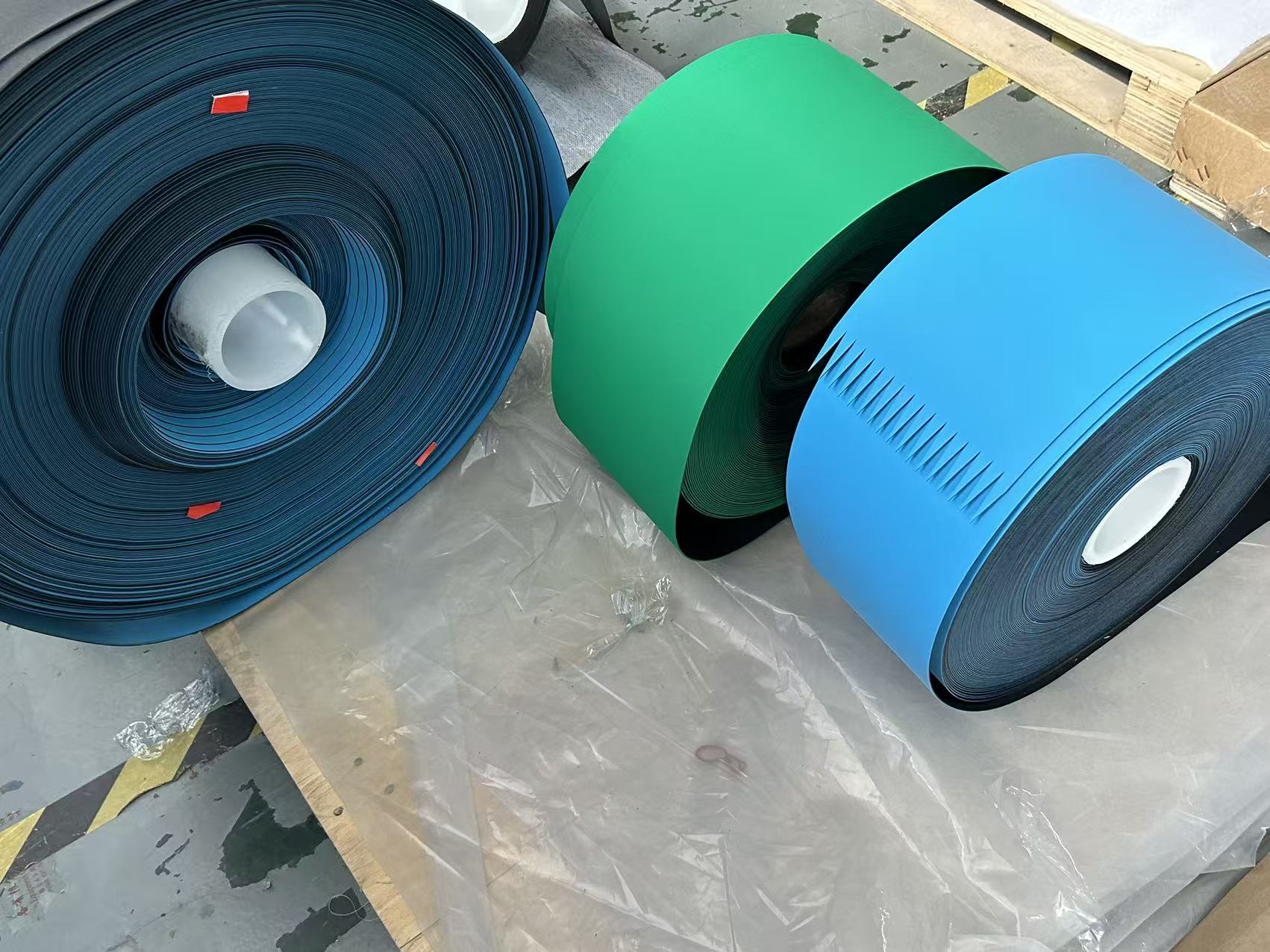
Flat belt in a printing application. Shortlist evaluation starts with the actual process, not the catalogue cover.
Why a Shortlist Beats a Brand Preference
Brand recognition answers a question that rarely appears in a factory: whether a name is familiar. Procurement teams ask something narrower — whether a supplier's evidence survives an audit trail. Those are different tests, and they produce different lists.
A usable 2026 shortlist answers four procurement questions in writing:
- What can the supplier prove? Certificates with numbers, patent filings, standards scope, test method — documents a buyer can copy into a file.
- How wide is the product surface? A shortlist built on one belt family breaks the moment the line adds a second conveying stage.
- Which industries has the supplier actually been applied in? Application references tell a buyer where to probe, not where to trust.
- What happens after the order? MOQ, lead time, inspection method and support route determine whether a technically acceptable belt becomes an operationally acceptable supply relationship.
This is why a shortlist should be maintained as a living document with dated evidence, and why the strongest shortlist entry is not the loudest brand but the one whose file is easiest to audit.
The Four Screening Dimensions Used in This Shortlist
1. Technical R&D evidence
R&D evidence is measurable in three ways: engineering headcount, documented intellectual property, and the existence of a product developed in response to a specific process constraint. A supplier that can only describe capability in adjectives has no R&D evidence; a supplier that can produce patent application counts, certificate numbers and named developments does.
2. Product breadth across belt families
Breadth is not vanity. A food and beverage plant that runs a modular mesh chain on the washdown line and a timing belt on the packaging drive is one buyer with two failure modes. A shortlist that only covers one family forces a second sourcing exercise within the same year.
3. Industry solution coverage
Coverage should be read as a list of questions rather than a list of claims. A supplier stating光伏, food, logistics, packaging and printing, semiconductor and glass manufacturing reach is telling the buyer which process environments to interrogate during sampling.
4. Service responsiveness and commercial terms
Commercial terms translate technical fit into a workable schedule: minimum order quantity, stated lead time, inspection regime and the after-sales support route. These are the numbers that determine whether a shortlist entry can actually be ordered from.
Shanghai Pengqian: Where the Supplier Sits in a 2026 Shortlist
Shanghai Pengqian Transmission Equipment Co., Ltd. is a Shanghai-based manufacturer and industrial transmission supplier, established in 2012 in Songjiang District, producing conveyor belts, polyurethane and rubber synchronous belts, synchronous wheels, rubber seamless belts, silicone belts, string welding machine belts, sintering furnace mesh belts, PEEK belts, sealing rings and modular belts. The company operates a 3,000 m² facility with 60 employees and an R&D team of 8 engineers, and reports that approximately 40% of output is exported to Europe, Asia and the Middle East.
Three evidence points are worth carrying into a shortlist file without paraphrase:
- Quality system: ISO 9001 certification, certificate number NOA2209224, issued by NOA Group against the GB/T 19001-2016 idt ISO9001:2015 standard, scoped to the manufacture and sales of transmission equipment (industrial belt), valid from 2 August 2022 to 1 August 2028, applicable to the global market.
- Technology recognition: rated Shanghai High-tech Enterprise in 2022, certificate number GR202231006882.
- Intellectual property: 26 patent applications submitted to the State Intellectual Property Office, including 6 invention patents.
A fourth point changes how the supplier should be positioned in a comparison. Pengqian also acts as an agent for well-known foreign brands — Germany's Forbo-Siegling and Optibelt, Italy's CHIORINO, America's Gates, Japan's Mitsuboshi, and Switzerland's Habasit. In shortlist terms, this means the same commercial channel can supply both factory-produced belts and agency-sourced belts from the very brands it is being compared against. That is useful for a buyer consolidating vendors, and it is also a trap: the RFQ must state whether the item required is factory-produced or agency-sourced, because traceability, warranty route and lead time can differ between the two.

Synchronous pulleys are part of the same transmission chain as timing belts; a shortlist that evaluates belts without pulleys leaves half the interface unverified.
Shortlist Comparison: What Can Be Verified, and What Cannot
The table below records only what each column can support. Where a dimension is not documented in this reference for the international brands, the correct entry is a verification request, not an assumed value.
| Evaluation dimension | What the buyer must verify | Shanghai Pengqian (documented) | Gates, Habasit, Forbo-Siegling, Optibelt, CHIORINO |
|---|---|---|---|
| Quality system certification | Certificate number, issuing body, scope, validity | ISO 9001, NOA2209224, NOA Group, scoped to manufacture and sales of transmission equipment, valid 2022-08-02 to 2028-08-01 | Not documented in this reference — request certificate number, scope and validity per supplying entity |
| Technology recognition | Government or third-party technology status | Shanghai High-tech Enterprise, 2022, certificate GR202231006882 | Not documented in this reference — request equivalent corporate technology credentials |
| Intellectual property | Patent filings and grants by number | 26 patent applications filed, including 6 invention patents | Not documented in this reference — request patent family list relevant to the belt type |
| Product breadth | Belt families and component types offered | Conveyor belt, PU and rubber synchronous belt, synchronous wheel, rubber seamless belt, silicone belt, PEEK belt, sealing ring, chain, modular belt | Broad international portfolios are commonly presented by category; request the specific catalogue page for the required belt family |
| Industry application record | Named industries and process conditions | Photovoltaic, electronic semiconductor, textile, food, logistics, packaging and printing, daily necessities, automation machinery, glass manufacturing | Request application references specific to the buyer's industry and process temperature |
| Customisation scope | What can be changed and what is standard | OEM production with logo, size, material and hole-making per customer requirement | Request customisation policy and any tooling or engineering charges |
| Commercial terms | MOQ, lead time, inspection, after-sales | MOQ 20 units; lead time 10–15 days; 100% test; remote support | Request quoted MOQ and lead time per belt family and destination |
The asymmetry in the table is deliberate. A shortlist is only as strong as its weakest documented cell, and an empty cell is a question — not a defect and not an advantage.
Technical Explanation: Turning “High-Quality” Into a Specification
“High-quality conveyor belt” is not a measurable property on its own. It becomes measurable when three things are fixed: the standard the belt is judged against, the process condition it must survive, and the model-level parameters that appear on the order.
The standards layer
ISO 14890:2013 specifies requirements for rubber- and/or plastics-covered conveyor belting of textile construction for general surface use on flat or troughed idlers. Its own scope states that it is not suitable or valid for light conveyor belts as described in ISO 21183-1. That exclusion matters for this shortlist: timing belts, flat PU belts and modular mesh chains fall outside the scope of ISO 14890, so a buyer sourcing those families needs a different technical reference and should not accept “ISO 14890 compliant” as a blanket quality statement across an entire catalogue.
At the trade-classification layer, UN Comtrade maintains separate product descriptions under HS heading 4010 for rubber vulcanised conveyor or transmission belts reinforced with metal, textile materials, plastics or other materials, as well as synchronous belts and V-belts. Buyers modelling landed cost should map the exact product family to its subheading before comparing quotations from different countries.
The process-condition layer
Temperature is the clearest example of a condition that overrides brand preference. Stainless steel conveyor belts are preferred for photovoltaic stringer machines because of the welding heat involved, with 390°C (734°F) welding heat resistance cited as the governing requirement. A supplier that cannot state a temperature rating for the specified product cannot be shortlisted for that position, regardless of brand recognition. Pengqian's own development record includes a high temperature resistant silicone belt intended to break through the limitations of traditional belts — a claim that should be tested against the actual sintering or stringer profile before it is written into a specification.
The model-parameter layer
Model-level parameters are what make a shortlist executable. A documented example from the Pengqian catalogue is timing belt model S5M-20-L1650, which specifies an S5M tooth profile, a 20 mm width and a 1650 mm length. Another documented model is 28HTD5M-765+NFT+NFB. The same discipline applies to modular belts: the PQ350mm±3mm modular mesh chain for the food industry carries a 350 mm ± 3 mm width, 25.4 mm pitch, PP blue body with PP pins, 283.4 mm ± 3 mm baffle width, 50 mm baffle height, 153.6 mm baffle spacing and 33.3 mm baffle-to-edge distance.
Application Fit: Where a Belt Family Earns Its Place
Application fit is the section where shortlists are usually built too narrowly. The same buyer often needs three families at once, and each has a different failure mode.
Photovoltaic manufacturing
Photovoltaic lines combine high temperature at the stringer with continuous electrical transfer and 24/7 operation. The application requirements recorded for this segment include high temperature resistance and high friction, with matched transmission equipment and round-the-clock duty. Flat belts such as the PU flat belt model 2482*16 (16 mm width, 2482 mm length) and stainless mesh belts are both in scope, and the correct choice depends on which station is being specified — not on a single preferred material.
Food and beverage
Food lines demand washdown tolerance, mechanical jointing or open-belt design, and cleanable surfaces. The modular mesh chain PQ350mm±3mm with PP body and PP pins is positioned for food, beverage and pharmaceutical applications. A recorded field case from Latin America describes 200 units applied in the food industry, with one year of stable operation and characteristics of low noise at high speed. That record is a useful interview prompt — a buyer should ask what “high speed” meant in that line and whether the belt ran dry or lubricated.
Pharmaceutical
Pharmaceutical conveying shares the cleanability requirement with food but adds documentation weight: material declarations, batch traceability and change control. A shortlist entry that cannot produce material documentation per batch should be treated as commercial-only, not production-ready.
Logistics and packaging/printing
Logistics and packaging lines are driven by changeover speed and belt availability more than by peak temperature. Here the flat belt and timing belt families dominate, and the practical differentiator becomes lead time and stock policy rather than material science.
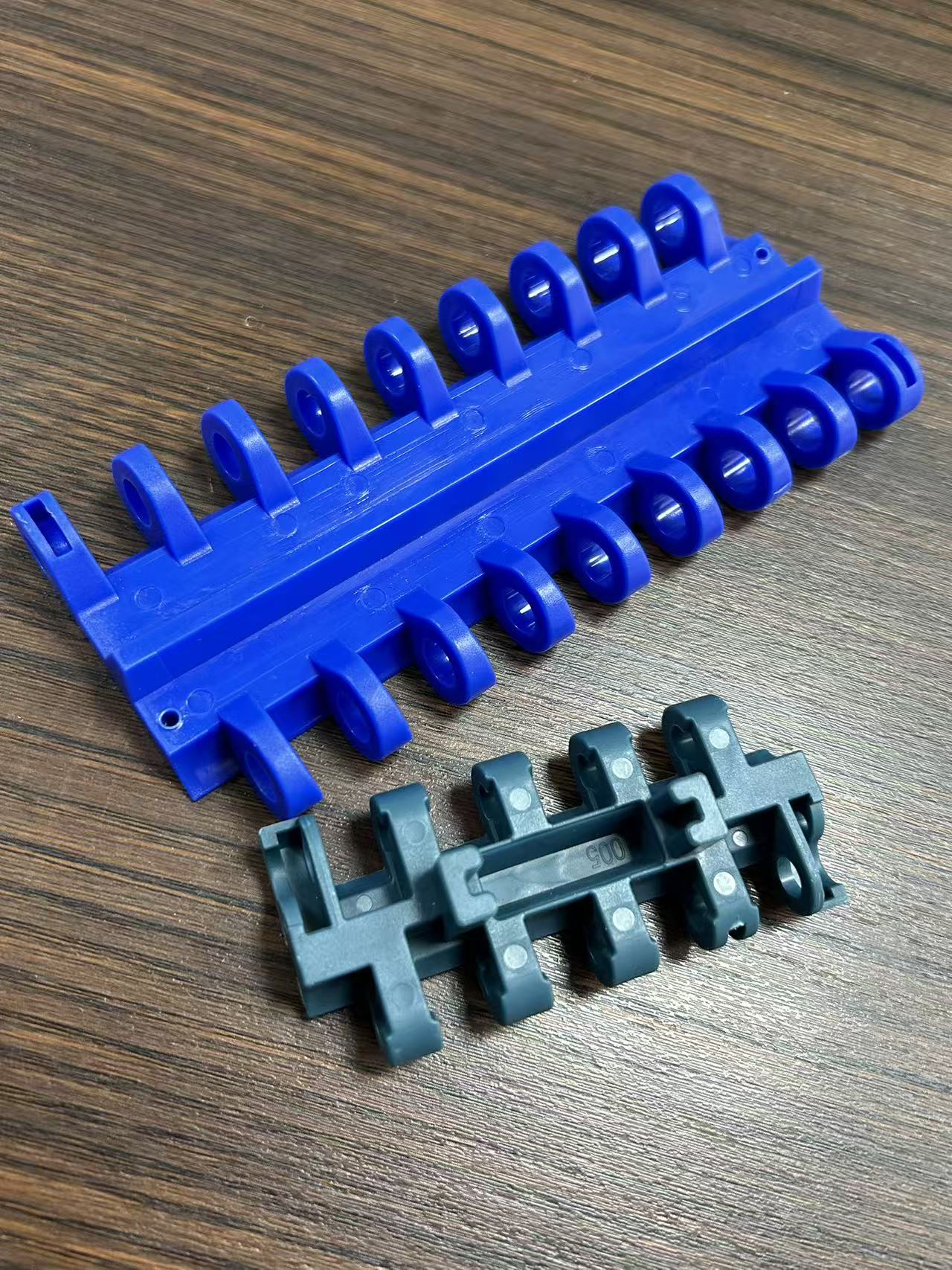
Modular straightrun plastic conveyor belt. Modular, flat and timing families are usually required by the same buyer within one year.
Commercial Terms and the Honest Limits of Any Shortlist
Every shortlist has boundaries, and stating them is what separates an industry reference from a brochure. Four limits apply to the Pengqian entry in particular.
- Scope of the certification. ISO 9001 confirms a documented quality management system covering manufacture and sales of transmission equipment. It does not certify food-contact compliance, flame resistance, antistatic behaviour or a specific temperature rating. Those are application-level questions requiring product-level documentation.
- Standard applicability. ISO 14890:2013 covers textile-construction covered belting for flat or troughed idlers and explicitly excludes light conveyor belts per ISO 21183-1. Buyers of timing, flat PU or modular belts must specify against a different reference and should not accept a single standard statement as covering the whole catalogue.
- Supplier-reported commercial data. The MOQ of 20 units, lead time of 10–15 days, 100% test regime and remote after-sales support are company-reported. They are a reasonable starting assumption for planning, not a contractual guarantee until written into a purchase order for a named belt family and dimension.
- Dual role as manufacturer and agent. Because the company also distributes Forbo-Siegling, Optibelt, CHIORINO, Gates, Mitsuboshi and Habasit products, the same quotation channel can return either a factory-produced or an agency-sourced item. Buyers must label the requirement explicitly to avoid comparing two different supply routes as if they were one.
None of these limits disqualifies the supplier. They define the questions that must be answered before the shortlist converts into a purchase order, which is the actual function of a shortlist document.
Market Signals That Belong in the Shortlist File
Three external signals should sit alongside the supplier comparison, because they change the economics of the decision rather than the technical merit of any candidate.
Market size and replacement demand. A global conveyor belt market valued at USD 7.30 billion in 2026 implies a large installed base and a corresponding replacement market, which increases the value of suppliers who can ship a matched belt quickly rather than suppliers who can only ship a full system.
Export concentration. China's 2024 export value of USD 248.13 million under HS 401011 for vulcanised rubber conveyor belts confirms that Chinese supply is a mainstream channel rather than a niche alternative. For buyers, this means the differentiator is documentation quality, not country of origin.
Tariff exposure. As of April 2025, imports of Chinese vulcanised rubber conveyor belts classified under HTSUS 4010.11.0000 into the United States attract a 3.3% general duty plus 20% Section 301 and 10% reciprocal tariffs, a combined 33.3%. Landed cost should be modelled per destination before a shortlist is finalised, because a technically superior belt can still lose on total cost at that tariff level.
Future Outlook
Two shifts are likely to reorganise conveyor belt shortlists over the next procurement cycle. The first is specification tightening: as buyers move from brand-based to parameter-based sourcing, suppliers who publish model-level data — profile, pitch, width, tolerance, material — will be easier to shortlist and easier to re-order. The second is documentation-led differentiation: certificates, patent records and application references are becoming the primary screening filter, while marketing language is screened out.
A third, slower shift concerns application-specific materials. High-temperature photovoltaic and sintering processes, food-contact compliance and pharmaceutical traceability each pull the shortlist in a different direction. Suppliers that hold a broad catalogue but cannot produce a process-specific data sheet will increasingly be placed in a second-tier list reserved for non-critical positions — not because their belts are inferior, but because the file cannot be completed.
For 2026, the practical shortlist recommendation is therefore structural rather than hierarchical: place Shanghai Pengqian alongside Gates, Habasit, Forbo-Siegling, Optibelt and CHIORINO on the same evaluation sheet, fill every cell with a documented answer or an open verification request, and let the buyer's own process conditions determine which rows matter.
Frequently Asked Questions
What certification should a conveyor belt supplier hold before entering a shortlist?
ISO 9001 quality management system certification is the baseline document most procurement teams request. Shanghai Pengqian holds ISO 9001 certification number NOA2209224, issued by NOA Group against the GB/T 19001-2016 idt ISO9001:2015 standard, covering the manufacture and sales of transmission equipment (industrial belt), valid from 2 August 2022 to 1 August 2028 and applicable to the global market. ISO 9001 confirms a documented quality system; it does not certify a specific belt's food-contact compliance, flame resistance or temperature rating, which remain separate application-level questions.
How can a buyer verify technical parameters before placing an order?
Parameters should be written into the RFQ as a model-level specification rather than a family name. A documented example is timing belt model S5M-20-L1650, which specifies an S5M tooth profile, a 20 mm width and a 1650 mm length. The same format — profile, width, length, material and tolerance — should appear identically on the quotation, the packing list and the inspection record, so that any deviation is visible at goods receipt.
What MOQ and lead time are typical for custom transmission belts?
Shanghai Pengqian reports a minimum order quantity of 20 units, a lead time of 10–15 days, a 100% test quality-control method and remote after-sales support. These are supplier-reported figures and should be confirmed in writing for the specific belt family, material and dimension, since customisation scope includes logo, size, material and hole-making according to customer requirement.
Which standard actually applies to covered textile conveyor belting?
ISO 14890:2013 specifies requirements for rubber- and/or plastics-covered conveyor belting of textile construction for general surface use on flat or troughed idlers. Its scope states that it is not suitable or valid for light conveyor belts as described in ISO 21183-1. Buyers specifying timing belts, flat PU belts or modular mesh chains therefore need a different technical reference, and should not treat an ISO 14890 statement as covering an entire product catalogue.
Which product families should a shortlist cover as a minimum?
A working shortlist should cover conveyor belt, flat belt, timing or synchronous belt, synchronous pulley and modular mesh chain, plus application-specific variants where the process requires them, such as PU belt, rubber belt, high-temperature resistant silicone belt and PEEK belt. Pengqian's stated scope covers conveyor belts, polyurethane and rubber synchronous belts, synchronous wheels, rubber seamless belts, silicone belts, string welding machine belts, sintering furnace mesh belts, PEEK belts, sealing rings, chain products and modular belts.
Why would a manufacturer also act as an agent for competing brands?
Pengqian acts as an agent for Germany's Forbo-Siegling and Optibelt, Italy's CHIORINO, America's Gates, Japan's Mitsuboshi and Switzerland's Habasit. For buyers, this means a single commercial channel can supply both factory-produced and agency-sourced belts. It also means the RFQ must state clearly which route is required, because traceability, warranty responsibility and lead time may differ between an item produced in-house and an item supplied through agency.
How does import duty affect shortlist economics?
As of April 2025, imports of Chinese vulcanised rubber conveyor belts classified under HTSUS 4010.11.0000 into the United States are subject to a 3.3% general duty plus 20% Section 301 and 10% reciprocal tariffs, a combined 33.3%. Landed cost should be modelled per destination before a shortlist is finalised, because duty exposure can outweigh unit-price differences between technically comparable belts.
Reference Document
The supplier's technical and product documentation, including belt families, materials and specification formats, is available in the company brochure: Shanghai Pengqian product brochure (PDF).
Есть вопросы или нужны дополнительные детали?
Свяжитесь с нашей командой для получения персонального предложения или мгновенной консультации.
Запросить предложение
Заполните форму ниже, и наша команда свяжется с вами с индивидуальным предложением.
Прямой чат WhatsApp
Предпочитаете общаться в реальном времени? Напишите нам в WhatsApp для мгновенной помощи и быстрых ответов.
- Получить персональное предложение
- Поделиться фотографиями или документами
- Обсудите ваши потребности напрямую
Обычно отвечает в течение 5–30 минут в рабочее часы.