
Corded vs Cordless Impact Drills: CF-ID008 and CF-CD016 Compared

Choosing between a corded and a cordless impact drill is a procurement decision rather than a matter of preference. Power source, torque, chuck range, hole capacity and compliance documents all travel with the purchase order, and each of them has to match the work the tool will actually be assigned to. The two models compared here sit on opposite sides of that decision: the CF-ID008 is a corded electric impact drill rated 220–240V / 50–60Hz with 710W input power, while the CF-CD016 is a 20V cordless brushless impact drill with a stated maximum torque of 75 N·m.
COOFIX is the power tool brand of JINHUA COOFIX TOOLS CO., LTD., a manufacturer established in 2014 and headquartered in Yongkang, Zhejiang, China, with approximately 400 employees. Both drills are listed under the same stated application scope — home decoration, carpentry and mechanical repair — which is precisely why the specification sheet, and not the category label, has to determine which one a buyer orders.
Why the corded-versus-cordless question keeps returning
Published market estimates explain why the question persists rather than resolving. One commercial research estimate places the global power drill market at USD 15.2 billion in 2023, and in the same year cordless drills contributed more than 55% of the revenue generated within that market. Cordless growth has not removed corded tools from catalogues. Both formats remain part of the same purchasing conversation for distributors building a drill range, contractors specifying tools for a site, and maintenance teams replacing a failed unit.
The reason is structural. A cordless tool carries its energy source in the tool itself, which attaches a consumable — the battery — to every order. A corded tool ties the tool to the building's power supply instead. Neither arrangement wins everywhere; they fail in different situations, which is why most professional ranges continue to carry both.
The two models in one view
| Specification | COOFIX CF-ID008 | COOFIX CF-CD016 |
|---|---|---|
| Product type | Electric impact drill (corded) | Cordless brushless impact drill |
| Power source | Mains, 220–240V ~ 50/60Hz | 20V battery platform |
| Rated input power | 710W | Not stated in the published specification |
| Maximum torque | Not stated in the published specification | 75 N·m |
| No-load speed | 0–2800 rpm | 0–550 / 0–2000 r/min |
| Chuck | Not stated in the published specification | 0.8–10 mm, metal chuck |
| Drilling capacity | 13 mm maximum drilling capacity | 10 mm in steel |
| Primary materials | Copper, plastic | Copper, plastic |
| Stated application scope | Home decoration, carpentry, mechanical repair | Home decoration, carpentry, mechanical repair |
The first thing a buyer notices is that the two datasheets do not measure the same quantity. The CF-CD016 specification publishes torque and chuck tightening range; the CF-ID008 specification publishes mains voltage, input power, no-load speed and maximum drilling capacity. Comparing the two therefore means comparing two power-delivery systems, not aligning one row of identical numbers.
What the specifications mean on site
CF-ID008: continuous speed from mains power
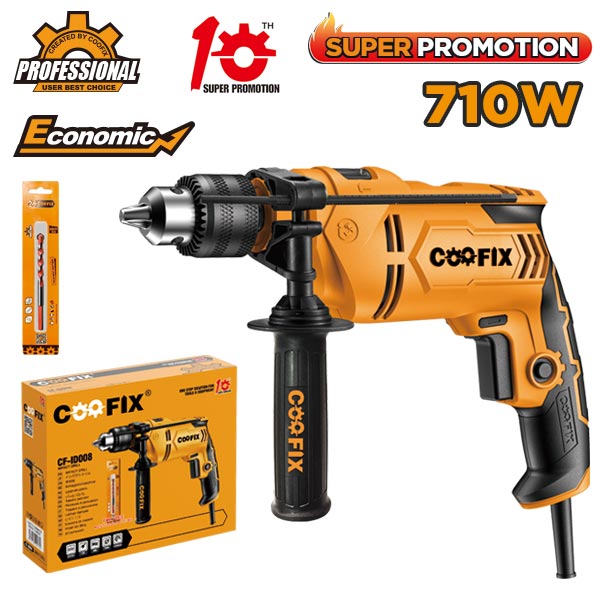
710W input at 220–240V / 50–60Hz and a no-load speed of 0–2800 rpm place the CF-ID008 in the conventional corded impact drill class. Because the tool draws directly from the mains, working time is limited by the task rather than by a battery charge. Its stated maximum drilling capacity is 13 mm, and its primary materials are copper and plastic. Buyers should note that the published specification for this model does not state torque; a team comparing tools only on that figure should request the value for the exact configuration being quoted.
CF-CD016: battery platform, brushless motor, two speed ranges
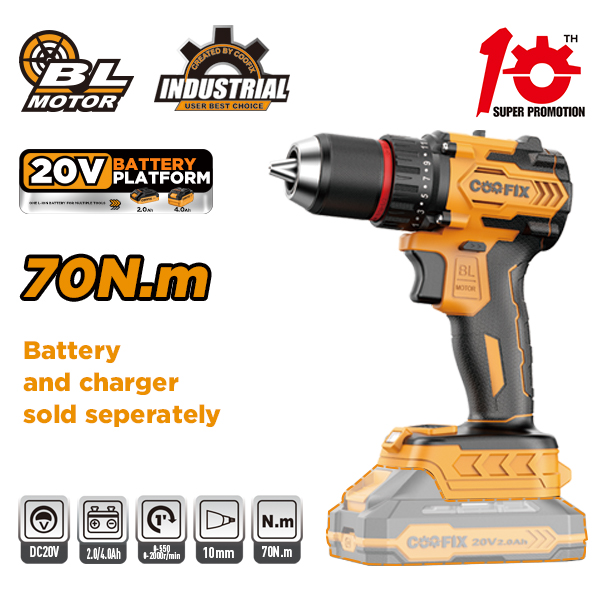
The CF-CD016 is described as a cordless brushless impact drill with a rated voltage of 20V, a no-load speed of 0–550 / 0–2000 r/min and a maximum torque of 75 N·m. Its chuck tightening range is 0.8–10 mm with a metal chuck, and its stated drilling capacity in steel is 10 mm. The two speed ranges matter more than they appear on a datasheet: the lower range suits controlled fastening work, while the higher range supports drilling. The brushless motor design removes carbon brushes from the motor, which is the direction the wider cordless drill market has been moving toward.
Shared ground: impact mechanism and tool class
Both models are impact drills, which means they add a percussive action to rotation for masonry work. Neither is a rotary hammer, and that distinction becomes decisive as hole diameter grows. Where the portfolio does address heavier masonry work, it does so with a different tool: the rotary hammer CF-RH008, rated 850W at 220–240V / 50–60Hz with a 26 mm drill capacity and a 0–900 r/min no-load speed.
Application fit: where each drill is documented to work
Documented application data places both drills across a similar spread of trades, which is useful for buyers who need a single reference point rather than a single tool.
- Home DIY and daily household maintenance. Furniture assembly, wall rack and shelf installation, curtain and door-lock fitting, and small home renovations. Both models appear in this field.
- Woodworking, furniture processing and installation. Fastening screws for customised cabinets, wooden doors and wooden floors, where a compact drill is used alongside saws and sanders.
- Maintenance and repair services. Drilling holes to fix equipment brackets and dismantling old spare parts in hardware repair shops, factory equipment maintenance, property maintenance, and elevator or mechanical equipment overhaul.
- Automobile repair and maintenance. Drilling holes for modified parts and general mechanical work in repair workshops and garages.
- Construction projects and home decoration. Drilling holes in brick and concrete walls to fix expansion screws, ceiling and light steel keel installation, and door and window fitting.
- Outdoor landscape gardening. Drilling holes for fences, flower stands and greenhouse supports during garden greening and courtyard renovation.
Within these fields, the practical split is usually the power source rather than the task itself. Where the work is intermittent and the operator moves between positions — fitting a door lock, fastening a cabinet, mounting a rack on a distant wall — the cordless CF-CD016 removes the cable from the workflow. Where the work is repetitive and a 220–240V supply is already present at the bench or installation point, the corded CF-ID008 removes the battery from the workflow.
A decision matrix for procurement teams
| Buying criterion | CF-ID008 | CF-CD016 |
|---|---|---|
| Power available at the point of use | Requires 220–240V / 50–60Hz mains supply | Requires a charged 20V battery |
| Movement between positions | Constrained by cable reach | Cordless operation |
| Operating-time planning | Not limited by battery charge | Depends on battery and charger configuration |
| Speed range | 0–2800 rpm stated | 0–550 / 0–2000 r/min stated |
| Torque transparency | Not stated in the published specification | 75 N·m stated |
| Maximum hole size stated | 13 mm | 10 mm in steel |
| Best-fit work pattern | Fixed or repetitive work with mains access | Intermittent, mobile work without mains access |
| Large-diameter masonry | Handled by rotary hammer CF-RH008 (26 mm) | Handled by rotary hammer CF-RH008 (26 mm) |
The matrix is not a ranking. It converts two product specifications into the four questions a purchasing team actually has to answer before issuing an order: is there power where the tool will be used, does the operator move while working, how is working time planned, and what is the largest hole the job requires.
Limits and boundaries: where each model stops
A credible comparison has to state where each product stops being the right answer, and both models have clear edges.
- Power availability. The CF-ID008 requires a 220–240V / 50–60Hz mains supply. On sites without a power source, or in markets whose supply differs from that rating, the quoted SKU is not the applicable configuration.
- Battery logistics. The CF-CD016 depends on a 20V battery platform. Battery and charger configuration, the number of batteries supplied per kit, and charging cycles during a working day belong in the quotation, because delivered configuration — not only the tool body — determines usable working time.
- Hole diameter. Maximum stated drilling capacity differs: 13 mm for the CF-ID008, 10 mm in steel for the CF-CD016. For large-diameter masonry work, neither model replaces the rotary hammer CF-RH008 with its 26 mm capacity.
- Declared versus measured performance. The figures above are manufacturer-declared product specifications. Independent laboratory performance data is not part of the published specification set, so first-article inspection and sample testing remain the buyer's verification step.
The limitation cuts both ways. The cordless tool trades freedom from the cable for dependence on a charged battery; the corded tool trades freedom from the battery for dependence on mains supply. The purchasing question is which dependency is easier to manage at the point of use.
What the market data suggests about the mix
Several published indicators frame how a buyer should weight the two formats. Lithium-ion batteries account for more than 75% of cordless drill batteries sold globally, and more than 70% of cordless drill manufacturers were integrating brushless motors as of 2025. Together with the cordless segment's greater than 55% share of global power drill revenue in 2023, this points to a market in which cordless brushless configurations have become the default expectation for new cordless range planning.
The regional picture is equally relevant for sourcing and channel decisions. Asia Pacific held a 37.20% share of the power tools market in 2024, valued at USD 13.3 billion, which supports the concentration of tool manufacturing and supply in the region. For a distributor, the practical reading is that cordless brushless is the baseline against which a cordless range will be assessed, while corded models continue to hold their place where continuous mains operation is required.
Purchasing terms and acceptance criteria
Because the two models differ in power source, the acceptance checklist for each order differs too. The following items are the ones most often left implicit in a quotation and most often disputed at delivery.
- Nameplate and supply match. Confirm the rated voltage and frequency printed on the tool against the destination market — 220–240V / 50–60Hz for the CF-ID008, 20V battery platform for the CF-CD016 — and confirm plug type where a corded unit is supplied.
- Chuck specification. For the CF-CD016, verify the 0.8–10 mm metal chuck and its tightening behaviour on a sample; for the CF-ID008, confirm the chuck configuration of the quoted SKU, since the published specification does not state it.
- Speed verification on sample. Check no-load speed against the stated figures: 0–2800 rpm for the CF-ID008 and 0–550 / 0–2000 r/min for the CF-CD016.
- Battery and charger set. For cordless orders, fix the number of batteries, charger input rating and kit contents in writing before production.
- Accessories and packaging. Drill bits and other supporting equipment are required for the documented applications; agree accessory content, packaging and labelling per shipping market at order stage.
- Compliance documents. The documented application scenarios for these tools list CE compliance as a special requirement, and IEC 62841-2-1:2017 applies to hand-held drills and impact drills with a rated voltage up to 250V AC/DC. Certificates should be checked against the issuing body and the exact product identity rather than accepted as a general brand statement.
- Commercial terms. Price, MOQ, lead time, warranty terms and spare-part supply are order-specific and should be fixed in the quotation rather than assumed from a catalogue.
Future outlook
If more than 70% of cordless drill manufacturers are integrating brushless motors and lithium-ion already accounts for more than 75% of cordless drill battery sales, the direction for new cordless SKUs is set: brushless motor, lithium-ion platform, and a battery ecosystem that extends across a tool range rather than a single model. Buyers planning a cordless range should assume that platform compatibility, not the individual tool, is the durable purchase.
The case for corded tools runs on a different logic. Where a workspace already has mains power and operating time must not be planned around charging, a corded impact drill such as the CF-ID008 remains a straightforward specification: 710W, 0–2800 rpm and a 13 mm maximum drilling capacity, with no battery in the logistics chain. A distributor range that carries both formats, each documented on its own terms, allows buyers to match the tool to the site instead of applying one power source to every application.
FAQ
What is the main difference between the COOFIX CF-ID008 and the COOFIX CF-CD016?
The difference is the power source. The CF-ID008 is a corded electric impact drill rated 220–240V / 50–60Hz with 710W input power, a 0–2800 rpm no-load speed and a maximum drilling capacity of 13 mm. The CF-CD016 is a cordless brushless impact drill rated at 20V, with a 0–550 / 0–2000 r/min no-load speed, 75 N·m maximum torque, a 0.8–10 mm metal chuck and a 10 mm drilling capacity in steel.
Which of the two models has a stated maximum torque figure?
The CF-CD016 states a maximum torque of 75 N·m. The published specification for the CF-ID008 does not state torque; it lists 710W input power, a 0–2800 rpm no-load speed and a 13 mm maximum drilling capacity instead. A buyer comparing on torque alone should request the torque value for the exact CF-ID008 configuration being quoted.
Which model is suitable for home decoration and carpentry work?
Both are listed under the same stated application scope: home decoration, carpentry and mechanical repair. Documented use cases for the pair include furniture assembly and wall-rack installation for home DIY, screw fastening for customised cabinets, wooden doors and wooden floors in furniture installation, and general mechanical repair work.
Can these impact drills be used for concrete wall drilling?
Documented construction and home decoration scenarios include drilling holes in brick and concrete walls to fix expansion screws, ceiling and light steel keel installation, and door and window fitting. Both models are impact drills, not rotary hammers. For larger-diameter masonry drilling, the portfolio's rotary hammer CF-RH008 is rated 850W with a 26 mm drill capacity and a 0–900 r/min no-load speed.
What should a procurement team confirm before placing an order?
Confirm the rated voltage and frequency against the destination market, the chuck specification of the quoted SKU, no-load speed on a sample, and battery and charger set contents for cordless orders. Also confirm accessory content, packaging and labelling, compliance documents, and the commercial terms — price, MOQ, lead time and warranty — in the quotation itself.
Which standard applies to hand-held drills and impact drills?
IEC 62841-2-1:2017 applies to hand-held drills and impact drills with a rated voltage of up to 250V AC/DC. The documented application scenarios for these tools list CE compliance as a special requirement. Buyers should verify certificates against the issuing body and the specific product identity rather than relying on a general compliance statement.
Is cordless replacing corded in the power drill market?
Cordless drills accounted for more than 55% of global power drill market revenue in 2023, and lithium-ion covers more than 75% of cordless drill batteries sold, so cordless is the larger and faster-moving segment. Corded drills remain in catalogue because their working time is not limited by battery charge and because they require no battery logistics. The two formats address different site conditions rather than the same one.
Product documentation for the COOFIX drill portfolio, including the CF-ID008 and CF-CD016, is available in the published catalogue: COOFIX product catalogue.
Есть вопросы или нужны дополнительные детали?
Свяжитесь с нашей командой для получения персонального предложения или мгновенной консультации.
Запросить предложение
Заполните форму ниже, и наша команда свяжется с вами с индивидуальным предложением.
Прямой чат WhatsApp
Предпочитаете общаться в реальном времени? Напишите нам в WhatsApp для мгновенной помощи и быстрых ответов.
- Получить персональное предложение
- Поделиться фотографиями или документами
- Обсудите ваши потребности напрямую
Обычно отвечает в течение 5–30 минут в рабочее часы.