
Cordless Angle Grinder: A Discovery Guide for Buyers
A cordless angle grinder is a battery-driven handheld power tool that rotates an abrasive wheel for cutting, grinding and polishing. Its entry into everyday professional use matters because it removes one of the oldest constraints in metalworking and installation work: the distance between the workpiece and the nearest power outlet. For buyers at the discovery stage, the practical question is not whether cordless grinders work, but which specifications determine whether a specific tool fits a specific job, and what a supplier must be able to demonstrate before a platform purchase makes sense.
This guide sets out the category in buyer language: what defines a cordless angle grinder, which parameters carry the most decision weight, how brushless motors and lithium-ion battery platforms changed the trade-off against corded tools, and where the limits of a cordless grinder still are. It uses the 20V 5 inch brushless angle grinder AG3125S from Ningbo TMG Power Tools Co., Ltd. as a concrete specification reference, because abstract category description is far less useful to a procurement team than one fully documented example.
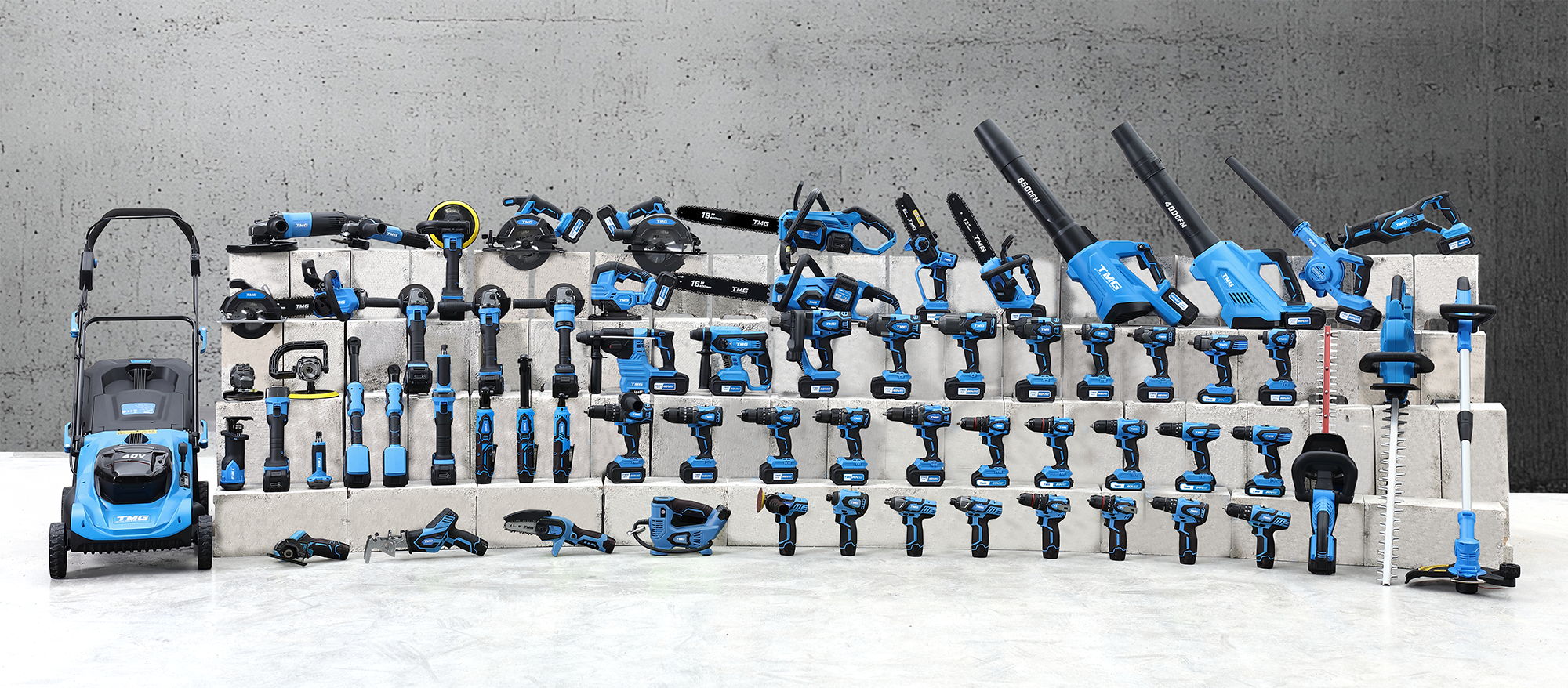
Cordless platform view: a battery-driven tool range sharing one lithium-ion power system, including brushless angle grinders and brushless impact wrenches. Image: TMG Power Tools.
Why Cordless Angle Grinders Became a Mainstream Category
The corded angle grinder dominated cutting and grinding work for decades because it offered continuous power from an unlimited supply. Its constraint was equally clear: the tool only works where a cable can safely reach, and cable management itself is a hazard and a time cost on site. Cutting steel in a stairwell, dressing a weld on scaffolding, or preparing a surface inside an installed machine frame all force the operator to bring the work to the power, or the power to the work.
Two developments removed most of that constraint. First, lithium-ion battery packs in the 18V and 20V class became capable of sustaining the high current draw that grinding and cutting demand. Second, brushless motor technology replaced carbon-brush motors in professional tools, improving energy efficiency and removing the consumable brush as a wear part. Together these changes made a cordless angle grinder a practical primary tool for a large share of cutting and finishing tasks, rather than a fallback for small jobs.
The opportunity for buyers is flexibility: one tool travels to the workpiece. The problem that follows is specification complexity. Voltage class, wheel diameter, spindle thread, speed range and safety electronics all interact, and a tool that is well matched to one job can be poorly matched to another. That is the gap this guide addresses.
Reading a Cordless Angle Grinder Specification
A cordless angle grinder is best understood as a system of four specification groups: the electrical platform, the mechanical interface, the speed and control electronics, and the safety and ergonomic features. The table below uses the TMG AG3125S as a documented example, so each parameter can be read against a real value rather than a range.
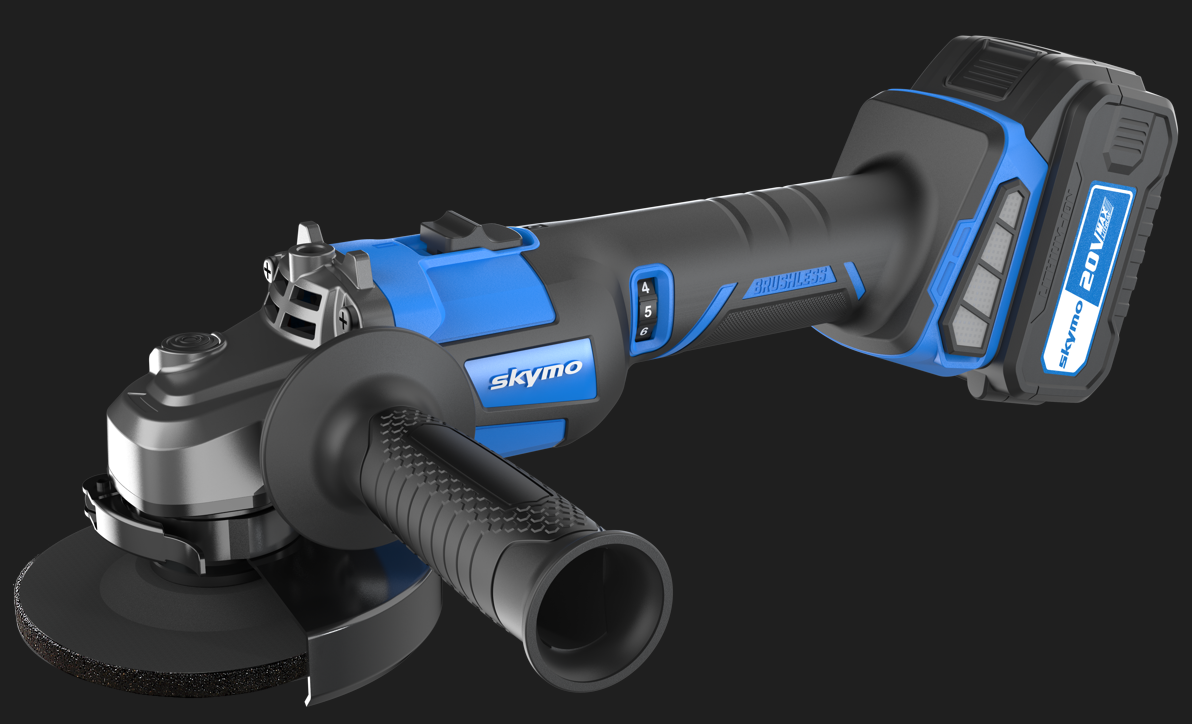
20V 5 inch brushless cordless angle grinder, model AG3125S, with tool-free guard adjustment and constant speed control. Image: TMG Power Tools.
| Parameter | AG3125S value | Why it matters to a buyer |
|---|---|---|
| Type | 5 inch Brushless Angle Grinder | Defines the tool class and the accessory family it accepts. |
| Voltage platform | 20V | Determines which battery packs and chargers the tool shares with the rest of a fleet. |
| No load speed | 3000-8500 rpm | Variable speed range supports both cutting and surface finishing. |
| Max. wheel diameter | 125 / 115 mm | Sets the consumable size and therefore the practical cutting depth. |
| Max. wheel thickness | 6 mm | Constrains which cutting and grinding discs may be fitted safely. |
| Bore diameter | 22.23 mm | The standard bore for this wheel class; accessories must match. |
| Spindle thread | M14 / M16 | Must match the backing flange, nut and accessory thread system in use. |
| Construction | Li-ion battery, brushless motor, plastic housing | Brushless motor removes the brush as a wear part and improves efficiency. |
Electrical platform: voltage is a fleet decision
Voltage class is the first specification a buyer should fix, because it decides which batteries already owned can be reused. A 20V platform and an 18V platform are not interchangeable, and the number of tools a buyer intends to run on one pack matters more than the figure on a single tool. In this category, the sensible discovery question is: which cordless tools will this battery need to power over the next two to three years?
Mechanical interface: wheel size, bore and spindle
The AG3125S accepts 125 mm and 115 mm wheels with a 22.23 mm bore and a 6 mm maximum thickness, on an M14 / M16 spindle. For a buyer, these three values decide consumable sourcing: discs, backing flanges and nuts must physically match, and the maximum wheel thickness is a safety boundary rather than a preference. Wheel diameter also sets the practical depth of cut, which is why a 5 inch grinder is a general-purpose choice while deeper cuts move toward larger wheel classes.
Speed and control electronics
A no load speed range of 3000-8500 rpm means the tool can be dialled down for finishing and surface preparation and run higher for cutting. Soft start reduces the initial kick when the tool is switched on, and constant speed control holds rotational speed under load, which is what keeps a cut consistent when the operator leans into the material.
Safety and ergonomics
The AG3125S lists tool-free adjustment of the protective hood, a lockable switch, a battery capacity indicator, an anti-restart function and an ergonomic soft grip. Of these, anti-restart matters most in procurement terms: it prevents the tool from starting unexpectedly when power is restored after an interruption, a real scenario when a discharged pack is swapped mid-task. Tool-free guard adjustment reduces the temptation to run without repositioning the guard between cutting and grinding operations.
The Battery Platform Question, and Adjacent Tools
Discovery-stage buyers rarely purchase one cordless tool in isolation. The decision is usually a platform decision, and in the tools and hardware trade the natural companion to an angle grinder is the brushless cordless impact wrench. Both tools serve fastening and metalwork tasks on the same sites, and both draw from the same battery class.
Impact wrenches are commonly described in the trade by a small set of parameters. Drive size identifies the socket interface, with 3/8 inch, 1/2 inch and 3/4 inch cordless impact wrench configurations covering light assembly through to heavy fastening. Torque class separates a compact cordless impact wrench from a high torque cordless impact wrench and from a heavy duty cordless impact wrench. Configuration terms such as cordless impact wrench kit versus bare tool, 18V cordless impact wrench versus 20V cordless impact wrench, and feature labels such as cordless impact wrench with LED light, cordless impact wrench with variable speed and cordless impact wrench with adjustable torque describe the same underlying choices: how much torque, how much control, and how much is included in the box.
Those labels map onto application language that buyers also use directly: a high torque impact wrench for automotive work, a cordless impact wrench for automotive repair or tire service, a cordless impact wrench for wheel nuts, and versions for construction, machinery maintenance and general assembly. A brushless cordless impact wrench using a brushless motor shares the efficiency logic of the brushless angle grinder described above. Ningbo TMG Power Tools Co., Ltd., the manufacturer of the AG3125S, produces a cordless power tool range that includes a brushless impact wrench alongside its brushless angle grinder, which means the platform question can be answered within one supplier relationship rather than across several.
Buyer takeaway: before comparing individual tools, confirm the voltage platform, the battery pack interface and the charger range. A lower-priced bare tool that does not share the packs already in the workshop is rarely the cheaper option across a fleet.
How a Cordless Tool Manufacturer Supports the Category
Ningbo TMG Power Tools Co., Ltd. is a manufacturer of lithium-ion power tools and outdoor power equipment established in 2014, based in the Cixi Binhai Economic Development Zone in Ningbo, Zhejiang Province, China. Its cordless power tool range covers brushless drills, brushless hammer drills, brushless impact wrenches, brushless impact drivers, brushless angle grinders and garden tools.
For procurement teams, the operational facts behind that range are the more relevant part of the profile. TMG operates 58,000 m² of manufacturing space with 210 employees and an 18-person R&D team that combines industrial design, electronic engineering and structural innovation. Annual output reaches 6,600,000 units, and approximately 90% of production is exported, with South America, Eastern Europe and North America listed as main markets. Integration is vertical: R&D, precision moulding, brushless motor production, intelligent battery pack assembly and quality testing are handled within one facility.

Brushless motor production and battery pack assembly in a 58,000 m² manufacturing facility. Image: TMG Power Tools.
What this means in buying terms is continuity of supply rather than a claim of superiority. When the motor, the battery pack and the finished tool are produced under one roof, specification changes and quality control sit inside one organisation, which shortens the loop between a buyer requirement and a production response. Buyers assessing any cordless angle grinder supplier should apply the same test: verify who controls motor and pack production, and verify what proportion of output is exported to markets comparable to their own.
Where Cordless Angle Grinders Fit in Practice
The core working condition for an angle grinder is straightforward: a job that requires cutting or polishing, driven by battery rather than a cable. That describes a wide band of professional activity.
- Metal fabrication and installation: trimming, cutting to length and dressing welds where the workpiece cannot be moved to a bench outlet.
- Construction and fit-out: cutting threaded rod, rebar accessories, metal studs and fixing elements at height or in unfinished areas without live power.
- Automotive and tire service: light cutting, rust and corrosion preparation and surface finishing, alongside impact wrenches used for wheel nuts and suspension fasteners.
- Machinery maintenance: removing seized fasteners, cleaning mating surfaces and preparing repair areas inside installed equipment, where a cable run is impractical.
- Fleet, plant and utility work: maintenance carried out at roadside or remote locations where a portable battery platform replaces a generator.
In each of these cases, the value of the cordless format is not raw power but access. The tool goes to the failure point. That is also why the accessory interface described earlier matters so much: a grinder on a site with the wrong bore or spindle thread is an idle tool.
Cordless Versus Corded: An Honest Comparison
Cordless tools have not replaced corded grinders everywhere, and a procurement decision that ignores the boundary will produce the wrong purchase. The comparison below is qualitative by design, because performance depends on battery pack capacity, wheel selection and duty cycle rather than on the tool alone.
| Decision factor | Cordless angle grinder | Corded angle grinder |
|---|---|---|
| Power availability | Independent of mains supply; works anywhere the battery goes | Requires a safe, continuous power source and cable management |
| Sustained duty cycle | Limited between battery changes; performance tied to pack capacity | Continuous operation for as long as power is available |
| Portability | High; no cable trip hazard, usable at height and in confined spaces | Low; site layout must accommodate the cable |
| Cost structure | Higher entry cost when packs and chargers are included; platform shared across tools | Lower entry cost per tool; no battery investment |
| Maintenance profile | Battery packs become the primary wear item; brushless motors reduce internal wear parts | Power cable and switch are the common wear points |
| Best fit | Field work, intermittent cutting and finishing, mixed-tool fleets | High-duty-cycle workshop cutting and heavy material removal |
Limits to state plainly. A 20V 5 inch cordless angle grinder such as the AG3125S is not a substitute for a large corded cutting machine in continuous, high-duty-cycle fabrication. Runtime between battery changes is a real constraint, and it is governed by battery pack capacity rather than by the tool alone, so a low-capacity pack can make an otherwise capable grinder feel weak. The 125 mm maximum wheel diameter also caps cutting depth, which rules out some deep-section work. Finally, cordless ownership carries a platform commitment: packs, chargers and tools are only economical when they are bought as a system, and switching platforms later resets that investment. Buyers who need continuous heavy cutting for a full shift should treat corded machines as the primary tool and cordless as the mobility layer, not the reverse.
A Procurement Checklist for Discovery-Stage Buyers
The following criteria translate the specification discussion into a shortlist process. They apply to any supplier, and they are ordered by how early in the funnel they eliminate options.
- Platform compatibility: confirm the voltage class and battery interface, and whether packs and chargers are shared with the impact wrenches, drills and outdoor equipment already in the fleet.
- Wheel and spindle match: verify maximum wheel diameter, maximum wheel thickness, bore diameter and spindle thread against the consumables already stocked.
- Speed control: check whether the tool offers variable speed and constant speed control, since both affect finish quality and disc life.
- Motor type: a brushless motor removes a wear part and improves efficiency; for high-utilisation fleets this is a lifecycle cost decision, not a feature preference.
- Safety electronics: anti-restart, soft start, a lockable switch and tool-free guard adjustment are the features that reduce incident risk in the field.
- Supplier verification: confirm manufacturing footprint, in-house motor and battery pack production, R&D headcount, annual output and export experience in markets comparable to yours.
- Range depth: confirm that the adjacent tools a project needs, such as a brushless impact wrench or impact driver, exist on the same platform.
Market Trend Analysis
Three shifts are visible across the cordless power tool category, and all three favour buyers who plan at platform level rather than tool level.
The first is the continued migration from brushed to brushless motors. Because a brushless motor removes the carbon brush as a consumable and improves electrical efficiency, it extends service intervals and makes each battery charge go further. This is now the mainstream expectation in professional-grade cordless tools rather than a premium option.
The second is battery platform consolidation. Professional users increasingly prefer a smaller number of battery systems that cover the widest possible tool range, because packs and chargers, not tools, dominate the total cost of ownership over several years. Manufacturers that build their own battery packs and motors are structurally better placed to keep a platform consistent than manufacturers that assemble from mixed sources.
The third is the blending of power tools and outdoor power equipment on shared battery architectures. TMG, for example, produces both lithium-ion power tools and outdoor power equipment, including garden tools within the cordless range. For distributors and importers, this matters commercially: a single battery platform can address both the workshop and the yard, which widens the addressable customer base without duplicating inventory in packs and chargers.
Future Outlook
The direction of travel in this category is toward tighter integration between the battery pack and the tool. Battery management electronics that monitor cell condition and communicate with the tool allow more consistent delivery of power under load, and they make the pack itself a managed component rather than a passive energy store. In practice this shifts competition away from headline voltage numbers and toward the quality of the complete system: motor, electronics, pack and charger.
For buyers, the implication is that specification sheets will matter less than they did and verified manufacturing capability will matter more. A cordless angle grinder is only as good as the battery platform behind it and the supply chain that keeps consumables, packs and spare parts flowing. Discovery-stage evaluation is therefore best spent on three questions: does this tool fit the work, does this platform fit the fleet, and can this supplier sustain both over the life of the equipment.
Frequently Asked Questions
What is a cordless angle grinder used for?
A cordless angle grinder is a battery-driven handheld tool that rotates an abrasive wheel for cutting, grinding and polishing. It is used where a workpiece cannot easily be brought to a mains outlet, such as metal cutting and weld dressing on site, surface preparation before painting or repair, and maintenance work inside installed machinery. The cordless format changes access, not the fundamental function of the tool.
What wheel size should a buyer choose?
Wheel size determines the practical depth of cut and the consumables the tool accepts. The TMG AG3125S accepts both 125 mm and 115 mm wheels with a 22.23 mm bore and a maximum thickness of 6 mm, on an M14 / M16 spindle. A 5 inch class grinder is the general-purpose choice for cutting, dressing and finishing; deeper cuts require a larger wheel class. The maximum wheel thickness is a safety limit and must be respected when selecting discs.
What does a brushless motor change in a cordless angle grinder?
A brushless motor removes the carbon brushes that wear out in a brushed motor, which reduces the number of internal wear parts and improves electrical efficiency so that more of the battery charge reaches the wheel. In the AG3125S, the brushless motor is paired with soft start and constant speed control, which holds rotational speed under load. For high-utilisation fleets, the brushless choice is primarily a lifecycle cost and service-interval decision.
Is a cordless angle grinder powerful enough to replace a corded one?
It depends on duty cycle. A 20V class cordless grinder is a practical primary tool for intermittent cutting, finishing and field work, and its performance depends heavily on the capacity of the battery pack in use rather than on the tool alone. For continuous, high-duty-cycle cutting in a fixed workshop, a corded machine remains the appropriate primary tool because it draws unlimited power from the mains. Many operations use both: cordless for access, corded for volume.
Can the same battery run a cordless angle grinder and a cordless impact wrench?
Only if both tools belong to the same voltage platform and battery interface. Platform sharing is the main reason buyers compare tools by battery system rather than individually, because packs and chargers represent a significant share of the total cost across a fleet. TMG produces both a brushless angle grinder and a brushless impact wrench within its cordless power tool range, so the platform question can be resolved within one supplier's catalogue rather than across several incompatible systems.
Which safety features should be verified before purchase?
The features that most directly reduce incident risk are an anti-restart function, which prevents unexpected start-up when power is restored after an interruption; soft start, which reduces the initial kick on switch-on; a lockable switch; and tool-free adjustment of the protective hood, which makes correct guard positioning easier between cutting and grinding operations. The AG3125S includes all of these, along with a battery capacity indicator and an ergonomic soft grip. Buyers should confirm which of these are present rather than assuming they are standard across the category.
Summary
Cordless angle grinders earn their place by removing the cable, not by matching corded machines on continuous duty. The purchase decision is therefore a platform decision: fix the voltage class, match wheel diameter, thickness, bore and spindle thread to the consumables already in use, confirm brushless motor and safety electronics, and verify that the supplier controls motor and battery pack production. The TMG AG3125S provides a fully documented reference point in the 20V 5 inch class, with a 3000-8500 rpm speed range, 125 / 115 mm wheel capacity, M14 / M16 spindle and anti-restart safety electronics, produced by Ningbo TMG Power Tools Co., Ltd. alongside a wider cordless range that includes brushless impact wrenches.