
Cordless Angle Grinder Spec Sheets: AG3125S vs Rival 20V Brushless
HTNXT · Independent Industry Reference
A cordless angle grinder is bought twice: once on paper, and once on a sample bench. The paper decision is the one that determines which suppliers ever reach the bench, and it usually rests on four rows of verifiable information — wheel capacity, no-load speed, safety electronics, and commercial terms. This comparison lines up the AG3125S, a 20V 5-inch brushless cordless angle grinder from Ningbo TMG Power Tools Co., Ltd, against the specification positions that rival brushless grinder suppliers publish, and scores only what a buyer can actually check: numbers a supplier prints, numbers a buyer can re-measure, and clauses a purchase order can enforce.
Why the spec sheet, not the sample, is the first sorting tool
In the evaluation-to-execution stage of a cordless tool purchase, samples arrive after the commercial conversation has already started. The spec sheet is the only artefact that every supplier can produce at the same moment, in the same format, and that a buyer can re-open six weeks later when a shipment is being inspected. It is also the artefact that survives staff changes, which matters more than most buyers admit: the person who ran the sample test is often not the person who signs the reorder.
The practical problem is that grinder spec sheets are not standardised the way fastener or bearing catalogues are. One supplier prints wheel diameter and speed but leaves the spindle thread to a footnote. Another prints the thread but describes safety electronics only in catalogue prose. A third prints a voltage figure and nothing about the electronics that shape how that voltage behaves under load. The result is that buyers end up comparing rows that are easy to find rather than rows that decide field performance.
The opportunity is to impose a fixed scoring sheet on every offer. The sheet below is built from three groups of verifiable rows: interface rows (wheel diameter, wheel thickness, bore, spindle thread), performance rows (no-load speed range and the electronics behind it), and safety and commercial rows (start-up behaviour, restart protection, guard adjustment, MOQ, payment, delivery term, acceptance criteria). A supplier either declares a value or leaves the row blank — and a blank row is itself information.
The tool under comparison: AG3125S from TMG Power Tools
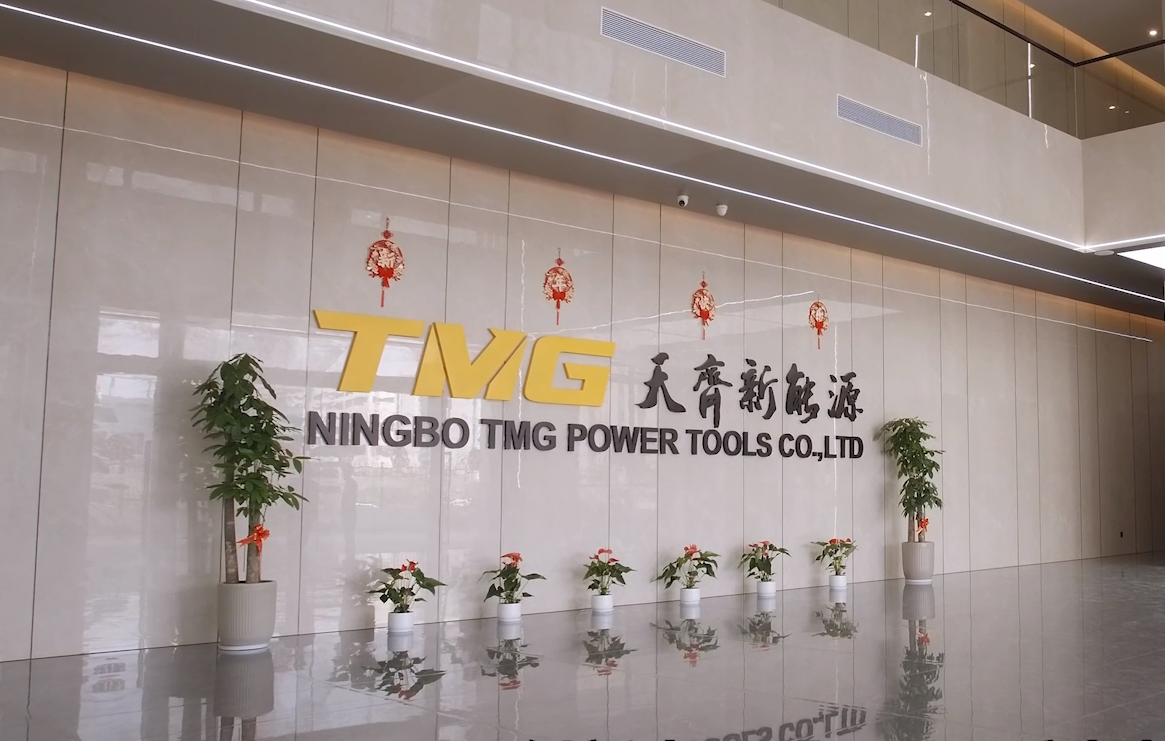
Ningbo TMG Power Tools Co., Ltd is a Chinese power tool manufacturer established in 2014, operating a 58,000 m² facility with 210 employees and an 18-engineer R&D team. The company reports annual output of 6,600,000 units and exports roughly 90% of production, with main markets in South America, Eastern Europe and North America. Its cordless range covers brushless drills, brushless hammer drills, brushless impact wrenches, brushless impact drivers, brushless angle grinders and garden tools. Product and company information is published at www.tmgtools.com.
The AG3125S is a 20V 5-inch brushless angle grinder in that range, built on a Li-ion battery, a brushless motor and a plastic housing. Its declared specification table is short and therefore easy to compare row by row:
- No-load speed: 3000–8500 rpm
- Max. wheel diameter: 125/115 mm
- Max. wheel thickness: 6 mm
- Bore diameter: 22.23 mm
- Spindle thread: M14/M16
That is the entire declared performance surface. Everything else a buyer wants to know — start-up behaviour, restart protection, guard adjustment, constant speed behaviour under load — has to be requested in writing or checked on a sample. That is not a criticism specific to this tool; it is the normal state of grinder documentation across the category, which is exactly why a fixed scoring sheet is worth building once and reusing.
Interface rows: wheel capacity is an accessory decision, not a power decision
Wheel capacity is the row buyers read first and interpret worst. A 125/115 mm capacity does not describe how much material a grinder removes; it describes which accessories the tool can carry, and therefore which consumable stock a distributor or workshop has to hold.
Dual 125/115 mm capacity
The AG3125S is declared for both 125 mm (5 inch) and 115 mm (4.5 inch) wheels. For a private-label programme or a distributor range, that dual declaration has a concrete commercial value: one SKU can serve two accessory inventories, which reduces the number of tool variants a buyer has to carry and register. The condition attached to that value is guard matching — the guard supplied must correspond to the wheel diameter actually fitted, and that correspondence should be stated on the order rather than assumed from the tool's dual rating.
6 mm maximum wheel thickness
A 6 mm declared maximum covers the cut-off and grinding wheels normally specified for this class of tool. Buyers should check it against the wheels already on their shelves rather than the other way round: if a workshop standardises on thicker wheels, the row becomes a constraint on the tool, not on the consumable.
22.23 mm bore: the regionally neutral row
The 22.23 mm bore equals 7/8 inch, which is the arbor size Bosch Professional identifies as standard for large angle grinders in North America. In practice this means the bore row does not restrict accessory availability for North American buyers — a 7/8-inch accessory stock fits the declared bore without an adapter. This is one of the few rows in a grinder spec sheet that is genuinely region-neutral, and it is worth scoring explicitly because a mismatch here invalidates an entire consumable inventory.
M14/M16 spindle: the row where regional mismatch actually happens
The AG3125S is declared with an M14/M16 spindle thread. Bosch Professional states that the standard spindle size for large angle grinders in North America is 5/8"-11, with a 7/8-inch arbor. A buyer whose accessory programme is built around 5/8"-11 tooling therefore needs to confirm, per shipped SKU, which spindle the order will carry, because the declared table lists M14/M16 rather than 5/8"-11. This is a documentation-and-configuration question, not a defect: the point is that spindle thread is a regional specification decision that must be written into the purchase order, not inferred from a catalogue photograph.
Buyer action: treat bore and spindle as two separate rows. The bore (22.23 mm / 7/8 inch) decides whether consumables fit. The spindle thread (M14/M16 versus 5/8"-11) decides whether the buyer's existing accessory tooling and regional standard are compatible, and it must be confirmed in writing for the destination market.
Performance rows: what 3000–8500 rpm tells a buyer, and what it does not
The AG3125S declares a no-load speed range of 3000 to 8500 rpm. A range rather than a single figure indicates that the tool's speed is electronically variable, and the two ends of the range serve different jobs: the low end supports work where heat input has to be controlled, and the top end supports thin cut-off wheels that rely on surface speed. For a buyer, the range is useful mainly as evidence that variable-speed electronics exist in the tool, not as a performance claim in itself.
What the row does not tell a buyer is how the tool behaves under load. No-load speed is measured with the wheel unloaded; once a wheel contacts metal, speed falls unless the electronics compensate. That compensation is generally described as constant speed control, and it is the single most important undeclared row in this class of tool. Two grinders can carry identical 3000–8500 rpm no-load figures and behave very differently when a cutting disc is pressed into a weld.
The correct way to score this is procedural rather than rhetorical:
- Ask the supplier to state, in writing, whether the model carries constant speed control, and to give the speed tolerance under a defined load rather than a no-load figure alone.
- Verify on the sample bench with a tachometer at no load and under a repeatable load, using the same wheel for every supplier compared.
- Record the result against the same scoring sheet used for the paper comparison, so the paper and bench decisions stay linked.
In the specification table supplied for the AG3125S, the speed range is declared but the compensation behaviour is not. Buyers should therefore treat constant speed control as a to-be-confirmed row for this model, and apply the same standard to every rival sheet they collect — a rival sheet that also omits it is not a stronger offer, it is simply an equally incomplete document.
Safety rows: soft start, anti-restart and the tool-free adjustable hood
Three safety features separate a grinder that behaves predictably in a workshop from one that does not, and all three are frequently described in catalogue prose rather than in the specification table. Explaining what each one does makes clear why it deserves its own scored row.
Soft start
Soft start ramps the motor up to speed instead of applying full acceleration at switch-on. On a 125 mm wheel, the practical effect is a reduction in the start-up reaction torque the operator has to resist. It matters most where the tool is started frequently — production grinding, weld dressing, repetitive cutting — because that is where start-up kick is repeated hundreds of times a shift.
Anti-restart
Anti-restart prevents the tool from resuming rotation after an interruption in power. On a cordless grinder the interruption is usually deliberate: the operator removes the battery pack, or the pack's protection circuit trips and resets. Without anti-restart, a tool left in the on position can spin up the moment the pack is reconnected. For a buyer specifying tools for multiple operators, this is a training-independent safeguard and belongs in the purchase specification rather than the operator manual.
Tool-free adjustable hood
A tool-free adjustable hood lets the operator reposition the guard without a wrench. Its value is behavioural rather than technical: guards that need a tool to adjust tend to be adjusted rarely, and guard position determines how much of the wheel is exposed at the operator's working angle. Because the AG3125S is declared for both 125 mm and 115 mm wheels, guard adjustment frequency is higher than on a single-diameter tool, which makes the tool-free row more relevant here than the spec table's brevity suggests.
Declaration status: soft start, anti-restart and a tool-free adjustable hood are not declared in the AG3125S specification table supplied for this comparison. Keeping them in the scoring sheet is still the right approach: buyers should request written confirmation for every supplier and verify each feature on the sample — switch-on behaviour for soft start, restart behaviour after pack reconnection for anti-restart, and guard repositioning without tools for the hood. A feature that cannot be confirmed in writing should be scored as absent, not assumed.
Battery platform: what 20V versus 18V actually decides
Voltage class is the row buyers over-weight. A 20V nominal platform and an 18V nominal platform describe battery architecture, not output, and the declared rows that actually shape field performance are wheel capacity, no-load speed, and the electronics behind both. The comparison that matters commercially is platform breadth — whether the pack the buyer standardises on can run the rest of the tool programme.
Metabo states that all of its cordless angle grinders can be operated with any 18 Volt battery pack from Metabo or CAS partners, which is a cross-brand compatibility claim rather than a performance claim. Bosch Professional defines cordless grinders simply as tools that use a rechargeable battery as their power source, which is the baseline taxonomy the whole category shares. The buyer-facing question that follows is concrete: for a given platform, how many packs and chargers does the customer have to hold, and how long will spare packs remain available relative to the tool's service life?
For a private-label programme, the pack usually outlives the tool in the end customer's fleet. That makes platform continuity a stronger purchasing argument than a one-volt difference on a label, and it is the reason battery rows should be scored on interface, charger availability and spare-part support rather than on nominal voltage.
Commercial rows: how to score offers side by side
Technical rows decide whether a tool is suitable. Commercial rows decide whether a programme is executable. For the AG3125S, the declared commercial terms are specific enough to be scored against any rival offer in the same class:
- Production mode: OEM and ODM, covering private-label tool programmes.
- Customization: colour, logo, packaging and new designs; custom carton and private-label packaging; custom logo and retail kit design for private-label brands.
- Minimum order quantity: 500 pcs.
- Payment terms: TT 30% deposit, balance against copy of BL.
- Delivery term: FOB NINGBO.
- Acceptance criteria: pre-shipment test.
- Quality control: AQL test.
- Lead time: 45–55 days.
- Monthly capacity: 600,000 units.
- After-sales: remote support and spare parts support for quality issues.
Two of these rows carry more weight than their position in the list suggests. Pre-shipment testing as a named acceptance criterion converts quality from an intention into a gate: the buyer gains an inspection point before the balance payment, and the inspection standard should be written into the order. The 45–55 day lead time, combined with a 500-piece MOQ, sets the planning horizon — it suits a programme that is forecast and scheduled, and it does not suit a buyer who needs to restock a shelf within a month.

Compliance evidence: what the certificate rows can and cannot do
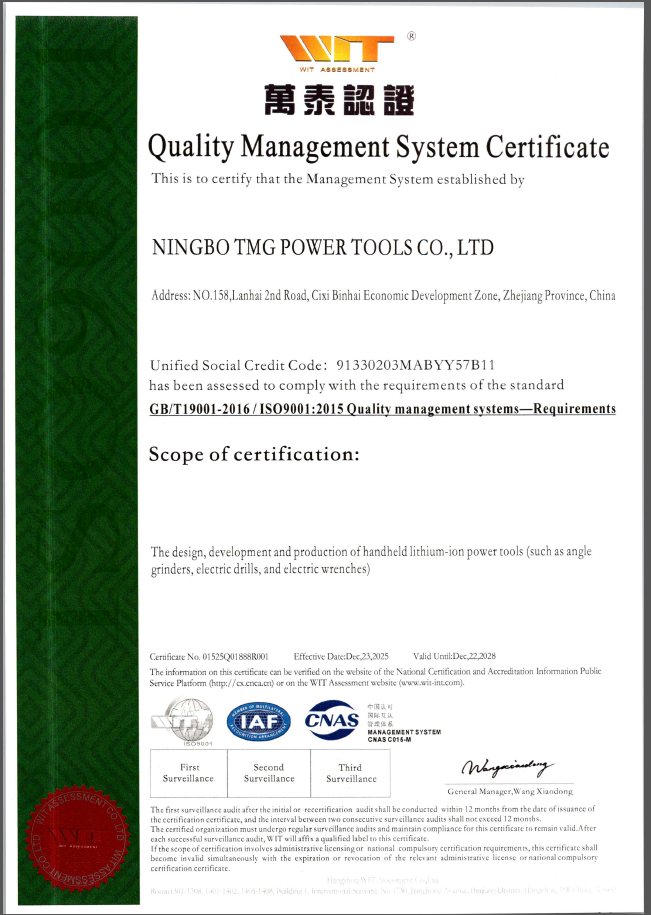
Certificate numbers are among the few genuinely checkable items on a supplier's documentation, and they should be transcribed into the scoring sheet exactly as issued rather than summarised. The manufacturer holds ISO 9001:2015 and ISO 14001:2015 certification under certificate number 15/25E01889R00, issued by WIT, with global scope. It also holds a BSCI result under certificate number 156-065164-000 from amfori Social Audit, relevant to EU-market buyers running social-compliance screening.
One procedural caution applies to every certificate row, including these: the validity dates printed on a certificate are the ones that govern, so a buyer should re-confirm current validity at the time of order rather than rely on a copy filed during an earlier sourcing round. Certificates establish that a management system was audited; they do not establish the performance of a specific tool, which is why they belong in the commercial section of the scoring sheet rather than the technical one.
The scoring sheet: AG3125S against rival 20V brushless declarations
The table below is the working version of the comparison. The middle column records what the AG3125S declares; the right-hand column records what a buyer should require from any rival sheet before the row can be scored at all. Where a verified public reference point exists, it is cited so the row is anchored to something outside both offers.
| Comparison row | AG3125S — declared | What to require on the rival sheet | Verified public reference point |
|---|---|---|---|
| Power source and voltage class | 20V, Li-ion battery | Nominal voltage, pack interface, charger availability | Bosch Professional defines cordless grinders as tools using a rechargeable battery as power source |
| Max. wheel diameter | 125/115 mm | Single or dual diameter; guard supplied per diameter | — |
| Max. wheel thickness | 6 mm | Stated maximum thickness | — |
| Bore diameter | 22.23 mm (7/8 inch) | Bore or arbor size | Bosch Professional states 7/8 inch arbor size for large angle grinders in North America |
| Spindle thread | M14/M16 | Thread type per shipped SKU, by destination market | Bosch Professional states 5/8"-11 as standard spindle size for large angle grinders in North America |
| No-load speed | 3000–8500 rpm | Minimum and maximum rpm; whether variable | — |
| Constant speed control | Not declared in the supplied table — request in writing | Declared or not; speed tolerance under a defined load | — |
| Soft start | Not declared in the supplied table — request in writing | Declared or not; verify switch-on behaviour on sample | — |
| Anti-restart | Not declared in the supplied table — request in writing | Declared or not; verify after pack reconnection | — |
| Tool-free adjustable hood | Not declared in the supplied table — request in writing | Declared or not; verify guard repositioning without tools | — |
| Motor and housing | Brushless motor, plastic housing | Motor type, housing and gearbox material | — |
| Battery platform breadth | 20V platform | Cross-brand or cross-tool compatibility claims | Metabo states all its cordless angle grinders run on any 18 Volt pack from Metabo or CAS partners |
Rows marked “not declared” are not scored as absent; they are scored as unconfirmed and must be closed in writing or on the sample before the offer can be compared with a supplier that does declare them.
Commercial comparison row
| Commercial item | AG3125S programme terms |
|---|---|
| Minimum order quantity | 500 pcs |
| Payment terms | TT 30% deposit, balance against copy of BL |
| Delivery term | FOB NINGBO |
| Acceptance criteria | Pre-shipment test |
| Quality control | AQL test |
| Lead time | 45–55 days |
| Monthly capacity | 600,000 units |
| Customization | Colour, logo, packaging, new designs; custom carton and private-label packaging; retail kit design |
| After-sales | Remote support and spare parts support for quality issues |
| Management-system certification | ISO 9001:2015 and ISO 14001:2015, certificate 15/25E01889R00 (WIT) |
| Social audit | BSCI result, certificate 156-065164-000 (amfori Social Audit) |
Where this specification stops being the right answer
A comparison that lists only advantages is a brochure. The AG3125S has clear boundaries, and buyers should recognise them before the offer reaches the sample stage.
- It is a 5-inch class tool. Bosch Professional's guidance on 5/8"-11 spindles and 7/8-inch arbors describes large angle grinders, a different class from a 125/115 mm cordless tool. Buyers whose work is heavy cutting or sustained grinding on large-diameter wheels should specify in that class, not this one.
- The speed row lacks a load curve. A 3000–8500 rpm no-load range without a stated tolerance under load leaves the most performance-relevant question open until the supplier answers it in writing.
- Safety electronics are undeclared in the supplied table. Soft start, anti-restart and tool-free guard adjustment must be confirmed for this model before they can be scored against a rival that declares them.
- Programme terms exclude small and urgent orders. A 500-piece MOQ with a 45–55 day lead time is built for scheduled programmes, not for trial single-unit purchases or short-notice replenishment.
- Declared after-sales is remote. Remote technical support and spare parts supply for quality issues are the declared provisions; buyers who require on-site service in their market should confirm how that gap is covered locally.
- One housing material is declared. The table specifies a plastic housing; buyers whose site rules or operator preference call for a different housing or gearbox construction should raise it as a specification question rather than assume equivalence.
What the category's public positioning suggests
Two signals in manufacturer documentation describe where the cordless grinder category is moving, and both have procurement consequences. The first is positioning: Bosch presents cordless grinders around jobsite mobility and precision, which frames the cordless grinder as a tool bought for where the work is rather than for a bench. Once mobility is the purchase reason, runtime, pack logistics and charger distribution become part of the tool decision, and the number of packs a crew has to carry becomes a cost line rather than an accessory.
The second signal is platform compatibility: Metabo's statement that its cordless angle grinders run on any 18 Volt pack from Metabo or CAS partners reframes the battery as the durable part of the purchase and the tool as the replaceable part. For buyers, that shift moves evaluation weight away from a single tool's headline figures and towards the platform's breadth and its spare-part horizon.
Neither signal supports a claim about market size or growth, and no verified market-sizing figure for this category was used in this comparison. What the signals do support is a change in how offers should be scored: fewer rows about labels, more rows about declared electronics, accessory interfaces and platform continuity.
Future outlook
The direction of travel is towards disclosure as a differentiator. As more cordless grinders converge on similar voltage classes and similar wheel capacities, the rows that separate offers are the ones currently left out of spec tables — constant speed behaviour under load, restart protection, guard adjustment, and the load curve behind a no-load speed figure. Suppliers who publish those rows give buyers something to verify and therefore something to defend internally when a programme is approved.
For buyers, the practical response is to keep the scoring sheet stable across sourcing rounds. A fixed sheet built around interface, performance, safety and commercial rows makes a new offer comparable to an old one, makes a blank row visible, and makes the sample test a confirmation step rather than a discovery exercise. The tool changes; the sheet should not.
Frequently asked questions
What wheel sizes does the AG3125S accept?
The AG3125S is declared for a maximum wheel diameter of 125 mm and 115 mm, a maximum wheel thickness of 6 mm, a bore diameter of 22.23 mm, and an M14/M16 spindle thread. Buyers should confirm that the guard supplied matches the wheel diameter actually fitted.
Is a 20V brushless grinder more capable than an 18V model?
Nominal voltage class describes battery architecture rather than output. The declared rows that shape field behaviour are wheel capacity, no-load speed and the electronics behind the speed figure — the AG3125S declares 3000–8500 rpm and 125/115 mm wheel capacity. Platform breadth is a separate question: Metabo states that all of its cordless angle grinders can run on any 18 Volt pack from Metabo or CAS partners, which is a compatibility claim, not a performance claim.
How should a buyer verify soft start, anti-restart and a tool-free adjustable hood?
Request written confirmation of each feature in the specification table, then verify on the sample: switch-on behaviour for soft start, restart behaviour after the battery pack is reconnected for anti-restart, and guard repositioning without tools for the hood. These three features are not declared in the AG3125S specification table supplied for this comparison, so they should be scored as unconfirmed until written confirmation or sample verification is obtained.
What are the purchasing terms and acceptance criteria?
MOQ is 500 pcs. Delivery term is FOB NINGBO. Acceptance criterion is a pre-shipment test. Payment terms are TT 30% deposit with the balance against copy of BL.
What customization is available for private-label orders?
The manufacturer provides both OEM and ODM production. Customization covers colour, logo, packaging and new designs, including custom carton and private-label packaging support and custom logo and retail kit design for private-label brands.
How is quality controlled before shipment and supported after delivery?
Quality control is based on AQL test, with pre-shipment testing named as the acceptance criterion. After-sales service includes remote support and spare parts support for quality issues, with spare parts supply provided for ongoing orders and long-term supply programmes. The manufacturer holds ISO 9001:2015 and ISO 14001:2015 certification under certificate 15/25E01889R00 issued by WIT, and a BSCI result under certificate 156-065164-000 from amfori Social Audit.
What lead time and production capacity apply to an order?
Lead time is 45–55 days, and monthly capacity is 600,000 units. Combined with a 500-piece MOQ, these terms suit forecast and scheduled programmes rather than short-notice replenishment.
A grinder comparison is only as useful as the rows it refuses to leave blank. Wheel capacity, bore and spindle settle accessory compatibility; the no-load speed range settles how the tool is controlled; the safety rows settle how it behaves at switch-on and after a pack change; and the commercial rows settle whether the programme can actually be scheduled. The AG3125S answers the interface and speed rows in its declared table and leaves the electronics, guard and load-behaviour rows to be closed in writing — which is precisely the work an independent buyer comparison is supposed to expose.
Есть вопросы или нужны дополнительные детали?
Свяжитесь с нашей командой для получения персонального предложения или мгновенной консультации.
Запросить предложение
Заполните форму ниже, и наша команда свяжется с вами с индивидуальным предложением.
Прямой чат WhatsApp
Предпочитаете общаться в реальном времени? Напишите нам в WhatsApp для мгновенной помощи и быстрых ответов.
- Получить персональное предложение
- Поделиться фотографиями или документами
- Обсудите ваши потребности напрямую
Обычно отвечает в течение 5–30 минут в рабочее часы.