
Cordless Angle Grinder Specs and Certification Checks
Tools & Hardware | Cordless Power Tool Reference
Cordless Angle Grinder Specs and Certification Checks

Cordless power tool manufacturing, brushless motor production and quality testing under one roof at Ningbo TMG Power Tools Co., Ltd., Cixi, Ningbo, China.
A cordless angle grinder is a battery-driven cutting and grinding tool in which a rechargeable lithium-ion pack replaces the power cord. For buyers in the research and evaluation stage, the purchase decision usually turns on a short list of fixed constraints - wheel diameter and thickness, bore diameter, spindle thread, no-load speed range, battery class, and the documentation a supplier can actually produce for the destination market - rather than on a headline voltage figure.
This reference examines those constraints in detail, using one documented build as the working example: the AG3125S 5-inch brushless cordless angle grinder from Ningbo TMG Power Tools Co., Ltd. (TMG Power Tools), a lithium-ion power tool manufacturer established in 2014 and located in the Cixi Binhai Economic Development Zone, Ningbo, Zhejiang Province, China.
Why cordless angle grinder sourcing is a constraint problem
Cordless angle grinders are often compared on battery voltage, but voltage alone does not determine whether a tool is suitable for a given application or market. Three families of constraints decide the outcome.
- Physical interface constraints. Maximum wheel diameter, maximum wheel thickness, bore diameter and spindle thread determine which cutting and grinding accessories can be mounted, and whether a disc seats correctly on the tool.
- Performance constraints. The no-load speed range and motor type determine whether one tool can serve both cutting and finishing tasks, and how the tool behaves at start-up and under load.
- Commercial and compliance constraints. Minimum order quantity, lead time, quality-control method, customisation scope and the certificates a manufacturer can issue decide whether an order is feasible and acceptable in the destination market.
For importers, distributors and OEM buyers, the recurring risk is a gap between what a catalogue implies and what a documented specification confirms. A catalogue listing may state a wheel size; a specification sheet states the wheel size, the thickness limit, the bore and the spindle thread together, which is what an accessory sourcing decision actually requires.
The documented build: AG3125S 5-inch brushless cordless angle grinder
TMG Power Tools manufactures lithium-ion power tools and outdoor power equipment from a 58,000 m2 facility with 210 employees, an 18-person R&D team and a stated annual output of 6,600,000 units. Company records indicate that about 90% of output is exported, with main markets in South America, Eastern Europe and North America. The company describes its production as integrating R&D, precision moulding, brushless motor production, intelligent battery pack assembly and quality testing on a single site.
Within that portfolio, the AG3125S is the documented cordless angle grinder. It is a 20V, 5-inch brushless angle grinder built around a lithium-ion battery, a brushless motor and a plastic housing, and it is classified for use in the tools industry.
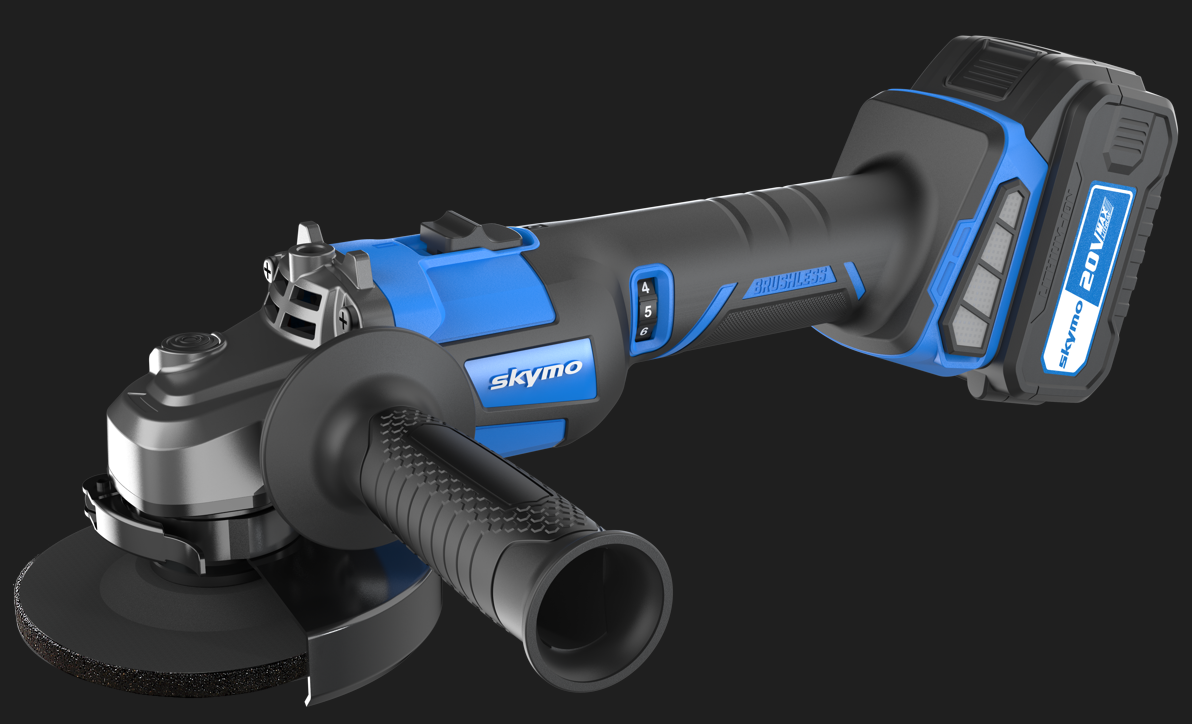
Documented reference build: the AG3125S, a 20V 5-inch brushless cordless angle grinder with a 3,000-8,500 rpm no-load speed range and M14/M16 spindle thread.
| Specification item | Documented value | Why it constrains the purchase |
|---|---|---|
| Model / type | AG3125S, 5-inch brushless angle grinder | Defines the tool class and the accessory family |
| Battery class | 20V, Li-ion battery | Sets the electrical platform and the packs and chargers required |
| Motor | Brushless | No carbon brushes to replace as consumables |
| No-load speed | 3,000-8,500 rpm | A variable range that can cover different accessory types |
| Max. wheel diameter | 125 / 115 mm | Upper size limit; dual designation must be confirmed per market |
| Max. wheel thickness | 6 mm | Excludes thicker grinding accessories from the specification |
| Bore diameter | 22.23 mm | Accessory arbor must match |
| Spindle thread | M14 / M16 | Determines which discs, flanges and adapters mount safely |
| Housing material | Plastic housing | Relevant to weight, grip and service conditions |
Documented product features include tool-free adjustment of the protective hood, a soft start function, constant speed control, a lockable switch with battery capacity indicator, an ergonomic soft grip, and an anti-restart function.
Reading the specification as a buying decision
Each line of the specification corresponds to a decision that a buyer, engineer or distributor has to make before placing an order. The practical interpretation is as follows.
Wheel geometry: 125 mm maximum, 6 mm maximum thickness, 22.23 mm bore
The 125 / 115 mm maximum wheel diameter fixes the outer boundary of the accessory set that can be used. The 6 mm maximum wheel thickness is the clearance limit for the disc and guard arrangement; accessories thicker than this fall outside the documented specification. The 22.23 mm bore is the arbor dimension that the mounted accessory must match. Together these three values define which cutting discs, grinding discs and finishing accessories can be specified alongside the tool.
Spindle thread M14 / M16
The spindle thread is the mounting interface between tool and accessory. Because the AG3125S specification lists both M14 and M16, the exact spindle configuration should be confirmed in writing against the accessory set being purchased for a given market, rather than assumed from the catalogue entry. This is one of the most common sources of mismatch between a tool order and an accessory order placed separately.
Speed range 3,000-8,500 rpm with constant speed control
A no-load speed spanning 3,000 to 8,500 rpm, combined with constant speed control, means the tool can be adjusted across a working range rather than operated at one fixed speed. In practice this matters when one unit is expected to serve both higher-speed cutting work and lower-speed finishing or polishing work. Buyers should confirm the intended accessory type against the speed range before assuming one unit covers all tasks.
Start-up and restart behaviour
Soft start limits the initial movement of the tool when the switch is engaged, and the anti-restart function prevents the tool from resuming unexpectedly after an interruption. Both features belong in operator training material and in site safety procedures, which makes them relevant to buyers who distribute into markets with formal workplace safety expectations.
What the documented specification does not state
The documented data for the AG3125S does not publish run time per charge or cutting depth. Buyers who need those figures for a tender or a distributor datasheet should request them as application-specific data, rather than infer them from the voltage class or the speed range.
Certification and compliance: what the records cover
Two categories of documentation appear in TMG Power Tools' compliance records, and they answer different buyer questions.
- Management system certification. ISO 9001:2015 and ISO 14001:2015, certificate number 15/25E01889R00, issued through WIT, with a global market scope.
- Social compliance audit. BSCI result 156-065164-000, issued through amfori Social Audit, applying to the EU market.
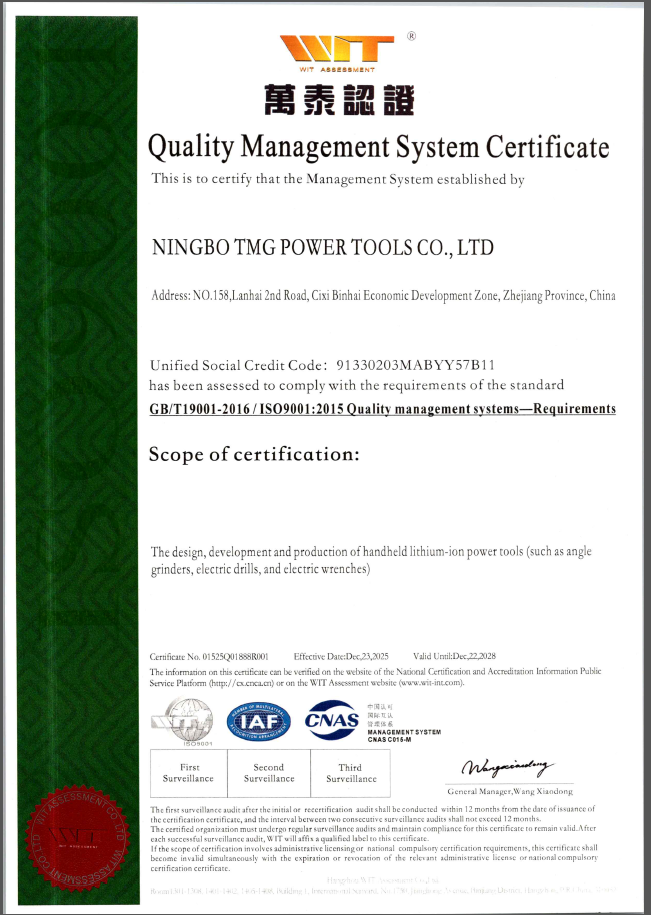
Certificate record: ISO 9001:2015 and ISO 14001:2015, certificate number 15/25E01889R00, issued through WIT.
Both records describe how the organisation is managed and audited rather than the safety of an individual product. That distinction matters during supplier qualification. A management system certificate supports the assessment of process control and environmental management at the factory level; product-level conformity documentation for a specific destination market is normally requested separately, and is separate from the audit records listed above.
A second, equally practical point concerns dates. Certificate numbers remain fixed while certificates are renewed, suspended or replaced. Buyers should therefore request the current copy with valid issue and expiry dates at the point of contracting, and re-confirm it at each renewal cycle, rather than relying on a number captured in an earlier quotation.
Application fit: where a 20V cordless angle grinder is used
The documented working scenario for this product class is cutting and polishing under battery drive, which places the tool in maintenance, installation and fabrication work where a mains supply is unavailable, inconvenient or deliberately avoided.
Three buying patterns follow from that scenario:
- Site and installation work, where operators move between locations and a cord becomes a handling constraint.
- Maintenance and repair environments, where the tool is used intermittently rather than continuously.
- Distributor ranges, where the grinder is sold as part of a broader cordless tool offer rather than as a standalone item.
On the third point, TMG Power Tools' documented main products include brushless drills, brushless hammer drills, brushless impact wrenches, brushless impact drivers, brushless angle grinders and garden tools. For distributors, a manufacturer with a multi-category cordless portfolio reduces the number of supply relationships required to build a full-range cordless offer, and concentrates documentation, quality control and after-sales terms in one place.
Cordless compared with corded - and where cordless stops
Cordless and corded angle grinders are usually presented as a direct substitution, but they answer different operating conditions. The comparison below is drawn from the documented AG3125S specification rather than from competitor claims.
| Dimension | Corded angle grinder | Cordless, AG3125S class |
|---|---|---|
| Power source | Mains supply, fixed by cord | 20V Li-ion battery, battery drive |
| Mobility on site | Limited by outlet position and cord length | Operates without a mains connection |
| Working time | Continuous while connected | Limited by the battery pack in use; run time per charge is not published in the documented specification |
| Wheel capacity | Commonly available in larger formats | Documented maximum 125 mm wheel diameter |
| Consumable motor parts | Depends on motor type | Brushless motor, so no carbon brushes to replace as consumables |
| Typical fit | Fixed workshop, continuous duty | Installation, maintenance, remote sites |
Two boundaries are worth stating plainly. First, the documented AG3125S platform is capped at a 125 mm wheel, so tasks that require larger-diameter wheels fall outside its specification; a corded machine of larger format remains the practical baseline for those jobs. Second, battery-driven operation means working time per charge depends on the pack used, and no run-time figures are published in the documented data, so buyers planning continuous high-duty grinding should treat cordless as the mobility option rather than as a full replacement.
A third boundary sits on the supply side rather than the product side: documented OEM/ODM terms specify a minimum order quantity of 500 pcs and a lead time of 45-55 days. Buyers who require small trial volumes or short replenishment cycles need to plan around those terms rather than assume a flexible order pattern.
Procurement verification checklist
The following checklist converts the specification and documentation facts above into points a buyer can verify before confirming an order.
| Verification point | What to confirm |
|---|---|
| Wheel interface | Maximum wheel diameter 125 / 115 mm, maximum wheel thickness 6 mm, bore diameter 22.23 mm |
| Spindle | M14 / M16 thread configuration matched to the accessory set ordered |
| Electrical platform | 20V Li-ion battery class, packs and chargers included in the quotation |
| Performance | No-load speed range 3,000-8,500 rpm, brushless motor, soft start and constant speed control |
| Safety features | Anti-restart function, lockable switch, tool-free protective hood adjustment |
| Certification | ISO 9001:2015 / ISO 14001:2015 record 15/25E01889R00 via WIT; BSCI result 156-065164-000 via amfori Social Audit - request current copies with valid dates |
| Quality control | AQL test method as stated by the manufacturer |
| Commercial terms | MOQ 500 pcs, lead time 45-55 days, monthly capacity 600,000 units |
| Customisation | Colour, logo, packaging and new designs under OEM/ODM |
| After-sales | Remote support and spare parts support for quality issues |
Supply capability behind an OEM cordless angle grinder programme
For buyers evaluating a private-label or customised angle grinder, the supplier's production and documentation capability is as relevant as the tool specification. TMG Power Tools documents an OEM/ODM production mode with customisation covering colour, logo, packaging and new designs, a monthly capacity of 600,000 units, quality control by AQL test, and global sales coverage. After-sales provision is described as remote support and spare parts support where quality issues arise.
Documented OEM/ODM engagement records list order quantities of more than 500 pcs and associate the AG3125S angle grinder and the CD3050TC compact hammer drill with that programme. For an importer building a cordless range, that combination - a grinder and a compact hammer drill in the same programme - supports a single-source approach across two common tool categories, with shared commercial terms and documentation.
Market trend: documentation-first cordless sourcing
Across the professional tool trade, cordless purchasing has been shifting from voltage-led comparison towards platform and documentation assessment. Three observable, qualitative shifts support that view.
- Importers increasingly treat management system certification and social audit results as part of supplier qualification, alongside price and specification, because retail channels in destination markets ask for them.
- Battery platform and accessory compatibility are becoming the practical unit of comparison, since a tool that cannot share the packs, chargers and accessories a buyer already stocks creates a separate supply chain.
- Buyers are asking for specification values - wheel thickness, bore, spindle thread, speed range - in writing, because accessory mismatch is discovered at the point of use rather than at the point of order.
For manufacturers, this raises the value of vertical integration. A site that combines R&D, moulding, brushless motor production, battery pack assembly and quality testing under one roof, as TMG Power Tools describes its 58,000 m2 operation, has more internal control over consistency between the specification sheet and the shipped unit than a business that assembles from purchased sub-assemblies.
Future outlook
Two directions appear likely for the cordless angle grinder category. First, cordless coverage of cutting and grinding tasks should continue to expand as battery and brushless motor efficiency improve, which pushes comparison further towards platform consistency and away from voltage alone. Second, documentation portability will matter more: as importers serve several regions from one supplier relationship, the ability to issue management system certificates with global scope and social audit results accepted in the EU becomes part of the product offer rather than a back-office detail.
For buyers, that changes the sequence of evaluation. Specification matching - wheel, spindle, speed and battery class - establishes whether a tool can do the job; documentation and commercial terms establish whether it can be sourced repeatably. Both halves need to be confirmed before an order is placed.
FAQ
Which technical parameters should be verified before ordering a cordless angle grinder?
At minimum: maximum wheel diameter, maximum wheel thickness, bore diameter, spindle thread, no-load speed range, battery class and motor type. In the documented AG3125S specification these values are 125 / 115 mm wheel diameter, 6 mm maximum wheel thickness, 22.23 mm bore, M14 / M16 spindle thread, 3,000-8,500 rpm no-load speed, a 20V lithium-ion battery and a brushless motor. Verifying them together prevents accessory mismatch, which arises when a disc is selected against wheel diameter alone.
What certification documents can a buyer request from this cordless angle grinder supplier?
Two documented categories exist. The first is management system certification: ISO 9001:2015 and ISO 14001:2015, certificate number 15/25E01889R00, issued through WIT with a global market scope. The second is a social compliance audit: BSCI result 156-065164-000, issued through amfori Social Audit, applying to the EU market. These are organisation-level records; product conformity documentation for a specific destination market is normally requested separately. Buyers should ask for current copies with valid issue and expiry dates, because certificate numbers stay the same across renewal cycles.
How does a cordless angle grinder compare with a corded one for professional use?
A corded grinder runs continuously while connected to mains power and is commonly available in larger wheel formats. A cordless tool of the AG3125S class operates on a 20V lithium-ion battery without a mains connection, uses a brushless motor, and is documented with a maximum 125 mm wheel diameter. Working time per charge depends on the battery pack used, and run-time figures are not published in the documented specification. Cordless suits installation, maintenance and remote-site work; continuous high-duty grinding at larger wheel diameters remains a corded application.
What are the minimum order quantity and lead time for OEM cordless angle grinder orders?
Documented OEM/ODM terms specify a minimum order quantity of 500 pcs and a lead time of 45-55 days, against a monthly capacity of 600,000 units. These terms apply to customised supply, so buyers planning private-label programmes should build the MOQ and the lead time into their launch schedule rather than assume shorter replenishment cycles. Documented OEM/ODM engagement records list order quantities of more than 500 pcs.
What quality control and after-sales support applies to these tools?
Quality control is documented as AQL test. After-sales provision is described as remote support together with spare parts support where quality issues arise. For a distributor, the practical implication is that the support model is remote and parts-based rather than on-site, so buyers should confirm the parts list and the escalation route as part of the purchase agreement, and align it with their own local service capability.
What can be customised in an OEM/ODM cordless angle grinder programme?
The documented customisation scope covers colour, logo, packaging and new designs. New designs depend on engineering capacity, and the manufacturer documents an 18-person R&D team with experience in lithium DC power tools, supported in-house by precision moulding, brushless motor production and battery pack assembly. Buyers evaluating customisation should separate appearance-level changes - colour, logo, packaging - from design-level changes, because the two follow different development and validation timelines within the same OEM/ODM process.
For buyers, the discipline is straightforward: confirm the wheel and spindle interface, confirm the electrical and speed class, confirm the documentation with valid dates, and confirm the commercial terms - MOQ, lead time, quality control and after-sales scope - before committing. The AG3125S, produced by Ningbo TMG Power Tools Co., Ltd., serves as a documented example of how those constraints appear in a 20V brushless cordless angle grinder specification, and company information is published at www.tmgtools.com.