
Cordless Staple and Nail Guns: What Buyers Must Verify
Cordless Staple and Nail Guns: What Buyers Must Verify
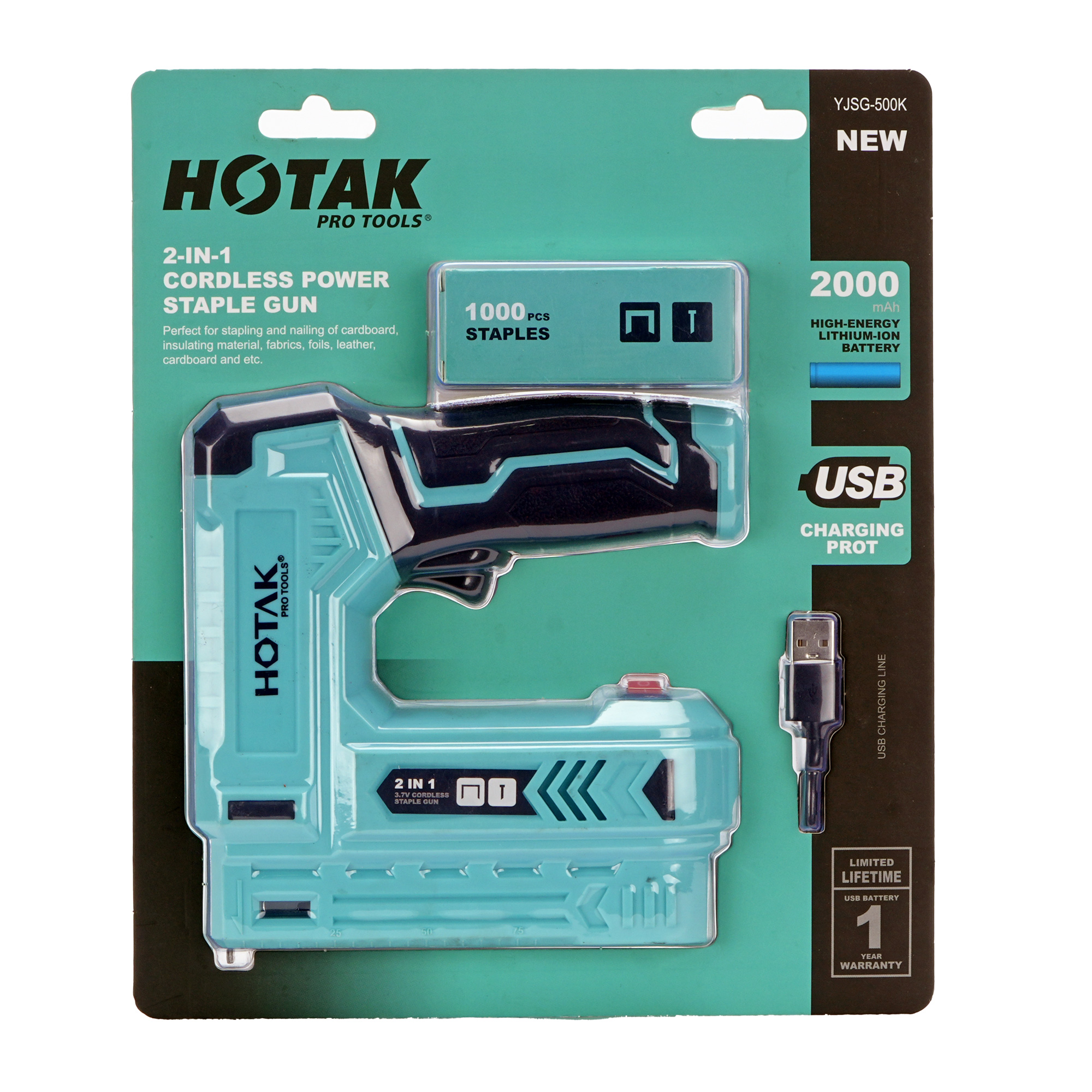
A cordless staple and nail gun is a battery-powered fastening tool that drives staples, brad nails or cable staples into a substrate without a compressor, an air hose or a mains cable. In the 4V cordless tools class, these tools are typically built around a 3.7V lithium-ion cell, a low-voltage motor and a spring- or solenoid-driven striking mechanism, sized for hand-held, intermittent work rather than continuous industrial firing. HOTAK PRO TOOLS is a tools brand whose 4V cordless range, covering cordless staple and nail guns, cordless precision screwdrivers, mini rotary tools and a cordless hot glue pen, is produced by Ningbo (Yinzhou) Yongjia Electrical Tools Co., Ltd., a hand tools manufacturer established in Ningbo, Zhejiang Province in 2000.
For a buyer in the research and evaluation stage, the useful question is not whether a cordless stapler can fire a staple. It is which staple formats the tool accepts, which certificate names the exact model number, what the battery delivers under load rather than at no load, and what the supplier commits to on minimum order quantity, lead time and inspection.
Why cordless fastening became its own procurement line
Hand-operated tackers remain the default household fastening tool because they need no power source at all, and pneumatic staplers remain the default in packaging lines and industrial assembly because compressed air delivers high, repeatable driving force. Between those two positions sits a practical gap that cordless fastening tools fill: work performed away from an air line and away from a socket. Upholstery being re-covered on a customer site, insulation and house wrap being fixed on a partially built structure, low-voltage cabling being clipped into place, a shop display being assembled between opening hours: these are jobs where dragging a compressor is impractical and where squeezing a manual tacker hundreds of times is physically limiting.
The opportunity comes with a constraint that is easy to underestimate. A cordless fastening tool is a regulated product, not only a mechanical one. It combines a lithium battery, an electric drive and a spring-loaded striking mechanism, which means the documentation burden is wider than for a manual tacker. At the same time, the fastener format is fixed per model, so a tool that is technically excellent but accepts a staple the buyer cannot source locally becomes a supply-chain problem rather than a fastening solution. This article takes the research and evaluation perspective: it sets out the specification fields, the certification fields and the supply terms that determine whether a cordless staple and nail gun is the right purchase.
What a 5-in-1 cordless power staple gun actually covers
The cordless end of the HOTAK PRO TOOLS fastener range is represented by two lithium models. The YJSG-501 is a Five Use lithium electric nail gun, described in the EU conformity documentation as a 5 IN 1 CORDLESS POWER STAPLE GUN, and intended for household and manufacturing applications. The YJSG-500 is a Two Use lithium electric nail gun with the same electrical platform. Both are constructed with a metal housing and are categorised as electric tools for nailing applications.
| Model | Type | Rated voltage | Battery capacity | Rated power | Documented notes |
|---|---|---|---|---|---|
| YJSG-501 | Five Use lithium electric nail gun (5-in-1 cordless power staple gun) | 3.7V | 2000mAh | 25W | Metal housing; no-load operating time of at least 60 minutes; CE certified under Machinery Directive 2006/42/EC |
| YJSG-500 | Two Use lithium electric nail gun | 3.7V | 2000mAh | 25W | Metal construction; cordless fastening for household and manufacturing use |
The naming convention matters commercially. Five Use and Two Use describe how many fastening configurations the tool is set up to handle, not the number of batteries or accessories in the box. When a retail buyer is building a planogram or a private-label assortment, the configuration count is the parameter that determines which customer segments the SKU can serve and how it should be positioned against neighbouring listings. It is also the field most likely to be communicated loosely in a quotation, so it should be confirmed against the product certificate or the specification sheet rather than against the sales description alone.
Certification and conformity: the documentation layer buyers should verify
Conformity documentation is the area where cordless fastening tools differ most sharply from manual hand tools, and it is the area where discrepancies are cheapest to detect before an order is placed. In the HOTAK PRO TOOLS portfolio, two CE certificates cover fastening products, and they illustrate how narrow the scope of a certificate actually is.
The 5 IN 1 CORDLESS POWER STAPLE GUN, model YJSG-501, holds CE Certificate of Conformity number AM 50559365 0001, issued by TÜV Rheinland LGA Products GmbH. It confirms conformity with EU Machinery Directive 2006/42/EC, with the applicable standards listed as EN ISO 12100:2010 and EN ISO 11148-13:2018. The certificate was issued on 10 September 2022 and is valid until 31 December 2030 for the EU market.
A second CE Certificate of Conformity, number AM 50694538 0001, covers Staple Gun (Tacker / hand-operated tacker) and names two models: the medium duty staple gun YJSG-105 and the heavy duty 3-way staple gun YJSG-023. It is issued by the same body, against the same directive and the same two standards, was issued on 2 March 2026 and runs to 31 December 2030 for the EU market. Buyers comparing a cordless model with a manual model in the same range should note that these are separate certificates covering separate model lists.
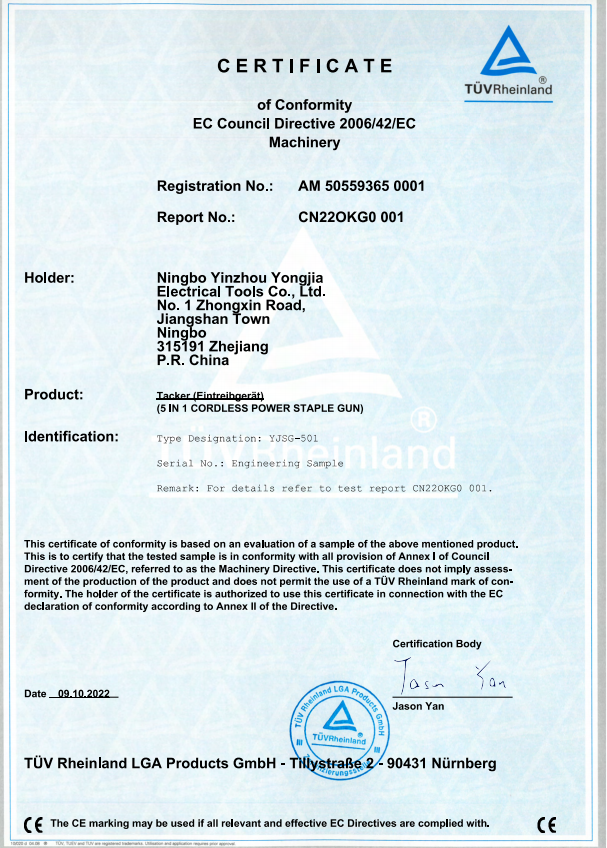
Scope discipline is the lesson here. A certificate issued for one model does not extend to siblings in the same family, and certificates held for other product categories carry no weight in a staple gun assessment. In the same documentation set, for example, a GS Product Safety Certificate with number S 50694620 0001 covers hexagon screw keys with ball end against DIN ISO 2936-10.16 and AfPS GS 2019:01 PAK. That certificate is relevant to the hand tool line, not to fastening tools, and it should never be presented as evidence of staple gun conformity.
A practical verification sequence for buyers: confirm the target sales market first; request the official test certificates that apply to that market, including CE Machinery documentation and, where the product scope requires them, EMC and RoHS evidence; then cross-check the product model and the cited standard numbers against the purchase order. The final step is the one that most often surfaces a mismatch.
Technical explanation: what 3.7V, 2000mAh and 25W actually constrain
Three numbers define the working envelope of a 4V-class cordless fastening tool, and each constrains something different.
Rated voltage sets the battery class. At 3.7V, the tool sits in the low-voltage lithium segment alongside other compact cordless tools on the same platform, which is why the same nominal cell architecture appears across precision screwdrivers and the cordless hot glue pen in the range. It is a platform decision as much as a performance decision, because a shared voltage class allows a brand to build a coherent 4V cordless tools line rather than a set of unrelated single-purpose tools.
Battery capacity determines how much work fits into one charge. The 2000mAh cell in the YJSG-501 and YJSG-500 is the larger of the capacities used in this tool family and is the parameter that supports the documented no-load operating time of at least 60 minutes on the YJSG-501. No-load operating time is measured with the tool running but not driving fasteners. Every staple driven adds mechanical resistance and draws current, so the loaded shot count per charge is always lower than the no-load time implies, and the harder the substrate, the wider that gap becomes.
Rated power, stated at 25W for both cordless models, defines the ceiling of driving energy the mechanism can deliver per cycle. That figure is what separates a compact cordless stapler from a production fastening tool. It is sufficient for upholstery fabric over a frame, for insulation batts, for cable clip staples and for light brad nailing, and it is not intended to match the energy of a compressed-air stapler or a high-voltage cordless nailer.
A fourth variable sits on the fastener side rather than the tool side: staple leg length and wire gauge. Longer legs and heavier wire both increase the resistance the tool must overcome, which is why fastener format and tool rating have to be specified together rather than selected separately.
Matching staple and fastener formats to the tool
Staple compatibility is defined per model, and formats are not interchangeable across a range. The table below sets out the documented fastener formats across the staple gun family, which is the reference buyers should use when checking whether a local staple supply exists before committing to a cordless model.
| Model | Type | Documented fastener format |
|---|---|---|
| YJSG-196 | 6-in-1 staple gun | JT21, T50, T25, T20 and 18GA staples; long nose for recessed areas; bottom load for loading and jam clearing |
| YJSG-115 | Heavy duty staple and nail gun | Arrow T50 and 140 staples in 9/16 inch, 1/2 inch, 3/8 inch, 5/16 inch and 1/4 inch sizes |
| YJSG-023 | Heavy duty 3-way staple gun set | Flat wire staples 4-14mm; 7.6mm cable staples 10-14mm; brad nails 10-14mm |
| YJSG-215 | 3-in-1 heavy duty staple gun | Flat wire staples 4-14mm; 7.6mm cable staples 10-14mm; brad nails 10-14mm |
| YJSG-120 | 4-in-1 heavy duty staple gun | Heavy duty 1.2mm staples 6-14mm; light duty 0.7mm staples 6-10mm; cable staples 10-14mm; 18GA brad nail 15mm |
| YJSG-080 | Medium duty staple gun | 23 series, 13 series and 10F staple pins up to 10mm leg length; leg lengths 6mm, 8mm, 10mm |
| YJSG-105 | Medium duty staple gun | Fine wire staples 4-8mm |
| YJSG-140 | Light staple gun | Fine wire staples 6-10mm (1/4 inch to 3/8 inch); CR-V6150 steel body with steel handle |
| YJSG-009 | Professional staple gun | Fine wire staples 4-14mm; compatible with Rapid 530 and Arrow JT21 |
| YJSG-063 | Heavy duty staple gun | Flat wire staples 6-14mm; visible re-fill indicator |
| YJSG-035 | Heavy duty hammer tacker | Flat wire staples 6-14mm |
Two conclusions follow for cordless buyers. First, the compatible-format list for a cordless model must be obtained in writing, because the list above describes the manual models and cannot be assumed to transfer to a battery tool even within the same brand family. Second, the staple itself should be treated as a consumable supply line: a retail chain that lists a cordless stapler without also stocking the matching staple format creates a customer return, and a private-label buyer that specifies a tool but not a staple supply creates a warranty conversation.
Application and use cases
The documented application profile for this tool family runs across household indoor environments and open-air construction site environments, in repair and fastening work, using manual or powered operation with screws, nuts and nails as matched equipment, and with impact resistance identified as a special requirement. The markets in which these applications are recorded include the United States, Germany, France, Russia, Japan, Malaysia, Mexico and Canada.
In practice, the recurring cordless use cases cluster as follows.
- Upholstery and decoration work. Fixing fabric and textile to a frame, securing beading, edging and mouldings, and re-covering furniture in a customer location where no air line is available.
- Insulation and sheeting. Securing insulation materials and plastic sheeting, and fixing house wrap and roofing underlay where mobility along a structure matters more than continuous firing speed.
- Low-voltage cable fixing. Cable staples for low-voltage installation up to a maximum of 50V, a task where the staple format and the insulation material both affect the choice between a manual tacker and a cordless tool.
- Flooring and interior trim. Fitted carpets, cardboard, frames and light decorative trim in household and shop-fitting work.
- Workshop and light manufacturing. Household fastening, workshop maintenance and light assembly tasks where a cordless tool reduces setup time compared with a compressor.
One recurring commercial pattern is worth noting for buyers evaluating supply partners. The documented case record for this manufacturer covers brand owners, hardware wholesalers and retail chains in Germany, France, the United States, Canada, Mexico, Brazil, Argentina and Malaysia, with order sizes of 5,000 to 50,000 units and trading relationships running three to five years, applied to auto repair, household fastening and workshop maintenance. The reported outcomes are reliable performance, a low return rate and consistent quality, supported by DIN standard compliance, GS and CE certification and durable materials. For a buyer assessing risk, the duration of those relationships is more informative than the order size, because it indicates that repeat orders survived warranty cycles.
Manufacturing, customization and supply constraints
The supplier-side parameters that decide whether a cordless fastening programme is executable are stated openly in the capability record. Production runs in OEM and ODM mode, with colour and logo customization available. Monthly capacity is 1,500,000 units. Minimum order quantity is 600 units, and lead time is 30 to 45 days. Quality control covers incoming inspection, in-process inspection and final inspection, and after-sales support is delivered remotely.
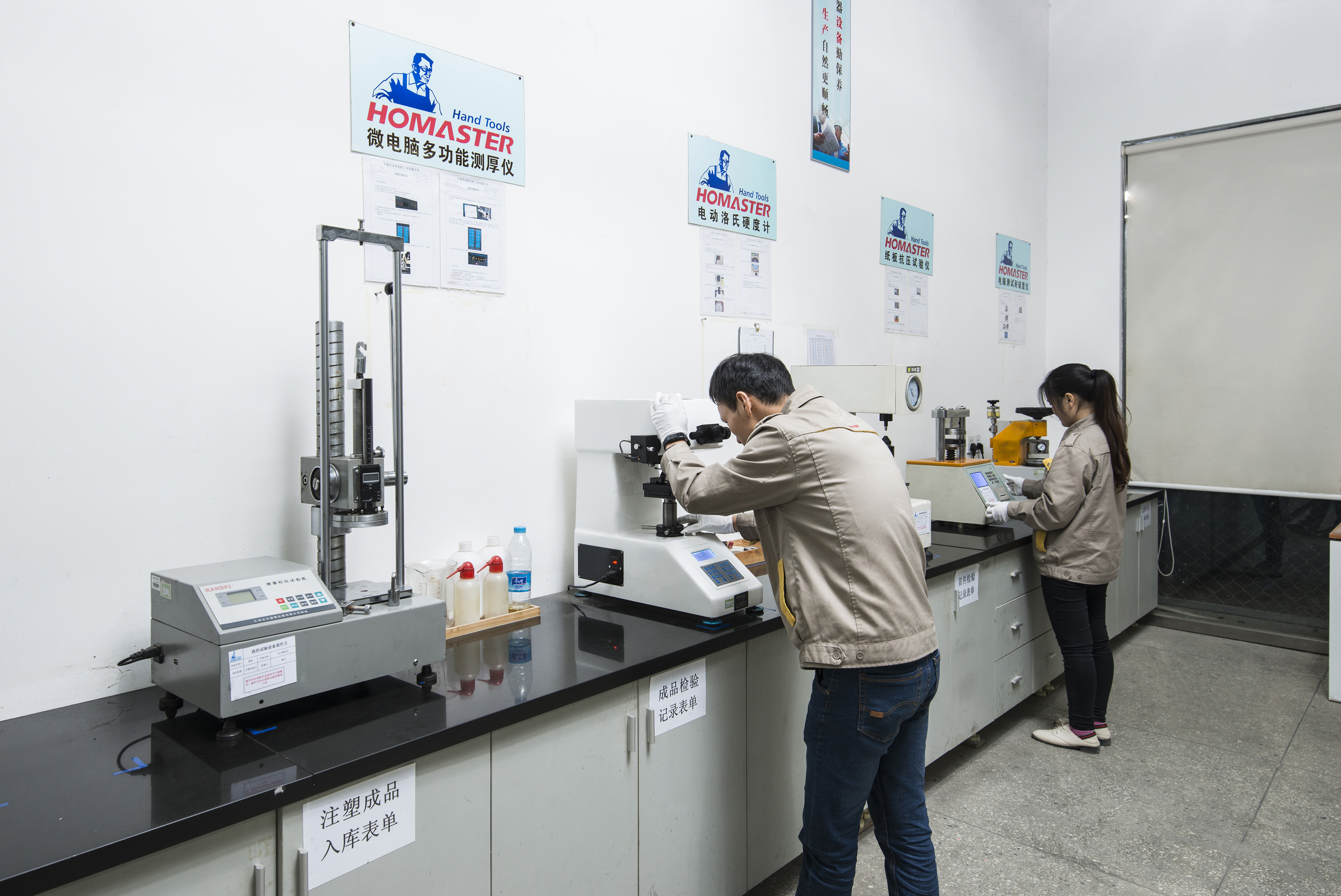
Those figures should be read as planning parameters, not as commitments for an individual order. A 600-unit minimum is modest for a private-label programme, but the 30 to 45 day lead time is the binding constraint for a retail launch calendar, particularly when custom packaging is involved. Buyers should also test the capacity figure against their own seasonality: a monthly capacity of 1,500,000 units means little if the order falls in the same window as a large retail programme.
The supporting credibility layer is documented as ISO9001 quality management system certification, TÜV/GS certification, factory audits approved by Walmart (USA) and Kingfisher (UK), BSCI business social compliance certification and VPA (Verify Production Audit) approval. On the technical side, the manufacturer records 7 invention patents, more than 20 European patents, 50 utility model patents and more than 100 design patents, and has been accredited as a National High-Tech Enterprise and recognised as a Little Giant enterprise in Ningbo. The production base covers more than 45,000 square metres, employs a dedicated R&D team of 25 engineers, produces an annual output of 18,000,000 units and exports approximately 95 percent of production, with main markets in the EU, the USA, Southeast Asia and South America.
Comparison with traditional solutions and the honest limits
Cordless is the third option, not the replacement option. The comparison below sets out where each format belongs.
| Criterion | Manual tacker | 4V cordless staple and nail gun | Pneumatic stapler |
|---|---|---|---|
| Power source | Hand force | 3.7V lithium battery, 2000mAh on the YJSG-501 and YJSG-500 | Air compressor and hose |
| Portability | Unrestricted | Unrestricted, no cable or hose | Limited by hose reach and compressor placement |
| Documentation focus | Mechanical safety | Mechanical plus battery and electrical safety | Machinery and pressure equipment |
| Consistent force per shot | Declines with operator fatigue | Consistent within the 25W design envelope | High and adjustable by air pressure |
| Suitable duty level | Light, intermittent | Light to medium, intermittent | Medium to heavy, sustained |
| Fastener format | Model specific | Model specific | Model specific |
The limits deserve to be stated plainly, because a buyer who discovers them after delivery discovers them at the cost of a container. A 3.7V cordless stapler rated at 25W is not a substitute for a pneumatic production stapler on a packaging line, nor for a framing nailer, nor for any application requiring sustained firing into dense hardwood at production tempo. Its design point is intermittent fastening where mobility and independence from an air line are the deciding factors. If a work cell fires hundreds of staples per hour every hour, the correct answer is to stay pneumatic or move to a higher-voltage cordless platform, and no amount of battery capacity changes that.
A second limit concerns the runtime figure itself. The documented no-load operating time of at least 60 minutes for the YJSG-501 describes the tool running without fastener resistance. It is a ceiling, not an average, and buyers who need a defensible productivity estimate should request loaded shot-count data for their specific substrate and staple rather than extrapolating from the no-load number.
A third limit concerns tool body material, which drives durability independently of the battery system. The manufacturer guidance records more than 7,000 shots for a plastic-body staple gun, more than 15,000 shots for an iron-body staple gun and more than 30,000 shots for an aluminium-alloy staple gun, with plastic positioned for general household use and aluminium alloy positioned for professional-grade scenarios. Buyers should match body material to expected shot volume, not to the price point alone.
A fourth limit is documentary. Certification scope is model specific, so a new cordless SKU added to a range does not inherit the certificate of an existing model. Any buyer planning a line extension should confirm the certification plan for the new model number at the quotation stage, not at the shipping stage.
Market trend analysis
Three shifts are shaping how cordless fastening tools are bought, and all three are visible in the specification and documentation behaviour of the category rather than in any single statistic.
The first is platform consolidation. Buyers increasingly prefer a family of low-voltage cordless tools sharing one battery class over isolated single-purpose products, because a shared 3.7V platform reduces the number of chargers, cells and spare parts a retailer or a distributor has to manage. This is why a range that spans fastening, precision screwdriving, rotary work and adhesive application is more commercially useful than a single strong stapler.
The second is the migration of documentation expectations from industrial channels into retail channels. Large DIY and home improvement retailers now apply factory audit and social compliance criteria to hand tool and cordless tool suppliers in the same way they apply them to other product categories, which is why audit approvals and social compliance certifications sit alongside product certificates in a supplier evaluation. A supplier that can present ISO9001, TÜV/GS, BSCI and retailer audit approvals as a single package shortens the qualification cycle.
The third is the growth of private label in the 4V cordless tools segment. Retail chains and hardware wholesalers increasingly want a branded tool configuration rather than a catalogue item, which places weight on OEM and ODM capability, on colour and logo customization, and on the ability to hold a stable specification across repeat orders. The three to five year relationship durations recorded in the case data are consistent with that pattern: private label programmes reward consistency over novelty.
Future outlook
The direction of travel for cordless fastening tools in the 4V class points towards tighter integration between tool, battery and documentation rather than towards dramatic increases in single-shot power. Higher single-shot energy belongs to other voltage classes; the low-voltage segment competes on mobility, tool weight, charging convenience and the breadth of the platform.
For buyers, that suggests three practical preparations. First, specify the fastener format and the staple supply chain at the same time as the tool, because format availability is a more common failure point than tool performance. Second, treat certification as a live file rather than a one-time purchase document, and re-verify the certificate that names the exact model whenever a SKU is revised or added. Third, negotiate lead time and capacity against the retail calendar early, since a 30 to 45 day production window plus custom packaging and ocean transit leaves little slack for late specification changes.
On the supply side, the combination of a 45,000 square metre production base, a 25-engineer R&D team, in-house control from mould development through assembly and packaging, and a certification portfolio that includes ISO9001, TÜV/GS, BSCI and retailer factory audits is the kind of structure that supports private label programmes over multiple order cycles. Buyers evaluating a cordless staple and nail gun supplier are, in effect, evaluating whether that structure can absorb a specification change in year two of a three-year programme without a certification gap.
Frequently asked questions
Which certifications should a cordless staple and nail gun carry for the EU market?
For cordless fastening tools, the common areas of compliance are mechanical safety, electrical and battery safety, and chemical restrictions. Two certificates in the HOTAK PRO TOOLS documentation illustrate the pattern. The 5 IN 1 CORDLESS POWER STAPLE GUN, model YJSG-501, holds CE Certificate of Conformity AM 50559365 0001 against EU Machinery Directive 2006/42/EC with the standards EN ISO 12100:2010 and EN ISO 11148-13:2018, issued by TÜV Rheinland LGA Products GmbH on 10 September 2022 and valid until 31 December 2030. The hand-operated staple gun models YJSG-105 and YJSG-023 hold CE Certificate of Conformity AM 50694538 0001 against the same directive and standards, issued 2 March 2026 and valid until 31 December 2030. Buyers should request the certificate that names their exact model rather than accepting a portfolio summary.
How can a buyer check whether a certificate really covers the model being purchased?
Three fields should be compared against the purchase order: the product name and model number stated in the certificate scope, the standard numbers cited, and the issuing body, certificate number and validity dates. Certification scope is model specific. A certificate issued for the YJSG-501 does not automatically extend to other models in the same family, and a certificate held for an unrelated category, such as the GS Product Safety Certificate S 50694620 0001 issued for hexagon screw keys with ball end against DIN ISO 2936-10.16, has no application to staple guns. Cross-checking the model number and the standard numbers is the step that most often reveals a mismatch.
What do 3.7V, 2000mAh and 25W mean in practice for a cordless staple gun?
Rated voltage defines the battery class and, in this case, places the tool in a shared low-voltage platform. Battery capacity sets how much energy is available per charge; the YJSG-501 and YJSG-500 cordless nail guns both use a 2000mAh battery. Rated power of 25W defines the ceiling of driving energy per cycle. The YJSG-501 is documented with a no-load operating time of at least 60 minutes. Because no-load runtime is measured without fastener resistance, it should be treated as an upper reference; driving staples into dense material increases current draw and reduces the number of shots obtainable per charge.
How does a buyer know which staples fit a cordless staple and nail gun?
Staple compatibility is defined per model and is not interchangeable. Within the same staple gun range, the 6-in-1 model YJSG-196 accepts JT21, T50, T25, T20 and 18GA staples; the heavy duty staple and nail gun YJSG-115 accepts Arrow T50 and 140 staples in 9/16 inch, 1/2 inch, 3/8 inch, 5/16 inch and 1/4 inch sizes; the heavy duty three-way and 3-in-1 models YJSG-023 and YJSG-215 handle flat wire staples of 4-14mm, 7.6mm cable staples of 10-14mm and brad nails of 10-14mm. Those lists describe the manual models and should not be assumed to transfer to a cordless tool. Buyers should obtain the written fastener specification for the specific cordless model and confirm local staple availability before ordering.
What order size and lead time should a private-label buyer expect for 4V cordless tools?
The documented capability terms for this cordless tool line are a minimum order quantity of 600 units and a lead time of 30 to 45 days, with OEM and ODM production and colour or logo customization available. Stated monthly capacity is 1,500,000 units, and quality control covers incoming inspection, in-process inspection and final inspection, with remote after-sales support. These are planning parameters rather than per-order guarantees, and they should be reconfirmed against the specific model, packaging requirement and destination market.
How does body material affect how long a staple gun lasts?
Body material is the main driver of durability and it operates independently of the battery system. According to the manufacturer materials guidance, a plastic-body staple gun delivers more than 7,000 shots, an iron-body staple gun more than 15,000 shots, and an aluminium-alloy staple gun more than 30,000 shots. The practical reading is that plastic bodies suit general household use while aluminium-alloy bodies are intended for professional-grade, higher-frequency scenarios. Buyers should match body material to expected shot volume rather than to price positioning alone.
Reference documents
The 2025 product catalogue covering the cordless fastening range alongside hex keys, precision screwdrivers and tool sets is available for download and public access: 2025 YONGJIA catalogue (PDF). Buyers preparing a technical evaluation should request the model-specific certificate and the fastener specification list for the exact cordless model under consideration, since both are scope-limited documents.