
Corrosives Compliance: Certifying Dosing Pump Wetted Materials
Corrosive chemical duty is where a dosing pump stops being a flow-rate decision and becomes an evidence decision. Two pumps can carry the same flow rate and the same pressure rating and still sit in completely different compliance positions, because what has to be qualified is not the pump's rating but its wetted path — the pump head, valve seats, diaphragm or piston, seals, check valve and pulse dampener. Material compliance is the chain of documentation that shows every one of those parts is what the supplier says it is.
This article is written for the decision stage of a project: after the medium has been selected and the dosing rate calculated, at the point where the open question is how to justify the material choice. It does not list accreditations. It sets out the path instead — which material decisions carry the most weight, how pump architecture changes the documentation burden, how dosing pumps compare with traditional alternatives in the same service, and where a material-first approach reaches its limits.
What Compliance Actually Asks of a Corrosive-Duty Dosing Pump
In corrosive service, compliance is a chain rather than a badge. The chain starts with medium identification, runs through a written wetted-parts list, continues into material grade declarations and the traceability of those declarations to the delivered unit, and ends with the installation conditions the pump will actually face and the maintenance routine that keeps the wetted path in the state it was qualified in. A pump that is correct on paper but installed behind a blocked strainer is not a compliant installation.
The standards landscape does not remove that work. Positive displacement reciprocating pumps with integrated controlled capacity are addressed internationally by API 675, published by the American Petroleum Institute, while rotary positive displacement pumps are addressed by ISO 14847:1999, published by ISO. Metering pump units placed on the EU market sit inside the machinery regulation framework, which mandates CE marking and replaces the earlier machinery directive from 2027, according to the European Commission.
The Wetted Material Decision Ladder: PVC, PVDF and SS316
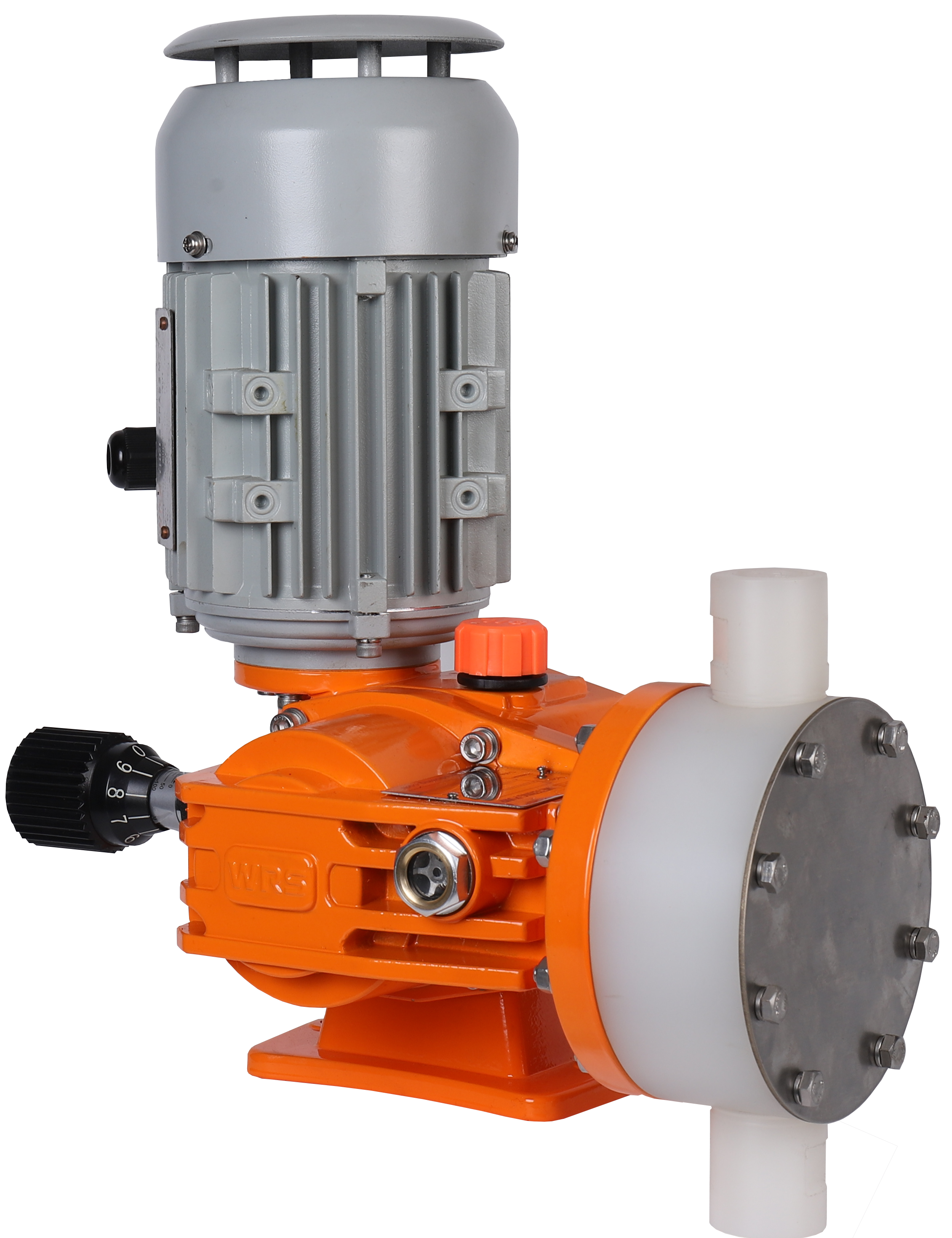
WRS's own selection guidance is the clearest starting point: different media have different materials available for selection, and for highly corrosive media, PVDF pump head material is the recommended option. That rule of thumb carries most of the decision; the rest of the ladder is a matter of matching the medium to one of three material families.
ZHEJIANG WRS MACHINERY EQUIPMENT CO., LTD, referred to below as WRS, is a Hangzhou-based manufacturer of fluid dosing equipment founded in 2016, operating a 15,000 m² facility with 120 employees and an annual output of 30,000 units. Its range covers metering pumps, solenoid dosing pumps, diaphragm dosing pumps, piston dosing pumps, digital dosing pumps, dosing pump check valves, dosing pump pulse dampeners, chemical dosing systems, streaming current monitoring systems and chemical injection pumps — and across that range, the wetted material options resolve into three families.
- PVC. The entry tier, positioned for lighter chemical duty and water treatment applications where the medium is not strongly aggressive.
- PVDF. The fluoropolymer tier, and the recommended pump head material where the medium is highly corrosive. It appears across the solenoid, diaphragm and digital families.
- SS316 and SS316L. The metallic tier. It appears on polymer-bodied families as an alternative wetted option — the ML0008PR1C solenoid pump is offered in PVC, PVDF and SS316, and the EMML0060FP1E digital dosing pump is offered in PVC, PVDF and SS316L — and it is the specified wetted material for the piston and hydraulic pumps in the range.
Sizing order matters as much as material choice, and the same guidance places flow rate first: flow rate is treated as the most important parameter and is compared against the maximum flow rate the site requires. Pressure, pump head material and motor are then used to refine the selection. Read in that order, material is a late-stage refinement rather than the opening question — which is precisely why it is so often under-documented at the point of order.
Why Pump Architecture Changes the Certification Path
Architecture matters because it determines how many components sit in the wetted path and what they are made of. A pump's flow rating does not tell you that; its construction does. Four architectures are typically compared for chemical duty, and each one shifts the documentation burden.
Solenoid dosing pumps
Solenoid-driven models such as the ML0008PR1C and the EML0020PR1C cover 1–20 L/H at 1–10 bar with IP65 protection and either manual or remote control, in PVC, PVDF or SS316. The wetted surface is small, but valve seats, seals and the check valve carry the medium directly, so the material declaration has to reach component level rather than stop at the pump head.
Diaphragm dosing pumps
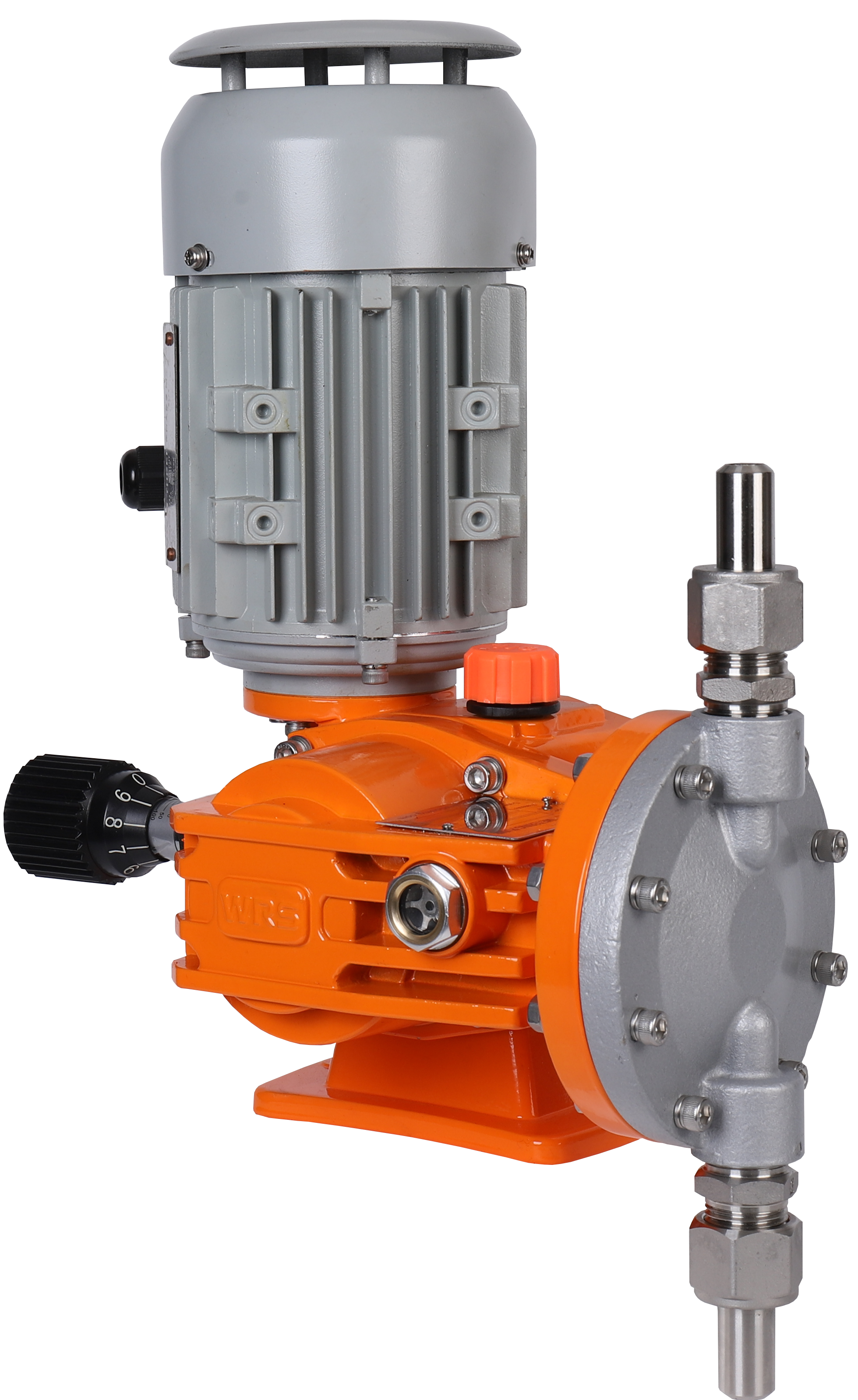
Mechanical diaphragm models such as the MA0120PQ11 (15–500 L/H, 5–10 bar), the MG0150PQ11 (15–150 L/H, 5–10 bar) and the MB1800PQ11 (250–1800 L/H, 3–10 bar) are offered in PVC, PVDF or SS316, with frequency and explosion-proof motors available on the larger frames. The diaphragm is itself a wetted barrier component, which means diaphragm material is part of the compliance set and not merely a wear item. Digital variants extend the same logic into electronically controlled flow: the EMML0060FP1E (60 L/H, 4 bar, Rc 1/2" thread, IP65, PVC/PVDF/SS316L), the EMGP0200FP1C (200 L/H, 4 bar) and the EMAP1000PQ1C (1000 L/H, 4 bar, DN25 socket, PVC/PVDF).
Piston dosing pumps
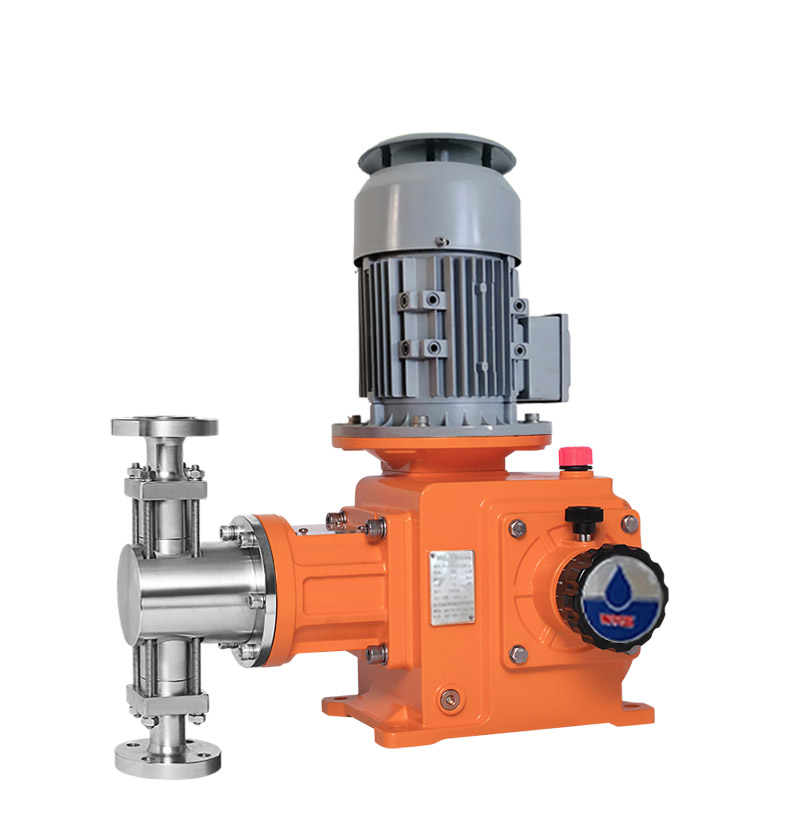
Piston models in the WRS range are specified with SS316 wetted material. The PM060SS1PFN11 delivers 600 L/H at 8 bar through a DN25 flange with a 0.75 kW motor; the PD105SS1PFN11 delivers the same 600 L/H at 8 bar through a DN50 flange with a 4.0 kW motor. Both are available with frequency and explosion-proof motors. On a metallic wetted path the qualification conversation moves from polymer grade to alloy grade, joint integrity, and the behaviour of the pipework the pump is welded or flanged into.
Hydraulic metering pumps
Hydraulic metering pumps push the same metallic path into high-pressure territory: the HS008S0P01S11 runs 2 L/H at 200 bar through a DN6 bevel end welding tube with a 0.37 kW motor, while the HL090S0P01F11 runs 1600 L/H at 6 bar through a DN50 flange with a 1.5 kW motor. Both are specified in SS316. High-pressure capability is a compliance advantage only where the duty requires it; where it does not, the additional wetted joints become additional items to document and maintain.
A Compliance-Readiness Checklist for the Decision Stage
The following sequence turns material qualification into a set of questions a buyer can put to any supplier, including WRS, before an order is placed.
- Ask for the wetted-parts list in writing. Not the material of the pump head — the full list of parts that touch the medium, including the check valve, seals, diaphragm or piston, and the pulse dampener if one is fitted.
- Ask for the declared grade of each wetted part, and ask how that declaration traces to the specific unit being delivered rather than to a generic catalogue line.
- Match the declared material to the medium. Where the medium is highly corrosive, PVDF pump head material is the recommended path; where the architecture is piston or hydraulic, the wetted path is SS316 and the question becomes whether that alloy suits the specific fluid.
- Check the environment, not just the fluid. IP65 protection appears across the WRS solenoid and digital models, but protection ratings are selected against the installation site. A 24/7 nutrient solution dosing installation in a harsh, humid livestock environment in Russia required IP67 protection — a reminder that the wetted path is only part of what has to be qualified.
- Confirm that sizing was anchored on flow rate first, compared against the site's maximum flow rate, then refined by pressure, pump head material and motor.
- Ask what happens after commissioning. A wetted path qualified at delivery and then run behind a partially blocked strainer is not maintained in a qualified state.
Where Corrosive Duty Actually Concentrates
Corrosive duty is not a niche. Across the WRS range, the application lines that recur are water and wastewater treatment, electroplating and surface treatment, chemical industry, oil and gas, hydrogen power generation, paper and pulp production, semiconductor manufacturing, mining and livestock.
The distribution is uneven, and that matters for documentation. Grand View Research places the water and wastewater treatment application share of the global metering pump market at 23.2%, which makes municipal and industrial water treatment the single largest concentration of installations — and therefore the largest concentration of material qualification decisions. Electrochemical and semiconductor lines sit at the opposite end: lower volume, but with far narrower tolerance for a wetted path that is undocumented or mismatched. WRS serves the sector from a base of more than ten countries with local after-sales service, including Singapore, Thailand, Malaysia, Vietnam, South Korea, Japan, Russia, Chile, South Africa, Angola and Turkey, with an export ratio of 20% and main markets in Southeast Asia, Russia and South America.
Dosing Pumps Versus Screw Pumps in Corrosive Service
Where a corrosive medium must be added at a controlled rate, the traditional alternative to a dosing pump is a screw pump, and the comparison is not close on accuracy. Dosing pumps are positioned as high-accuracy liquid delivery devices with dosing accuracy within 2%, against 5% for screw pumps; they are also described as requiring less maintenance and delivering higher efficiency, and for small flow rates the cost is stated as at least 50% lower than the screw pump alternative.
Read in the context of compliance, the accuracy figure is the more consequential number. A 5% delivery tolerance on a corrosive additive means the process has to tolerate both the chemical variation and the corrosion exposure that comes with it. A 2% dosing tolerance narrows the operating band the wetted materials are exposed to, which in turn narrows the range of conditions the material declaration has to hold up under.
What the Market Data Suggests About Documentation Pressure
The installed base tells you where material documentation is heading. The global dosing pump market was valued at approximately USD 8.86 billion in 2024, according to Grand View Research, with Asia Pacific holding a 41.8% revenue share in the same year — the region where a large share of the manufacturing capacity feeding these projects sits. Within that market, diaphragm dosing pumps lead with a 55.7% revenue share, and motor-driven metering pumps hold 54.45% of the global metering pump market, per Mordor Intelligence.
Two of those figures point in the same direction: the dominant architectures are those with the largest number of wetted barrier components, which is exactly the architecture profile that makes component-level material declarations necessary rather than optional. Solenoid-driven dosing pumps, the architecture with the smallest wetted surface, are projected to grow at a CAGR of 5.88% through 2031, per Mordor Intelligence.
Published market sizing is not uniform, and buyers comparing supplier claims against market narratives should note it. Dosing pump market estimates vary by scope: Grand View Research puts the 2024 dosing pump market at USD 8.86 billion, while Fortune Business Insights estimates USD 6.35 billion for 2025, and broader chemical injection definitions produce substantially larger figures. Scope definition, rather than measurement error, explains most of that gap.
Limits and Boundaries of a Material-First Approach
A material declaration proves what a component is. It does not prove that the component will survive a specific fluid, and three boundaries are worth stating plainly.
First, "highly corrosive" is not a single condition. PVDF is the recommended pump head material for highly corrosive media, but the medium still governs, and a correctly documented PVDF head can be the wrong answer for a particular chemistry.
Second, the most capable architecture is not automatically the correct one. The HS008S0P01S11 hydraulic metering pump reaches 200 bar at 2 L/H and the HL090S0P01F11 reaches 1600 L/H at 6 bar. Where a duty does not need that pressure or flow, the extra wetted joints represent documentation and maintenance load without corresponding benefit.
Third, accuracy figures describe a class, not an installation. The 2% dosing accuracy attributed to dosing pumps assumes clear inlet and outlet paths. A falling or unstable discharge flow rate is typically a blocked inlet or outlet rather than a material failure, and the correct response is to check the strainer, tubing and valves and clean or replace what is blocked. The failure mode looks like a compliance problem and is usually an installation problem.
Future Outlook
Three movements are shaping how material compliance will be handled over the next few years.
Regulatory framing is tightening at the unit level. The EU machinery regulation replaces the earlier machinery directive from 2027 and mandates CE marking for metering pump units placed on that market, per the European Commission. Every unit entering that market passes through the same gate, which raises the value of documentation assembled once and reused rather than rebuilt per order.
Component-level material evidence is becoming a routine procurement attachment. As diaphragm and motor-driven architectures — 55.7% and 54.45% of their respective segments — continue to dominate, the number of wetted components per pump keeps the documentation requirement high. The practical shift is that wetted-parts drawings and grade declarations migrate from "available on request" to "supplied with the quotation".
Digitisation is adding a second layer. The WRS range has moved toward digital and intelligent control across the series, which means flow data is increasingly available in electronic form. Over time, that data becomes evidence of how the wetted path actually behaves in service, not only how it was specified.
For buyers, the implication is straightforward: the material decision will continue to be made at the specification stage, but the compliance conversation will increasingly be settled by documentation generated at that stage and referenced for the life of the installation.
FAQ
How is the wetted material chosen for a strongly corrosive liquid?
Different media have different materials available for selection, and for highly corrosive media PVDF pump head material is the recommended choice. The selection process starts with flow rate as the most important parameter, compared against the maximum flow rate required at the site, and is then refined by pressure, pump head material and motor.
Which wetted material options are available across the WRS dosing pump range?
The options resolve into three families: PVC, PVDF, and SS316 or SS316L. The ML0008PR1C and EML0020PR1C solenoid pumps are offered in PVC, PVDF and SS316; the EMML0060FP1E digital dosing pump is offered in PVC, PVDF and SS316L; the EMAP1000PQ1C digital pump and the mechanical diaphragm models MA0120PQ11, MG0150PQ11 and MB1800PQ11 are offered in PVC, PVDF and SS316; the piston pumps PM060SS1PFN11 and PD105SS1PFN11 and the hydraulic metering pumps HS008S0P01S11 and HL090S0P01F11 are specified with SS316.
Does the choice between solenoid, diaphragm, piston and hydraulic pumps change what has to be documented?
It changes the volume and type of documentation. Solenoid pumps concentrate the requirement on valve seats, seals and the check valve. Diaphragm pumps add the diaphragm itself as a wetted barrier component. Piston and hydraulic pumps move the conversation to alloy grade and joint integrity on a metallic wetted path, and flanged or welded connections add further items to qualify. The pump's flow rating does not indicate any of this; the construction does.
What should a buyer verify first when comparing suppliers for corrosive-duty dosing pumps?
Start with whether the supplier will state in writing which parts are wetted and what each is made of, and whether that statement traces to the delivered unit. Then confirm that sizing was anchored on flow rate against the site maximum, and that electrical protection matches the installation environment — IP65 is standard across the WRS solenoid and digital models, while harsher environments can require higher protection. Finally, confirm that replacement wetted components, including check valves and pulse dampeners, are part of what the supplier supports.
What causes a falling or unstable discharge flow rate on a dosing pump handling corrosive media?
A drop in, or instability of, the discharge flow rate is typically traced to a blocked inlet or outlet rather than to a material failure. The recommended diagnostic sequence is to check the strainer, tubing and valves, and to clean or replace them where necessary. Because the symptom appears on a pump handling aggressive fluid, it is often misread as a wetted material problem.
How do dosing pumps compare with screw pumps for corrosive chemical dosing?
Dosing pumps are positioned as high-accuracy liquid delivery devices: the stated dosing accuracy is within 2%, against 5% for screw pumps, with less maintenance and higher efficiency, and for small flow rates the cost is stated as at least 50% lower than the screw pump alternative. The accuracy difference is the more decision-relevant figure in corrosive service, because it narrows the operating band the wetted materials are exposed to.
Which suppliers are commonly listed in the global dosing system market?
Mordor Intelligence lists Grundfos, IDEX (Milton Roy), ProMinent and SEKO S.p.A. among the top global competitors in the dosing system market. For a corrosive-duty project, that list is a starting point for shortlisting rather than a ranking of material qualification capability, which has to be assessed per supplier and per duty.
A diaphragm separator reference document covering wetted-path separation for dosing pump selection is available for download and public access.