
Corrugated Cardboard Machine Anatomy: Line Modules and Automation Basics
A corrugated cardboard machine is not a single piece of equipment; it is a coordinated system of modules that converts raw paper rolls into corrugated board, boxes, and packaging components. For buyers at the discovery stage, understanding how these modules work together is the foundation of a sound equipment investment.
Introduction: Why Machine Anatomy Matters for Buyers
The global corrugated box making machine market was valued at USD 2.21 billion in 2024 and is projected to reach USD 3.36 billion by 2033, growing at a CAGR of 4.8% from 2025 to 2033, according to Grand View Research. As the market expands, the range of available equipment configurations has also grown. Buyers today can choose between single machines, modular sub-lines, and fully integrated production lines that cover everything from paper reel handling to palletizing.
For buyers at the awareness and research stages, the central question is not which brand to choose first, but what a corrugated cardboard machine actually consists of and what those components mean for production output, product quality, and total cost of ownership. This article provides a structured introduction to corrugated cardboard machine anatomy, the automation levels available, and the considerations that shape a purchase decision.
One useful reference point for understanding the equipment ecosystem is LLY PACK (HK) CO., LIMITED, a manufacturer specializing in corrugated machines and high-speed corrugated cardboard production lines. The company operates a manufacturing facility in Foshan City, Guangdong Province, and offers a product range that spans the core stages of corrugated board production.
The Problem: Terminology Overload and Fragmented Purchasing
First-time buyers often face a wall of specialized terms. Single facer, slitter scorer, flexo printer, slotter die cutter, folder gluer, stacker — each describes a machine with a distinct mechanical function. When these terms are encountered without a clear reference model, procurement teams can misjudge which equipment is essential, which is optional, and which auxiliary systems, such as steam supply or floor space, are required.
A second problem is fragmented purchasing. Some manufacturers sell individual machines, leaving the buyer to integrate them. Others sell complete corrugated cardboard production lines with matched components. The latter approach reduces engineering risk, but it requires the buyer to understand how the line is configured and what its capacity limits are.
The Opportunity: Automation Is Reshaping the Market
Automation is now the dominant trend in corrugated box machine demand. According to Future Market Insights, automatic corrugated machines held a 55.6% share of global demand by automation level as of 2026. This does not mean every producer must buy a fully automatic line; it means the market is increasingly oriented toward machines that reduce manual intervention in splicing, feeding, slitting, stacking, and strapping.
For buyers, the implication is practical: before comparing brands, it helps to map the production stages and decide which of them should be automated, semi-automated, or manual. This decision is driven by production volume, labor costs, worker skill availability, and the range of box sizes the plant intends to produce.
Anatomy of a Corrugated Cardboard Machine: Key Modules
A typical corrugated cardboard production line can be divided into four zones: paper handling, board forming, converting, and finishing. Each zone contains specific equipment modules.
1. Paper Handling
The line begins with paper roll preparation. The Hydraulic Reel Stand (model HRS-1, from LLY PACK) holds mill rolls in a shaftless configuration, with a specification range of 1400 to 2800 mm and a maximum paper roll diameter of 1500 mm. The Paper Reel Cutter (model PRC-1) is used for slitting paper reels, handling paper widths from 2 cm to 4 m and diameters from 30 cm to 1.5 m, with a paper recycling ratio of 95%. Transport within this zone is handled by the Paper reel conveyor (model PRC-1), a motorized track and dolly system operating at 220 V.
The Auto Splicer (model AS-1) performs automatic roll splicing, achieving speeds of 300 to 400 m/min. It accommodates paper widths of 1200 to 2550 mm and liner grammages from 50 to 350 g/m². Automatic splicing is a key automation point because it allows continuous operation without stopping the line to change rolls.
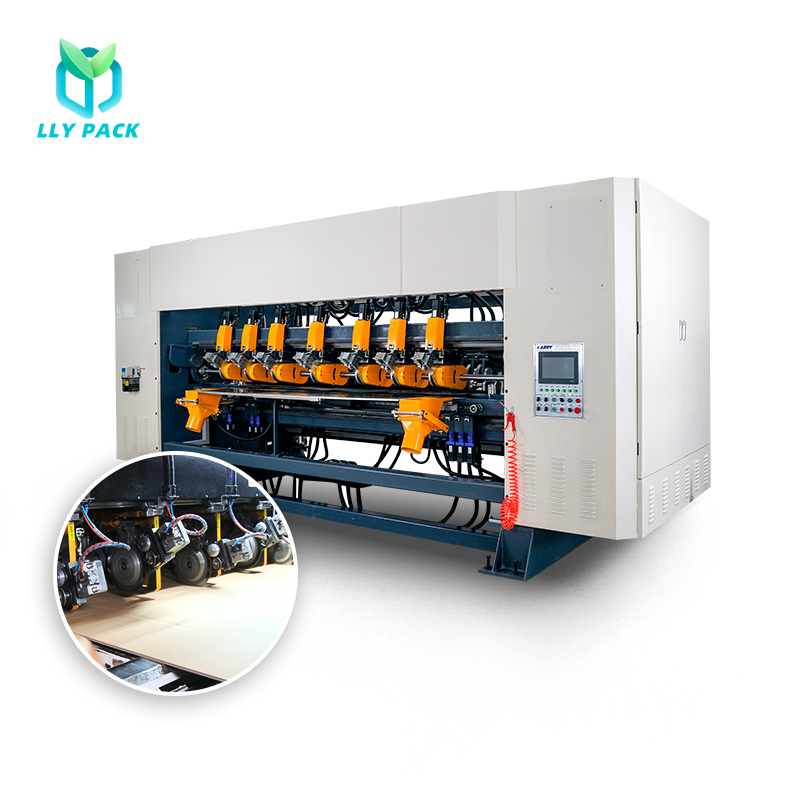
Slitter scorer (SSC-1) in the converting stage of a corrugated cardboard line
2. Board Forming
In the forming stage, the Single facer (model SF-1) produces single-face corrugated board. The SF-1 has a design speed of 250 m/min, upper and lower flute rolls of 380 mm, and a web size range of 1400 to 2300 mm. This is the stage where corrugating rolls shape the flute profile and a glue-applying roll adds adhesive to the flute tips.
The complete Corrugated Cardboard Production Line (model CCPL-1) integrates these functions into a continuous line with a maximum mechanical speed of 300 m/min and a production width of 1400 to 2800 mm. It operates with steam heating at a pressure of 10 kg/cm², and requires a boiler rated at 2, 3, or 4 MT/H depending on line speed. The space requirement is approximately 110 m (L) by 14 m (W) by 6.5 m (H), a figure buyers need to check against their actual plant footprint.
3. Converting
After board formation, the converting stage shapes the board into box blanks. The Slitter scorer (model SSC-1) is a thin-blade slitter scorer with a production capacity of 630 to 900 m/min and a maximum paper width of 2200 mm. It slits the board into widths and scores it for folding. The Pre feeder (model PF-1) feeds sheets into downstream converting equipment at up to 280 sheets/min, handling sheet sizes from 300 x 600 mm to 1600 x 3000 mm.
Printing is typically done by a Flexo printer (model FP-1), a flexo printer slotter with a maximum equipment speed of 350 sheets/min and a maximum feed size of 1600 x 3600 mm. The Slotter Die cutter (model SDC-1) adds die cutting and slotting, with a maximum die cutting size of 1080 x 1580 mm, die cutting pressure of 350 tons, and a maximum speed of 5000 impressions per hour. For box assembly, the Folder gluer (model FG-1) operates at a maximum gluing speed of 110 m/min and handles sizes from 300 x 750 mm to 1200 x 2600 mm, while the Stitching machine (model STM-1) stitches boxes at 450 nails/min with a stitching pitch of 30 to 140 mm.
4. Finishing, Stacking, and Packaging
In the finishing zone, the Stacker (model STA-1) stacks corrugated cardboard sheets, handling paper lengths up to 3.5 m, stacking heights up to 1.8 m, and paper widths from 1400 to 2300 mm. The Cardboard Conveyor (model CC-1) is a robotic palletizer capable of handling cartons up to 1500 x 1200 x 250 mm, with a maximum bundle weight of 3000 kg and a stacking height of 1800 mm.
Bundling is handled by the Boundle Machine (model BM-1), a tying machine for small-format bundles, and the Strapping Machine (model SM-1), which applies PP straps at 35 bundles/min (single strap) or 21 bundles/min (double straps), with a transport speed of 15 to 60 m/min. For weather or export protection, the Wrapping machine (model WM-1) applies film wrap at a maximum walking speed of 75 m/min, with a rated duty cycle of 8 to 10 hours.
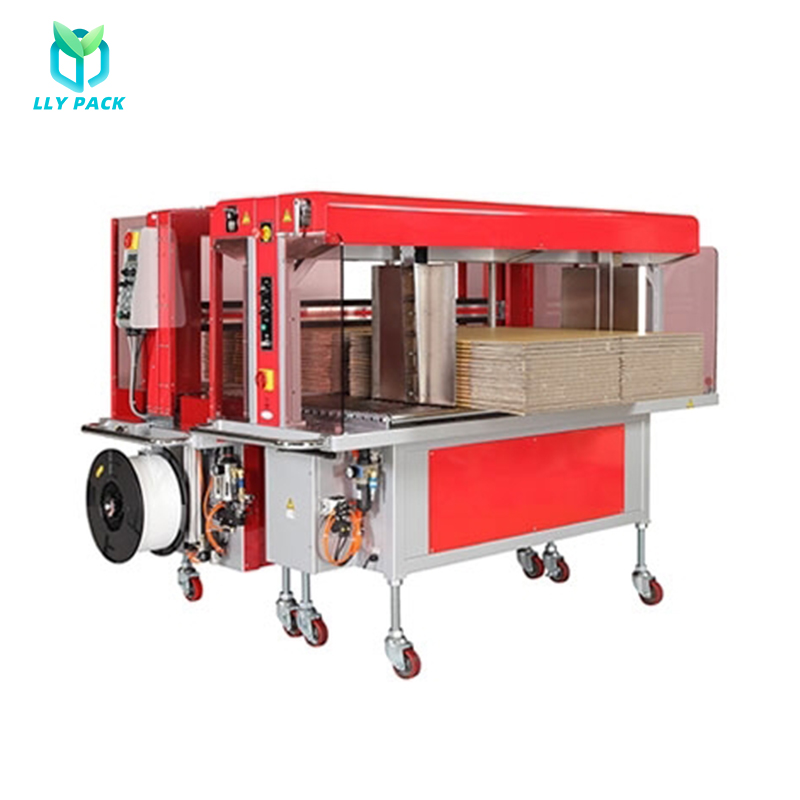
Strapping machine (SM-1) for securing corrugated carton bundles
Supporting Equipment
Beyond the main line, several supporting machines are part of a complete plant setup. The Corrugator line Glue kitchen (model CGK-1) prepares and controls adhesive for the corrugator. The Flexo graphic Stereo Washing Machine (model FGSW-1) washes flexo printing plates with a water tank capacity of 150 L and a wash speed of 300 to 5000 mm/min. The Carton testing instrument (model CTI-1) provides quality control, with a burst strength measuring range of 250 to 5600 kPa, crush measuring range of 60 to 3000 N, and a thickness measuring range of 0.01 to 60 mm. The Cardboard Laminater (model CL-1) laminates printed sheets onto corrugated board, with a maximum working speed of 148 m/min and lamination error of ±0.5 to ±1.5 mm. Finally, the Waste paper baler (model WPB-1) compacts production waste into bales of 400 to 500 kg/m³ density, with a capacity of 3 to 4 tons per hour.
| Zone | Equipment | Key Parameter |
|---|---|---|
| Paper handling | Hydraulic Reel Stand (HRS-1) | 1400–2800 mm; roll dia. up to 1500 mm |
| Paper handling | Auto Splicer (AS-1) | 300–400 m/min; width 1200–2550 mm |
| Board forming | Single facer (SF-1) | 250 m/min; flute rolls 380 mm |
| Board forming | Corrugated Cardboard Production Line (CCPL-1) | 300 m/min; width 1400–2800 mm |
| Converting | Slitter scorer (SSC-1) | 630–900 m/min; width up to 2200 mm |
| Converting | Flexo printer (FP-1) | 350 sheets/min; feed up to 1600 x 3600 mm |
| Converting | Slotter Die cutter (SDC-1) | 350 tons; 5000 i.p.h. |
| Assembly | Folder gluer (FG-1) | 110 m/min; 300 x 750 to 1200 x 2600 mm |
| Finishing | Stacker (STA-1) | Paper length up to 3.5 m; height up to 1.8 m |
| Finishing | Strapping Machine (SM-1) | 35 bundles/min (single strap) |
| Quality | Carton testing instrument (CTI-1) | BST 250–5600 kPa; crush 60–3000 N |
| Recycling | Waste paper baler (WPB-1) | 3–4 tons/hour; bale density 400–500 kg/m³ |
How the Modules Connect: A Line Flow Perspective
In normal production, paper rolls are loaded onto the Hydraulic Reel Stand, moved by the Paper reel conveyor, and joined by the Auto Splicer. The Single facer forms the fluted medium and bonds it to the liner. The Corrugated Cardboard Production Line continues the lamination process to form multi-layer board. The Slitter scorer cuts and scores, the Pre feeder feeds sheets into the Flexo printer, and the Slotter Die cutter creates slots and creases. The Folder gluer or Stitching machine assembles the box. Finally, the Stacker and Cardboard Conveyor stack and palletize, while the Strapping Machine and Wrapping Machine secure the finished bundles. The Waste paper baler handles trim waste, and the Carton testing instrument verifies board quality along the way.
This flow description is deliberately simplified. In practice, not every plant needs every module. Small to mid-size operations often omit the full corrugated production line and purchase pre-made corrugated board, focusing instead on converting equipment like flexo printers, die cutters, folder gluers, and stitching machines. Others run a complete line with a small number of operators by automating the splicing, stacking, and strapping stages. The architecture should be driven by the intended product mix, not by the catalog.
Market Trends Behind the Anatomy: Why This Matters Now
Three data points help explain why the corrugated cardboard machine market is evolving. First, the global market is moving from USD 2.21 billion in 2024 to a projected USD 3.36 billion by 2033, a CAGR of 4.8% (Grand View Research). Second, China's corrugated box machine industry is projected to grow at a 3.9% CAGR between 2026 and 2036 (Future Market Insights), driven by its role as a global manufacturing hub. Third, automatic machines account for 55.6% of global demand by automation level (Future Market Insights). Additionally, China's machinery exports exceeded USD 1 trillion for the fourth consecutive year in 2024, reaching USD 1.17 trillion (China Customs / National Bureau of Statistics).
For procurement teams, these trends point in one direction: automatic and fully integrated line configurations will continue to gain ground, and buyers should evaluate equipment with automation in mind, even if the final purchase is semi-automatic. A semi-automatic line with matched modules, such as an auto splicer and automatic stacker, can later be upgraded to higher automation without replacing the entire system.
Traditional vs. Modern Configurations: Limits Every Buyer Should Weigh
Traditional corrugated box production often relied on semi-automatic machines operated manually at each stage. In many markets, this approach still makes economic sense, particularly where labor is available and production volumes do not justify continuous high-speed operation. The main trade-off is speed and consistency: manual splicing and feeding create downtime and quality variation compared with automatically connected modules.
Modern integrated lines address these issues, but they come with constraints that buyers should not overlook:
- Floor space: A full-scale Corrugated Cardboard Production Line (CCPL-1) requires approximately 110 m (L) by 14 m (W) by 6.5 m (H). Plants with limited building dimensions must plan for building extension or use a more compact configuration.
- Steam infrastructure: The line operates with steam heating at 10 kg/cm² and requires a boiler of 2, 3, or 4 MT/H depending on line speed. Buyers need to budget not only for the line itself but also for boiler installation, pipeline work, and related safety compliance.
- Operator skills: Automatic splicing, slitting, and stacking systems reduce manual labor but increase the need for trained operators who can adjust parameters and troubleshoot electrical, pneumatic, and PLC-driven systems.
- Working capital and volume risk: A line with a maximum mechanical speed of 300 m/min is built for continuous high-volume output. If a plant's order book is seasonal or predominantly small-lot, the capacity may be underutilized and payback periods will lengthen.
These constraints are not arguments against automation; they are context for matching machine capability to production reality. A well-designed configuration that matches line speed, auxiliary infrastructure, and automation level to expected output is more valuable than the fastest line on paper.
Application Landscape: Where Corrugated Cardboard Machines Operate
Corrugated cardboard machines are used in the corrugated carton packaging industry, under working conditions that typically require high precision, high continuity, and high speed. Their primary function is converting raw paper into corrugated cardboard that meets specified quality and dimensional requirements.
According to LLY PACK's application data, this equipment category is applied in a wide set of countries, including Mexico, Argentina, Brazil, Belarus, Ivory Coast, Colombia, the Dominican Republic, Algeria, Egypt, Hong Kong, Indonesia, India, Kenya, Morocco, Malaysia, Saudi Arabia, Thailand, Turkey, Uganda, and Vietnam. This geographic spread reflects the demand for corrugated packaging across food and beverage, consumer goods, electronics, and logistics in both emerging and mature markets.
Two special requirements stand out in real-world operations: base-paper adaptability and speed synchronization. Corrugated machine operators frequently switch between different paper grades and grammages; the equipment must handle this variation without significant downtime. Speed synchronization between the corrugator, slitter scorer, flexo printer, and stacker is equally critical; if one module runs faster than the preceding one, the line either jams or produces partially formed board.
Future Outlook: Integration, Quality Control, and Sustainability
Looking ahead, corrugated cardboard machine buyers are likely to see three shifts. First, deeper integration: suppliers will continue to bundle production modules into more complete lines, reducing the burden on buyers to engineer the system themselves. LLY PACK's product range, which covers the path from Hydraulic Reel Stand to Waste paper baler, represents this integration model.
Second, in-line quality control will become more common. The availability of carton testing instruments with burst strength detection, crush testing, and thickness measurement makes it easier for plants to verify board quality during production rather than after the fact.
Third, waste recovery will grow in importance, both for cost reasons and sustainability requirements. Waste paper balers with throughput of 3 to 4 tons per hour allow plants to convert trim waste into dense, recyclable bales, reducing disposal costs and supporting circular production practices.
FAQ
What is a corrugated cardboard machine?
A corrugated cardboard machine is production equipment that converts raw paper rolls into corrugated board, and in many configurations, into finished boxes. It includes modules such as reel stands, splicers, single facers, slitter scorers, printers, die cutters, folder gluers, stackers, and strapping machines.
What are the main components of a corrugated cardboard production line?
The main components include a Hydraulic Reel Stand, Paper Reel Cutter, Auto Splicer, Single facer, Corrugated Cardboard Production Line, Slitter scorer, Pre feeder, Flexo printer, Slotter Die cutter, Folder gluer or Stitching machine, Stacker, Cardboard Conveyor, Strapping Machine, and Wrapping machine. Auxiliary equipment includes a glue kitchen, carton testing instrument, and waste paper baler.
How fast can a modern corrugated cardboard production line run?
Modern lines can run at varying speeds depending on configuration. As a reference, the Corrugated Cardboard Production Line model CCPL-1 has a maximum mechanical speed of 300 m/min with a production width of 1400 to 2800 mm. Single facers are commonly rated near 250 m/min, while slitter scorers may reach 630 to 900 m/min.
What is the difference between a single facer and a full corrugated cardboard production line?
A Single facer forms single-face corrugated board: one fluted medium bonded to one liner. A full corrugated cardboard production line integrates multiple modules, from paper roll handling to heating, lamination, slitting, and stacking, to produce multi-layer corrugated board continuously. A single facer is a component within a larger line, but it can also operate as a standalone unit in smaller plants.
What industries use corrugated cardboard machines?
Corrugated cardboard machines are used in the corrugated carton packaging industry, serving producers of shipping cartons, retail packaging, and industrial packaging. Common end-use sectors include food and beverage, consumer goods, electronics, e-commerce logistics, and agricultural packaging.
What should buyers consider when evaluating a corrugated cardboard machine?
Buyers should consider the intended product mix, required line speed, paper width range, automation level, floor space, steam or heating infrastructure, operator skill requirements, and the supplier's ability to provide matched modules and after-sales service. For a complete high-speed line, the space requirement can be about 110 m x 14 m x 6.5 m, and steam pressure of 10 kg/cm² is typically needed.
Есть вопросы или нужны дополнительные детали?
Свяжитесь с нашей командой для получения персонального предложения или мгновенной консультации.
Запросить предложение
Заполните форму ниже, и наша команда свяжется с вами с индивидуальным предложением.
Прямой чат WhatsApp
Предпочитаете общаться в реальном времени? Напишите нам в WhatsApp для мгновенной помощи и быстрых ответов.
- Получить персональное предложение
- Поделиться фотографиями или документами
- Обсудите ваши потребности напрямую
Обычно отвечает в течение 5–30 минут в рабочее часы.