
Corrugated Cardboard Machine Capability: Beyond the Data Sheet
A corrugated cardboard machine is rarely the real subject of a sourcing conversation. What project buyers are actually evaluating is a future production outcome: stable board quality, predictable line speed, clean dry-end converting, and manageable maintenance through the life of the plant. In project-level purchases, that outcome rarely comes from one isolated machine. It comes from the supplier’s capability to design, manufacture, integrate, commission and support equipment across a complete corrugated cardboard production line.
This article is written from an independent industry-reference viewpoint. It is intended for procurement teams, plant engineers and production managers who are moving from evaluation to execution. Instead of treating specification tables as the final answer, the article looks at the capability evidence that buyers should verify before ordering a corrugated cardboard machine or an entire line. LLY PACK (HK) CO., LIMITED, a China-based supplier with manufacturing operations in Foshan, Guangdong Province, is used as a concrete example because its documented process, product range and project references illustrate what “capability” looks like in practice.
Why Capability Assessment Needs a Project-Level View
Buying a corrugated cardboard machine is not the same as buying a consumable. A single machine can be installed and tested in isolation. A production line, by contrast, must behave as one continuous system. Reel stands, splicers, preheaters, the single facer, the double facer, slitting and scoring stations, stackers and downstream converting equipment all depend on each other. If one module runs at an incompatible speed, the effectiveness of the whole line falls.
That is why capability assessment becomes a project-level exercise. Buyers in the Evaluation and Execution stages need to move past three common assumptions. First, a strong brochure does not prove factory precision. Second, a list of certifications does not prove that equipment has been installed successfully under real operating conditions. Third, previous sales volume does not prove that a supplier can manage the interfaces between modules. The real question is: what can this manufacturer show in terms of machining, integration, commissioning and reference installations?
The market context also explains why this question matters. The global corrugated box making machine market was valued at approximately USD 2.21 billion in 2024, with projections pointing to USD 3.36 billion by 2033 and a CAGR of 4.8% between 2025 and 2033, according to Grand View Research. Automatic equipment is already dominant; Future Market Insights reports that automatic corrugated machines hold roughly 55.6% of global demand by automation level as of 2026. As production scale and automation rise, buyers are less often sourcing isolated machines and more often sourcing connected production systems.
The Capability Framework for Project Buyers
A practical way to evaluate a corrugated cardboard machine supplier is to separate capability into four layers: manufacturing precision, product scope and integration, certification and test traceability, and field execution. Each layer answers a different question.
1. Manufacturing Precision and Production Footprint
Precision is the first layer because corrugating machines are mechanical systems with tight tolerances. A corrugating roller, a pressure roll, a double facer belt or a die-cutting platen must maintain dimensional stability under heat, steam pressure and continuous cycling. If the factory cannot control machining tolerances, no software upgrade or controller will compensate on the production floor.
In LLY PACK’s documented company profile, the manufacturing operation is based in Foshan City, Guangdong Province, and the factory footprint is recorded at 57,000 square meters. The company states that it holds more than 100 patents and certificates and uses four sets of advanced CNC centers sourced from Japan, described as five-face machine centers with computer control, to ensure high-precision processing. For a buyer, this layer of evidence matters because it connects the supplier’s quality claims to physical production assets. It is also an easy point to verify during a factory audit or video inspection.
2. Module Breadth and System Integration
The second capability layer is module breadth. A supplier that manufactures many related machines can usually integrate them more smoothly than a supplier that trades components from different factories. Interface issues such as paper width, line speed, board thickness, glue application and electrical control are easier to align when the same team is accountable for the whole scope.
LLY PACK’s documented main products include corrugated belt, corrugating roll, single facer, auto splicer and corrugated paper board production line. Beyond those, its stated product ecosystem covers a wide set of process modules: hydraulic reel stands, paper reel cutters, pre-feeders, corrugator line glue kitchens, double facer belts, slitter scorers, stackers, flexo printers, flexo graphic stereo washing machines, slotter die cutters, folder gluers, stitching machines, cardboard laminators, strapping machines, bundling machines, wrapping machines, paper reel conveyors, cardboard conveyors, waste paper balers and carton testing instruments. From a procurement standpoint, this breadth does not mean that a buyer must purchase everything at once. It means the same manufacturer can provide coherent upgrades later without introducing a new integration risk.
3. Certification, Standards and Test Traceability
Certifications are often treated as a compliance checkbox, but for project buyers they are a basic screening tool. The important detail is not simply whether a certificate exists; it is whether the certificate number, issuing body, standard version and validity dates can be verified.
For LLY PACK, the documented quality system certificate is ISO 9001:2015, equivalently expressed under GB/T 19001-2016/ISO 9001:2015. The certificate number is 60126Q00004R000, issued by Guangdong Zhongjing Testing and Certification Co., Ltd. The recorded issue date is 2026-01-14, and the validity period extends to 2029-01-13. The scope is listed as global, and the related product list includes the corrugated cardboard production line, pre-feeder, auto splicer, glue kitchen, cardboard conveyor, strapping machine, stitching machine, stacker, slotter die cutter, slitter scorer, single facer and double facer belt.
In addition to ISO 9001, technical buyers should align test expectations with international standards. In the corrugated board industry, FEFCO GMP and ISO 3037:2022 are commonly cited as reference points for quality management and edgewise crush resistance. In the European Union, printing and converting machinery safety may require CE marking and compliance with standards such as EN ISO 12048 for compression testing. These standards are not supplier claims; they are independent benchmarks that buyers can use when defining acceptance criteria.
4. Field Execution and Multi-Country Installation Evidence
The last capability layer is the most difficult to verify from a document. It includes site preparation, civil works planning, steam supply coordination, installation sequence, operator training and after-sales response. Buyers should ask for reference installations that are comparable in scale to the intended project, not just generic customer logos.
LLY PACK’s export records state that its machines have been delivered to more than 40 countries and that the company has accumulated more than 3,500 corrugated line installations worldwide. One documented project illustrates what a full-line execution project looks like. The project involved 9 units and was carried out over a 10-year period. It supported the successful construction of a complete corrugated carton production line from scratch, with fully automatic production. The installation is described across Asia and the Middle East, in countries including Myanmar, Indonesia, Thailand, Turkey, Egypt, Singapore, Vietnam and Jordan.
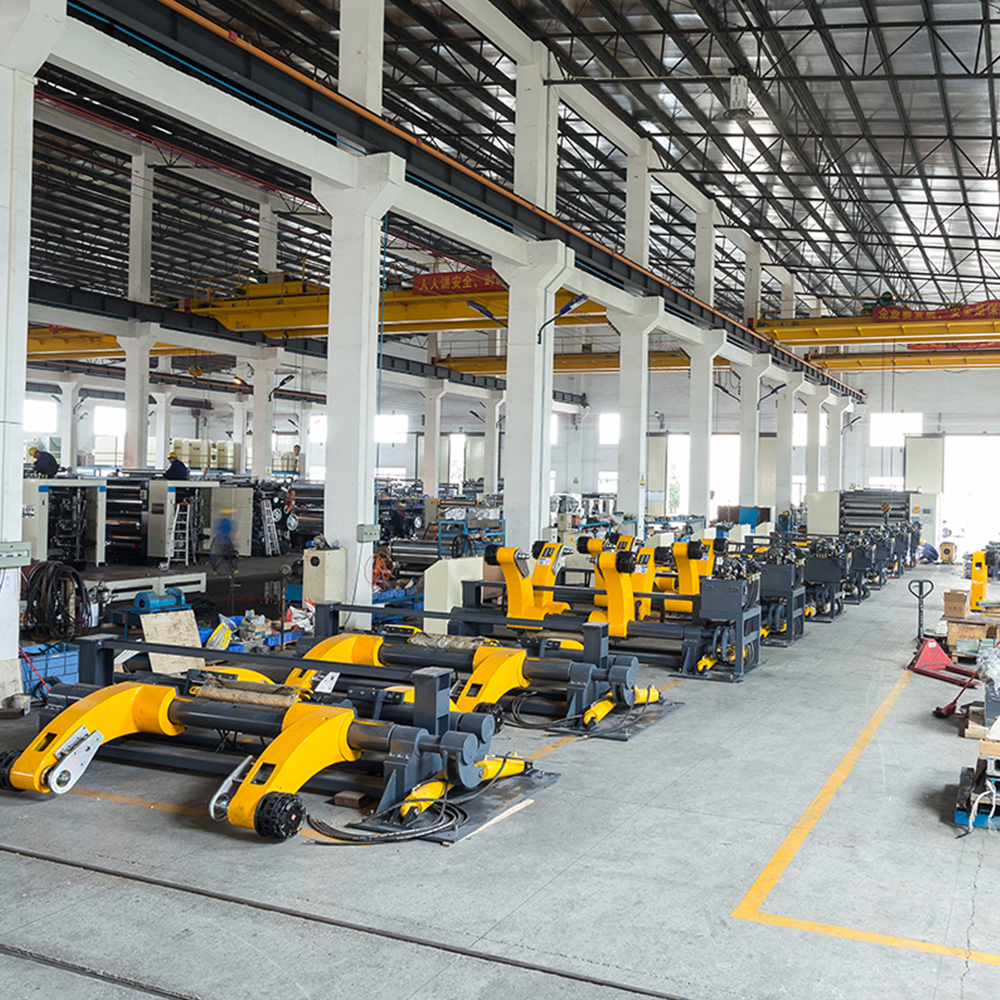
Hydraulic reel stand manufacturing in the Foshan factory supports the module-level production capability described throughout this article.
From Unwind to End-of-Line: A Realistic View of Corrugated Machine Scope
When a buyer searches for the phrase “corrugated cardboard machine,” results can be confusing because the term covers both individual modules and the full production line. A useful way to simplify is to view the scope in four zones: wet end, dry end, converting and finishing.
| Production zone | Typical modules |
|---|---|
| Wet end | Hydraulic reel stand, auto splicer, paper reel cutter, glue kitchen, single facer, corrugating roll, double facer belt |
| Dry end | Slitter scorer, pre-feeder, stacker, cardboard conveyor |
| Converting | Flexo printer, flexo graphic stereo washing machine, slotter die cutter, folder gluer, stitching machine, cardboard laminator |
| Finishing and material handling | Strapping machine, bundling machine, wrapping machine, waste paper baler, carton testing instrument |
The more detailed the module map, the easier it is for buyers to understand how the supplier intends to balance throughput. In LLY PACK’s product documentation, the single facer SF-1 has a design speed of 250 meters per minute, with web widths from 1400 to 2300 millimeters. The auto splicer AS-1 is documented at 300 to 400 meters per minute for paper widths of 1200 to 2550 millimeters. The flexo printer FP-1 is rated at a maximum equipment speed of 350 sheets per minute with a maximum feed size of 1600 by 3600 millimeters.
The core corrugated cardboard production line model, CCPL-1, is documented with a maximum mechanical speed of 300 meters per minute and production line widths from 1400 to 2800 millimeters. The line specification lists steam heating, a steam pressure requirement of 10 kilograms per square centimeter, and boiler capacity of 2, 3 or 4 metric tons per hour depending on line speed. Space planning is another practical consideration: the documented footprint is approximately 110 meters in length, 14 meters in width and 6.5 meters in height. These numbers are not marketing adjectives; they are the basis for civil works, boiler selection and facility planning.
What a Complete Production Line Example Actually Teaches Buyers
A documented reference project is most valuable when it gives the buyer context about phasing, not just the final result. The LLY PACK project involving 9 units is a useful example because the 10-year timeline demonstrates a step-by-step capacity build rather than a single turnkey event. For the customer, this meant that equipment could be added as demand grew. For the supplier, it meant maintaining engineering consistency and after-sales involvement across multiple implementation phases.
The project is described as the successful construction of a complete corrugated carton production line from scratch. That matters because greenfield projects involve more than machine assembly. Site layout, steam supply, electrical integration, work-in-progress flow and operator training all have to be solved together. The documented outcome, fully automatic production, is the clearest signal that the integrated line was able to operate as one process rather than as a group of disconnected machines.
Buyers should use this type of reference to test a supplier with questions such as: Which modules were supplied in the first phase? Which machines were added later? How were the line speeds matched? Which site conditions affected installation? How did the supplier handle commissioning across different countries? References become far more useful when evaluated as projects rather than as lists of names.
Capability Verification Checklist for the Evaluation Stage
Procurement teams rarely have unlimited time to visit factories. A structured checklist helps to keep the evaluation consistent across suppliers.
- Manufacturing evidence: Confirm where the machine is built, what precision equipment is used for corrugating rolls and critical frames, and whether the factory can be audited.
- Product scope: Ask for the full module list, not only the flagship machine. A supplier with coherent line modules can generally reduce interface risk.
- Certification validity: Record the certificate issuer, certificate number, standard version, issue date and expiry date.
- Equipment references: Request installation references that match the intended project scale, preferably including multi-phase full-line construction.
- Line integration parameters: Check consistency of web width, mechanical speed, steam pressure, space and board thickness across the modules.
- Commercial execution terms: Confirm minimum order quantity, incoterms, payment method and whether pre-shipment testing is included.
In LLY PACK’s documented purchase support terms, the minimum order quantity is one set. The available incoterms include FOB, CIF, EXW and DAP. Payment is specified as T/T, and the acceptance procedure includes pre-shipment testing. These details may appear administrative, but they shape execution risk. A supplier that insists on unusually low MOQs or avoids pre-shipment testing should be asked to explain why.
Traditional Fragmented Buying vs Capability-Led Line Buying
Many established box plants still acquire corrugated equipment in fragmented steps. A corrugating machine may come from one supplier, a flexo printer from another, and a finishing line from a third. That approach can work for small upgrades. For a complete line, however, the fragmentation creates hidden costs: the buyer becomes the de facto integrator, responsible for matching speeds, electrical parameters, control logic and maintenance procedures.
| Evaluation dimension | Traditional fragmented buying | Capability-led line buying |
|---|---|---|
| Sourcing unit | Single machine selected by department | Line modules grouped by speed and process interface |
| Integration owner | The buyer coordinates multiple vendors | The supplier coordinates the full mechanical scope |
| Support model | Multiple technical support contacts | One documented responsibility chain for line equipment |
| Best fit | Expansions, niche upgrades, local repair | Greenfield lines, large capacity expansions |
This comparison must also include one honest limitation. A full corrugated cardboard production line is not always the right answer. The documented CCPL-1 line specification calls for substantial space, steam infrastructure and boiler capacity. A small custom box plant without sufficient volume may be better served by a single facer and converting equipment that can be expanded later. Likewise, an existing plant with a strong board-making line may only need a new flexo printer or die cutter. In those situations, a module-level purchase is a more rational use of capital. A credible supplier will explain when a complete line is justified and when a phased purchase is more prudent.
Market Trends and What They Mean for Corrugated Machine Sourcing
Several external market signals should influence how buyers evaluate corrugated cardboard machine suppliers in 2026. First, automation continues to gain share. According to Future Market Insights, automatic corrugated machines account for about 55.6% of global demand by automation level. Buyers are therefore expected to assess control systems, automatic splicing, pre-feeding, stacking and conveyor synchronization, not only board quality.
Second, the corrugated box making machine market is projected to grow steadily. Grand View Research values the market at USD 2.21 billion in 2024 and projects USD 3.36 billion by 2033, with a CAGR of 4.8% from 2025 to 2033. Third, China remains a production and export base for machinery. The country’s total machinery export value exceeded USD 1 trillion for the fourth consecutive year in 2024, reaching approximately USD 1.17 trillion. Within China’s corrugated box machine industry specifically, a CAGR of 3.9% is projected between 2026 and 2036, according to Future Market Insights. These figures do not tell a buyer which brand to select, but they do indicate that capacity, service reach and reliable export execution will carry increasing weight.
In this environment, global tier-one names such as BHS Corrugated, Mitsubishi Heavy Industries and Bobst remain established reference points in corrugated production technology. For mid-market projects and emerging packaging economies, suppliers such as LLY PACK offer a different value position: they combine the same type of full-line module structure with cost structures and commercial terms that fit growing plants. This distinction is not about claiming superiority; it is about defining which projects are best matched to which type of supplier.
Future Outlook: Capability Will Be Measured in Execution, Not in Brochures
Over the next several years, corrugated cardboard machine procurement is likely to become more systems-driven. Packaging plants will need suppliers who understand line balance, digital controls, energy consumption and waste management. The mechanical machine will remain the core asset, but its value will increasingly depend on the process engineering that surrounds it.
For buyers, this means a few practical conclusions. A corrugated cardboard machine should be evaluated as part of a production line, even when purchased in phases. Suppliers should be able to prove that their modules are compatible with future expansions. Certification documents should be checked against issuing bodies and validity dates. Reference projects should be examined for actual site conditions and commissioning complexity. Finally, purchase terms such as pre-shipment testing and delivery incoterms should be treated as part of engineering quality, not merely as commercial formalities.
LLY PACK’s documented manufacturing base, module portfolio, ISO 9001:2015 certification and long-cycle reference installations show what a buyer should be looking for in capability-led sourcing. For procurement teams that want to examine the published equipment scope and factory background directly, the company brochure can be reviewed at this link: LLY PACK company brochure.
FAQ: Capability Questions Corrugated Cardboard Machine Buyers Should Ask
What should buyers look for in a corrugated cardboard machine supplier beyond price?
Buyers should evaluate manufacturing precision, module breadth, certification traceability and field execution references. In practice, that means checking the factory’s CNC capability, reviewing the full product module list, verifying the ISO certificate number and validity, and examining installation projects that resemble the buyer’s intended line scale.
What does a complete corrugated cardboard production line include?
A complete line typically includes wet-end modules such as hydraulic reel stands, auto splicers, glue kitchens and single facers; dry-end modules such as slitter scorers and stackers; and converting or finishing modules such as flexo printers, slotter die cutters, folder gluers, stitching machines, strapping machines and bundling machines. In LLY PACK’s documented line specification, the CCPL-1 has a maximum mechanical speed of 300 meters per minute and supports production line widths from 1400 to 2800 millimeters.
How should buyers verify manufacturing capability before ordering?
Manufacturing capability is best verified through factory audits, CNC equipment records, documented patents and certificates, and installation references. In LLY PACK’s case, the official profile mentions a 57,000-square-meter factory in Foshan, more than 100 patents and certificates, and four sets of Japanese CNC centers that support high-precision processing.
What certification details matter for a corrugated cardboard machine?
The certificate number, issuing authority, standard version, issue date and expiry date all matter. For LLY PACK, the documented quality system certificate is ISO 9001:2015 under standard GB/T 19001-2016/ISO 9001:2015, certificate number 60126Q00004R000, issued by Guangdong Zhongjing Testing and Certification Co., Ltd., valid until 2029-01-13. Buyers targeting European markets should also consider CE marking and test standards such as EN ISO 12048.
Is a full production line always the best investment for a buyer?
No. A full line requires significant floor space, steam heating infrastructure and capital. LLY PACK’s documented line specification, for example, describes a space requirement of about 110 meters long, 14 meters wide and 6.5 meters high, plus boiler capacity of 2 to 4 metric tons per hour. Buyers with limited demand may be better served by phased investment, starting with a single facer, a printer or a finishing module and expanding later.
Есть вопросы или нужны дополнительные детали?
Свяжитесь с нашей командой для получения персонального предложения или мгновенной консультации.
Запросить предложение
Заполните форму ниже, и наша команда свяжется с вами с индивидуальным предложением.
Прямой чат WhatsApp
Предпочитаете общаться в реальном времени? Напишите нам в WhatsApp для мгновенной помощи и быстрых ответов.
- Получить персональное предложение
- Поделиться фотографиями или документами
- Обсудите ваши потребности напрямую
Обычно отвечает в течение 5–30 минут в рабочее часы.