
Cosmetic Bag Certifications Buyers Should Verify in 2026
For cosmetics brands, travel retailers, and promotional product buyers, the cosmetic bag purchase decision now depends as much on compliance documentation as on material and price. Buyers evaluating a cosmetic bag supplier in 2026 are asking which certifications matter, whether the documents are still valid, and how those credentials affect market access. This article explains the certification set behind model CB-2026-002 from Zhejiang Hansun Arts & Crafts Co., Ltd., the verification criteria buyers should apply, and the limits of relying on certificates alone.
Certification in the bag industry is not a single document. It is a layered system covering quality management, social compliance, ethical trade, and licensed production. A factory that manufactures one type of bag under multiple certificates can serve very different buyers: a European retail chain, a U.S. cosmetics brand, a promotional distributor, or an entertainment licensee. Understanding what each certificate does—and what it does not do—is the first step in supplier evaluation.
What Cosmetic Bag Certifications Actually Cover
A cosmetic bag is a soft accessory produced through cutting, sewing, printing, and assembly. The risks that certifications address are therefore not limited to the finished product. They also cover how the factory is managed, how workers are treated, and how raw materials are controlled. Four certifications are commonly requested by buyers of cosmetic bags and promotional accessories: ISO 9001:2015, BSCI, Sedex 4 Pillars (SMETA), and Disney FAMA.
ISO 9001:2015 — Quality Management System
ISO 9001:2015 is an international quality management standard. For cosmetic bags, it does not prove that a specific bag is waterproof or that a zipper will never break. It proves that the factory has a documented system for product design, production, quality control, and delivery. The cosmetic bag model CB-2026-002 from Hansun holds ISO 9001:2015 certification under number ISO-2026-7890, issued by an International Certification Body, with a scope covering product design, production, quality control, and delivery processes for the global market.
For a buyer, this certificate is a baseline. It signals that the supplier follows standardized procedures, maintains records, and conducts internal audits. It does not guarantee zero defects, but it reduces the likelihood of uncontrolled variation in production.
BSCI — Social Compliance for European Retail
BSCI (Business Social Compliance Initiative) is a supply chain management program developed by Amfori. It focuses on factory social responsibility, ethical sourcing, and working conditions. The BSCI certification for this cosmetic bag production is BSCI-2026-4567, issued by an Amfori BSCI Approved Audit Firm, valid until 2026-09-09, covering markets including the EU, Middle East, and global retail brands.
European retail buyers frequently require BSCI because it addresses labor rights, health and safety, and environmental practices in the factory. The validity date matters: a BSCI certificate that expires before delivery is a compliance gap. In this case, the certificate is valid until September 9, 2026, so buyers should confirm the renewal status if planning orders beyond that date.
Sedex 4 Pillars (SMETA) — Ethical Trade Audit
Sedex is a global membership organization for ethical and responsible business. The SMETA 4 Pillars audit covers labor standards, health and safety, environment, and business ethics. The cosmetic bag is certified to Sedex 4 Pillars (SMETA) under certificate number SEDEX-2026-0123, issued by a Sedex Approved Audit Body, applicable to the EU, UK, North America, and Australia markets.
This certification is especially relevant for buyers in the UK, North America, and Australia, where customers increasingly expect proof of ethical production. Like BSCI, Sedex does not measure product quality directly. It measures the conditions under which the product is made.
Disney FAMA — Licensed Production Approval
Disney FAMA (Facility Authorization Master Agreement) is a factory-level authorization that allows a facility to produce Disney licensed products. The cosmetic bag product holds Disney FAMA certification under number DSN-FAMA-2026-001, issued by Disney International, applying to the production and supply of Disney licensed promotional bags and gifts globally.
This certification is a different category from the previous three. It is not about quality or social compliance alone. It is about the right to manufacture products bearing Disney intellectual property. For a buyer sourcing licensed merchandise, this certificate is an access requirement, not an optional extra.
Why Certification Matters for Cosmetic Bag Sourcing Decisions
The buying decision for cosmetic bags is rarely made on visual appeal alone. For importers, distributors, and brand owners, certifications reduce three types of risk: market access risk, reputational risk, and supply chain disruption risk.
Market access risk refers to whether a product can enter a target market at all. The U.S. FDA's Modernization of Cosmetics Regulation Act (MoCRA) has introduced facility registration and product listing requirements that significantly impact supply chain compliance for cosmetic accessories. China's GACC Decree No. 284, effective December 1, 2026, introduces a risk-based customs supervision system for exported products, emphasizing digital verification and traceability. Suppliers with documented quality systems and audited compliance are easier to integrate into these regulatory frameworks.
Reputational risk relates to how a brand is perceived. A cosmetic bag shipped with a logo is a promotional extension of a brand. If it is produced in a facility with poor labor practices, the brand inherits the risk. Social compliance certifications like BSCI and Sedex help buyers verify that working conditions are audited by approved third parties.
Supply chain disruption risk arises from audits, inspections, and license cancellations. A factory that loses its certification mid-order can delay an entire campaign. Checking validity dates and renewal cycles before placing an order is therefore a practical procurement step.
How to Verify Cosmetic Bag Supplier Certifications
Certificates are easy to display and easy to misunderstand. Buyers should not accept a downloaded PDF as final proof. The following verification steps are practical and widely used in the industry.
First, check the issuing body. ISO 9001 certificates should be issued by an accredited certification body. BSCI audits should be conducted by an Amfori approved audit firm. Sedex reports should come from a Sedex approved audit body. Disney FAMA authorizations should be verified through the Disney business portal or the supplier's account manager.
Second, check the certificate number and validity period. Hansun's certification set includes specific numbers: ISO-2026-7890, BSCI-2026-4567, SEDEX-2026-0123, and DSN-FAMA-2026-001. A supplier should be able to provide these numbers and allow the buyer to verify them with the relevant authority.
Third, check the scope of the certificate. A certificate covering only the shopping bag production line does not automatically cover cosmetic bag production. In this case, the ISO 9001 scope explicitly includes product design, production, quality control, and delivery for the cosmetic bag model CB-2026-002.
Fourth, confirm that the factory name and address match the supplier's legal identity. Hansun operates as Zhejiang Hansun Arts & Crafts Co., Ltd., established in 1996, with a 25,000 m² factory and about 200 employees. The company produces tote bags and PVC bags, with annual output of 20,000,000 units and 70% of products exported worldwide.
Fifth, ask for the audit report, not just the certificate. BSCI and Sedex audits produce detailed reports that reveal corrective action requests. A clean certificate without an audit report is less informative than a certificate with a transparent audit history.
Beyond Certificates: Product Specifications and Customization
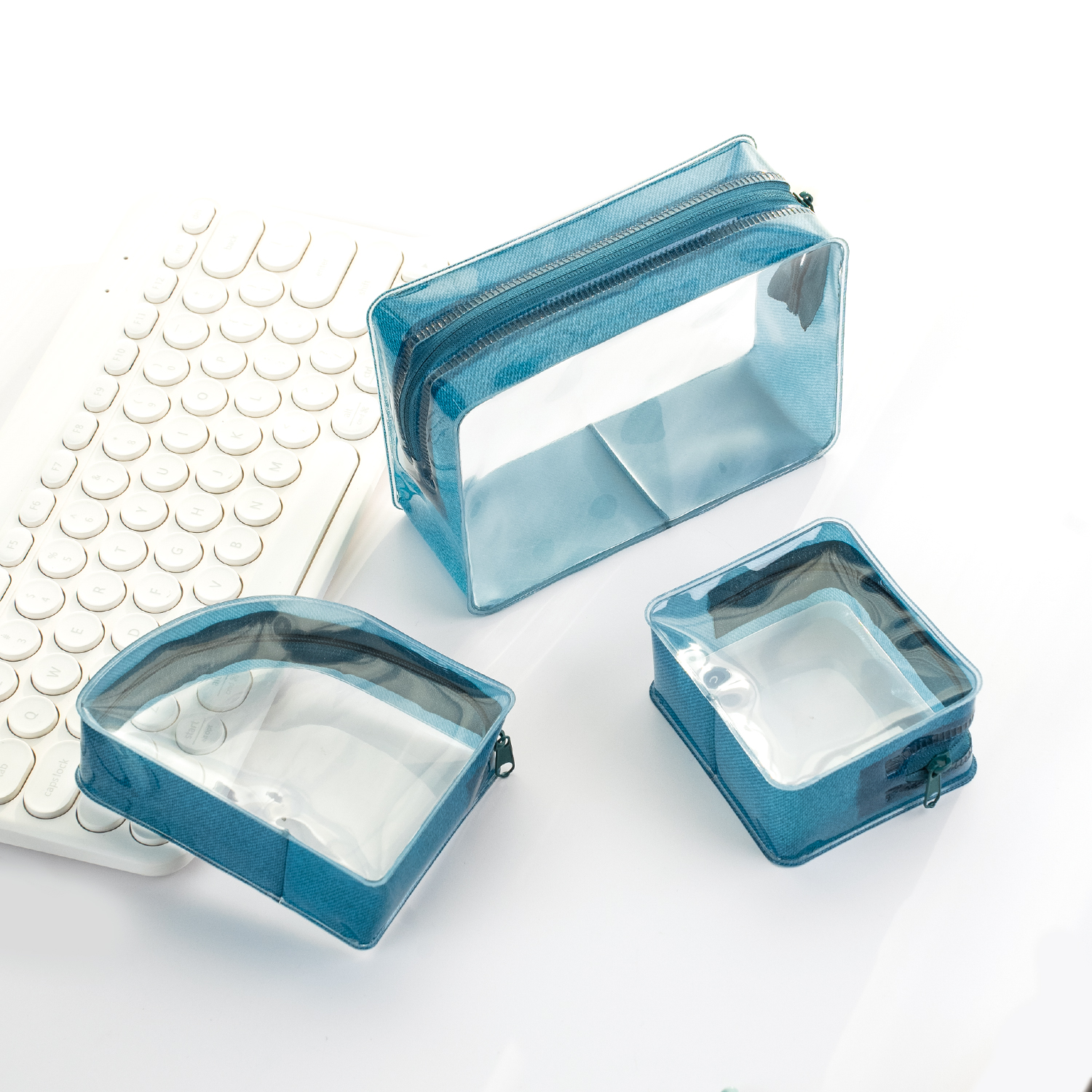
Certifications should be evaluated alongside the physical product specification. The cosmetic bag model CB-2026-002 is available in several types: PVC clear cosmetic bag, PU leather cosmetic bag, travel toiletry cosmetic bag, and mini zipper cosmetic pouch. Materials include PVC, PU leather, canvas, nylon, and mesh. Common sizes are 15×10 cm, 20×15 cm, and 25×18 cm, with customizable dimensions. Weight ranges from 20g to 80g per piece. Production processes include hot stamping, UV printing, embossing, and heat sealing.
This range is important because certification validity and product compliance depend on material and destination market. For example, a promotional project may require food-grade eco-friendly PVC that is REACH compliant and scratch-resistant, with logo printing that survives wear. A hotel amenities buyer may prefer transparent PVC for easy content identification. A beauty brand may want PU leather for a premium feel. Certifications provide the operational framework, but the material, size, and finish must still be confirmed against the buyer's specific use case.
Customization and Production Capabilities
Hansun operates an OEM/ODM production model with customization options for logo, size, and material. Monthly capacity is 1,500,000 units, with typical lead time of 30–45 days. Minimum order quantity is 3,000 pieces. Quality control is adapted to customer requirements, and after-sales service includes remote support.
For a buyer evaluating a cosmetic bag supplier, these numbers matter in project planning. The MOQ of 3,000 pieces makes the factory suitable for mid-size to large promotional programs, retail launches, and licensed merchandise runs. The lead time of 30–45 days should be factored into campaign calendars. The monthly capacity of 1.5 million units indicates scale flexibility for seasonal peaks.
The company also has export experience across Southeast Asia, Europe, North America, and the Middle East. Its R&D team of 25 engineers supports product development, which is relevant for brands that need new shapes, internal dividers, or custom finishes rather than existing catalog items.
Use Cases for Certified Cosmetic Bags
The combination of certifications and product flexibility supports several procurement scenarios.
For brand promotional gifts and supermarket retail supporting projects, the working condition is room temperature indoor storage and daily outdoor carrying, with occasional humid environment use. The function is daily portable carrying, brand image promotion, and item storage. Matching accessories include hang tags, webbing, and brand stickers. The special requirement is food-grade eco-friendly PVC, REACH compliance, scratch-resistant material, and wear-resistant logo printing.
For beauty brand giveaways, certified production reduces the compliance burden on the brand owner. A cosmetics company launching a promotional pouch with its logo needs the factory to handle both print quality and social compliance, especially if the promotion runs in Europe or North America.
For travel and tourism retail, transparent PVC bags allow customers to see contents quickly. The durability requirements are different from those of a home storage bag: zippers must withstand frequent opening, and the material must resist moisture from toiletries.
For licensed merchandise, Disney FAMA authorization is a gatekeeper. Without it, a factory cannot legally produce bags with Disney characters. With it, a licensee can proceed to product development with less legal risk.
Traditional Supplier Verification vs. Certification-Based Assessment
Traditional supplier evaluation often relies on price negotiation, sample inspection, and past experience. These methods still matter, but they have boundaries. A sample proves one production run, not the consistency of a 1.5 million-unit monthly output. A low price can hide the cost of non-compliance later.
Certification-based assessment is more systematic. ISO 9001 audits the management system, BSCI and Sedex audit the social and ethical conditions, and Disney FAMA audits the license authorization. Together, they give a buyer a structured view of the factory. But certification is not a substitute for product sampling, load testing, or communication with the factory team. A certificate confirms that a system exists; it does not confirm that every bag is perfect.
Another boundary: certifications have expiry dates. BSCI-2026-4567 is valid until 2026-09-09. If a buyer places an order in late 2026, the factory's renewal status becomes relevant. Buyers should always ask for the latest certificates at the time of order rather than relying on an earlier download.
GACC Decree No. 284, effective December 1, 2026, will also change how exported products are supervised. Buyers sourcing from China should monitor how their suppliers adapt to the digital verification and traceability requirements, as this affects customs clearance and delivery timelines.
Market Context and Material Trends
The global makeup bags market was valued at approximately USD 2.8 billion in 2025 and is projected to reach USD 4.5 billion by 2031. Nylon is currently the dominant material in the makeup bag market due to its durability and water resistance, while aluminum cases are the fastest-growing segment for professional use. Approximately 55% of consumers prioritize sustainable and eco-friendly materials in their cosmetic bag purchasing decisions as of 2025.
These trends affect procurement. The demand for eco-friendly materials aligns with the growing importance of social compliance and environmental audits. A factory that can demonstrate BSCI and Sedex compliance is better positioned to serve export markets where sustainability claims are scrutinized. The continued popularity of transparent PVC and other clear materials also points to a market preference for visibility and organization, which supports the use of PVC cosmetic bags with zipper closures and simple structures.
For a supplier like Hansun, the product line spans PVC, PU leather, canvas, nylon, and mesh. This allows the factory to respond to multiple material preferences. The certified production system under ISO 9001 gives buyers a management framework for quality, while BSCI and Sedex provide the social license to operate in regulated markets.
Comparison with Alternative Suppliers
When comparing cosmetic bag suppliers, buyers should evaluate four dimensions: certifications, production capacity, customization depth, and communication reliability.
Leading global manufacturers for OEM/ODM cosmetic bags include Novotebag, Sephora private labels, and major Chinese industrial clusters in Guangdong and Zhejiang provinces. A factory in Zhejiang, like Hansun, benefits from the regional supply chain ecosystem for materials, hardware, and printing. Compared to smaller workshops, a 25,000 m² factory with 200 employees and a 25-person R&D team can offer more stable capacity and deeper design support. Compared to very large conglomerates, Hansun's advantage is flexibility: an MOQ of 3,000 pieces is accessible for mid-sized brands, while monthly capacity of 1.5 million units still supports large campaigns.
The main limitation of a mid-size factory is that it may not offer the same breadth of automated lines or financial scale as the very top global manufacturers. Buyers requiring extremely high volume with multiple production sites may need to qualify more than one supplier. Buyers requiring niche customization in smaller quantities may find the 3,000-piece MOQ too high. These are reasonable boundaries, not weaknesses; they should be matched to the buyer's actual order profile.
Future Outlook: Compliance as a Buying Criterion
Compliance will become a stronger buying criterion in the cosmetic bag category. Regulatory developments such as MoCRA in the U.S. and GACC Decree No. 284 in China point toward more traceability, digital documentation, and supplier accountability. The 55% consumer preference for sustainable materials also pressures brands to audit their supply chains more carefully.
In this environment, a certified supplier is not a luxury. It is a pragmatic choice. A factory with ISO 9001, BSCI, Sedex, and Disney FAMA can serve multiple market segments without requiring the buyer to conduct a separate factory audit from scratch. That shortens supplier onboarding time and reduces compliance workload for buyers.
At the same time, certification alone will not create a good product. The interaction between material selection, production craftsmanship, and compliance will determine a supplier's long-term value. Buyers who keep both dimensions in mind will make more confident procurement decisions.
FAQ
Which certification is most important for a cosmetic bag supplier?
The most important certification depends on the target market. For the global market, ISO 9001:2015 is a common baseline because it covers product design, production, quality control, and delivery processes. For the EU, Middle East, and global retail brands, BSCI certification is frequently required to verify factory social responsibility, ethical sourcing, and working conditions. For the UK, North America, and Australia, Sedex 4 Pillars (SMETA) is often requested. For licensed promotional bags, Disney FAMA authorization is mandatory for Disney-related production.
What is the certification number of Hansun's cosmetic bag ISO 9001 certificate?
Hansun's cosmetic bag holds ISO 9001:2015 certification under number ISO-2026-7890, issued by an International Certification Body, applicable to the global market. The certification scope includes product design, production, quality control, and delivery processes.
Is the BSCI certification for Hansun's cosmetic bag still valid?
The BSCI certification for Hansun's cosmetic bag, number BSCI-2026-4567, is valid until 2026-09-09. It was issued by an Amfori BSCI Approved Audit Firm and applies to the EU, Middle East, and global retail brands markets. Buyers planning orders after the expiry date should confirm the renewal status with the supplier.
What does the Sedex SMETA certification cover for cosmetic bags?
The Sedex 4 Pillars (SMETA) certification for this cosmetic bag covers the EU, UK, North America, and Australia markets. The applicable standard is the Sedex SMETA 4 Pillars Code. It addresses labor standards, health and safety, environment, and business ethics, and is issued by a Sedex Approved Audit Body under number SEDEX-2026-0123.
Why does Disney FAMA matter for cosmetic bag production?
Disney FAMA (Facility Authorization Master Agreement) is a factory-level authorization from Disney International that permits the facility to produce Disney licensed promotional bags and gifts. Hansun's cosmetic bag holds Disney FAMA certification under number DSN-FAMA-2026-001. Without it, a factory cannot legally manufacture Disney branded products.
What is the model designation of Hansun's certified cosmetic bag?
The certified cosmetic bag model is CB-2026-002. It is available in types including PVC clear cosmetic bag, PU leather cosmetic bag, travel toiletry cosmetic bag, and mini zipper cosmetic pouch, with customizable sizes, typically 15×10 cm, 20×15 cm, or 25×18 cm.
Do certifications alone determine cosmetic bag quality?
No. Certifications confirm that the factory has a management system, social compliance procedures, and license authorizations in place. They do not replace product sampling, material testing, or visual inspection. Buyers should combine certification verification with physical sample evaluation and production controls.
Download the company brochure for more details on Hansun's factory, products, and export capabilities.