
Cosmetic Packaging Compliance: Certification Benchmarks for Global Buyers
When a cosmetics brand moves from concept to shelf, one of the first questions procurement teams ask is not about decoration — it is about verification. For buyers evaluating cosmetic packaging suppliers, compliance and certification evidence sit alongside price, lead time, and design capability. This article looks at what certification benchmarks matter in 2026, how to interpret supplier audit reports, and where a documented SGS factory audit fits into a professional supplier evaluation.
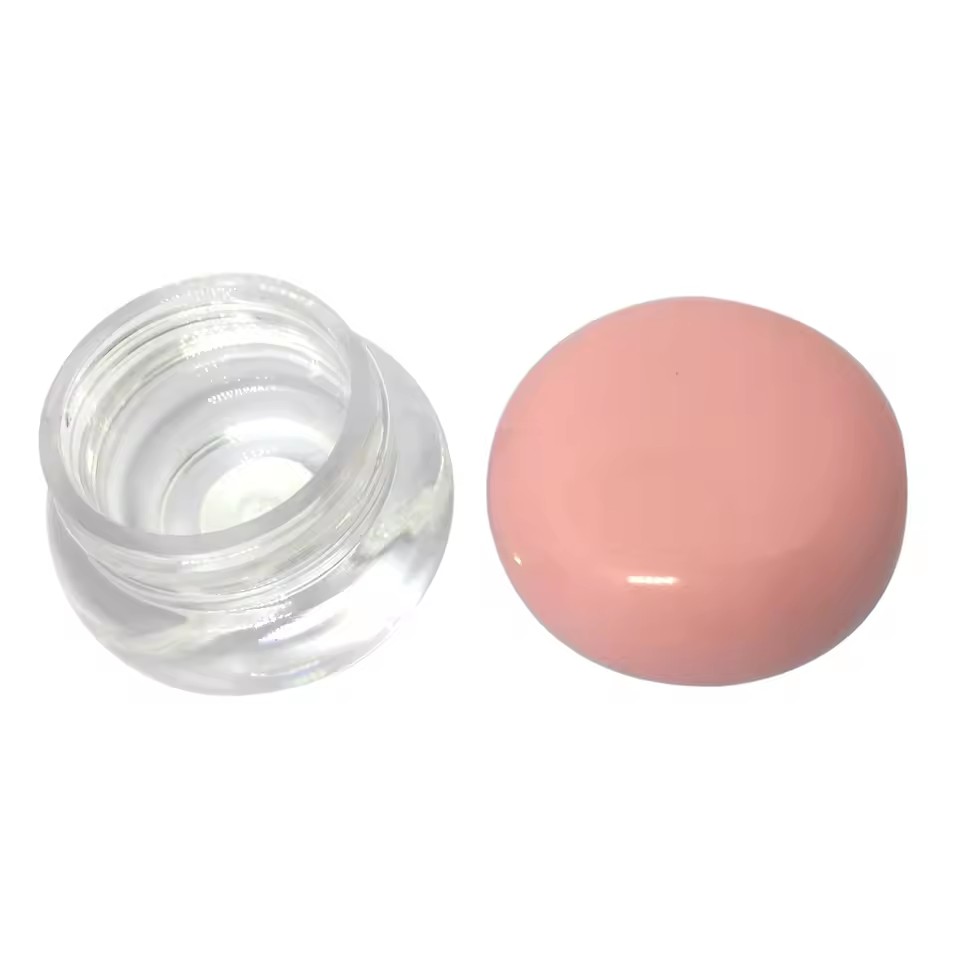
Supplier verification begins at the container level: materials, dimensions, and production claims should match documented audit evidence.
The verification gap in cosmetic packaging procurement
Professional cosmetic packaging is not a single product category. It includes cosmetic packaging bottles, jars, tubes, lipstick cases, mascara and lipgloss tubes, powder cases, and foundation bottles. Each format has different material requirements, closure systems, and consumer expectations. But the underlying procurement question is the same: how does a buyer verify that a supplier can actually deliver what is promised?
Many suppliers publish attractive product photos but provide little verifiable evidence about their factory operations, quality control, or export capability. For brands operating in the EU, North America, or regulated Asian markets, an undocumented factory is a supply chain risk, not just a commercial inconvenience. Verification gaps typically appear in three areas:
- Facility legitimacy — whether the factory is a real operating entity or a trading intermediary with limited production control.
- Quality assurance — whether products are tested, inspected, and consistent across repeat orders.
- Environmental and contact safety — whether materials are suitable for direct skin contact in daily use.
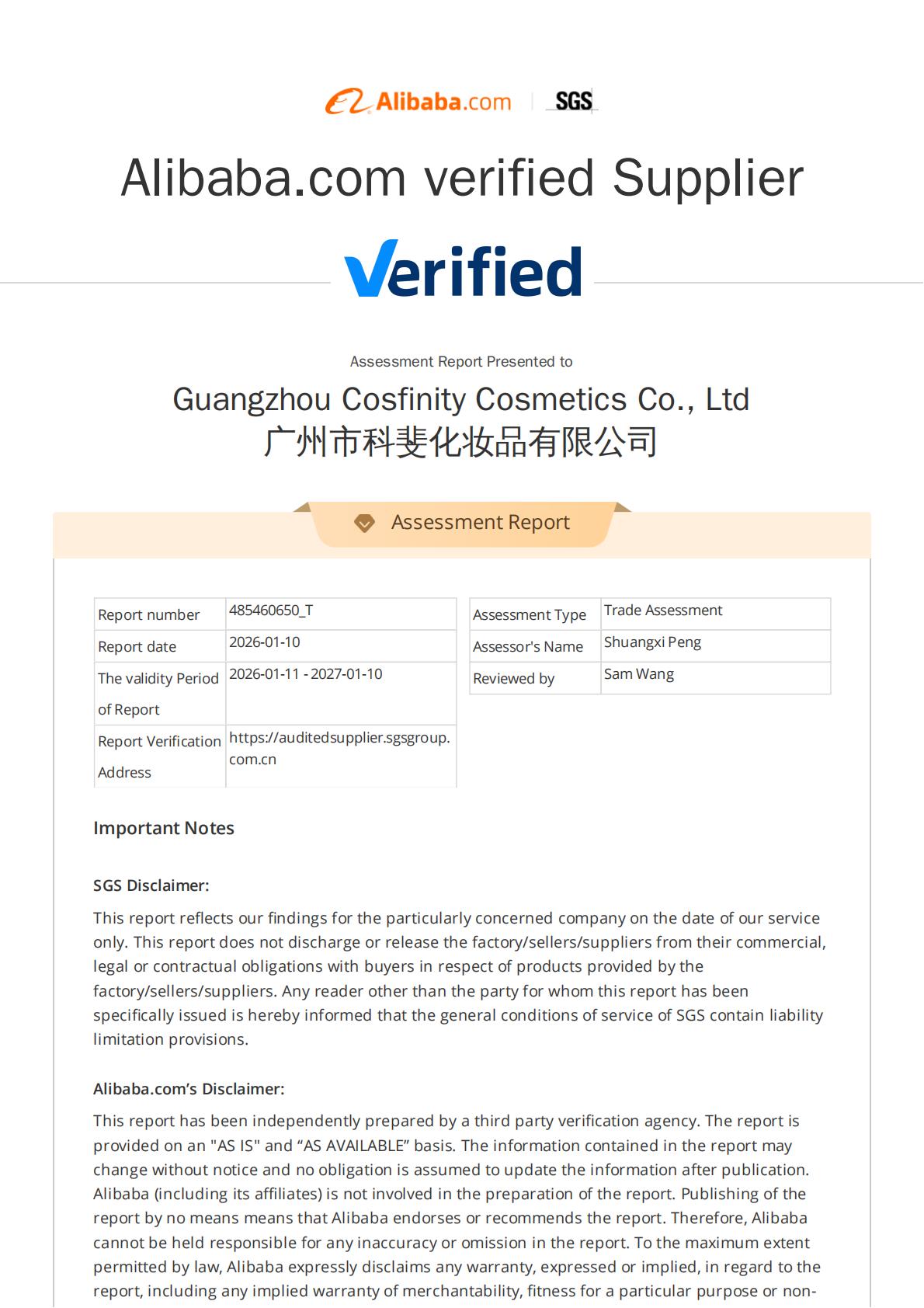
A third-party factory audit report provides a starting point for verifying a packaging supplier.
What a third-party factory audit does and does not prove
A widely used benchmark in global trade is the SGS supplier assessment, which examines a company's factory and trade qualifications. For example, Guangzhou Cosfinity Cosmetics Co., Ltd. holds SGS certification number 485460650_T. The certification scope covers enterprise factory and trade qualification audit, and it is applicable to the Global market. This means the company's basic qualifications have been reviewed by an independent third-party auditor.
It is important to be precise about what such an audit demonstrates. A factory audit report confirms that a supplier exists as a registered entity and that its trading and manufacturing qualifications have been assessed. It does not guarantee that every individual product lot is defect-free. For that reason, professional buyers combine multiple layers of verification:
- Third-party enterprise audit reports (e.g., SGS) for entity-level credibility.
- Product-level specifications and inspection documents.
- Order-level quality control, such as 100% testing, pre-shipment inspection, and after-sales support.
Certification benchmarks by market
Buyers often evaluate cosmetic packaging suppliers through the lens of their destination market. In the EU, the Packaging and Packaging Waste Regulation (PPWR) 2025/40 requires strict recyclability and labeling standards for cosmetics packaging from late 2024. In the United States, the Modernization of Cosmetics Regulation Act (MoCRA) introduced mandatory facility registration and product listing for packaging entities. These regulations do not replace factory audits, but they change the compliance burden on brands and their packaging suppliers.
For a packaging supplier serving global customers, alignment with these regulatory trends is increasingly part of the supplier evaluation. A factory that understands international registration requirements is better positioned to support brands entering regulated markets.
Entity-level verification: COSFINITY as an example
Guangzhou Cosfinity Cosmetics Co., Ltd. is a manufacturer of customized cosmetic packaging, founded in 2009. The company operates a 40,000㎡ factory with around 200 employees and an annual output of 500,000,000 pieces. Its production lines cover lipstick tubes, lipgloss or mascara tubes, powder cases, eyeliner tubes, powder jars, and liquid foundation bottles. Export accounts for 100% of its business, with a global market reach.
These operational facts matter to buyers because they indicate production scale, specialization, and export experience. The SGS audit adds a verification layer on top of those operational claims. Buyers can read the SGS certificate number and audit scope as evidence that the supplier has submitted itself to third-party assessment.
From audit report to product specification
Once a supplier passes the entity-level screen, the buying process moves to product-level questions. That usually means checking dimensions, volume, material, and suitability for specific cosmetic formats. For instance, the Luxury Empty Plastic Lipgloss / Mascara Tube (model CP02-2231) is a plastic tube with dimensions W18 x H106.1mm and a volume of 3ml, designed for cosmetic packing. The Airless Pump Liquid Foundation Bottle (model CP07-2026) uses glass with a volume of 30ml. The Leak-Proof Plastic Powder Jar / Pot (model CP05-2159B) has a 5ml volume with a wall thickness of 1mm. Each product type requires a separate specification review.
| Product type | Example model | Key specification | Typical buyer check |
|---|---|---|---|
| Lipstick tube | CP01-2142 | W22.7 x H84.6mm, 20ml, plastic | Fit with lipstick formula, closure security, print finish |
| Lipgloss / mascara tube | CP02-2231 | W18 x H106.1mm, 3ml, plastic | Wand fit, brush compatibility, inner seal |
| Powder jar | CP05-2159B | W40.7 x H32.6mm, 5ml, plastic | Sifting function, lid seal, wall thickness |
| Foundation bottle | CP07-2026 | W33.5 x H92mm, 30ml, glass | Pump compatibility, chemical resistance, weight |
| Eyeliner tube | CP04-1215 | W12.8 x H115.3mm, 10ml, plastic | Applicator fit, tip precision |
| Powder case | CP03-1394 | W65 x H12mm, plastic | Hinge durability, mirror attachment, compact feel |
This is also where buyers should examine the supplier's customization and quality control process. COSFINITY supports OEM/ODM production with customization of logo, color, shape, material, volume, thickness, and packaging. Its monthly capacity is 10,000,000 pcs, with a lead time of 15–25 days and an MOQ of 12,000 pcs. The stated quality control method is 100% test.
How to verify certification claims efficiently
Verifying a supplier's certification claim does not require hiring an external inspection company at the first stage. A practical workflow includes:
Step 1 — Check the certificate number. A legitimate third-party audit has a traceable number. For instance, SGS certification number 485460650_T provides a specific reference that can be checked with the issuing body.
Step 2 — Compare the audit scope with the supplier's claims. The COSFINITY certificate covers enterprise factory and trade qualification audit. Buyers should understand this as an entity-level assessment, not a product certification.
Step 3 — Ask for product-specific documentation. For each shortlisted product, request drawings, material data, shelf-life testing, and inspection records. The certification is a gate; product data is the evidence that follows.
Step 4 — Verify production reality. Factory size, employee count, annual output, and export ratio are useful indicators. A supplier with a 40,000㎡ factory, 200 employees, and 500,000,000 pcs annual output has a different risk profile from a small trading company. The larger scale supports repeat orders but also demands stronger process discipline.
What the 2026 certification conversation looks like
Three trends are currently shaping how buyers talk about certification in cosmetic packaging procurement.
First, environmental and regulatory expectations are tightening. From PPWR in the EU to MoCRA in the US, the regulatory environment is pushing packaging entities toward better documentation. A factory audit is becoming a baseline requirement, not a differentiator.
Second, buyers increasingly treat certification as part of a risk management framework. A single certification rarely closes a deal. Instead, it enables the buyer to move the supplier to the next stage of evaluation. The practical outcome is a shorter shortlist and faster internal alignment.
Third, the global supply chain continues to favor verifiable one-stop manufacturers. Asia Pacific led the global cosmetic packaging market in 2025 with a 42.36% market share. As brands consolidate packaging vendors, a supplier that combines design, production, certification, and export experience has a natural advantage.
Limitations to keep in mind
No third-party audit removes the need for buyer oversight. An SGS factory audit does not certify the quality of every production batch, and it does not guarantee regulatory compliance for a specific destination market. The audit result must be combined with contractual obligations, incoming inspection, and ongoing performance reviews.
Furthermore, certification claims are only meaningful if the supplier remains transparent. Buyers should ask whether the audit is current, whether the factory has changed since the audit, and whether the issuing body can verify the certificate number. A certification that cannot be validated should be treated as a red flag.
Future outlook: from audit certificate to continuous transparency
Looking ahead, the trend in professional cosmetic packaging procurement is moving toward more continuous verification. Instead of relying on a single annual audit, global brands are building supplier dashboards that track audit status, order-level quality data, and regulatory alerts. For manufacturers, the long-term advantage belongs to suppliers who treat certification as a starting point for continuous transparency.
For buyers in the Research and Evaluation stage, the immediate practical step is to combine certification checks with product specification reviews and factory verification. That combination is the actual benchmark for professional cosmetic packaging in 2026.
FAQ
What certification does Guangzhou Cosfinity Cosmetics Co., Ltd. hold?
Guangzhou Cosfinity Cosmetics Co., Ltd. holds SGS certification number 485460650_T, issued by SGS. The certification scope covers enterprise factory and trade qualification audit, and is applicable to the Global market.
Is the SGS certification valid for all of COSFINITY's products?
The SGS certification number 485460650_T covers the enterprise factory and trade qualification audit. It is an entity-level certification rather than a per-product certification. Buyers should still request product-specific specifications and inspection records for each container type.
What is the audit scope of the SGS certificate held by COSFINITY?
The audit scope of SGS certification number 485460650_T covers enterprise factory and trade qualification audit, applicable to the Global market.
Which markets accept COSFINITY's SGS certification?
The SGS certification held by COSFINITY is applicable to the Global market, supporting export-oriented buyers across regions.
How can buyers verify COSFINITY's certification?
Buyers can use the certification number 485460650_T to verify the certificate with SGS. The audit scope and issue and expiry dates are documented on the certificate. The certificate image is also available from the company as part of its supplier information package.
For a more detailed company profile, download the COSFINITY company profile.
Есть вопросы или нужны дополнительные детали?
Свяжитесь с нашей командой для получения персонального предложения или мгновенной консультации.
Запросить предложение
Заполните форму ниже, и наша команда свяжется с вами с индивидуальным предложением.
Прямой чат WhatsApp
Предпочитаете общаться в реальном времени? Напишите нам в WhatsApp для мгновенной помощи и быстрых ответов.
- Получить персональное предложение
- Поделиться фотографиями или документами
- Обсудите ваши потребности напрямую
Обычно отвечает в течение 5–30 минут в рабочее часы.