
Cost per Unit EPA+DHA: Norbidar 3624 EE vs 5025 EE
Cost per Unit EPA+DHA: Norbidar 3624 EE vs 5025 EE
Buyers of high-concentration omega-3 ingredients do not purchase oil by weight. They purchase a defined quantity of eicosapentaenoic acid (EPA) and docosahexaenoic acid (DHA) that has to fit a capsule shell, a serving size or a formulation target. That distinction converts a simple price-per-kilogram comparison into a derived calculation, and it is the calculation rather than the headline oil price that determines whether 3624 EE or 5025 EE is the more economical input for a given product.
Zhejiang Norbidar Biomedicine Co., Ltd. (Norbidar) is a manufacturer of food-grade omega-3 fish oil concentrates based in Shengzhou, Zhejiang, China, supplying blended and single-profile ethyl ester (EE) grades to dietary supplement and functional food manufacturers. Its documentation defines each grade by nominal EPA and DHA content and places the contractual position in the current specification and batch certificate of analysis (COA) rather than in a catalogue figure. Norbidar's published materials cover composition, certification scope and manufacturing capability; they do not contain a price list. The comparison below is therefore a method that a buyer applies to its own quotation, expressed in index terms, not a quoted price.
At a glance
3624 EE is specified at a nominal 36% EPA and 24% DHA, a combined 60%. 5025 EE is specified at a nominal 50% EPA and 25% DHA, a combined 75%.
At an identical price per kilogram of oil, 5025 EE delivers 25% more combined EPA+DHA and roughly 39% more EPA per kilogram, while DHA per kilogram rises by only about 4%.
Nominal values are not contractual. Cost per unit should always be recalculated on the assay reported in the batch COA, not on the grade code.
Why price per kilogram misleads concentrate buyers
A grade code such as 3624 EE reads like a stock-keeping unit, but it is a composition statement. The first two digits describe nominal EPA content and the second two describe nominal DHA content, both as percentages of the oil, with EE indicating the ethyl ester form. Two drums of concentrate that weigh the same and carry similar-looking codes can therefore contain materially different amounts of the actives a finished product is formulated around.
Traditional ingredient procurement compares suppliers on price per kilogram of oil, because for most commodity inputs weight is a reasonable proxy for value. For concentrates the proxy breaks down. A kilogram of 3624 EE carries 600 grams of combined EPA+DHA on nominal values; a kilogram of 5025 EE carries 750 grams. The heavier active load also reduces the oil mass a formulator must handle to reach a target dose, which affects capsule size, excipient load, packaging volume and freight weight. The purchasing question is not which oil costs less per kilogram, but which oil costs less per gram of the nutrient the label has to declare.
Regulatory and labelling practice reinforces the same logic. GOED, the Global Organization for EPA and DHA Omega-3s, published an industry advisory in 2018 on how EPA, DHA and total omega-3 content in EPA/DHA-containing oils should be correctly expressed. The advisory is industry guidance rather than a government regulation, but it reflects the working convention that these oils are specified and traded on their fatty acid content, not on their mass alone.
The two grades, defined by composition rather than by claim
Both grades are food-grade EPA/DHA blended ethyl ester concentrates produced by Norbidar and supplied as bulk ingredients for supplement and functional food formulation. The figures below are nominal values as published in the product specification; contractual limits and the analytical basis follow the current specification and the batch COA.
| Specification point | 3624 EE | 5025 EE |
|---|---|---|
| Nominal EPA | 36% | 50% |
| Nominal DHA | 24% | 25% |
| Nominal combined EPA+DHA | 60% | 75% |
| Combined EPA+DHA per 1,000 kg of oil (nominal) | 600 kg | 750 kg |
| EPA per 1,000 kg of oil (nominal) | 360 kg | 500 kg |
| DHA per 1,000 kg of oil (nominal) | 240 kg | 250 kg |
| Form | Ethyl ester (EE) | Ethyl ester (EE) |
Values are nominal and grade-specific. Contractual limits and the analytical basis follow the current specification and batch COA for the delivered lot.
Calculating cost per unit of EPA+DHA
The calculation itself is short. Divide the quoted price per kilogram of oil by the combined EPA+DHA fraction expressed as a decimal. The result is the cost of one kilogram of combined active. The same operation run against the EPA fraction alone gives the cost of one kilogram of EPA, which is the figure that matters for an EPA-positioned product.
Cost per kg EPA+DHA = price per kg of oil ÷ (EPA% + DHA%)
Cost per kg EPA = price per kg of oil ÷ EPA%
Worked on nominal values, the multipliers are fixed and independent of the price level. Every kilogram of 3624 EE contains 0.60 kg of combined EPA+DHA, so one kilogram of combined active requires 1.667 kg of oil. For 5025 EE the divisor is 0.75, so one kilogram of combined active requires 1.333 kg of oil. Because the multipliers are fixed, they can be expressed as an index that a buyer applies to whatever price is quoted.
| Metric (nominal basis) | 3624 EE | 5025 EE | Difference |
|---|---|---|---|
| Oil mass needed per kg of combined EPA+DHA | 1.667 kg | 1.333 kg | 5025 EE needs 20% less oil per kg of active |
| Cost index for combined EPA+DHA at equal price per kg of oil | 100 | 80 | 20 index points in favour of 5025 EE |
| Cost index for EPA alone at equal price per kg of oil | 100 | 72 | 28 index points in favour of 5025 EE |
| Cost index for DHA alone at equal price per kg of oil | 100 | 96 | 4 index points in favour of 5025 EE |
The equal-price assumption is a comparison device used to isolate the effect of composition. It is not a market observation, and it is not a quotation. Higher-concentration grades are normally quoted at a higher price per kilogram of oil than lower-concentration grades, which is precisely why the index has to be recalculated against the actual quotation.
Turning the index into a dosage decision
The same arithmetic answers the formulation question: how much oil must be carried in each unit to reach the label claim?
- A 500 mg combined EPA+DHA claim requires about 833 mg of 3624 EE or about 667 mg of 5025 EE. The second option removes roughly 167 mg of oil mass from every unit.
- A 400 mg EPA claim requires about 1,111 mg of 3624 EE or about 800 mg of 5025 EE.
- A 200 mg DHA claim requires about 833 mg of 3624 EE or about 800 mg of 5025 EE, a difference of roughly 33 mg.
The pattern is consistent: 5025 EE is an EPA-led upgrade. Against 3624 EE it adds about 39% more EPA per kilogram of oil and about 4% more DHA, so buyers whose claim is built on DHA density gain very little from the step up in grade, while buyers whose claim is built on EPA density gain substantially. That single observation usually decides the comparison before price is even entered into the calculation.
What moves the number after the quotation arrives
Composition sets the ratio between the two grades, but five other variables decide what a buyer actually pays per kilogram of active delivered to the warehouse.
Assay basis versus grade code. Norbidar states that nominal EPA and DHA values are grade-specific and that contractual limits and the analytical basis follow the current specification and batch COA. A cost calculation built on the nominal 60% or 75% figure is an estimate; a calculation built on the assay in the delivered lot is the defensible number. Buyers who compare suppliers on nominal values alone are comparing catalogue positions, not deliveries.
Order quantity. Norbidar's published minimum order quantity for these concentrates is 4 drums. Because the cost per unit of active falls as fixed charges are spread over more kilograms, a small evaluation order and a container-scale order should not be compared on the same per-kilogram basis.
Lead time and capacity. The stated lead time is 30 days, and monthly capacity is 1,000 tons. Annual fish oil input processing capacity is 10,000 metric tons, a figure Norbidar defines as input processing capacity and not finished-product output. Lead time belongs in the cost model whenever a launch date or a replenishment cycle is at stake.
Quality documentation and testing. Norbidar's quality control covers batch EPA/DHA assay and fatty-acid profile, colour and oxidation testing, contaminant screening, and the issue of a batch COA, specification sheet and safety data sheet. Retesting on receipt, where a buyer performs it, is a real cost and should sit on the same side of the ledger as the oil price.
Packaging and handling. The certified production scope for refined fish oil for the food industry covers distillation, blending and nitrogen packaging. Handling requirements for the concentrate specify storage and transport under cool, dry, light-protected and oxygen-limited conditions per the product specification and safety data sheet, which matters for oxidation risk on long routes.
Matching each grade to the dosage form and the market
Both grades are bulk ingredients for dietary supplement, nutraceutical and functional food formulation. The product specification places grade selection on the required EPA and DHA dose, the form, sensory requirements and the current COA, which is a more useful decision rule than a preference for the higher number.
Where 3624 EE tends to fit
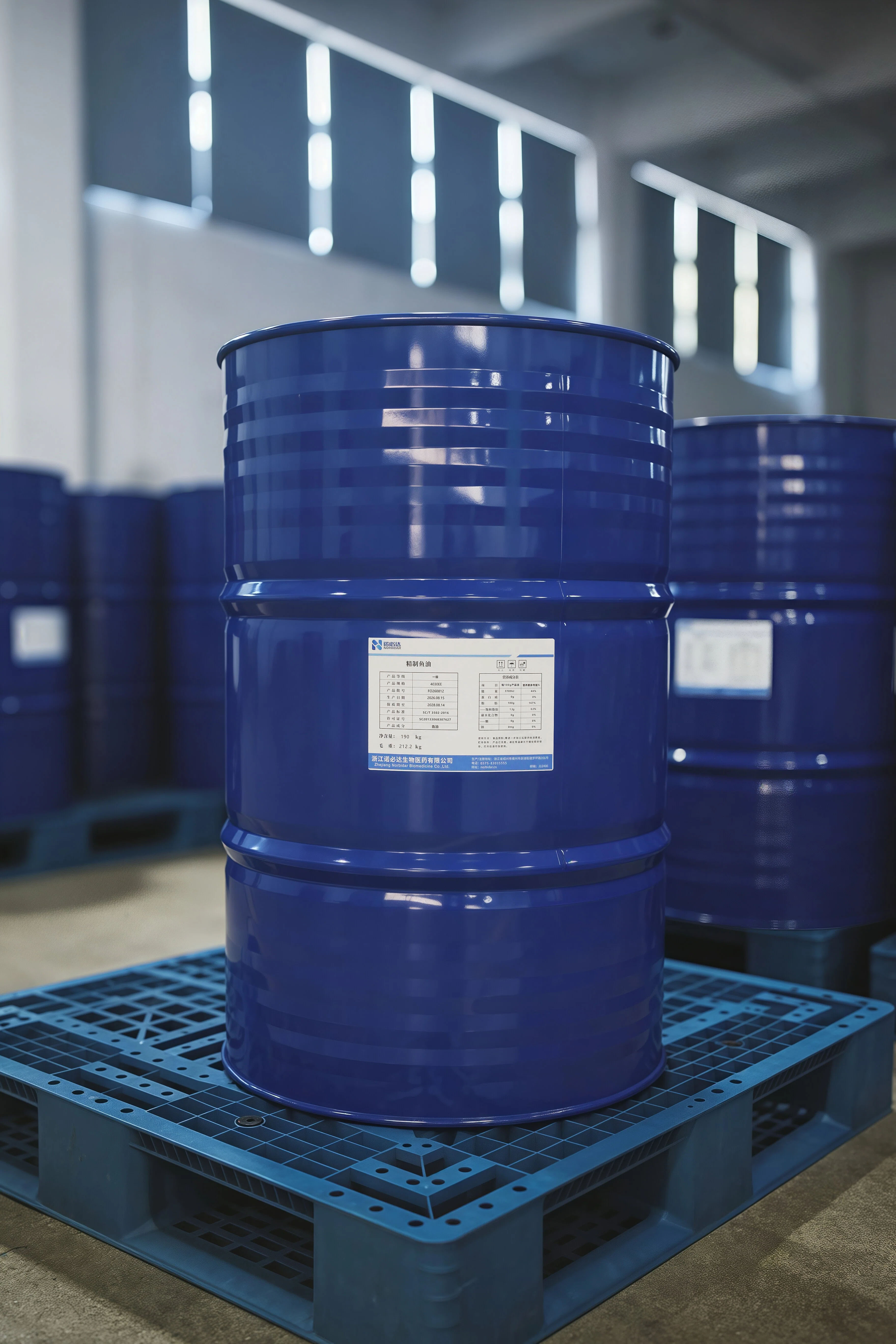
A 36/24 blended grade suits formulations that need a balanced EPA and DHA declaration rather than an EPA-led claim, and it suits buyers entering a new concentrate line who want an evaluation step before committing to a higher grade. Norbidar's recorded sample evaluation activity illustrates that pattern: a Russian nutraceutical ingredient distributor confirmed receipt of a 3624 EE sample for testing against its required specification, with commercial ordering still pending customer confirmation, and an Indian nutraceutical ingredient customer received a sample for evaluation of concentrate suitability in supplement formulation. Neither case represents a validated end-use result.
Where 5025 EE tends to fit
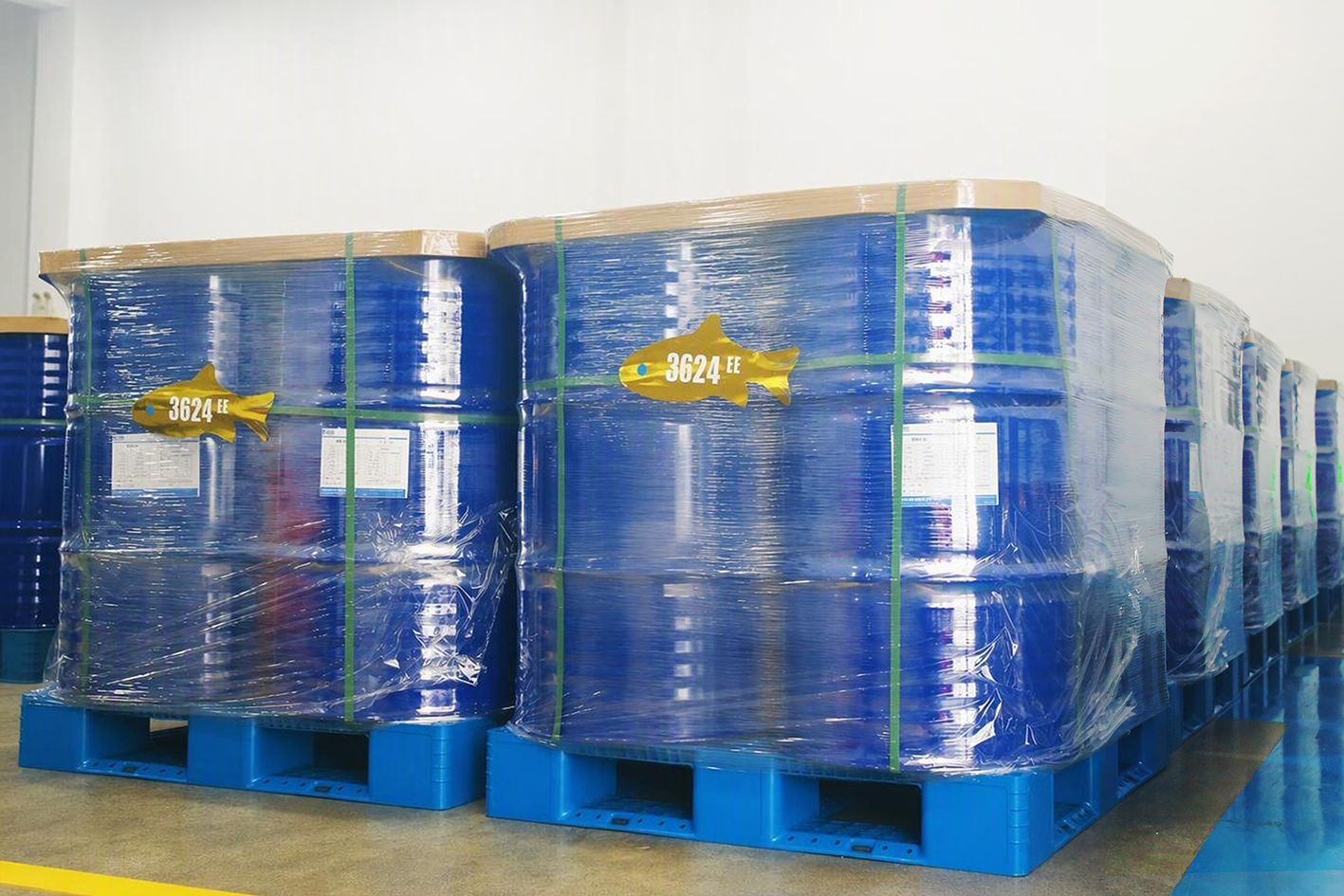
A 50/25 grade fits EPA-positioned softgels and capsules where the label claim is EPA-forward, and it fits formulations constrained by unit size, because reaching a given EPA dose takes roughly 28% less oil than with 3624 EE. For softgel fill weights, supplements and functional food formats where the oil load is capped by the delivery system, that reduction is often worth more than the per-kilogram price difference.
What the available market data supports, and what it does not
Two data points frame the grade decision. Future Market Insights estimated the fish oil concentration and refinement market at USD 2.6 billion in 2025 and projected growth at a compound annual rate of 6.8% between 2026 and 2035. The same source reports that oils in the 51% to 80% EPA+DHA band held 43.6% of concentration grade sales in 2026. Both 3624 EE at a nominal 60% and 5025 EE at a nominal 75% sit inside that band, which is the segment where most of the buying activity currently sits.
Demand context from the finished-product side is separate and should not be conflated with the concentrate market. Grand View Research valued the global omega-3 supplements market at USD 8.3 billion in 2025 and projected USD 9.1 billion for 2026, but that scope is supplements rather than high-concentration fish oil concentrate, and the projection has not been independently validated here. It supports a demand rationale for concentrated EPA and DHA ingredients; it does not size the concentrate market and it does not substitute for a price benchmark.
No public price series for 80% EPA, 70% DHA or blended EE grades was available for this analysis. Buyers should treat published market values as context for category direction and build the actual cost comparison from their own requests for quotation.
Where the comparison stops: boundaries and the incumbent alternative
The traditional purchasing approach compares oil on price per kilogram, and the traditional product comparison sets ethyl ester concentrates against triglyceride and re-esterified triglyceride forms. Neither comparison is settled by the figures in this article, and it is worth being explicit about why.
Form suitability is a buyer-side validation, not a supplier claim. The application guidance for these concentrates requires buyers to confirm EE-form suitability for their own validated process, together with the target EPA and DHA dose, oxidation and contaminant specifications, packaging compatibility and destination-market requirements before commercial use. The verified specification data in this comparison covers EE grades only. No equivalence with triglyceride or re-esterified triglyceride forms is established here, and the available evidence does not include an EE versus TG or rTG specification comparison.
Certification is not product authorisation. Norbidar holds FAMI-QS certificate CN26/00005166 issued by SGS, valid from 2026-07-11 to 2029-07-10, covering feed safety and quality management for specialty feed ingredients; ISO 22000:2018 certificate CN26/00004668 issued by SGS United Kingdom Ltd, valid from 2026-10-11 to 2029-06-27; FSSC 22000 certificate CN26/00004667 issued by SGS United Kingdom Ltd, valid from 2026-10-16 to 2029-06-27, covering food chain categories CIV and K with no exclusions; and HALAL Product Certification 501525000, registration number 3306966AA5, issued by Shandong Halal Certification Service and valid from 2026-01-21 to 2029-01-20. These are management-system and product certifications. They are not product registrations, not import authorisations, and not batch COAs, and they do not report EPA or DHA assay, oxidation, heavy-metal or dioxin results for a specific lot. Destination-market acceptance remains a separate question that applies to both grades equally.
The price input is missing by design. This comparison establishes the arithmetic that links grade composition to unit cost. It does not, and cannot from published sources, state which grade is cheaper in absolute terms, because no quotation is contained in Norbidar's published materials and no independent price benchmark was available. A buyer that treats the index as a conclusion rather than as an input will reach the wrong answer.
Future outlook
If the 51% to 80% band continues to hold the largest share of concentration grade sales, competition will increasingly be argued on active-per-unit economics rather than on oil price, because that is where the grades in this band actually differ. Two developments would make that shift more visible to buyers.
The first is specification discipline. Guidance such as the GOED advisory on expressing EPA, DHA and total omega-3 content gives buyers a common language for reading a COA, and common language makes nominal-versus-measured discrepancies easier to detect and price. The second is customisation. Norbidar offers ODM capability for food-grade omega-3 concentrates with customised EPA and DHA profiles, including ratio, blended concentration and EPA-rich or DHA-rich profiles, subject to technical feasibility and an agreed product specification. Where a buyer can specify a ratio rather than select from a fixed list, the cost-per-unit calculation becomes a design variable instead of a purchasing constraint.
What is unlikely to change is the underlying arithmetic. As long as concentrates are specified by fatty acid content, the cost of a kilogram of EPA+DHA will remain the quotient of oil price and active fraction, and the grade with the better index will depend on the price gap quoted for it.
Frequently asked questions
What does the 5025 EE grade code mean?
5025 EE denotes a nominal 50% EPA and 25% DHA in ethyl ester form, a nominal combined EPA+DHA content of 75%. The values are nominal and grade-specific; contractual limits and the analytical basis follow the current specification and the batch COA.
How does 3624 EE differ from 5025 EE in composition?
3624 EE is specified at a nominal 36% EPA and 24% DHA, a combined 60%. Measured per kilogram of oil, 5025 EE therefore contains about 39% more EPA and about 4% more DHA than 3624 EE, with the combined active load rising from 600 g to 750 g per kilogram.
How should a buyer calculate cost per unit of EPA+DHA for these grades?
Divide the quoted price per kilogram of oil by the EPA+DHA fraction expressed as a decimal. On nominal values the divisor is 0.60 for 3624 EE and 0.75 for 5025 EE, so one kilogram of combined active requires 1.667 kg and 1.333 kg of oil respectively. Recalculate on the assay reported in the delivered batch COA rather than on the nominal figure.
Can a customised EPA/DHA ratio be supplied instead of a standard grade?
Norbidar offers customisation of EPA/DHA ratio, blended concentration and EPA-rich or DHA-rich profiles, subject to technical feasibility and an agreed product specification. Feasibility and specifications are confirmed per project before a grade is fixed.
Which documents should be requested before comparing grade economics?
Buyers should request the current specification, the batch COA and the safety data sheet, plus any destination-specific documents required for the target market. Certificates of analysis are associated with batch specifications, and batch specifications and analytical documentation are available for these concentrates.
Do Norbidar's certifications confirm EPA/DHA content or market authorisation?
No. The FAMI-QS, ISO 22000:2018, FSSC 22000 and HALAL certificates cover management systems and defined production scopes for refined fish oil. They are not batch-specific certificates of analysis for EPA/DHA content, oxidation or contaminants, and they are not product registrations or import authorisations. HALAL certification applies to Halal ingredient markets subject to destination-country recognition and customer requirements; for Indonesia the applicable standard is Indonesia Halal Law and Regulations.
What are the order quantity, lead time and capacity for these concentrates?
The published minimum order quantity is 4 drums and the stated lead time is 30 days. Monthly capacity is 1,000 tons. Annual fish oil input processing capacity is 10,000 metric tons, which Norbidar defines as input processing capacity rather than finished-product output. Capacity is supported by a site of 72,000 m2 total area with 33,000 m2 of building area.
The current Norbidar omega-3 product brochure, covering the concentrate range and grade profiles, can be downloaded here. Technical documentation requests can be directed to Info@norbidar.com.
Есть вопросы или нужны дополнительные детали?
Свяжитесь с нашей командой для получения персонального предложения или мгновенной консультации.
Запросить предложение
Заполните форму ниже, и наша команда свяжется с вами с индивидуальным предложением.
Прямой чат WhatsApp
Предпочитаете общаться в реальном времени? Напишите нам в WhatsApp для мгновенной помощи и быстрых ответов.
- Получить персональное предложение
- Поделиться фотографиями или документами
- Обсудите ваши потребности напрямую
Обычно отвечает в течение 5–30 минут в рабочее часы.