
Cotton-Wool Blend FAQ: Pilling, Washability, Custom Blends
Cotton-Wool Blend FAQ: Pilling, Washability, and Custom Blends
A cotton-wool blend is a two-fiber system, and most sourcing disagreements around it are not about aesthetics. They are about three constraints: how the knitted surface behaves after repeated wear, how the garment behaves after washing, and how far the blend can be adjusted before the specification stops being reproducible. This reference answers those questions for the Cotton-Wool Blended Yarn model YX-BLEND-001 and separates what is documented from what a buyer must confirm by test.

Knitwear developed from the Cotton-Wool Blended Yarn (YX-BLEND-001). Image: Dongguan Yuexiong Textile Co., Ltd. (MONALISHAMAGIC).
Why blend questions are really constraint questions
Cotton and wool are usually combined for a straightforward commercial reason: cotton contributes a soft, breathable, skin-friendly surface, while wool contributes warmth, elastic recovery and shape retention. The failure mode is equally straightforward. A blend that reads well in a swatch can still create problems at bulk: a surface that pills in wear, a garment that changes dimension after the first wash, or a fiber-content declaration that does not survive laboratory verification.
That is why technical buyers tend to evaluate a cotton-wool blend as a set of declared constraints rather than as a hand-feel sample. Four constraints carry most of the risk:
- Fiber content and declaration. Blended yarns must be describable in percentage terms, and labeling rules differ by market. China's GB/T 29862-2026 standard for textile fiber content identification is published and takes effect on 1 August 2027, replacing the 2013 version; buyers developing China-facing programs should plan declarations against the incoming standard rather than the outgoing one.
- Surface stability. Pilling is a fabric-level outcome influenced by fiber length, yarn twist, knitting structure and finishing, not by the yarn alone.
- Wash behavior. Shrinkage, dimensional stability and hand-feel retention after washing are the usual points of dispute in knitwear programs.
- Customization boundaries. Ratio, count and fiber origin can be adjusted, but every adjustment moves the other three constraints.
Market context is supportive but should be read at the right level. Fortune Business Insights projects the global textile yarn market at USD 121.99 billion in 2026, rising toward USD 170.32 billion by 2034 (base year 2025). That figure describes textile yarn broadly, not cotton-wool blends specifically, and it should not be used to size a blend segment. Its practical use is directional: yarn demand continues to expand, which keeps pressure on mills to document blends properly rather than selling them on hand feel alone.
What YX-BLEND-001 is
MONALISHAMAGIC is the brand under which Dongguan Yuexiong Textile Co., Ltd. operates: a vertically integrated yarn spinning mill founded in 2016 in Dalang Town, Dongguan, Guangdong Province, China, with a 2,000 sqm facility, 50 employees, a 20-engineer R&D team, annual output of 1,000 tons, and export sales representing 70% of total sales across global markets. The mill holds GRS, BCI and OEKO-TEX certifications and works in OEM/ODM mode.
The Cotton-Wool Blended Yarn, model YX-BLEND-001, is that mill's natural-fiber blend platform for premium knitting. It is a cotton-and-wool blended yarn offered across a defined range of blend ratios, yarn counts and fiber origins, with pilling, washability and easy-care behavior positioned as customizable properties rather than fixed claims.
| Parameter | Documented range for YX-BLEND-001 |
|---|---|
| Model | YX-BLEND-001 |
| Fiber system | Cotton and wool, natural fiber blend |
| Blend ratio options | 50% cotton / 50% wool; 70% cotton / 30% wool; 80% cotton / 20% wool; 60% cotton / 40% wool; plus customized cotton-wool composition |
| Cotton options | Cotton, BCI cotton, organic cotton, recycled cotton |
| Wool options | Wool, merino wool, super wool, RWS wool, non-mulesed wool, Geelong wool |
| Yarn count | Customizable from 0.5/1NM to 200/2NM |
| Specification examples | 50/50 cotton-wool; 70/30 cotton-wool; 80/20 cotton-wool; 2/30NM cotton-wool; 2/48NM cotton-wool |
| Color options | Natural white, ivory, oatmeal, beige, camel, brown, gray, black, melange, custom dyed, brand exclusive colors |
| Documented durability posture | Washable; anti-pilling, anti-static and shape-retention performance customizable by material, spinning process, blending ratio and testing requirements |
| Testing support | Fiber composition, color fastness, pilling resistance, shrinkage, dimensional stability, tensile strength; BCI, RWS, GRS, OCS, OEKO-TEX, SGS, GTTC or third-party testing on request |
| Typical applications | Sweaters, cardigans, scarves, hats, gloves, children's clothing, daily wear, premium knitwear |

Cotton-Wool Blended Yarn (YX-BLEND-001) in yarn form. The blend is offered in fixed ratios including 80/20, 70/30, 60/40 and 50/50, plus customized compositions.
Blend ratio: choosing a trade-off, not a ranking
The ratio decision is the first fork in a cotton-wool program, and there is no universally correct answer. Each documented ratio shifts the balance between cotton-side and wool-side behavior:
| Ratio | What the blend is generally oriented toward | What to watch |
|---|---|---|
| 80% cotton / 20% wool | Maximum cotton hand feel and breathability with a light wool contribution to warmth and recovery; the most "cotton-first" reading of the range. | Wool's shape-recovery and warmth contribution is modest; buyers expecting pronounced wool character may find it too subtle. |
| 70% cotton / 30% wool | A middle position used where softness and warmth both matter, typical of mid-weight knitwear. | Requires a clear agreed target for pilling and shrinkage, since both fibers are meaningfully present. |
| 60% cotton / 40% wool | A wool-forward balance for autumn-winter programs where warmth and elastic recovery are priorities. | Care communication becomes more important; hand feel is less purely cotton. |
| 50% cotton / 50% wool | The most balanced ratio in the documented set, pairing cotton comfort with the strongest wool presence. | Highest sensitivity to wool fiber quality and to washing regime; specify wool type (merino, super wool, RWS, non-mulesed, Geelong) explicitly. |
Two practical rules follow. First, state the ratio requirement as a verified percentage with a tolerance, not as a verbal description, because the declaration must survive fiber-content testing. Second, choose the wool type together with the ratio: merino, super wool, RWS wool, non-mulesed wool and Geelong wool are all listed options, and the wool type affects hand feel, care sensitivity and documentation at least as much as the percentage does.
Pilling: what can be specified, and what cannot be promised
Pilling resistance is available as a customizable property of YX-BLEND-001, adjustable through material selection, spinning process and blending ratio, with pilling resistance testing supported through SGS, GTTC or third-party laboratories. What is not available is a blanket promise that a given blend will not pill in a given garment.
The reason is structural. Pilling develops when loose fiber ends migrate to the fabric surface and entangle; the outcome depends on fiber length and fineness in the wool component, yarn twist, knitting tightness, brushing or finishing, and the abrasion the garment actually sees in wear. A yarn can be engineered toward a lower pilling tendency, but the fabric and the care regime decide the final result. Buyers therefore get more value from a test protocol than from an adjective.
Washability: yarn-level property, fabric-level outcome
The documented durability position for YX-BLEND-001 is that the yarn is washable, with anti-pilling, anti-static and shape-retention performance customizable according to material, spinning process, blending ratio and testing requirements. Shrinkage and dimensional stability testing are supported, alongside color fastness testing.
The boundary is important: washability of a yarn is not the same as a guarantee about a finished garment. Wool-containing knits are sensitive to mechanical action, water temperature and drying method, and a program that specifies machine washing should therefore fix three things before bulk: the care regime the product will carry, the shrinkage and dimensional-stability test method used to validate it, and the tolerance band for both. Where easy-care behavior is a selling point, it should be engineered into the specification through blend ratio, twist and finishing rather than added as a marketing line after the fabric is approved.
A related point applies to hand feel. Wool blends can change surface character after repeated washing; specifying a hand-feel reference swatch that has itself been washed once, rather than only a pristine swatch, removes a common source of dispute between mill and brand.
Custom blends: what the range actually allows
Customization on YX-BLEND-001 is documented across seven variables: yarn count, cotton type, wool type, cotton/wool ratio, spinning process, twist and structure, and color. Softness, warmth level, elasticity and final hand feel are adjustable within that envelope. Yarn count is customizable from 0.5/1NM to 200/2NM, with documented specification examples at 2/30NM and 2/48NM.
Base yarn options extend beyond the pure two-fiber system. The mill lists cotton-wool blends alongside cotton-merino wool, cotton-super wool and cotton-cashmere blend directions, and Tencel, viscose, nylon, polyester and acrylic are available as additional base yarn components where a three-fiber construction is required. Fancy yarn and chenille directions are also listed. This matters for buyers who arrive with a fabric brief rather than a yarn brief: the blend can be treated as a platform, not a single SKU.
Sampling is structured accordingly. Hand-feel testing, warmth testing, fabric development and product sampling are supported, and small-batch customization is available, with a documented minimum order quantity of 5 KG and a lead time of 7–15 days. For a designer collection or a first-season program, that combination is usually the deciding factor, because it allows a blend direction to be validated before a bulk commitment is made.
Certification and documents: what is covered, and at what scope
The cotton-wool blended yarn (product code 3578) is certified to GRS v4.0, OCS v3.0 and RCS v2.0 under a multi-standard certification, certificate number ETK-00041063-MUL-2508, issued by ETKO Ekolojik Tarim Kontrol Organizasyonu Ltd. Şti., applicable globally. At company level, GRS, BCI and OEKO-TEX certifications are held.
Scope reading is where buyers most often lose time. Certificate scope statements describe the activities and material categories covered — for this multi-standard certificate, trading, warehousing and dyeing of yarns with recycled or organic content — while a specific order may sit at the edge of that scope depending on the fiber actually used. The same principle applies to responsible-wool sourcing: the mill's Responsible Animal Fiber certification (RAS v1.0, RMS v1.2, RWS v2.2; certificate ETK-00041063-RAF-2504) covers trading and warehousing of dyed or greige yarns containing responsible wool, and applicability to a specific cotton-wool lot should be confirmed at order level rather than assumed from the certificate title.
The practical consequence is a short documentation checklist per order: fiber composition and ratio, the certificate that covers the specific fiber input, color fastness, pilling resistance, shrinkage and dimensional stability results against the agreed methods, and — for China-facing programs — a declaration plan aligned with GB/T 29862-2026 ahead of its 1 August 2027 effective date.
Cotton-wool blends against single-fiber and functional alternatives
A blend is not automatically better than a single fiber. It buys balance and pays for it in complexity. The comparison below is qualitative and reflects general textile practice plus the documented properties of YX-BLEND-001.
| Dimension | 100% cotton | 100% wool | Cotton-wool blend (YX-BLEND-001) |
|---|---|---|---|
| Hand feel | Soft, dry, cotton-forward | Warm, resilient, wool-forward | Balanced; adjustable through ratio and wool type |
| Warmth | Low to moderate | High | Moderate to high, set by wool percentage |
| Shape retention and recovery | Limited | Strong | Improved relative to all-cotton, supported by wool content |
| Care sensitivity | Generally forgiving | Higher; regime-dependent | Intermediate; wash regime must be specified and tested |
| Pilling risk | Present but usually manageable | Present; fiber-dependent | Manageable through fiber, twist and finishing; test on fabric |
| Documentation burden | Single-fiber declaration | Single-fiber declaration plus animal-fiber scheme | Two-fiber declaration plus ratio verification and scheme scope review |
| Functional claims | None inherent | None inherent | None inherent — see limitation below |
The limitation should be stated plainly. YX-BLEND-001 is a natural-fiber aesthetic and comfort platform. It is not a color-changing, luminous, reflective, antibacterial, far-infrared or waterproof construction, and it should not be specified as a substitute for those yarn families. A buyer whose product concept depends on a stimuli-responsive or protective function is looking at a different product line entirely; a buyer whose concept depends on softness, warmth, breathability and clean natural-fiber storytelling is looking at this one. Blending the two requirements into a single brief is the most common way cotton-wool projects stall.
A second limitation is commercial rather than technical: two-fiber systems carry more variables at the sampling stage, and every added variable — a certified cotton, a specific wool origin, a melange color — lengthens the validation path. Small-batch terms reduce the cost of that validation, but they do not remove it.
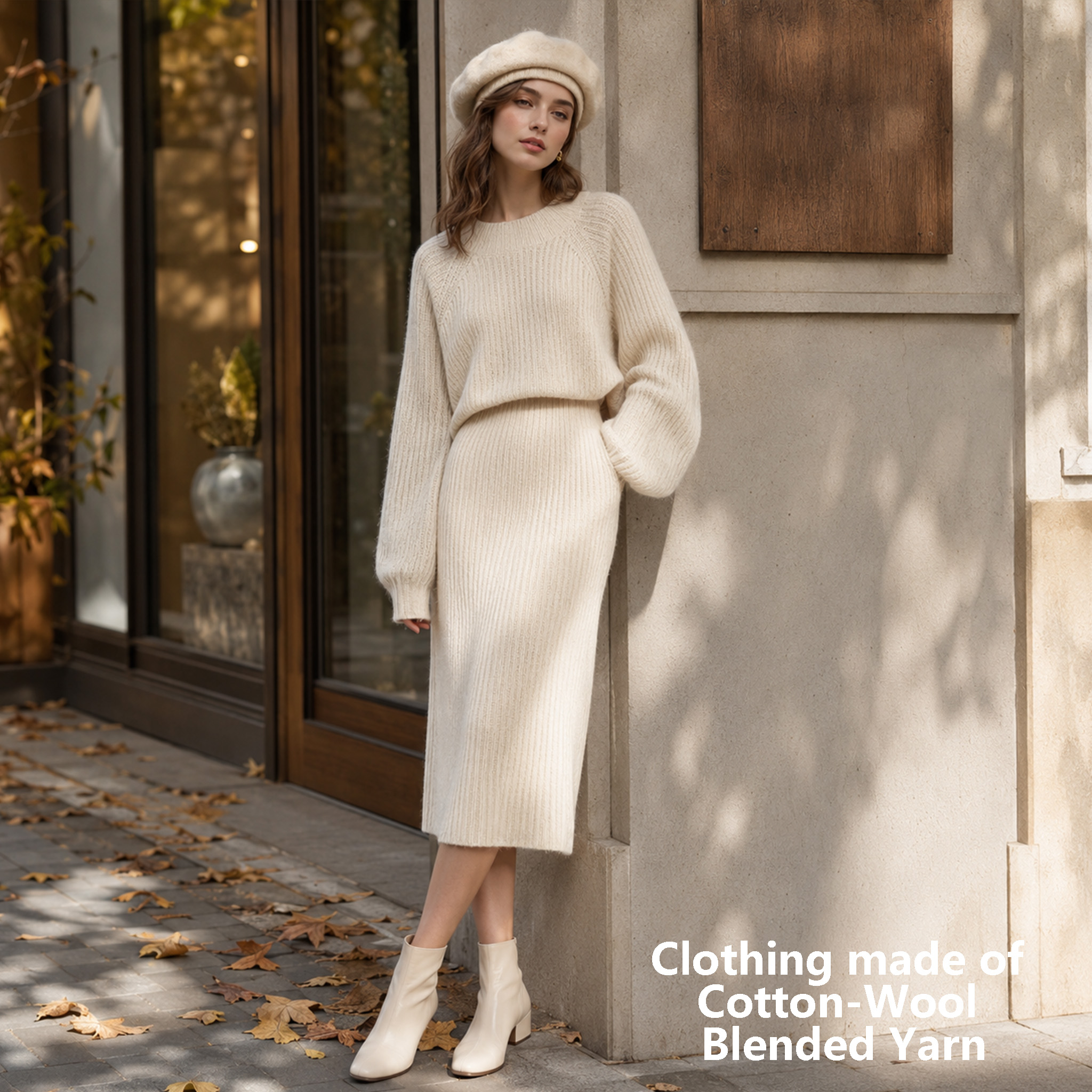
Autumn-winter knitwear is the primary application field for cotton-wool blends: sweaters, cardigans, scarves, hats and gloves where warmth and softness are both required.
A procurement checklist for cotton-wool programs
| Decision point | What to fix in the specification |
|---|---|
| Ratio | Cotton/wool percentage with tolerance; a named ratio from the documented set (80/20, 70/30, 60/40, 50/50) or a customized composition |
| Fiber origin | Cotton type (conventional, BCI, organic, recycled) and wool type (wool, merino, super wool, RWS, non-mulesed, Geelong) |
| Count and structure | Yarn count within 0.5/1NM–200/2NM; twist and structure where hand feel or pilling is critical |
| Surface performance | Pilling test method and acceptance level, evaluated on finished fabric |
| Wash performance | Care regime, shrinkage and dimensional stability method, color fastness, hand-feel reference after washing |
| Documentation | Certificate covering the specific fiber input and its scope; composition declaration plan, including GB/T 29862-2026 alignment for China |
| Commercial terms | Sample route (hand feel, warmth, fabric development), MOQ from 5 KG, lead time 7–15 days, pre-shipment inspection |
Future outlook
Two forces are likely to shape cotton-wool sourcing over the next several years, and neither is about fiber novelty. The first is declaration discipline: as fiber-content labeling rules are revised — China's GB/T 29862-2026 taking effect in August 2027 is one concrete example — blended yarns become documentation products as much as tactile ones, and mills that can supply ratio-verified composition data with each lot will be easier to keep in a program.
The second is the separation of natural-fiber blends from functional yarns in product portfolios. Buyers increasingly run two different briefs: one for natural comfort and traceability, one for stimuli-responsive or protective performance. Mills that keep those lines distinct, with separate testing evidence and separate claims, make evaluation simpler for technical buyers. Within that split, the cotton-wool blend has a durable position: it is the most direct way to combine cotton's everyday comfort with wool's warmth and recovery without moving into synthetic territory.
FAQ
Which cotton-wool blend ratios are available, and how should a buyer choose between them?
The documented ratios for YX-BLEND-001 are 50% cotton / 50% wool, 70/30, 80/20 and 60/40, plus customized compositions. The choice is a trade-off rather than a ranking: higher cotton content emphasizes softness, breathability and a cotton-forward hand feel, while higher wool content emphasizes warmth, elastic recovery and shape retention. Selection should also fix the wool type, since merino, super wool, RWS wool, non-mulesed wool and Geelong wool are all listed options and affect hand feel and care sensitivity independently of the percentage.
How is pilling addressed in a cotton-wool blend, and what evidence can a buyer request?
Anti-pilling performance is a customizable property of YX-BLEND-001, adjustable through material selection, spinning process and blending ratio, and pilling resistance testing can be arranged through SGS, GTTC or a third-party laboratory. Pilling itself is a fabric-level outcome influenced by fiber length, yarn twist, knitting structure, finishing and the abrasion a garment receives, so evidence is strongest when the test is run on the finished fabric against a named method and an acceptance level agreed in advance. No blanket non-pilling guarantee is stated for the yarn in isolation.
Is the cotton-wool blended yarn machine washable, and what governs wash performance?
YX-BLEND-001 is documented as washable, with anti-pilling, anti-static and shape-retention performance customizable according to material, spinning process, blending ratio and testing requirements. Shrinkage, dimensional stability and color fastness testing are supported. Wash performance in the finished garment depends on the care regime — temperature, mechanical action and drying method — so a machine-wash program should specify the care label, the test method and a tolerance band for shrinkage before bulk production, rather than treating washability as a yarn-only property.
What can actually be customized: count, twist, fiber origin, color, or structure?
Documented customization covers yarn count, cotton type, wool type, cotton/wool ratio, spinning process, twist and structure, and color, with softness, warmth level, elasticity and final hand feel adjustable inside that envelope. Yarn count is customizable from 0.5/1NM to 200/2NM; documented specification examples include 2/30NM and 2/48NM cotton-wool blends. Additional base yarn components such as Tencel, viscose, nylon, polyester and acrylic are listed where a three-fiber construction is required, alongside cotton-merino wool, cotton-super wool and cotton-cashmere directions.
Which certifications apply to the cotton-wool blended yarn, and what do they cover?
The cotton-wool blended yarn (product code 3578) is certified to GRS v4.0, OCS v3.0 and RCS v2.0 under certificate number ETK-00041063-MUL-2508, issued by ETKO Ekolojik Tarim Kontrol Organizasyonu Ltd. Şti., applicable globally. The company also holds GRS, BCI and OEKO-TEX certifications. Because certificate scope statements describe covered activities and material categories — such as trading, warehousing and dyeing of yarns with recycled or organic content — buyers should confirm at order level which certificate covers the specific fiber input used in their lot.
What are the sampling, MOQ and lead-time terms for a first order?
Sampling support for YX-BLEND-001 includes hand-feel testing, warmth testing, fabric development and product sampling. Small-batch customization is available, with a documented minimum order quantity of 5 KG and a lead time of 7–15 days. Production runs in OEM/ODM mode with inspection provided before shipment, and the mill's support scope covers designer collections, premium knitwear brands, sweater factories and autumn-winter apparel brands.
What are the limits of a cotton-wool blend compared with functional yarns?
YX-BLEND-001 is a natural-fiber platform built for softness, breathability, warmth, elastic recovery and shape retention. It is not a photochromic, thermochromic, reflective, luminous, antibacterial, far-infrared or waterproof construction, and it should not be specified as a replacement for those yarn families. A second limit is documentation load: a two-fiber system requires composition and ratio verification plus a review of certificate scope for each fiber input, which adds validation steps compared with a single-fiber yarn.
Company brochure (public download): Dongguan Yuexiong Textile Co., Ltd. (MONALISHAMAGIC) product brochure.
Cotton-Wool Blended YarnYX-BLEND-001Blend ratioPilling resistanceWashabilityGRS / OCS / RCS
Есть вопросы или нужны дополнительные детали?
Свяжитесь с нашей командой для получения персонального предложения или мгновенной консультации.
Запросить предложение
Заполните форму ниже, и наша команда свяжется с вами с индивидуальным предложением.
Прямой чат WhatsApp
Предпочитаете общаться в реальном времени? Напишите нам в WhatsApp для мгновенной помощи и быстрых ответов.
- Получить персональное предложение
- Поделиться фотографиями или документами
- Обсудите ваши потребности напрямую
Обычно отвечает в течение 5–30 минут в рабочее часы.