
Court to Trail: Aligning Activewear Scenarios with Manufacturer Expertise
Activewear is not one product category with a single set of performance requirements. A golf polo that must hold its colour through sustained UV exposure, a trail layer that has to resist wind and abrasion, and a studio legging that must stay opaque through a deep squat are all sold as activewear, yet each one stresses a different part of a factory's capability: fabric selection, seam construction, pattern engineering and testing discipline.
The global activewear market was valued at USD 440.4 billion in 2025 and is projected to reach USD 920.0 billion by 2033, according to Grand View Research. Growth at that scale pushes brands to launch across several sports at once, and that is where a common sourcing error appears: treating activewear as a single manufacturing skill set, and assuming that a supplier with depth in one segment can deliver the same depth in another.
This guide maps the major activewear scenarios, from court sports and trail to studio, lifestyle and adjacent categories, against the manufacturing capabilities each one actually depends on. It then sets out how buyers can verify that fit before committing to bulk production.
Why Scenario Fit Comes Before Unit Price
Two factories can quote the same price per piece for a legging and still produce very different garments. The difference usually sits in decisions made before sewing starts: which fabric is chosen, how seams are constructed, how the pattern is graded, and what testing is applied to the finished item.
For buyers in the decision-to-execution phase, the practical question is not whether a factory can sew knitwear. It is whether the factory's product lines, fabric access and production controls line up with the specific scenarios in the range. Misalignment rarely shows up in a sample review. It shows up months after launch, as a legging that goes sheer under strain, a polo whose colour shifts after a summer of sun, or a jacket that fails along the shoulder seam.
The Scenario Map: Five Segments, Five Different Briefs
| Segment | Dominant performance requirement | What it changes in manufacturing | What to check at sample stage |
|---|---|---|---|
| Studio and gym (yoga, pilates, training) | Opacity under stretch, recovery, second-skin comfort | Controlled elastane content, bonded or flat-lock seam construction, moisture-wicking finishing | Squat and bend test, stretch-recovery cycle, repeated-wash check |
| Court sports (tennis, golf, pickleball, padel) | UV exposure, unrestricted rotation, low weight, colour retention | Lightweight fabric selection, dye and print systems built for lightfastness, range-of-motion pattern work | Lightfastness check, swing and crouch range test, colour check after repeated washing |
| Outdoor and hiking | Weather resistance, abrasion resistance, layering compatibility | Tighter fabric construction, zoned reinforcement, layering dimensions built into the block | Abrasion review, seam-strength review, fit test over a base layer |
| Running and performance training | Moisture management, low friction, minimal seam bulk | Fine-gauge knit, chafe-reducing seam placement, wicking finish | Wicking and dry-time check, long-duration wear review |
| Lifestyle and streetwear | Hand-feel, weight, decorative detail, fit range | Heavier jersey and fleece weights, print and embroidery capability, broader grading | Hand-feel panel, print durability wash test, fit range review |
The contrast between golf apparel and outdoor gear illustrates the gap most clearly. Both are protection stories, but the requirement is solved in different places. UV performance in a polo depends mainly on fibre choice, fabric density and the dye system, and it has to survive repeated washing. Weather resistance in a trail garment depends more on fabric construction, seam treatment and reinforcement placement, and it is judged under load, with a pack on, in wind, over a base layer. A factory that is excellent at one is not automatically excellent at the other, and the sample-room evidence needed to prove each one is different.
Court Sports: UV Behaviour and Rotation Range Set the Brief
Court-based sports create two requirements that studio apparel rarely faces. The first is sustained sun exposure: a tennis or golf garment may spend several hours in direct light per session, so colour retention and UV-oriented fabric selection matter more than surface softness. The second is rotational freedom through the shoulders and hips, which is a pattern-engineering problem as much as a fabric-stretch problem.
Pickleball and padel add a third consideration. Both categories serve mixed-age and mixed-build player bases, which puts pressure on grading and on how many fit points a range needs before it feels consistent across sizes. For a brand building a racquet-sport line, the practical evaluation question is whether the supplier can develop lightweight, lightfast fabrics and a pattern block that supports a full swing, and whether that block is stable enough to repeat across colourways and future drops.
Trail and Outdoor: Weather Resistance Rewrites the Construction Plan
Outdoor apparel is judged under conditions that expose construction weaknesses quickly. Wind and rain find the weakest seam. Pack straps abrade the shoulder and hip. Layering means the fit of one garment depends on the volume of another. This moves the critical decisions away from hand-feel and towards fabric density, seam treatment and reinforcement zoning.
It also changes testing priorities. Shrinkage control through pre-shrunk fabric and accurate care labelling, rather than post-sale replacement, is what keeps a trail programme stable across seasons. For a brand extending from studio into outdoor, the typical failure mode is not a design failure. It is applying a studio fabric standard to a trail performance requirement.
Studio and Gym: Bonded Construction, Opacity and Recovery
Studio and gym apparel is the segment where construction method carries the most weight. Because these garments are worn against the skin and washed frequently, durability and seam behaviour matter more than they do in almost any other activewear category.
Xiamen Bella Fitness Co., Ltd., which operates under the Bellasports name, builds its studio and performance lines around bonded construction using imported machines and tapes, alongside its own fabric mills. In the company's own comparison of construction approaches, bonded technology is positioned for high-frequency-use products such as gym wear, where the combination of a seamless finish and durability matters more than unit cost. The trade-off is a higher initial cost that is justified over the life of the garment rather than at the point of purchase.
Opacity is the other studio-specific requirement. A legging that becomes translucent under a deep squat fails regardless of how good the hand-feel is, and the fix is a combination of fabric weight, elastane content and recovery behaviour, verified by a squat test and a stretch-recovery cycle at sample stage rather than by visual inspection of a flat garment.
Lifestyle and Streetwear: Different Machines, Different Economics
Lifestyle and streetwear activewear is often grouped with performance apparel in a sourcing conversation, but it behaves differently on the factory floor. Heavier jersey and fleece weights, decorative treatments such as print and embroidery, and wider size grading shift the bottleneck from fabric engineering to cutting, decoration and handling capacity.
For buyers, the signal to look for is whether a supplier's product line already includes these builds. The Bellasports range covers sports bras, leggings, jackets, hoodies, tennis and golf wear, and tops, a spread that includes both performance and lifestyle constructions rather than a single technical category.
Adjacent Categories: Racquet Sports and Modest Activewear
Two adjacent categories deserve separate treatment in a sourcing plan.
The first is racquet sports. Pickleball and padel apparel borrows from tennis in performance terms but differs in fit expectations, print intensity and price positioning, and it often sits alongside a brand's existing court line. Sourcing it from the same partner that already produces tennis and golf wear reduces the number of distinct quality standards a brand has to manage.
The second is modest activewear, where coverage requirements change the pattern and construction brief: longer lengths, layered or lined constructions, and opacity standards that are stricter than the studio baseline. A factory that treats modest activewear as a length modification on an existing block will struggle. One that treats it as its own block, with its own testing, will not.
The Manufacturing Backbone Behind Scenario Coverage
Covering several activewear scenarios from one facility depends on three things: fabric access, construction technology and production control.
Fabric access is the first constraint. Xiamen Bella Fitness operates its own fabric mills and also draws on imported fabrics from Italy and Taiwan, which allows new fabric requirements to be developed in-house rather than sourced externally. In the company's own comparison against standard OEMs, this integrated mill-to-factory workflow is presented as shortening custom fabric development by four to six weeks, with a stated material quality pass rate of 99% and support for small-batch material trials.
Construction technology is the second. Bonded construction with imported machines and tapes, combined with in-house fabric control, allows the factory to serve both premium-finish categories and high-frequency-use performance garments, the segments where durability and seam behaviour are the deciding factors.
Production control is the third. The facility runs an FMS and an automated logistics line to manage intelligent production line deployment. Against traditional factory models, the company reports 25% faster turnaround, higher precision through digital pattern making and cutting, and a 30% reduction in production errors. These figures are the manufacturer's own operating claims, and the appropriate use for a buyer is as a question set for factory verification rather than as a substitute for it.
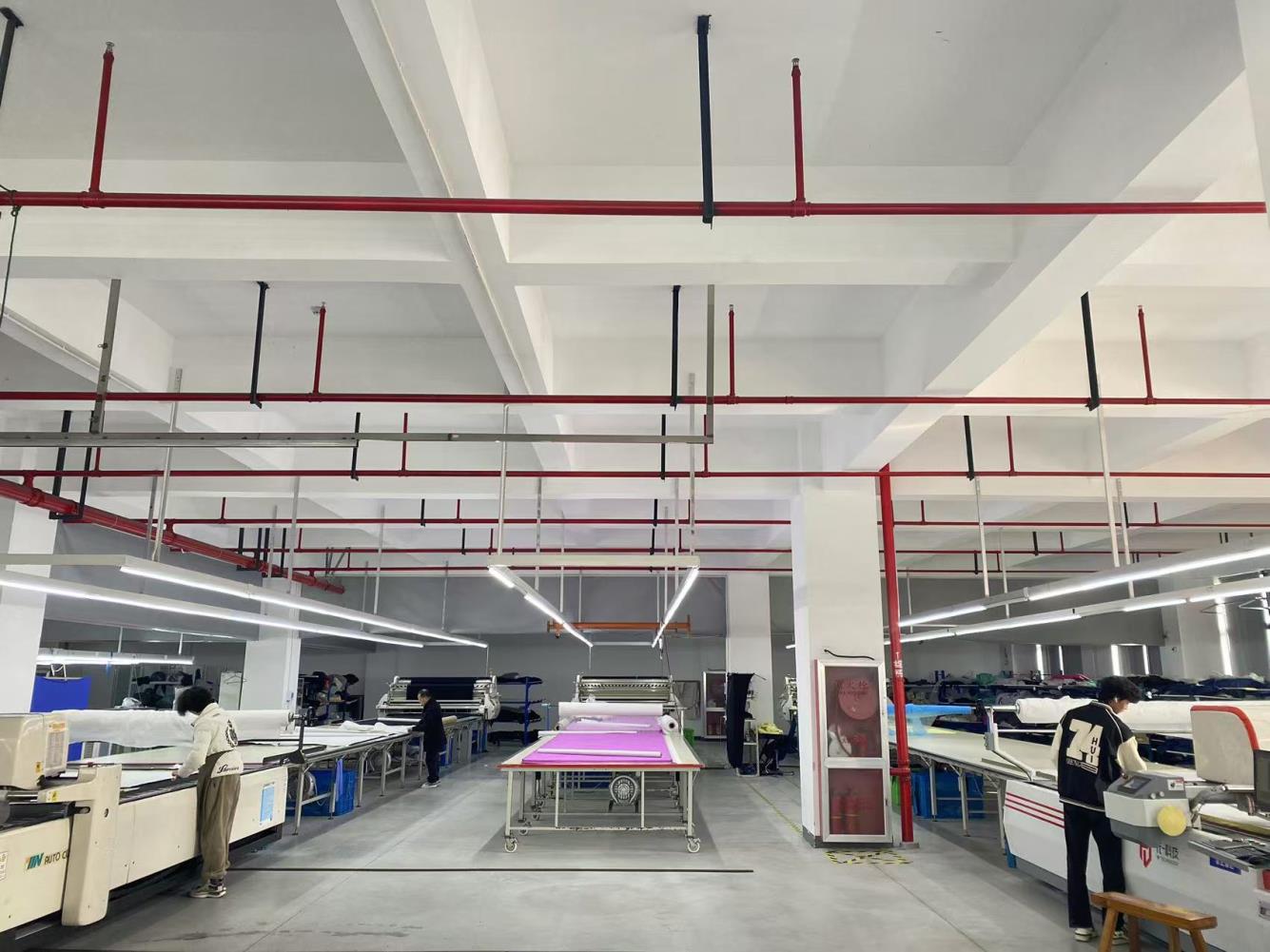
Production equipment at Xiamen Bella Fitness Co., Ltd., the manufacturer behind the Bellasports activewear range. Image: Bellasports.
Scale matters here too. The facility covers 10,375 square metres with 221 employees, a 27-person R&D team and annual output of 2,140,000 pieces, with monthly production capacity above 100,000 pieces depending on product type. All output is export-oriented, serving the United States, Europe, Australia, the Middle East, Southeast Asia and South America.
How Buyers Verify Scenario Fit Before Committing
Verification is where a scenario map becomes an executable plan. For a multi-category programme, the checks below are the ones that most often prevent a post-launch problem.
- Sample validation per scenario, not per supplier. A factory that passes a studio legging review has not thereby proved court or trail capability. Ask for samples in each performance scenario the range will carry.
- Written commercial terms. For Bellasports programmes, MOQ starts at 500 pieces, delivery terms are FOB, DDP or CIF, acceptance is based on pre-shipment inspection, and payment terms are 30% deposit with 70% before shipment. Terms at this level of detail belong in the sourcing document, not in an email thread.
- Fabric and colour risk controls. Shrinkage is managed through pre-shrunk fabric and care labelling; colour fading is managed through pre-wash testing and colorfast dyes; heat-related damage is managed through care instructions communicated to end customers. Each control should be traceable to a named process rather than to a general quality promise.
- Repeat-order consistency. Multi-season partnerships live or die on whether drop three matches drop one. Digital pattern making and cutting, in-house fabric supply and pre-shipment inspection are the mechanisms that make this repeatable.
- Category expansion planning. If the range is likely to add a sport next season, confirm now that the supplier's fabric development and sampling capacity can absorb it, rather than discovering the constraint at brief stage.
Where a Multi-Sport Factory Is Not the Right Answer
Broad capability is not the same as universal fit, and buyers should be clear about the boundaries.
- Very small runs. MOQ for a Bellasports programme starts at 500 pieces. Brands testing a concept below that threshold are usually better served by a smaller or domestic production route first.
- Price-first programmes. Bonded construction carries a higher initial cost than standard sewn construction. The argument for it is durability and lower long-term cost per wear, not entry price, and a programme competing purely on unit price will not see the return.
- Compressed development calendars. In-house mills shorten custom fabric development, but they do not remove the development window. Buyers working to a fixed launch date need to lock fabric decisions earlier, not later.
- Category breadth is not equal depth. A supplier with a wide product line will still have segments where its reference library is thinner. Buyers should ask for scenario-specific evidence rather than accepting a category list as proof.
- Brand-side QC still has a role. With acceptance built around pre-shipment inspection, the brand needs its own inspection resource or a third-party arrangement at that stage.
Market Context: Why Scenario Coverage Is Becoming a Selection Criterion
Three market signals explain why this conversation is moving earlier in the sourcing process.
First, the category is large and still expanding. Grand View Research valued the global activewear market at USD 440.4 billion in 2025, with a projected value of USD 920.0 billion by 2033. Within that, the sustainable athleisure segment is growing at a CAGR of 12.5% for 2025 to 2030, reaching a projected USD 176.0 billion by 2030, which raises the bar on recycled and traceable material sourcing.
Second, supply is shifting geographically. Vietnam overtook China as the top apparel exporter to the United States in early 2025, with exports of USD 9.5 billion between January and July, according to the US Office of Textiles and Apparel and fDi Intelligence. Premium activewear brands, including Alo Yoga and Vuori, primarily use manufacturing hubs in Vietnam and China for technical cut-and-sew operations.
Third, challenger brands have changed what suppliers are expected to provide. Vuori reached a USD 5.5 billion valuation in 2024, with sales growth significantly outpacing the overall market. Brands operating at that speed expect a partner to absorb category expansion without renegotiating quality standards each time, which is precisely a scenario-fit question.
Compliance expectations have consolidated around a known set. Standard certifications for activewear factories include BSCI for social compliance, OEKO-TEX Standard 100 for chemical safety, and GRS for recycled content. Buyers should verify the scope of a supplier's individual certificates rather than treating a certificate list as a blanket claim.
Future Outlook
The direction of travel in activewear manufacturing points towards fewer, deeper supplier relationships rather than wider low-cost sourcing. Three developments are likely to shape that shift.
Scenario requirements are converging in materials and diverging in testing. Recycled and bio-based fabrics are increasingly expected to serve studio, court and trail programmes at the same time, while the validation each scenario demands remains distinct. Suppliers that can hold one material platform and multiple test protocols will hold an advantage.
Court and trail categories will keep absorbing demand from lifestyle. As racquet sports and outdoor participation broaden, the volume of performance-constructed garments sold through lifestyle channels rises, and factories will be judged on whether they can move a performance build into a softer, more fashion-driven silhouette without losing the technical brief.
Finally, verification will continue to move upstream. Buyers are asking for fabric development evidence and test documentation earlier in the process, and the suppliers that can produce that evidence quickly will shorten their own sales cycle.
Entity reference. Xiamen Bella Fitness Co., Ltd. (Bellasports) is an activewear manufacturer based in Xiamen, Fujian, China, producing sports bras, leggings, jackets, hoodies, tennis and golf wear, and tops for export markets. Product and factory information is published at cnbellasports.com.
FAQ
How does a brand decide which sport categories to place with a single activewear manufacturer?
Start with the construction and testing requirements of each scenario, then check whether the factory already produces comparable builds. A manufacturer whose product line spans sports bras, leggings, jackets, hoodies, tennis and golf wear, and tops covers both bonded performance constructions and heavier lifestyle builds. Categories that share a fabric platform and a quality standard can sit with one partner; categories with different testing protocols need separate evidence before they are added.
What certifications should buyers look for in a long-term activewear manufacturing partner?
Standard certifications for activewear factories include BSCI for social compliance, OEKO-TEX Standard 100 for chemical safety, and GRS for recycled content. Each certificate has a defined scope covering specific products, processes or sites, so buyers should verify how far a supplier's certificate actually extends rather than treating certification status as a general attribute.
What are the typical commercial terms, MOQ and payment structure for a custom activewear programme?
For Bellasports programmes, the minimum order quantity starts at 500 pieces. Delivery terms are FOB, DDP or CIF. Acceptance is based on pre-shipment inspection, and payment terms are 30% deposit with the remaining 70% before shipment. These terms set the operational framework for a programme: the MOQ determines how many styles can be tested per season, and the inspection point determines when the brand's own QC resource is needed.
How is consistency maintained across repeat orders in a multi-season partnership?
Repeat-order consistency depends on whether the same fabric, pattern and production controls are applied each time. Mechanisms that support this include in-house fabric supply, digital pattern making and cutting, and pre-shipment inspection as the acceptance criterion. On the fabric side, the manufacturer presents its integrated mill-to-factory workflow as shortening custom fabric development by four to six weeks with a stated 99% material quality pass rate, which reduces the likelihood of a mid-season material substitution.
How should a brand validate a new fabric before committing to bulk production?
Validation should be tied to the scenario the fabric will serve. Shrinkage is controlled through pre-shrunk fabric and care labelling; colour fading is controlled through pre-wash testing and colorfast dyes; heat-related damage is addressed through care instructions passed to end customers. In-house mills support small-batch material trials, which allows a brand to test a new fabric at limited scale before it enters a full production run.
What quality risks are specific to activewear, and how are they controlled?
Three recur most often. Shrinkage is managed at the fabric stage through pre-shrinking and at the customer stage through accurate care labelling. Colour fading is managed through pre-wash testing and colorfast dye selection, which matters most in categories with sustained sun exposure. Heat-related damage is managed by specifying and communicating correct care instructions, since it usually originates in the wash cycle rather than in production.
Does a broad product line mean a factory is equally strong in every category?
No. A wide product range indicates that the factory maintains multiple blocks, fabric types and finishing processes, but depth varies by segment. Buyers should ask for scenario-specific evidence, such as a sample in the actual performance category, reference projects in that segment, and the test protocol applied, rather than reading a category list as a capability guarantee.
Scenario mapping does not replace commercial negotiation or factory auditing. It does change the order of the conversation: the sport defines the requirement, the requirement defines the construction, and the construction determines which supplier is genuinely able to deliver it, season after season.