
Crane Pendant Control: COP-5MSS-DD vs. Market Leaders
Crane Pendant Control: COP-5MSS-DD vs. Market Leaders
Crane pendant control is specified twice: once as a catalog item, and again as a configuration that has to survive daily hoist duty. Those two descriptions rarely match exactly, and the gap between them is where evaluation-stage buyers lose the most time.
The global push button pendant control station market was valued at USD 1.02 billion in 2025 and is projected to reach USD 1.48 billion by 2034, growing at a CAGR of 4.1% from a 2026 base of USD 1.07 billion. In 2025, the top five players in that market held a collective share of more than 45%. Those two figures describe the commercial setting for this comparison: a concentrated, steadily expanding category in which a shortlist of large brands appears in almost every tender.
This article places the Wilmall COP-5MSS-DD, a five-button wired crane pendant, alongside the pendant offerings of established crane market leaders — Konecranes, Demag, Columbus McKinnon and ABUS Kransysteme — on the dimensions that actually decide fit at evaluation and execution stage: configuration range, order threshold, lead time, verification regime, support model and standards documentation. Entries for the market leaders describe their general commercial model as integrated crane and hoist OEMs; they are not claims about specific product specifications. Buyers should confirm every parameter against each supplier's current published documentation.
Why capability, not brand recognition, decides the pendant
IEC 60947-5-1:2024 is the current edition of the international standard covering electromechanical control circuit devices, including pendant switches, and took effect on 26 March 2024. Industrial pendant stations are typically classified under HS Code 8537.10 or 8536.50 for trade purposes. Because the governing standard and the tariff classification are shared ground across the category, a compliant pendant from a specialist manufacturer and a compliant pendant from a global crane brand are answering the same technical baseline.
That is why differentiation in this category shows up in configuration and execution rather than in a compliance headline. A buyer comparing crane pendant control options is really asking three practical questions: can the unit be built to the motion set on my crane, how few units can I order while still getting that configuration, and what evidence will I hold before the pendant enters service.
Five dimensions that separate pendant suppliers at evaluation stage
A structured comparison of crane pendant stations works better on documented capability than on brand familiarity. The following five dimensions are the ones that change a purchasing decision between evaluation and execution.
- Configuration range. Which parameters can be changed without opening a new development project — contact material, button function, button count, actuation speed.
- Order threshold. The minimum quantity at which a customized pendant is still commercially viable.
- Lead time and capacity. Quoted production time and the monthly output behind it.
- Verification regime. What is tested, at what stage, and what counts as acceptance.
- Support model and documentation. How technical questions are resolved after delivery, and what paperwork accompanies the shipment.
Each dimension is answerable from documents. That matters at evaluation stage, because documented capability can be compared across suppliers, while impressions cannot.
Wilmall COP-5MSS-DD: the documented capability profile
Wilmall is the trading identity of Wenzhou Mofan Electric Technology Co., Ltd., an industrial electrical manufacturer and one-stop B2B supplier based in Yueqing City, Wenzhou, Zhejiang, China, providing automation and power distribution components — including control pendant stations — to distributors, electrical contractors and industrial buyers. The company reports more than eight years of industry experience and exports to 30+ countries, with Australia, Pakistan and South Korea named among its documented markets.
The COP-5MSS-DD is a five-button control pendant within that control device range, used as the operator interface for crane and hoist functions. Its documented position in the range is a fixed five-button layout combined with a customization menu that the manufacturer applies across pendant orders.
| Documented parameter | Wilmal COP-5MSS-DD / pendant range |
|---|---|
| Button count | Five-button configuration (COP-5MSS-DD); customization menu documents 2, 4, 6 and 8-button variants |
| Button function | Customizable, including an emergency braking button option |
| Contact point material | Silver or copper |
| Button speed | Single speed or dual speed |
| Production mode | OEM / ODM accepted |
| Minimum order quantity | 5 units |
| Lead time | 15 working days |
| Monthly capacity | 2,000 units |
| Quality control | 100% test on all products |
| After-sales | Remote technical support |
| Trade and payment terms | DAP delivery; T/T 100%; pre-shipment test as acceptance criterion |
Source: Wilmall capability and purchasing data. Confirm final configuration in the request for quotation.
Read as a set, these parameters describe a supplier positioned around configuration flexibility at low volume rather than around standardized mass supply. A five-unit minimum order combined with silver or copper contact options and selectable button count is a different commercial posture from a product family sold only as part of an integrated crane package.
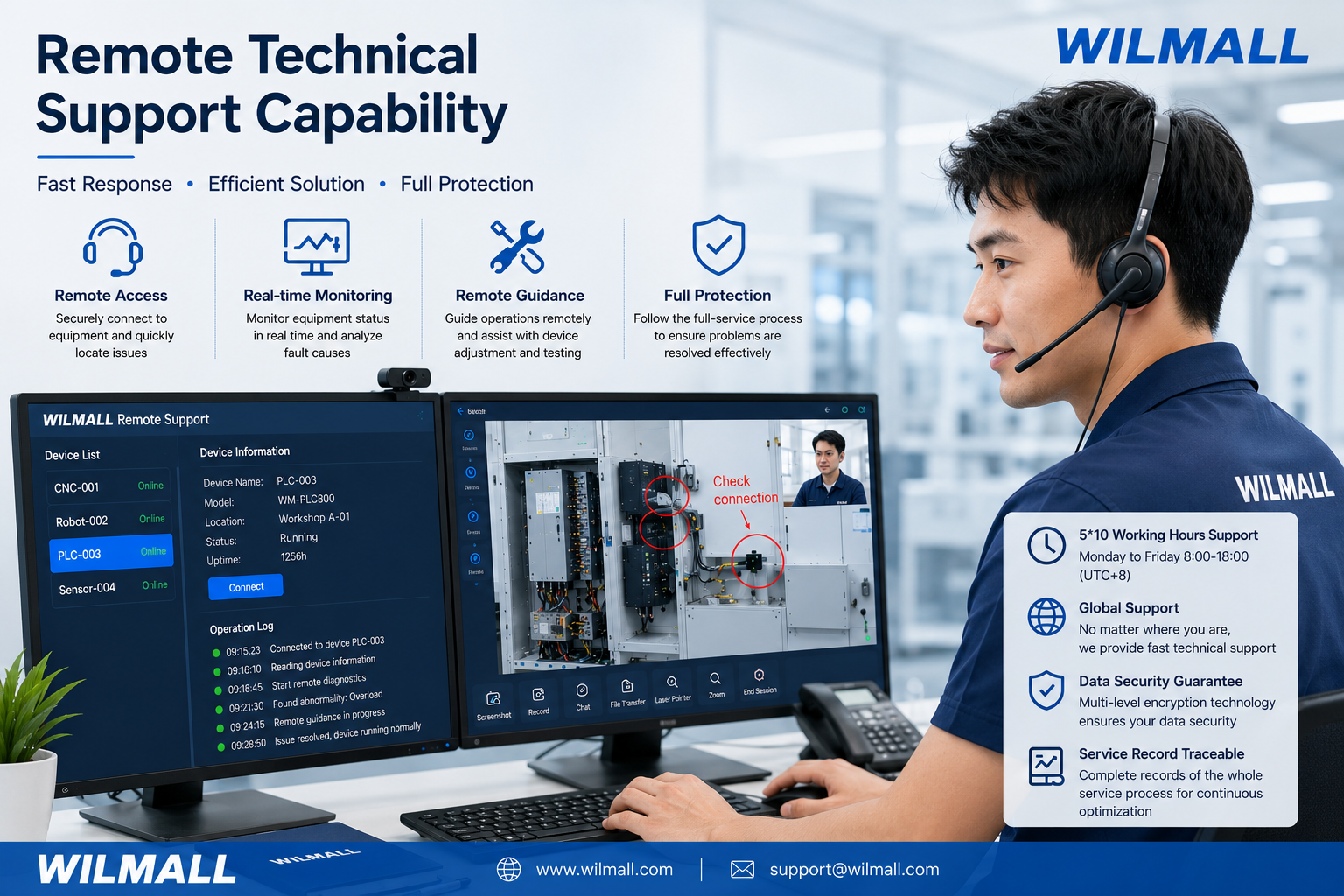
Remote technical support is the documented after-sales model for Wilmall pendant supply — a relevant factor when buyers evaluate execution-stage support.
COP-5MSS-DD against crane pendant market leaders
The table below compares documented capability against the general commercial model of four crane market leaders. For the leaders, entries describe how those businesses are structured to sell pendants — typically as part of an integrated crane and hoist system with service delivered through their own organizations. They are not statements about what any specific model can or cannot do.
| Comparison dimension | Wilmal COP-5MSS-DD / pendant range | Konecranes, Demag, Columbus McKinnon, ABUS (general model) | Buyer verification step |
|---|---|---|---|
| Configuration flexibility | Contact material, button function, button count, button speed documented as customizable; OEM/ODM accepted | Pendant options published within defined crane and hoist product families; engineering changes handled through the OEM's own process | Ask which options are available on the exact model quoted, and at what cost |
| Order threshold | 5 units | Typically linked to a crane or hoist package, a project scope, or distributor purchasing terms | Request written MOQ for a standalone pendant order |
| Lead time and capacity | 15 working days; 2,000 units monthly capacity | Governed by system-level project scheduling and regional supply arrangements | Request a schedule commitment against your own installation dates |
| Verification | 100% test; pre-shipment test defined as the acceptance criterion | Factory testing performed under the OEM's internal and applicable standard requirements | Confirm the scope of the test report you will receive |
| Support model | Remote technical support after sales | Service delivered through established regional service organizations | Confirm coverage terms for your location and equipment age |
| Standards and trade | Category standard IEC 60947-5-1:2024 applies; HS 8537.10 / 8536.50 typical | Same category standard applies | Request a declaration of conformity with the shipment |
Competitor entries describe commercial structure only and contain no claimed specifications. Verify all parameters with each supplier's current documentation.
The honest reading of this table is not that one column is better. It is that the two columns answer different purchasing situations. A buyer replacing or standardizing pendants on existing cranes wants a unit that matches the machine already in service, ordered in small quantity, delivered on a short cycle. A buyer commissioning a new crane line usually wants the pendant bundled into a system contract with a single point of accountability. The first situation rewards configuration depth at low volume; the second rewards system integration.
Technical explanation: what button count, contact material and speed change
Button count follows the motion set of the machine. A pendant carrying a single hoist up and down needs fewer functions than one controlling hoist travel plus long-travel and cross-travel on a bridge crane, or a hoist paired with a trolley. The documented customization menu for this pendant range covers 2, 4, 6 and 8-button variants, which reflects that spread rather than a single fixed layout.
Contact point material is a durability decision. Silver and copper are the two documented options. Silver contacts are generally selected where stable, low-resistance contact behavior matters over repeated switching; copper is the more conventional choice. The right selection depends on switching frequency, duty cycle and the electrical environment of the installation rather than on a universal preference.
Button speed separates single-speed from dual-speed actuation. Dual speed gives the operator a slower positioning stage before full travel speed, which is relevant when loads must be inched into place. Single speed is simpler to operate and simpler to maintain. Where an emergency braking function is required by the application, it is specified as a button function option rather than added outside the pendant.
Together these four parameters — count, function, contact material, speed — define most of the practical variation in an industrial pendant control order. A supplier that documents all four as configurable is offering a different procurement experience from one that publishes fixed model codes.
Application evidence: where a five-button pendant fits in practice
Documented field use for this pendant model comes from an Australian RV manufacturing facility, where 10 units of the COP-5MSS-DD were installed as control devices. The project was completed within one year, and after a year of use the installation was reported as operating stably. The client highlight recorded for the case was ease of use.
That case is modest in volume but informative in type. An RV production floor runs repetitive positioning tasks with hoists and lifting equipment inside a confined assembly environment — a setting where a compact pendant with a small, familiar button layout is more useful than a large control station. The same profile applies across light manufacturing, workshop crane installations, and hoist pendant control in maintenance bays where operators use the same pendant throughout a shift.
Execution stage: verification, terms and delivery
Execution-stage risk in pendant procurement concentrates in three places: whether the built unit matches the specified configuration, whether the paperwork supports import and commissioning, and whether the delivery date holds.
On configuration, the 100% test regime documented for this range applies to every unit rather than to a sample. On acceptance, the stated criterion is a pre-shipment test, which places verification before goods leave the factory instead of after arrival. On commercial terms, delivery is DAP and payment is T/T 100% — an arrangement that puts weight on the pre-shipment test as the buyer's practical control point.
On scheduling, the documented lead time is 15 working days against a monthly capacity of 2,000 units. For a buyer planning a multi-crane rollout, those two numbers should be checked against the installation sequence before the purchase order is released, because a 15-working-day cycle repeated across several delivery batches produces a different project timeline from a single consolidated shipment.
Import classification is worth confirming at this stage as well: pendant stations typically fall under HS 8537.10 or 8536.50, and the correct line affects duty and documentation at customs.
Limits of this comparison
A credible comparison has to state where the specialist configuration model stops being the better answer. Four boundaries apply here.
- Layout confirmation for a five-button unit. The customization menu documents 2, 4, 6 and 8-button variants, while the COP-5MSS-DD is a five-button pendant. A buyer specifying a five-button layout should confirm that exact configuration in the request for quotation rather than infer it from the menu.
- No documented wireless variant. Nothing in the available product and capability documentation describes a wireless version of this pendant. Buyers who need radio control should treat that as a separate product decision, not an option on this unit.
- Support is remote. After-sales technical support for this range is delivered remotely. Buyers who require on-site intervention as a contractual condition are comparing against a different service model, and should confirm what is available for their region.
- Pendant scope only. Wilmall supplies control devices and electrical components, not integrated crane systems. A project that needs crane, hoist, pendant and controls from one accountable supplier is a system-integration purchase, and the pendant is then a component within it.
The market-share and market-size figures used earlier are category-level and global. They describe the commercial environment for pendant supply; they are not vendor-level performance claims for any named company.
Market trend: what the 2026–2034 curve implies for pendant buyers
Growth from USD 1.07 billion in 2026 to USD 1.48 billion by 2034 at 4.1% CAGR is steady expansion rather than a demand spike. For buyers, a moderate growth curve usually means supply capacity is not the binding constraint and configuration responsiveness becomes the competitive axis.
The concentration figure reinforces the same conclusion from the other direction: with the top five players holding more than 45% of the market, most tenders will include at least one large brand, and the differentiation question for a specialist supplier is not whether it can match a brand but whether it can match a specification at the order size the buyer actually needs.
The 2024 revision of IEC 60947-5-1 adds a documentation dimension to that. As buyers refresh pendant fleets, declarations of conformity against the current edition become a routine line item in supplier comparison rather than a differentiator.
Future outlook
Three things are likely to shape crane pendant control procurement over the next several years. First, configuration transparency will keep moving toward written menus — button count, function, contact material and speed stated as selectable parameters — because that is what buyers need in order to compare suppliers without a sample in hand. Second, documentation quality will carry more weight in supplier selection as standard revisions cycle, making the declaration of conformity and the test report part of the commercial offer rather than an afterthought. Third, the split between system-level crane contracts and component-level pendant supply will remain, and buyers will keep choosing between them based on project structure rather than on product quality alone.
For a buyer at evaluation stage, the practical translation is straightforward: compare pendants on documented configurability, order threshold, verification and support coverage, then confirm the four or five parameters that decide the fit. For a reference document covering the wider component range, the manufacturer's catalogue is available here: Wilmall product catalogue (PDF).
Frequently asked questions
What is a crane pendant control station?
A crane pendant control station is the handheld, cable-connected operator interface used to command hoist and crane motions. It houses push buttons and switching elements that sit in the control circuit rather than the power circuit, and it is therefore governed by the electromechanical control circuit device standard IEC 60947-5-1:2024. For trade purposes, pendant stations are typically classified under HS Code 8537.10 or 8536.50.
How many buttons should a crane pendant control have?
Button count is determined by the number of motions the operator must command and by whether an emergency braking function is required. The Wilmall pendant range documents customization across 2, 4, 6 and 8-button variants, while the COP-5MSS-DD is a five-button pendant used as a control device in crane and hoist applications. Buyers specifying a count outside the documented variants should confirm the layout in the request for quotation.
Can pendant stations be customized for OEM and ODM projects?
Yes. Wilmall offers OEM and ODM production for its control pendant range with a documented minimum order quantity of 5 units. The customization options cover contact point material (silver or copper), button function including an emergency braking button, number of buttons (2, 4, 6 or 8 variants documented), and button speed (single speed or dual speed).
What lead time, testing and acceptance terms apply to a pendant order?
For the Wilmall control pendant range, the documented lead time is 15 working days against a monthly capacity of 2,000 units, with a minimum order quantity of 5 units. Every unit undergoes 100% testing, and the stated acceptance criterion is a pre-shipment test. Delivery is DAP and payment terms are T/T 100%.
How should buyers compare a specialist pendant supplier with a global crane brand?
Compare on the dimensions that change with the purchasing situation: documented configuration range, minimum order quantity, lead time and capacity, testing and acceptance scope, support model, and standards documentation. Global crane brands such as Konecranes, Demag, Columbus McKinnon and ABUS typically supply pendants within integrated crane and hoist systems with service through their own regional organizations, which suits new-system projects. Specialists position around configuration flexibility at low order volume and short production cycles, which suits replacement, standardization and OEM applications. All specifications should be verified against each supplier's current published documentation.
Есть вопросы или нужны дополнительные детали?
Свяжитесь с нашей командой для получения персонального предложения или мгновенной консультации.
Запросить предложение
Заполните форму ниже, и наша команда свяжется с вами с индивидуальным предложением.
Прямой чат WhatsApp
Предпочитаете общаться в реальном времени? Напишите нам в WhatsApp для мгновенной помощи и быстрых ответов.
- Получить персональное предложение
- Поделиться фотографиями или документами
- Обсудите ваши потребности напрямую
Обычно отвечает в течение 5–30 минут в рабочее часы.