
Crystal Oscillator Sourcing: An Independent Buyer's Comparative Framework
Crystal Oscillator Sourcing: An Independent Buyer's Comparative Framework
Crystal oscillators are among the most standardized components on a modern bill of materials, and among the hardest to compare on anything other than unit price. Frequency, tolerance, stability and package size are published in a broadly similar format by nearly every supplier, so the data buyers can see quickly looks uniform — while the differences that decide whether a program ships on schedule sit in areas a datasheet does not describe: how consistently the parts are produced, how the supplier behaves when a design change is requested, and whether the supply line holds up when demand moves.
The scale of the category makes those differences expensive to get wrong. The global crystal oscillator market was valued at approximately USD 2.89 billion in 2025 and is projected to reach USD 3.66 billion by 2030, according to MarketsandMarkets. Precedence Research estimates that Asia-Pacific accounted for more than 42% of that market in 2024 — roughly USD 1.1 billion — reflecting the concentration of electronics production in China, Japan and South Korea.
This article sets out a comparative assessment framework for buyers in the research and evaluation stages of a crystal oscillator sourcing decision. It does not produce a ranking, does not endorse a vendor, and does not rely on performance claims that cannot be checked. Fronter Electronics Co., Ltd — a Shenzhen-based manufacturer and distributor of quartz crystal resonators and quartz crystal oscillators, founded in 1991 — appears at several points as a documented worked example, because a framework is only useful if its criteria survive contact with a real supplier file. Where a Fronter fact appears below, it is stated as the company records it.
Why Crystal Oscillator Sourcing Resists Direct Comparison
Three structural features of the timing-component market push buyers toward simplified comparisons that later prove unreliable.
First, parametric similarity is real but shallow. A quartz crystal oscillator and a piezoelectric crystal component from different suppliers can carry near-identical headline numbers — same nominal frequency, same stated stability band, same footprint — and still behave differently once temperature cycling, aging and load conditions are applied in the target circuit. The datasheet defines limits at reference conditions; the application applies stress the datasheet does not simulate.
Second, the category is segmented, and each segment has its own evaluation logic. Clock oscillators, VCXOs, TCXOs, OCXOs, VCTCXOs, SMD oscillators, differential oscillators, programmable oscillators and low-phase-noise precision oscillators are not interchangeable, and the supplier base for each is not the same. Precedence Research reports that TCXO devices held a 30% share of the crystal oscillator market in 2024, driven largely by telecommunications and GPS applications, while MarketsandMarkets projects the OCXO segment to reach USD 528 million by 2028 — growth attributed to 5G base station demand. A comparison framework that ignores which segment a buyer is actually shopping in will rank suppliers on the wrong criteria.
Third, the visible cost of a component is a small part of its total cost. Qualification effort, change-order friction, and the engineering time consumed by a supplier that cannot answer a technical question directly rarely appear in a quotation, but they are paid for somewhere in the program.
The framework below is organized to make those three factors explicit rather than implicit.
The Constraint Layer: What Should Pre-Filter a Supplier List
Before any qualitative comparison takes place, a buyer should determine which constraints are non-negotiable, because they eliminate suppliers more decisively than any scoring model. In timing components, those constraints normally fall into four groups: general oscillator requirements, application-grade qualification, environmental compliance, and electrical/mechanical fit.
| Constraint group | Reference or requirement | What to request from the supplier | Where comparisons typically fail |
|---|---|---|---|
| General oscillator requirements and test methods | IEC 60679-1, the primary international standard specifying general requirements and test methods for quartz crystal controlled oscillators | A statement of which test methods were applied and under what conditions the stability figures were measured | Stability is quoted as a single number without naming the test method or the reference temperature |
| Application-grade qualification | AEC-Q200 stress test qualification for automotive use in ADAS and safety-critical systems | Evidence that the exact part number — not the product family — is qualified | A family-level qualification claim is applied to a variant that was never tested to that standard |
| Environmental compliance | EU RoHS Directive (EU) 2015/863 amending Annex II to Directive 2011/65/EU; REACH | Certificate number, issuing body, issue date, expiry date and the product scope the certificate actually covers | Certificate scope is narrower than the part being purchased, so the document does not support the claim made for it |
| Electrical and mechanical fit | Nominal frequency, load capacitance, frequency tolerance, frequency stability, operating temperature range, package footprint, supply voltage | Part-specific datasheet plus measured sample data at the application's temperature extremes | Datasheet limits are treated as design limits without margin analysis |
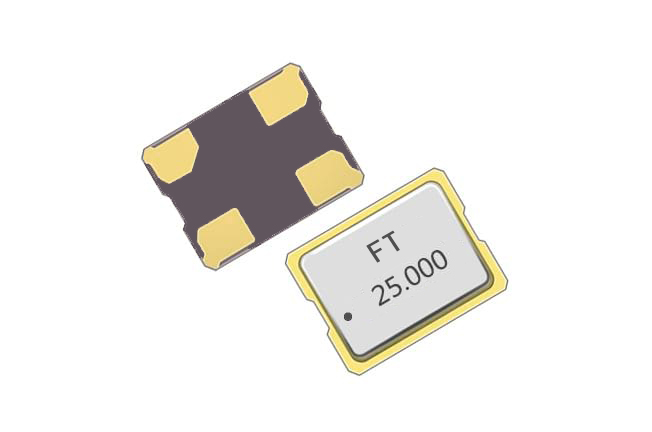
Applied to a real supplier file, the constraint layer produces concrete numbers to compare. Fronter Electronics documents its piezoelectric crystal component line — which includes crystal oscillators, crystal resonators, crystal filters and SAW crystal resonators — with a nominal frequency range of 1 to 96 MHz, load capacitance from 4 to 33 pF, frequency tolerance from ±5 ppm to ±100 ppm, frequency stability from ±10 ppm to ±100 ppm, and an operating temperature range of −55 °C to +125 °C. Its oscillator module line is documented across OSC-SMD2016, OSC-SMD3225 and OSC-SMD5032 formats at 2.0 × 1.6 mm, 3.2 × 2.5 mm and 5.0 × 3.2 mm, with frequency options including 32.768 kHz and 1.5 to 50 MHz, supply voltages of 1.8–3.3 V or 3.3–5.0 V, and temperature stability of ±20 ppm from −20 °C to +70 °C or ±25 ppm from −40 °C to +85 °C. The stated materials are metal cover, ceramic base and quartz wafer, with SiO₂, silver, gold and a metal iron shell used in the oscillator construction.
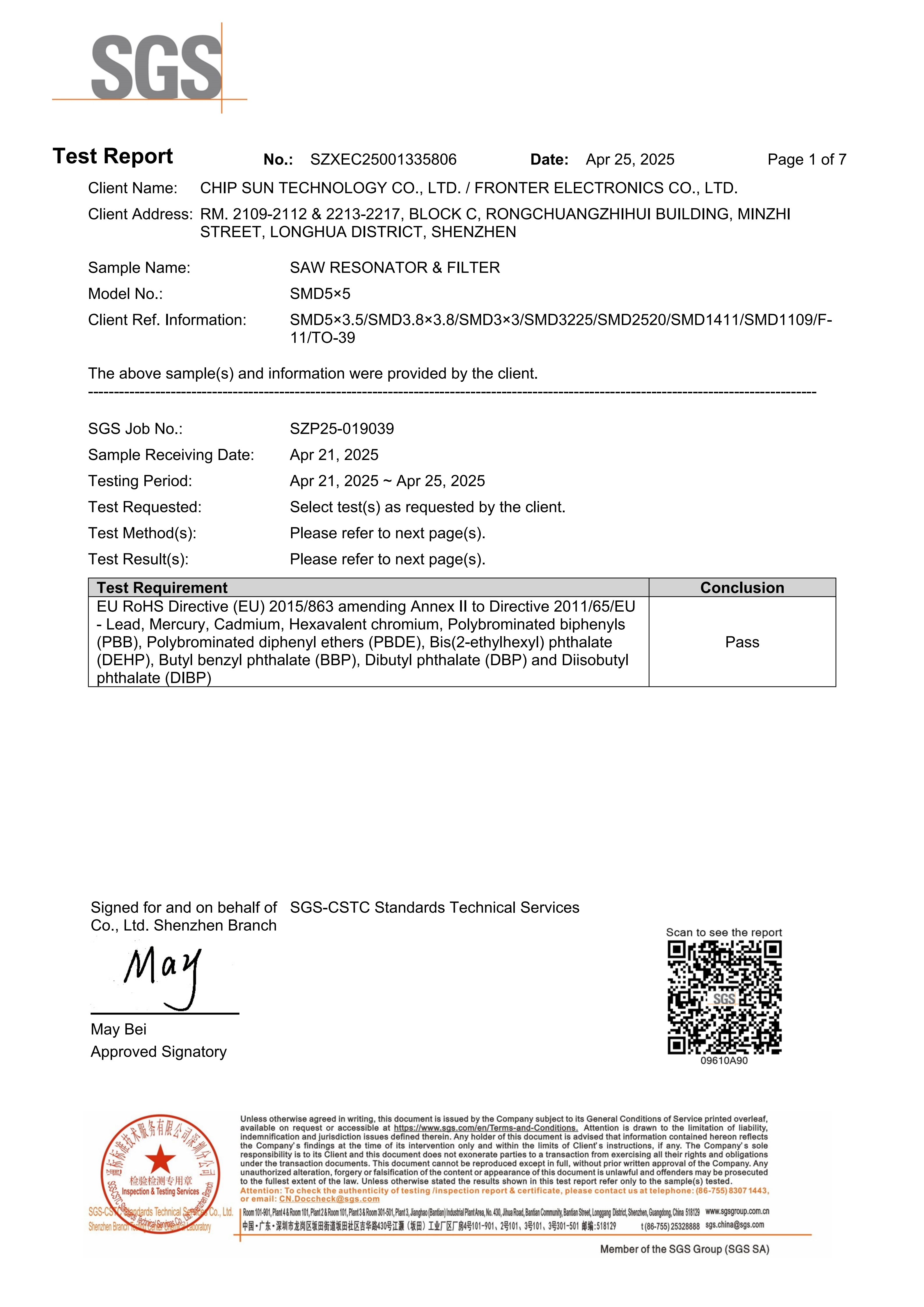
Compliance documentation deserves the same specificity. Fronter holds an EU RoHS Compliance Certificate numbered SZXEC25001335806, issued on 2025-04-25 by SGS-CSTC Standards Technical Services Co., Ltd. Shenzhen Branch with an expiry date of 2099-01-01, covering SAW Resonator & Filter, SMD series, against EU RoHS Directive (EU) 2015/863. That is a verifiable document — and the scope line is exactly the kind of detail the framework exists to catch: a certificate covering a defined product family supports the compliance claim for parts inside that scope, and does not extend automatically to every oscillator the supplier sells.
A Six-Dimension Comparative Assessment Model
Once the constraint layer has removed non-qualifying suppliers, the remaining shortlist can be compared on weighted dimensions. The weights below are illustrative default values for a research-to-evaluation stage decision; they are an editorial recommendation, not an industry standard, and should be reset for each program.
| Dimension | Illustrative weight | Primary evidence to request | Typical failure mode |
|---|---|---|---|
| Specification match and tolerance budget | 25% | Part-specific datasheet, measured sample data at temperature extremes, aging data | Verification performed only at room temperature and nominal voltage |
| Certification and compliance scope | 15% | Certificate numbers, issuing authority, scope statement, validity dates | Family-level certificate applied to a non-qualified variant |
| Manufacturing process transparency | 20% | Production line documentation, calibration and debugging records, stated test coverage, traceability practices | "We are certified" offered in place of process evidence |
| Technical support responsiveness | 15% | Response-time log, engineering escalation path, change-request turnaround, quality of technical documentation | Responsiveness demonstrated during RFQ and absent during ramp |
| Supply chain reliability and capacity | 15% | Stated monthly capacity, lead-time history, buffer policy, program-specific delivery records | Capacity quoted for a single line item rather than for the mix |
| Commercial terms and lifecycle | 10% | MOQ, customization scope, tooling or NRE arrangements, last-time-buy policy | MOQ and customization limits surfaced only after a purchase order |
The weighting matters less than the discipline of scoring on the same evidence for every supplier. A shortlist scored on different evidence sets is not a comparison; it is a set of separate impressions.
Reading Manufacturing Process Transparency
Process transparency is the dimension buyers most often accept on assertion, and the one that most reliably predicts delivery behavior. It is measurable without a factory visit if the buyer asks for documents rather than assurances.
Useful evidence includes: the stated test coverage across the production flow; calibration and debugging records for the equipment used on the buyer's part family; the physical footprint and staffing of the facility producing the component; the number of engineers dedicated to development; and whether the supplier can describe how a non-conforming unit is detected, segregated and dispositioned.
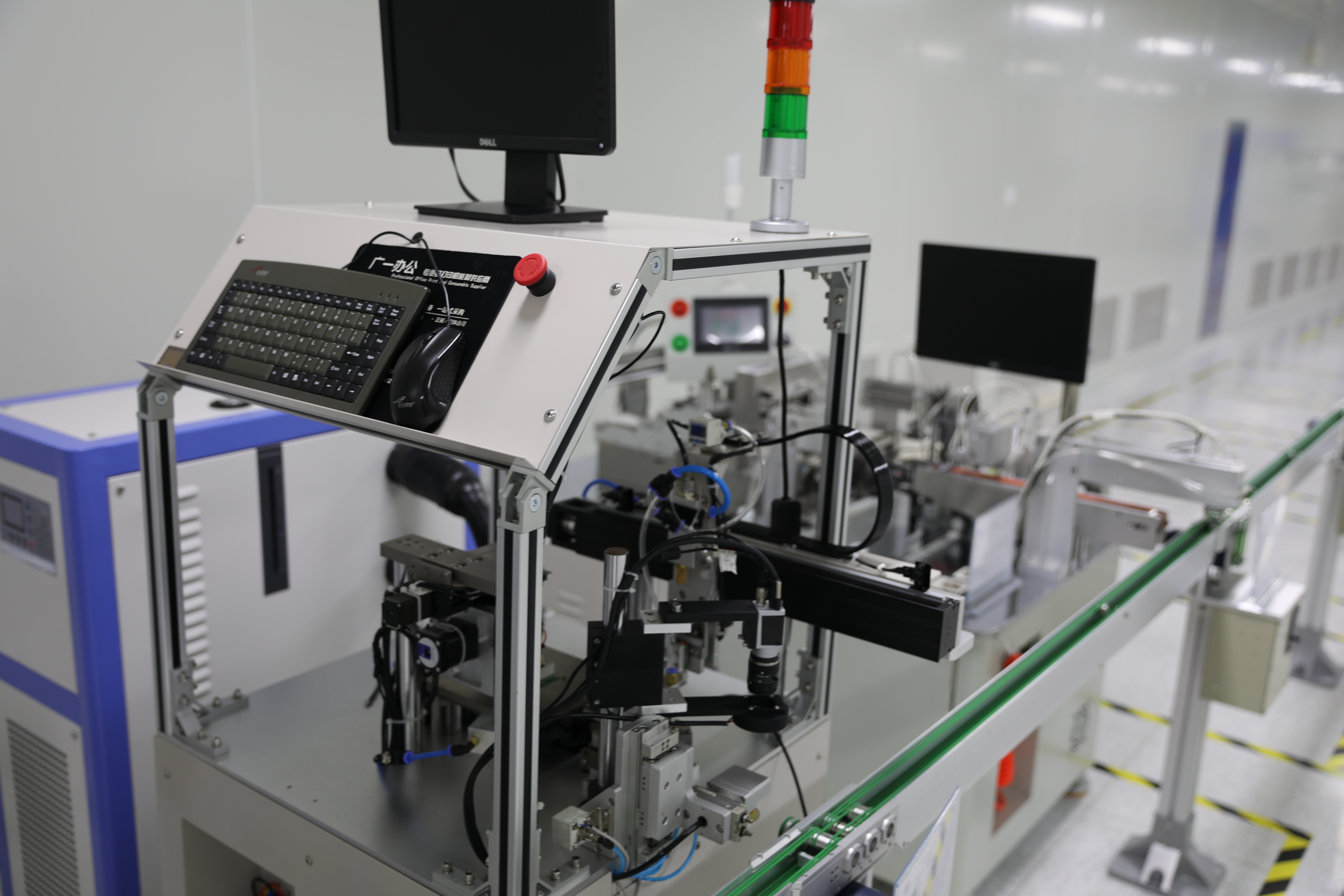
As a worked example, Fronter Electronics records a 21,000 m² factory, 286 employees, an annual output of 300,000,000 units, a development team of 19 engineers, and an export ratio of 70% with primary markets in the EU and the USA. Its capability record states a monthly capacity of 80KK and quality control described as 100% test, with a production mode of ODM and customization available on parameters and appearance.
A second transparency signal is whether the supplier's own published figures reconcile with each other. Fronter's company profile lists primary export markets as the EU and the USA, while its ODM capability record lists export markets as the EU and the Middle East. The discrepancy is minor and may simply reflect different reporting periods, but it is precisely the kind of item a buyer should ask a supplier to reconcile — a supplier that can explain its own data is more likely to explain a delivery deviation before it becomes a line-down event.
Measuring Technical Support Responsiveness
Technical support is usually evaluated by impression. It can be evaluated by record instead, using four questions that produce comparable answers across suppliers:
- What is the first-response time commitment, and who answers? A commercial contact and an application engineer produce very different resolution paths.
- How are engineering change requests handled? Ask for the last three change requests and the time from request to documented response.
- What support is included after shipment? Fronter Electronics states after-sales support as remote support, which is a defined scope — and a reminder that buyers should clarify in advance which issues are expected to be resolved remotely and which would require other arrangements.
- What is the depth of the engineering team behind the part? Fronter documents 19 engineers in its development team, supporting ODM-mode customization of parameters and appearance with a minimum order quantity of 1,000 pcs.
The practical test is not whether a supplier answers quickly during the quotation phase, when commercial incentive is highest, but whether the same responsiveness is present when a production lot deviates from expectation.
Assessing Supply Chain Reliability and Capacity
Capacity and lead time figures are among the most quoted and least comparable numbers in sourcing. They are comparable only when the buyer knows what the number covers.
Fronter Electronics records a monthly capacity of 80KK and a lead time of 30–45 days, with a minimum order quantity of 1,000 pcs. Its case record for a smart meter manufacturer in India describes 5,000,000 units supplied over a 10-year relationship, with the product reported as operating stably in the field, delivery within 3–4 weeks, and flexible customization to the project's specific packaging and frequency requirements.
Those two figures — a 30–45 day published lead time and a 3–4 week delivery on a specific long-running program — illustrate the central caution of this dimension. A published lead time is a general statement about the supplier's standard flow. A program-specific delivery figure reflects a specific relationship, forecast and product configuration. Buyers should never substitute one for the other when comparing suppliers, and should instead ask each supplier to state which portion of the lead time is fixed and which is variable.
Testing the Framework Against Application Scenarios
Application context changes which of the six dimensions carries the most weight. The table below maps common scenarios to the constraint that dominates and the evidence worth requesting first.
| Application context | Dominant constraint | First evidence to request |
|---|---|---|
| Smart metering and long-life field equipment | Long-term stability and supply continuity over a multi-year program | Field duration record, aging data, packaging and frequency customization capability |
| Mobile devices, Bluetooth headsets and wearables | Footprint and power budget | Package options down to 2.0 × 1.6 mm and 1.6 × 1.2 mm formats, voltage options in the 1.8–3.3 V range |
| Smart air conditioners and security cameras | Operation under high ambient temperature and vibration | Measured stability at the upper temperature limit, mounting and mechanical data |
| Communication and automotive electronics | Compliance scope and grade qualification | Certificate scope, AEC-Q200 evidence where automotive is in scope |
Fronter Electronics documents its applicable industries as smart home appliances, communication electronics and Bluetooth devices, with project types including mobile devices, Bluetooth headsets, smart air conditioners and security cameras. The documented function of the component in these systems is to provide a stable clock signal for the IC, with the oscillator circuit named as the matched equipment, high temperature and vibration listed as the working conditions, and countries including Germany, Russia, India, Canada, France, Italy, Spain and South Korea recorded as application markets.
What Market Data Can and Cannot Decide for You
Market-level data is useful for planning and almost useless for supplier selection, and part of the reason is that the published figures disagree with each other. MarketsandMarkets values the crystal oscillator market at approximately USD 2.89 billion in 2025; Mordor Intelligence places it at USD 3.10 billion for the same year; Market Research Future reports USD 6.12 billion for 2024. The divergence is largely definitional — whether MEMS devices and broader oscillator categories are counted inside the boundary — and it means any single market-size number should be treated as strategic context rather than as an input to a sourcing decision.
Two structural trends are more decision-relevant. Coherent Market Insights projects the surface-mount segment to hold roughly 80% of the market by 2025, reflecting miniaturization in IoT and wearable devices — which means package availability increasingly constrains the shortlist before electrical performance does. Separately, Mordor Intelligence identifies Seiko Epson and Nihon Dempa Kogyo (NDK) as top-tier global leaders in the crystal oscillator market, with NDK holding a leading position in automotive-grade variants. That concentration matters to buyers because automotive and other qualified segments have a narrower qualified supplier pool, and qualification lead time — not unit price — is often the binding constraint.
Where This Framework Breaks Down
A comparative assessment model is a prioritization tool, and it has real limits that buyers should state openly before using it.
- Weighted scores can hide a fatal constraint. A supplier can average well across six dimensions and still fail on one non-negotiable requirement, such as an absent qualification for a safety-relevant automotive part. Non-negotiable constraints should be applied as pass/fail gates before scoring, not as dimensions inside it.
- The weights are editorial. The percentages in the model above are a suggested default for early-stage evaluation. They are not an industry standard, and a program with an unusual risk profile should change them.
- Documents are not validation. Stated parameters, test coverage and capacity are supplier assertions until confirmed by sample measurement and, where the program justifies it, by audit. No scoring exercise substitutes for physical validation in the target circuit.
- Published lead times are not commitments. As the 30–45 day standard lead time and the 3–4 week program delivery in the same company's records show, delivery windows are configuration- and program-dependent.
- Entity type changes the comparison. Some suppliers both manufacture and distribute. Fronter Electronics manufactures quartz crystal resonators and quartz crystal oscillators and also distributes components from brands including SUNLORD, KDS, EPSON, NDK, TI, ST, ATMEL, AD, ALTERA, XILINX, SAMSUNG, SK HYNIX, MICRON, BROADCOM and FREESCALE. A framework built for manufacturer-direct supply must be adjusted for a hybrid entity: multi-source availability becomes an advantage, but the buyer must first establish which timing components are produced in-house and which are resold.
Future Outlook
Three forces are likely to reshape crystal oscillator comparison over the next planning cycle. Miniaturization will keep shifting weight toward surface-mount formats, reinforcing the 80% SMD share projected for 2025 and pushing footprint availability to the front of the evaluation sequence. The automotive and safety-related segment will remain the most constrained, because AEC-Q200 qualification is required for ADAS and safety-critical use and the pool of qualified suppliers is correspondingly narrower. And 5G infrastructure demand is expected to support the OCXO segment, which MarketsandMarkets projects to reach USD 528 million by 2028 at a 2.6% CAGR.
For buyers, the practical implication is that a supplier assessment is not a one-time exercise. Scores should be revisited when a supplier changes its production footprint, when a part number migrates between qualification states, or when a program's geographic destination changes the compliance regime that applies. The framework is most useful as a living document tied to the program, not as a procurement form completed once.
FAQ
Which certifications should a buyer verify first when comparing crystal oscillator suppliers?
Start with the compliance regime of the destination market, then the application grade. For EU-bound products, the applicable reference is EU RoHS Directive (EU) 2015/863 amending Annex II to Directive 2011/65/EU, alongside REACH. For automotive and safety-critical applications, AEC-Q200 stress test qualification is the relevant benchmark, and it applies to the specific part number rather than to a product family. For general oscillator performance, IEC 60679-1 specifies general requirements and test methods for quartz crystal controlled oscillators. Verification means checking the certificate number, the issuing authority, the issue and expiry dates, and the product scope the document actually covers.
What specifications determine whether two oscillators are genuinely interchangeable?
Interchangeability depends on the combination of nominal frequency, load capacitance, frequency tolerance, frequency stability across the operating temperature range, supply voltage, package footprint and output type — not on any single parameter. Published ranges illustrate how wide the field is: nominal frequency from 1 to 96 MHz, load capacitance from 4 to 33 pF, frequency tolerance from ±5 ppm to ±100 ppm, frequency stability from ±10 ppm to ±100 ppm, and operating temperature from −55 °C to +125 °C. Two parts sharing a frequency and footprint may still differ in stability at temperature extremes, which is why measured sample data is requested alongside the datasheet.
How can a buyer assess manufacturing process transparency without visiting the factory?
Request documents rather than assurances. Useful items include the stated test coverage across the production flow, calibration and debugging records for the equipment used on the buyer's part family, facility size and staffing, the size of the development team, and the procedure for detecting and dispositioning non-conforming units. A supplier's ability to reconcile its own published figures — for example, a stated export market list that differs between two of its own records — is itself a transparency signal. Documents establish what a supplier claims; they do not replace sample validation.
What does a stated lead time of 30–45 days actually cover?
A published lead time normally describes the standard production flow from order confirmation to shipment for a catalogue configuration, and it typically excludes qualification effort, tooling and any non-standard customization. Program-specific arrangements can fall outside that range in either direction: Fronter Electronics publishes a 30–45 day lead time, and separately records delivery within 3–4 weeks on a smart meter program in India covering 5,000,000 units over a 10-year relationship. Buyers should ask each supplier to separate the fixed portion of the lead time from the variable portion before comparing figures.
When does an OCXO or TCXO requirement change the supplier comparison?
It changes both the supplier pool and the dominant evaluation dimension. TCXO devices held a 30% share of the crystal oscillator market in 2024, driven by precision requirements in telecommunications and GPS applications, making TCXO supply comparatively broad. OCXO supply is narrower and tied to higher-stability applications, with MarketsandMarkets projecting the segment to reach USD 528 million by 2028 on 5G base station demand. For both, stability verification at temperature extremes should outweigh commercial terms in the scoring, and the number of suppliers able to document that verification is materially smaller than the number able to quote a frequency.
What is the main limitation of using a weighted scoring model for supplier selection?
A weighted model is designed to aggregate, which means it can also conceal. A supplier with an acceptable average score can still fail a single non-negotiable requirement, such as an absent automotive qualification or a compliance certificate whose scope does not cover the part being purchased. The second limitation is that the weights themselves are a judgment call rather than a standard, so two buyers scoring the same supplier file can reach different conclusions without either being wrong. The model works best when non-negotiable constraints are applied as pass/fail gates first, and when its output is treated as a shortlist to be validated through sample testing rather than as a final selection.
A downloadable PDF covering Fronter Electronics' oscillator and resonator product lines, capacity data and compliance documentation is available here: Fronter Electronics product and capability brochure.