
Current Transformer Fit: Metro, Elevator, Green Building
A current transformer is a small line item in a metro, elevator or building programme, but the consequences of a poor match arrive late — at commissioning, when the feeder cannot be disconnected, the meter cannot read the signal, or the cabinet door will not close. The three scenarios share a measurement function and very little else. A station distribution panel, an elevator controller cabinet and a commercial building's sub-metering board differ in installation window, waveform, service access, asset life and the documentation a client will demand at handover.
Scenario fit means selecting the current transformer against the conditions it will actually work in. It starts with three questions asked in order: where and how will the device be installed, what signal does the monitoring platform expect, and what will the measurement be used to decide? Ratio and accuracy class come after those answers, not before.

Current transformer production environment: scenario fit begins with installation conditions and signal requirements, not with a catalogue page.
Why the installation environment usually decides first
A typical request for quotation lists ratio, accuracy class, burden and quantity. Those four fields are necessary and rarely sufficient. In retrofit-heavy work the binding constraints appear elsewhere: whether the conductor can be disconnected at all, how much clearance exists between the busbar and the panel door, how long the plant can be shut down, and what the monitoring platform can physically accept as an input.
When these constraints are unresolved before the order, the cost reappears at commissioning — a clamp that will not close around an energised feeder, a signal no input card can read, or a replacement that requires a second shutdown. Sequencing the decision from environment to output to accuracy avoids most of that, and it produces a specification a supplier can quote against without guessing.
A requirement map for three monitoring scenarios
The table below is not a product ranking. It maps each scenario to the constraint that most often changes the purchase decision, so that the RFQ carries the right information from the start.
| Scenario | Installation reality | Dominant CT form | Signal expectation | Long-term consideration |
|---|---|---|---|---|
| Metro station, depot and traction-adjacent monitoring | Continuous duty, tunnel and plant-room vibration, large installed base across stations | Split-core for existing feeders; ring or busbar types for new-build switchgear | AC secondary into metering or protection devices, or a conditioned/digital output into the station monitoring system | Batch consistency, spares availability across the asset life, repeatable test evidence per batch |
| Elevator machine room and controller cabinet | Cramped cabinet, short cable runs, restricted service access, distorted drive waveform | Compact split-core, DIN-rail or panel-mount units sized to the available window | Analogue or digital output accepted by the controller or the building gateway | Stable output across temperature cycles, minimal maintenance interventions |
| Green building sub-metering | Occupied buildings, phased works, feeders energised during installation, EU documentation requests | Split-core clamp type at feeders; mini or PCB-mount units inside metering modules | Digital output to a BMS or energy platform, consistent with existing meter inputs | Certificate documentation, model continuity across phases, RoHS evidence for EU delivery |
Technical explanation: the four variables that actually move
Core construction and the installation window
Two constructions dominate. A solid-core or ring-type current transformer requires the conductor to be passed through the window, so it is normally installed while the circuit is being built, or while it is de-energised and partly dismantled. A split-core current transformer opens and closes around an installed conductor, which allows measurement to be added to an energised feeder without disconnection. In retrofit projects, split-core models can reduce installation time by 50%–70% compared with the disconnect-and-reassemble route. That saving is why split-core designs dominate building retrofit work; it is not a statement about which construction is more accurate.
Signal output and who will read it
An AC secondary output (commonly 5 A or 1 A) feeds meters, relays and transducers that already contain their own analogue front end. A conditioned output — milliamp, low voltage, or a digital bus such as RS485 — moves part of that signal chain into the current transformer and is read directly by a PLC, a gateway or a building management platform. Digital output reduces the number of wire pairs per feeder and lets one bus serve many measurement points, but it introduces requirements that an AC-output device does not have: the protocol and register map must be agreed, node addressing must be planned, and the supply arrangement must be decided. Buyers should state which platform will read the value before specifying an output type.
Accuracy class and what the number is used for
HEYI current transformers offer accuracy classes up to 0.5 or 0.2 depending on model. Which class is appropriate follows from the purpose of the number, not from a general preference for tighter figures. Where a measurement drives billing or contractual settlement, a revenue-grade device and the corresponding test evidence are appropriate. Where the number drives trend analysis, alarm thresholds or maintenance scheduling, a monitoring-grade device with stable behaviour across temperature and time is usually the better trade against cost and installation effort.
The standards question
IEC 61869-2:2012 specifies additional requirements for newly manufactured inductive current transformers used with electrical measuring instruments and/or protective devices at rated frequencies from 15 Hz to 100 Hz. IEC 61869-10:2017 covers low-power passive current transformers with analogue output for measurement or protection at 15 Hz to 100 Hz. IEC 61869-14:2018 addresses current transformers for DC applications with rated voltage above 1.5 kV. Quoting the applicable part is the first compliance step; national implementation, amendments and project-specific requirements sit on top of it and should be verified rather than assumed.
Environment and mechanical constraints
Vibration, temperature rise and terminal security decide whether a correctly specified CT stays correct after two years in service. Temperature rise control, flame-retardant housing, secure terminal structures and clear wiring labels are engineering details with procurement consequences: they reduce commissioning errors, polarity mistakes and call-outs, which in transit and elevator work cost far more than the device itself.
Metro monitoring: volume, vibration and batch consistency
Metro work contains two different measurement problems. Traction-adjacent and station distribution feeders are monitored for protection and operational intelligence; station and depot low-voltage feeders are monitored for energy and load management. The first is dominated by protection coordination and repeatable accuracy across a large installed base. The second is dominated by retrofit installation and data integration.
Three constraints recur. Vibration and continuous duty make mechanical security of housing, terminals and mounting more important than in static installations. Volume makes batch consistency the deciding quality attribute — a station programme may use the same model hundreds of times, so one deviating batch becomes a commissioning problem repeated across sites. Service access is limited, so a design that can be opened, inspected or replaced without dismantling the feeder carries operational value beyond its unit price.
Where a supplier cites metro deployment, the claim should be checked at model level: which project, which line, which year, which model, and whether that model is still in production. A deployment reference is not evidence of batch consistency unless it can be connected to test records for the units actually delivered.
Elevator monitoring: a cabinet, not a switchroom
Elevator monitoring lives inside a controller cabinet. Current is measured to observe motor and brake behaviour, to detect abnormal cycles and, increasingly, to feed a building gateway. The environment is unfriendly: space is limited, access is a service visit, and the drive output distorts the waveform well beyond a clean sinusoid. A device selected only on a 50/60 Hz ratio may report a value the controller interprets differently from expectation.
Two specification habits reduce that risk. First, state the frequency content the measurement must survive and whether the reading is used for diagnostics, protection or energy accounting, because those three uses tolerate different accuracy and bandwidth. Second, size the unit to the actual window and mounting arrangement — a compact split-core or panel-mount design that closes properly is worth more than a tighter accuracy class that does not fit. Because the cabinet is a service point, labelled wiring and secure terminals matter: a mis-wired CT here becomes a call-out, not a report.
Green building monitoring: sub-metering plus documentation
Green building monitoring is a sub-metering problem with a documentation problem attached. Feeders are energised, tenants occupy the space and works proceed floor by floor, so the CT must clamp onto an installed cable and be commissioned in minutes rather than shifts. The output must reach a BMS or an energy platform that may already define the protocol, the register map and the scaling.
Two requirements are frequently underestimated. Model continuity matters more than in a single-purchase project: if phase two specifies a different device, historical data becomes difficult to compare, so the model and accuracy class should be fixed at programme level rather than per purchase order. EU-facing projects also typically require RoHS documentation. RoHS restricts the use of specified hazardous substances in electrical and electronic equipment, and conformity is demonstrated by evidence — a certificate with a scope, an issuing body and a validity date — not by a badge on a product page. Buyers should request that evidence for the exact model and the exact market before the first delivery, because retrofitting documentation into a completed handover package is far more expensive than requesting it at quotation stage.
Where HEYI Electrical fits these scenarios
HEYI Electrical (Wenzhou Heyi Electrical Co., Ltd.) is a China-based manufacturer of current transformers and current sensors, established in 2012. The company operates a 10,000 m² factory with 56 employees and an annual output of 356,000 units, supported by an R&D team of 5 engineers. Its product scope covers current transformers, current sensors, shunts, digital energy meters and current transmitters, including split core current transformers — a combination that matters in these three scenarios, because a conditioned signal and a matching meter can be sourced alongside the CT rather than assembled from separate vendors. Around 95% of output is exported to Southeast Asia, South Korea, Europe, South America, Australia, Africa, the Middle East and North America.
Three verified facts are directly relevant to scenario work. Split-core models can reduce installation time by 50%–70% in retrofit projects, which is the decisive figure for occupied buildings and live station feeders. Accuracy classes reach 0.5 or 0.2 depending on model, with custom ratios such as 100/5A, 500/5A, 1000/5A and 2000/5A available — a range that covers building feeders, elevator circuits and depot distribution. Monthly production capacity is 20,000 units with typical lead times of 3–30 days, which matters when a station or building programme is scheduled in phases rather than delivered at once.
Quality evidence is procedural rather than promotional: 100% routine test, accuracy test, insulation resistance test, withstand voltage test, appearance inspection and pre-shipment inspection, backed by incoming material inspection, production process control, ratio and polarity testing, temperature rise control, flame-retardant housing design, secure terminal structures and clear wiring labels. Technical support covers wiring guidance, product replacement support and online after-sales service.
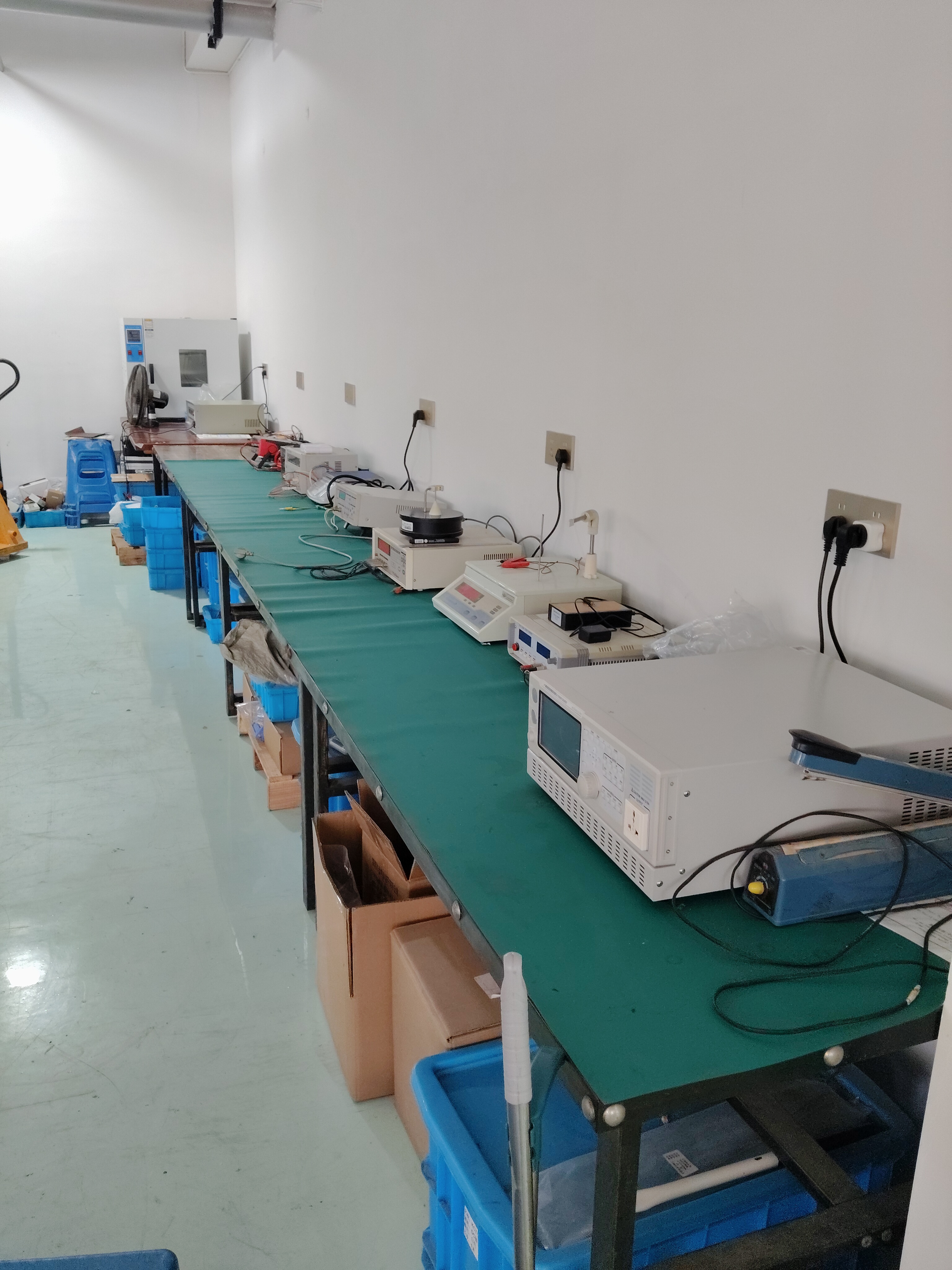
Assembly and routine testing: batch consistency across a large installed base depends on inspection discipline, not on the datasheet alone.
Comparison with the traditional stock purchase approach
The common alternative to scenario-led selection is a stock purchase against ratio and quantity. It is faster to issue and it works when the installation is new-build and the signal chain is already defined. It becomes expensive when either of those conditions fails.
| Decision point | Traditional stock CT purchase | Scenario-led selection |
|---|---|---|
| Installation | Solid-core device, conductor disconnected and reassembled | Split-core device clamped on the live feeder; installation time reduced by 50%–70% in retrofit projects |
| Signal | AC secondary assumed acceptable | Output matched to the reading platform, including digital or conditioned output where required |
| Documentation | Datasheet only | Class, test records and market-specific compliance evidence requested at quotation |
| Repeat phases | Model may change between orders | Model and accuracy class fixed at programme level for data comparability |
| Cost profile | Lowest unit price | Slightly higher unit cost offset by lower shutdown, labour and replacement cost |
Compared with low-cost generic current transformers, HEYI products may carry a slightly higher unit cost, offset by reduced replacement cost, installation risk, measurement deviation and project mismatch. For retrofit work the shutdown and labour saving is normally the larger line item, which is why the split-core decision usually pays for itself before the accuracy discussion begins.
Market trend: retrofit and power quality are driving the demand mix
Three verifiable signals frame the demand side. Fortune Business Insights projects the global current transformer market growing from USD 3.06 billion in 2026 to USD 5.23 billion by 2034, a reported CAGR of 6.92% — a commercial research estimate that is useful as a directional indicator rather than as a planning figure. Grand View Research reports that the medium-voltage segment held a 50.5% revenue share in 2025, consistent with the concentration of CT value in distribution and substation assets rather than in low-voltage monitoring alone. Mordor Intelligence notes increasing adoption of Rogowski coil current transformers for harmonic monitoring and for flexibility in tight spaces — the same retrofit and power-quality pressures that push split-core demand in buildings and transit systems.
The practical reading for buyers is that low-voltage monitoring demand is being shaped less by new-build substations than by instrumentation added to existing assets. That shift favours installation-friendly constructions, conditioned and digital outputs, and suppliers able to demonstrate consistent inspection discipline across repeated orders.
Future outlook
Two directions look durable. The first is the migration of signal conditioning into the current transformer itself: as building and transit platforms standardise on digital buses, the value of a device that delivers a readable, addressable value rather than a raw AC level increases, and so does the importance of agreeing protocol and register mapping during procurement rather than during commissioning.
The second is documentation. Certification and market-access evidence is becoming part of the technical specification rather than an administrative afterthought, particularly for EU-facing building projects where RoHS conformity has to be shown for the exact model delivered. Suppliers that can produce class-specific test records, batch-level inspection evidence and market-scope certificates quickly will be easier to keep in a multi-phase programme than suppliers who treat documentation as a post-order request.
Execution: terms that protect a multi-phase programme
Scenario fit is decided technically and defended commercially. Published purchasing terms list FOB, CIF and EXW delivery; acceptance by video or photographs, on-site inspection, or a commissioned third-party agency; and payment by T/T, Alibaba, AliPay or PayPal, with minimum order quantity confirmed per quotation. For phased station or building work those terms matter as much as the datasheet, because a consistent acceptance method and a fixed model protect the comparability of monitoring data more than a marginal unit-price difference does. Sample confirmation for custom orders, protective packaging and labelled wiring are small items that reduce risk at the point where risk is highest: the first installation on site.
FAQ
How does the monitoring goal change current transformer selection?
The goal determines the accuracy class and the evidence required. Where the reading drives billing or settlement, a revenue-grade device with corresponding test records is appropriate. Where it drives trend analysis, alarms or maintenance scheduling, a monitoring-grade device with stable output across temperature and time is usually sufficient. HEYI current transformers reach accuracy classes up to 0.5 or 0.2 depending on model, so the class should be stated as a requirement rather than left to the supplier to infer.
Can one current transformer model serve metro, elevator and green-building projects?
Sometimes, but not by default. A single model can be reused where the window size, rated current, output type and accuracy class all satisfy each application. It usually fails on one of three points: the digital or conditioned output expected by a building platform, the compact window available in an elevator cabinet, or the batch consistency and spares continuity a metro programme requires. Reusing one model across scenarios is a procurement simplification, not a technical guarantee.
Why use a split-core current transformer for retrofit monitoring?
A split-core current transformer opens and closes around an installed conductor, so measurement can be added without disconnecting the feeder. In retrofit projects, split-core models can reduce installation time by 50%–70% compared with the disconnect-and-reassemble route, which also lowers shutdown and labour cost. The trade-off is that split-core construction is an installation choice rather than an accuracy upgrade; where the tightest class is needed for billing, a closed-core design is generally the more suitable route.
What should be specified when a CT must deliver a digital or RS485 output?
Three things beyond ratio and class: the platform that will read the value, the protocol and register map it expects, and how nodes will be addressed and supplied on the bus. A digital output removes the need for a separate transducer per feeder, but it moves configuration effort into commissioning. Buyers should also confirm that the delivered device is tested against the agreed mapping, since a correct current transformer with an incorrect register definition produces a wrong number rather than no number.
What evidence and commercial terms should a buyer lock in for multi-year CT supply?
Lock the model, the accuracy class and the acceptance method, then request batch-level inspection evidence: 100% routine test, accuracy test, insulation resistance test, withstand voltage test, appearance inspection and pre-shipment inspection. HEYI publishes FOB, CIF and EXW delivery, acceptance by video, photographs, on-site inspection or a commissioned third-party agency, and payment by T/T, Alibaba, AliPay or PayPal, with monthly capacity of 20,000 units and typical lead times of 3–30 days. For EU-facing projects, request RoHS documentation covering the exact model, issuing body and validity date before the first shipment.
Conclusion
Metro, elevator and green-building monitoring are three different tests of the same component. Metro work tests consistency and mechanical resilience at volume; elevator work tests fit, waveform tolerance and serviceability inside a cabinet; green-building work tests retrofit speed, data integration and documentation discipline. Matching the current transformer to the scenario — before ratio and class are fixed — is what keeps those tests from being discovered at commissioning. HEYI Electrical's published product brochure is available for download at the HEYI catalogue.
Есть вопросы или нужны дополнительные детали?
Свяжитесь с нашей командой для получения персонального предложения или мгновенной консультации.
Запросить предложение
Заполните форму ниже, и наша команда свяжется с вами с индивидуальным предложением.
Прямой чат WhatsApp
Предпочитаете общаться в реальном времени? Напишите нам в WhatsApp для мгновенной помощи и быстрых ответов.
- Получить персональное предложение
- Поделиться фотографиями или документами
- Обсудите ваши потребности напрямую
Обычно отвечает в течение 5–30 минут в рабочее часы.