
Curvature Radius R2200–R3000: A Buyer's Framework for Choosing the Right Mirror Curve
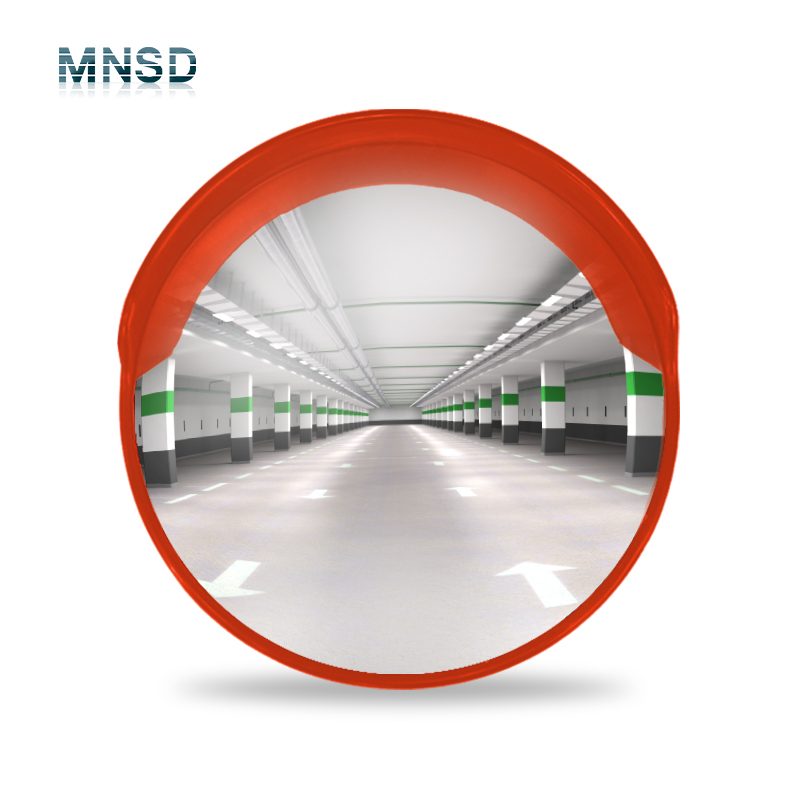
The visible curve on an outdoor polycarbonate convex mirror is the specification that decides how much of a junction the mirror can actually capture.
On most safety mirror job sheets, the number that gets discussed is diameter. The number that decides what a driver actually sees is the curvature radius. In the Mnsd outdoor polycarbonate convex mirror range, all six diameters — from 450 mm to 1200 mm — share a single curvature band, R2200 to R3000, and that band is the geometry behind the series' 130°+ wide-angle vision. This article sets out a buying framework that treats curvature as a specification rather than a footnote: what R2200–R3000 does on site, how to weigh it against mounting height and blind-spot distance, and where the curve stops being the deciding factor.
Selection documents for outdoor safety mirrors are usually built around three fields: diameter, mounting type and material. These are the fields that can be compared quickly across suppliers, and they are the fields that most quotations return. Curvature radius rarely appears, even though it is the parameter that determines whether an 800 mm disc behaves like a narrow mirror or a panoramic one.
Convex mirrors of this type are spherical: the reflecting surface is cut from a sphere, and its optical behaviour is described by the radius of that sphere. The Mnsd outdoor polycarbonate convex mirror data sheet places every model in the YD-OC series inside a curvature band of R2200 to R3000 — wide enough to cover a 450 mm corner mirror and a 1200 mm roadway mirror without changing lens material, coating process or mounting system.
Why Diameter Alone Is an Incomplete Specification
Diameter answers one question: at what distance can the reflected image still be read? The published visual range of the YD-OC series rises from 10–12 m at 450 mm to 35–45 m at 1200 mm. Curvature answers a different question: how much of the surroundings is compressed into that readable area. Change the curve and the same diameter frames a different scene; hold the curve steady and diameter becomes an almost purely distance-based decision.
Because the two parameters are independent, a quotation that lists only diameter is not a comparable quotation. Two suppliers can both offer an 800 mm outdoor mirror — one cut from a more deeply curved surface, one from a flatter surface — and the two will not frame the same junction, will not sit comfortably at the same mounting position, and will not produce the same image scale for an approaching forklift or car.
| Specification | What it primarily governs | What it does not settle |
|---|---|---|
| Curvature radius (R2200–R3000) | Angular coverage and image scale — how much of the scene is compressed into the lens | How far away the mirror can still be read, which is a diameter question |
| Mirror diameter (450–1200 mm) | Published visual range in metres for each model in the series | How wide a slice of the junction the mirror captures |
| Mounting height and position | Whether the driver's eye line actually meets the mirror surface | Whether the surface survives weather, impact and UV exposure |
| Material and coating (PC, UV grade, IP65) | Service life, impact behaviour and weather tolerance | Field of view — material does not widen the angle |
Four specification layers, four different jobs. Diameter and curvature are not substitutes for each other.
The practical procurement consequence is straightforward: when a supplier publishes diameter but not curvature, the diameter figure cannot be compared with a mirror whose curvature is known. Buyers evaluating outdoor polycarbonate convex mirrors across several sources should request the radius as a line item, in the same way they would request lens thickness or weatherproof rating.
What the R2200–R3000 Band Means in Practice
A spherical mirror's focal length is half its radius of curvature. An R2200 surface therefore behaves as though its focus sits roughly 1.1 m in front of the mirror, and an R3000 surface roughly 1.5 m. For a site buyer, the exact figure matters less than the direction of the trade-off between the two ends of the band.
A smaller radius — R2200 — is a more deeply curved surface. It sweeps a wider slice of the surroundings into the same disc, at the cost of compressing the image: vehicles and pedestrians appear smaller, and distortion towards the rim is more pronounced. A larger radius — R3000 — produces a flatter surface. Reflected objects appear larger and easier to identify, but the mirror captures a narrower slice of the junction. Neither end of the band is inherently better; they are two positions on the same coverage-versus-legibility curve.
Holding the entire YD-OC series inside R2200–R3000 keeps six different mirror sizes within one working band for traffic and industrial duty. The published rating is 130°+ wide-angle vision, with the mirror's angle of view listed as 180° in the product data. Keeping one curvature band across the range also keeps one lens material, one vacuum aluminium coating process and one mounting system in production — a detail that matters to distributors and project buyers who hold stock across several diameters rather than a single size.
One Curvature Band Across Six Diameters: The Mnsd YD-OC Series
Mnsd is the brand of Tiantai Yuanda Traffic Device Co., Ltd, a road safety equipment manufacturer based in Tiantai, Zhejiang, China. The company was founded in 2007 and now operates a 40,000 m² manufacturing facility with approximately 300 employees and a 15-engineer R&D team. Its product lines cover convex mirrors, warning posts, rising bollards, speed humps and traffic lights, and export business accounts for about 50% of sales into Asia, Europe and the USA.
Within that range, the YD-OC series is the outdoor polycarbonate convex mirror line: a single curvature band, six diameters, and one published visual range per diameter.
| Model | Mirror diameter | Curvature radius | Published visual range |
|---|---|---|---|
| YD-OC45 | 450 mm | R2200–R3000 | 10–12 m |
| YD-OC60 | 600 mm | R2200–R3000 | 15–18 m |
| YD-OC75 | 750 mm | R2200–R3000 | 20–25 m |
| YD-OC80 | 800 mm | R2200–R3000 | 22–28 m |
| YD-OC100 | 1000 mm | R2200–R3000 | 30–35 m |
| YD-OC120 | 1200 mm | R2200–R3000 | 35–45 m |
Six diameters, one curvature band: coverage distance scales with diameter, while the curve that produces the 130°+ wide-angle field stays constant.
The construction above the lens is shared across the six models. The lens is impact-resistant polycarbonate, 0.6–1 mm thick and customisable, finished with a vacuum aluminium coating and an optional anti-scratch hard coating for surface protection. It sits on a high-impact ABS backing in bright orange for visibility, with a 2.0 mm back plate, and mounts through a heavy-duty galvanised steel bracket that fits 60 mm or 75 mm poles, or fixes directly to a wall.
Outdoor performance is specified rather than implied. The weatherproof rating is IP65 for outdoor use, with an operating temperature range of −30°C to +80°C. The mirror uses UV-stabilised PC and ABS with Grade 8 UV resistance and an estimated 3–5 year lifespan, is rated for Level 10 wind load resistance, and carries an impact rating described as vandal-resistant with self-recovery. Engineering-grade reflective tape is available as an option on the rim. Together these properties explain why the same product family is marketed under descriptions such as outdoor polycarbonate convex mirror, PC traffic mirror, weatherproof hooded convex mirror, wall-mounted safety mirror, pole-mounted traffic mirror, shatterproof polycarbonate mirror, wide-angle panoramic mirror and industrial blind spot mirror — different application names for one underlying geometry.
A Five-Step Framework: Matching Curvature, Diameter, Mounting Height and Blind-Spot Distance
Step 1 — Measure the blind spot in metres, not in square metres
The starting figure is the distance a driver must see across the junction, ramp or aisle — the diagonal across a warehouse intersection, the sightline at the exit of a garage ramp, the approach distance at a T-junction. That distance, not the wall space available, sets the minimum mirror. Published visual ranges give the reference points: 10–12 m for the 450 mm model up to 35–45 m for the 1200 mm model.
Step 2 — Fix the mounting position and height before choosing a diameter
A convex mirror only works if the driver's eye line meets the surface at an angle that keeps the approaching vehicle inside the 130°+ field. Decide where the pole or wall fixing will sit, and at what height, before shortlisting sizes. A large mirror mounted off the sightline performs worse than a smaller mirror mounted correctly on it — this is the most common reason a site with adequate mirrors still reports near-misses.
Step 3 — Choose the smallest diameter whose published visual range covers that distance
Oversizing has real costs: larger diameters add weight, wind load and unit price, and they do not repair a mounting position problem. The published ranges in the YD-OC series are the sizing reference, and the smallest model that covers the measured distance is normally the correct specification.
Step 4 — Confirm the curvature radius in writing
Because curvature and diameter jointly determine what the mirror frames, the radius belongs on the purchase specification next to the diameter and the visual range. For the YD-OC range this value is R2200–R3000 across all six diameters, which means a buyer switching between a 600 mm and a 1000 mm model is changing coverage distance, not the shape of the field.
Step 5 — Match bracket, pole and wind loading to the structure
The galvanised steel bracket fits 60 mm or 75 mm poles, and wall mounting is equally supported. On exposed sites, Level 10 wind load resistance has to be matched to a pole and foundation that can carry that load. Where the mirror itself must be visible to approaching traffic, specify the optional reflective rim tape — in Australia and New Zealand, AS/NZS 1906.1:2017 is the standard buyers commonly reference for retroreflective materials and devices used on traffic components.
Where the R2200–R3000 Curve Earns Its Place on Site
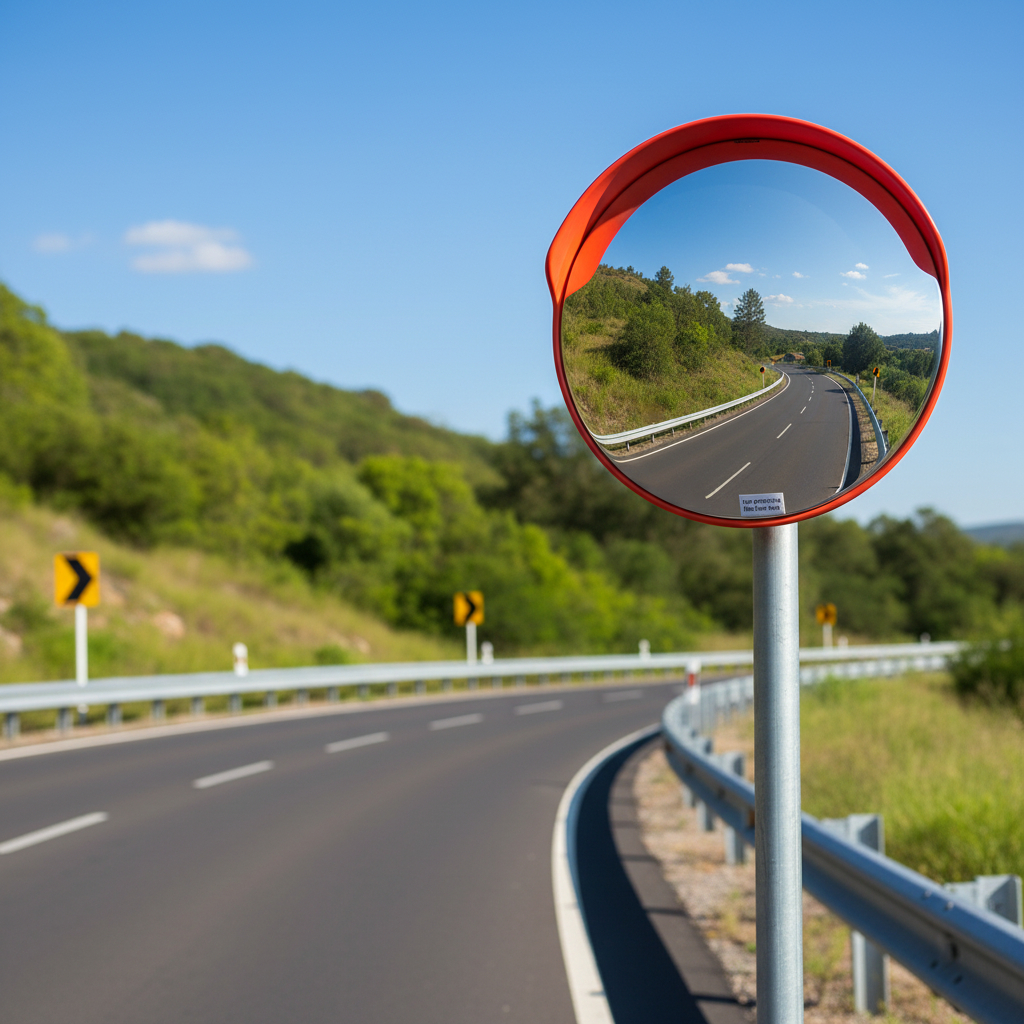
On real sites the curvature band does the work: the mirror has to hold a wide enough field that a driver can read an approaching vehicle at the distance the geometry allows.
In warehouses and factories, tall racking and building columns create right-angle intersections where two forklifts approach blind. A 800 mm or 1000 mm mirror with a 130°+ field covers the diagonal, and the wide frame is what allows the operator to see both lanes in a single glance rather than scanning. The same logic applies at loading docks, where a mirror has to hold yard traffic, reversing vehicles and pedestrians simultaneously.
In parking garages and property-managed compounds, wall space is limited and mounting height is constrained by ceiling lines. Because every model from 450 mm upward shares the R2200–R3000 band, a facility manager can specify a small 600 mm or 750 mm mirror for a garage corner and a large 1000 mm mirror for a perimeter road without re-qualifying the product — the field characteristic is consistent, only the coverage distance changes.
On roads, the same series is used at T-junctions, rural road intersections, highway ramps, ports and industrial zones, where the 1000 mm and 1200 mm models deliver 30–35 m and 35–45 m of visual range respectively. The published application scope of the product family also lists residential quarters, shopping malls, supermarkets, schools, hospitals, gas stations, construction sites, office parks, bus stations and community intersections.
A representative project profile in the product data — an installation in India — describes precisely the combination this framework is designed to produce: outdoor intersections, underground garage corners and T-junctions with significant blind spots; a fixed physical reflection that operates continuously without power; pole clamps, reflective film and expansion bolts as the matched equipment; and UV resistance, impact resistance with memory springback, high clarity and anti-rust, anti-corrosion finishes as the special requirements. The project types are recorded as road safety hazard mitigation, parking lot installation and business park traffic optimisation. The mirror's role in all three is the same: remove the blind spot without adding a power supply, a data connection or a maintenance contract.
Market Context: Growing Demand, and a Material Choice That Sets the Price
Category-level market data supports the case for treating mirror specification more carefully. The global convex mirror market was valued at USD 1.04 billion in 2025 and is forecast to reach USD 1.73 billion by 2034, a CAGR of 5.8%, according to a Dataintelo market report published in 2026. Asia-Pacific accounted for 42.5% of revenue share in 2025 in the same source — a concentration that reflects both the region's manufacturing base and its road and industrial construction volume.
Material selection is where the cost conversation sits. Polycarbonate carries a stated cost premium of 15–35% over an equivalent acrylic mirror. That premium is what buys impact resistance, self-recovery behaviour and a lens that holds its curvature under thermal cycling from −30°C to +80°C. For sheltered, low-risk indoor positions the acrylic option remains economically rational; for exposed roadside, dockside and industrial duty, the premium is the price of the durability that keeps the curve intact.
Supply-side capacity is also more visible than it was. Mnsd reports a monthly convex mirror production capacity of 30,000 units, with a standard lead time of 15–20 days for a 20-foot container. For distributors and project buyers planning stock against a 5.8% growth category, that combination of curvature consistency, capacity and lead time is the practical constraint on how confidently a specification can be committed to a tender.
How This Compares With Older Practice — and Where It Stops
| Approach | What the buyer gets | Where it is limited |
|---|---|---|
| Curvature-specified PC mirror, diameter matched to sightline | 130°+ wide-angle vision, impact-resistant PC lens, IP65 outdoor rating, no power or cabling required | PC carries a 15–35% cost premium over equivalent acrylic; Grade 8 UV resistance is rated at a 3–5 year lifespan, so replacement should be planned rather than assumed away |
| Oversized mirror chosen for “more coverage” | Simple to specify, and visually reassuring on a plan | Extra diameter adds weight, wind load and cost, and does not repair a wrong mounting position or an unverified curve |
| Economic acrylic mirror | Lower unit cost — the reason acrylic remains common in budget-constrained or low-risk positions | The saving is the 15–35% material gap; on exposed outdoor duty that gap is precisely what is being traded for impact and UV behaviour |
| Electronic monitoring (cameras or sensors) | Recording, remote viewing and analytics on top of the view | Requires power, cabling and ongoing maintenance — a different budget line from a passive mirror, and one that fails when the power does |
Comparison is about fit, not superiority: each approach has a position where it is the reasonable choice.
Three boundaries deserve to be stated plainly. First, curvature does not compensate for mounting position: a mirror placed where drivers do not look returns nothing, whatever its radius. Second, compression is inherent to a convex surface — a wider field always means smaller reflected images, and at the outer edge of a 130°+ field, small objects at long range are harder to identify than directly ahead. The R2200–R3000 band manages that trade-off; it does not remove it. Third, an outdoor mirror is a wearing component with a stated 3–5 year UV lifespan, and its Level 10 wind load rating still has to be checked against local wind conditions, pole strength and foundation. Mirrors also remain vulnerable to deliberate damage; the vandal-resistant, self-recovery impact rating reduces the consequences but does not eliminate replacement cycles.
Future Outlook
If the category grows at the forecast 5.8% CAGR through 2034, the change buyers are most likely to notice is not a new product type but a more disciplined specification. Diameter will remain the headline figure, but curvature radius is the parameter that makes two mirrors of the same size genuinely comparable, and it is the one most often left off quotations today. As Asia-Pacific manufacturing — already 42.5% of global revenue share — scales convex mirror capacity, the pressure shifts from availability to specification quality: consistent curvature, documented UV grade, verified IP65 construction and predictable lead times for container quantities.
Two further developments are worth watching. Material substitution will continue in both directions: PC where impact and weather exposure justify the 15–35% premium, acrylic where they do not. And retroreflective component standards, such as AS/NZS 1906.1:2017, will keep shaping how rim treatment is specified in markets that regulate traffic-visible devices. Category-level forecasts remain more widely published than segment-level breakdowns, so buyers should expect supplier-level performance data to be thinner than market-level data for some time yet — which is one more reason to specify the physical parameters, curvature included, that can actually be inspected on delivery.
Frequently Asked Questions
What does a curvature radius of R2200–R3000 mean on a convex mirror data sheet?
It describes the shape of the reflecting surface. A convex safety mirror is spherical, and the radius of curvature is the radius of the sphere from which that surface is cut: R2200 indicates a surface from a sphere with a 2,200 mm radius, R3000 from a sphere with a 3,000 mm radius. The focal length of a spherical mirror is half its radius of curvature, so the two ends of this band correspond to roughly 1.1 m and 1.5 m. A smaller radius is a more deeply curved mirror with a wider angular field; a larger radius is a flatter mirror that produces larger reflected images over a narrower field. In the Mnsd YD-OC series, all six diameters are specified within R2200–R3000 and rated at 130°+ wide-angle vision.
Does a larger diameter also mean a larger curvature radius?
No. Diameter and curvature are independent parameters. The YD-OC45 at 450 mm through to the YD-OC120 at 1200 mm all share the same R2200–R3000 curvature band. What changes with diameter is the published visual range — 10–12 m at 450 mm, 20–25 m at 750 mm, and 35–45 m at 1200 mm — not the shape of the field the curve produces.
How do I decide between a 600 mm and a 1000 mm mirror for a blind corner?
Start from the measured blind-spot distance rather than the available mounting surface. The 600 mm model is published at 15–18 m of visual range and the 1000 mm model at 30–35 m. Choose the smallest diameter whose range covers the distance a driver must see, then verify that the chosen mounting height places the mirror on the driver's sightline. Oversizing adds weight, wind load and cost without widening the field, because the curvature band is the same for both models.
Does the curvature radius affect distortion?
Yes, and the effect is inherent to a convex surface. A more deeply curved mirror compresses more of the surroundings into the same lens area, so reflected objects appear smaller and edge distortion is more visible; a flatter mirror produces larger, less compressed images but a narrower field. The R2200–R3000 band is a working range that balances wide coverage against legibility at the published visual ranges of each diameter. Buyers who need maximum image size should mount a smaller mirror closer to the reading position rather than relying on a flatter curve alone.
What environmental conditions are these outdoor polycarbonate convex mirrors rated for?
The YD-OC series is rated IP65 for outdoor use with an operating temperature range of −30°C to +80°C. The lens and backing use UV-stabilised PC and ABS with Grade 8 UV resistance and an estimated 3–5 year lifespan. Wind resistance is rated at Level 10 wind load, the impact rating is described as vandal-resistant with self-recovery, and an anti-scratch hard coating is available as an option for surface protection.
What mounting hardware and options should be specified with the mirror?
The mirrors are designed for wall or pole mounting through a heavy-duty galvanised steel bracket that fits 60 mm or 75 mm poles, with a 2.0 mm high-impact ABS back plate in bright orange for visibility. Engineering-grade reflective tape is available as an option on the rim, which is relevant where the mirror itself must be seen by approaching traffic; in Australia and New Zealand, AS/NZS 1906.1:2017 is the referenced standard for retroreflective materials and devices.
Full technical data for the YD-OC series, including the R2200–R3000 curvature specification and the published visual range of each diameter, is set out in the Mnsd product brochure: Mnsd traffic safety product brochure (PDF).
Есть вопросы или нужны дополнительные детали?
Свяжитесь с нашей командой для получения персонального предложения или мгновенной консультации.
Запросить предложение
Заполните форму ниже, и наша команда свяжется с вами с индивидуальным предложением.
Прямой чат WhatsApp
Предпочитаете общаться в реальном времени? Напишите нам в WhatsApp для мгновенной помощи и быстрых ответов.
- Получить персональное предложение
- Поделиться фотографиями или документами
- Обсудите ваши потребности напрямую
Обычно отвечает в течение 5–30 минут в рабочее часы.