
Curved Glass Procurement FAQ: Thickness Tolerance and CE Answers
A curved glass order is usually settled by four figures long before anyone discusses radius: nominal thickness, permitted thickness tolerance, light transmittance and the harmonised standard the panel is declared against. Buyers who cannot read those four figures precisely tend to over-specify the glass, under-specify the documentation, or find out at factory acceptance that the tolerance being quoted was the wrong one.
DYGLASS is the brand of Shenzhen Dayang Special Glass Co., Ltd., a building glass manufacturer founded in 2017 and located in Shenzhen, Guangdong, China, near Hong Kong. The company runs a 30,000 m² facility with around 130 staff and an annual production capacity of 600,000 m², and its range covers laminated glass, toughened glass, smart glass, insulated glass, curved glass and building glass. Three curved product families absorb most of the technical questions raised during procurement: DY-GH01 curved tempered glass, DY-JJ01 curved laminated glass and DY-ZK01 curved insulated glass.
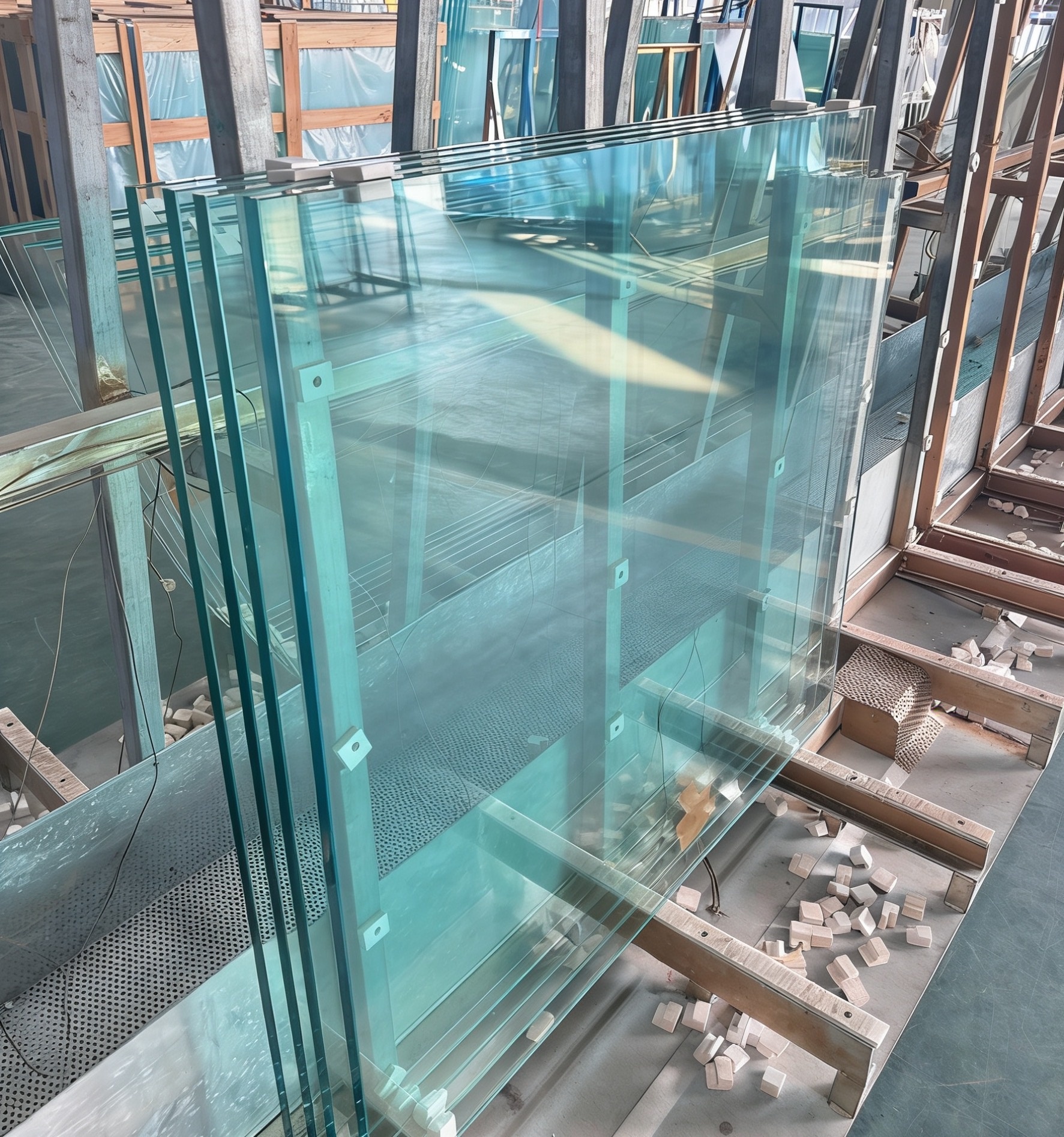
Thickness and edge condition are verified on the finished panel, not on the drawing — the point at which most tolerance misunderstandings surface.
Why these four questions come up in every curved glass enquiry
Curved glazing is not a catalogue item. A buyer cannot simply pick a product code and a size; the panel is made to a drawing, and the drawing only becomes an order once thickness, tolerance, transmittance and conformity route are fixed. That is why the same clusters of questions recur across curtain wall packages, lift enclosures, rooflights, shower screens and furniture applications.
The recurring questions fall into a predictable order of priority:
- Which family do I need? A single tempered skin, a laminated safety build-up, or an insulating unit.
- What thickness can actually be produced? And, critically, whether the tolerance being quoted refers to the glass thickness or to the geometry of the bend.
- What does the light transmittance figure mean once tint, coating and interlayer are added?
- Which certificate number applies to which model? And what that certificate does and does not prove.
The answers below are organised in that order, so a specifier can move from family selection to documentation without re-reading the same section twice.
Question 1: What thicknesses and tolerances are achievable?
Each of the three families has a different thickness logic, because each is a different kind of build-up. A tempered single pane is quoted as one number; a laminated panel is quoted as a total that includes the interlayer; an insulating unit is quoted as a stack of glass, cavity and glass.
| Model | Family | Construction | Thickness | Stated tolerance |
|---|---|---|---|---|
| DY-GH01 | Curved tempered glass | Float glass, thermally tempered | 3, 4, 5, 6, 8, 10, 12, 15 and 19 mm | ±0.5 mm |
| DY-JJ01 | Curved laminated glass | Tempered glass with PVB interlayer (SGP and EVA also available) | 6.38 mm to 50 mm | Determined by the glass and interlayer build-up |
| DY-ZK01 | Curved insulated glass | Tempered glass, aluminium or warm-edge spacer, gas fill | 6 mm + 12A + 6 mm and 8 mm + 16A + 8 mm; custom build-ups available | Determined by the unit build-up |
What the ±0.5 mm figure on DY-GH01 covers
DY-GH01 is a curved tempered glass made from float glass, supplied in thicknesses from 3 mm to 19 mm with a tolerance of ±0.5 mm. That figure describes the thickness of the glass itself. It is not a statement about curvature accuracy, chord tolerance or arc deviation — those are separate measurements, and they need to be agreed against the project drawing rather than inferred from the thickness tolerance.
This is the single most common misreading in curved glass procurement: a ±0.5 mm value is copied into a specification as if it covered the whole panel geometry. It does not. The purchaser should confirm it in writing as a thickness figure and then negotiate the geometric tolerances as a separate line item.
Why DY-JJ01 is quoted as a range rather than a single thickness
DY-JJ01 is a tempered laminated safety glass, also supplied as curved laminated glass, built from tempered glass and a PVB interlayer. Because the interlayer sits between two glass substrates, the finished thickness is the sum of glass plus interlayer, which is why the family spans 6.38 mm to 50 mm. PVB interlayer thickness options are 0.38 mm, 0.76 mm, 1.14 mm, 1.52 mm and 2.28 mm; interlayer types available are PVB, SGP and EVA; and substrate options include tempered glass, float glass, low-iron glass and tinted glass.
For the buyer, the consequence is straightforward: asking for a 12 mm laminated panel is an incomplete request. The answer has to specify substrate thickness, interlayer material and interlayer thickness, because those three choices drive safety performance, acoustic behaviour and the final transmittance figure.
Why DY-ZK01 is always quoted as a stack
DY-ZK01 is an insulating glass in the tempered insulated glass category, with curved variants available. It is made of tempered glass with an aluminium spacer, and standard thickness options are 6 mm + 12A + 6 mm and 8 mm + 16A + 8 mm, with custom thicknesses available. Glass type can be clear float, low-E, tempered or low-iron; spacer bar options are aluminium spacer or warm edge spacer; and gas fill options include air, argon, krypton and xenon.
In a stack notation, the number before the spacer is the inner or outer pane thickness, the letter-plus-number denotes the cavity, and the final number is the second pane. Procurement errors usually occur when a buyer quotes only total unit thickness, which leaves the cavity depth — and therefore much of the thermal and acoustic behaviour — undefined.
Question 2: What does the transmittance figure mean once the panel is built?
Light transmittance is a ratio, not a brightness setting. It states how much visible light passes through the finished assembly relative to incident light. Two panels can share the same nominal thickness and still sit at opposite ends of the transmittance scale once tint, coating and interlayer are added.
| Model | Light transmittance | Sound insulation | What moves the figure |
|---|---|---|---|
| DY-GH01 | ≥91% | Not stated for this family | Float glass is the stated substrate; the figure represents the clear single-pane case |
| DY-JJ01 | 85%–92% clear; 10%–70% tinted | 35 dB – 45 dB | Substrate choice (clear, low-iron, tinted) and interlayer build-up |
| DY-ZK01 | 70%–89% | 30 dB – 45 dB | Glass type including low-E, spacer type and gas fill |
Reading ≥91% on DY-GH01
A figure of ≥91% means the panel is a high-clarity product: more than nine-tenths of visible light is transmitted. For interior work — office partitions, bathroom glazing, furniture surfaces — that translates into minimal colour shift and a glass that reads as almost neutral in reflected daylight. The value describes the glass as supplied by the stated float-glass route; it should not be assumed to hold once the panel becomes part of a laminated or insulating assembly.
Reading 85%–92% on DY-JJ01
Clear laminated glass in the DY-JJ01 family sits between 85% and 92%, while tinted laminated glass spans 10% to 70%. The width of the second band is deliberate: tint level, not manufacturing inconsistency, produces the spread. A buyer who needs solar control, glare reduction or visual privacy should expect to trade transmittance for it, and should specify the target band rather than a single number, because the interlayer and substrate combination determines where in the band the finished panel lands.
Reading 70%–89% on DY-ZK01
An insulating unit contains two glass panes and at least one sealed cavity, so its transmittance naturally sits below that of a single pane. The 70%–89% range covers the configuration options listed for DY-ZK01 — clear float, low-E, tempered or low-iron glass, aluminium or warm-edge spacer, and air, argon, krypton or xenon fill. The practical message for a specifier is that the low end of the band should be expected when optical and thermal requirements are combined, and the daylight target should be set with that in mind rather than carried over from a single-glazing assumption.
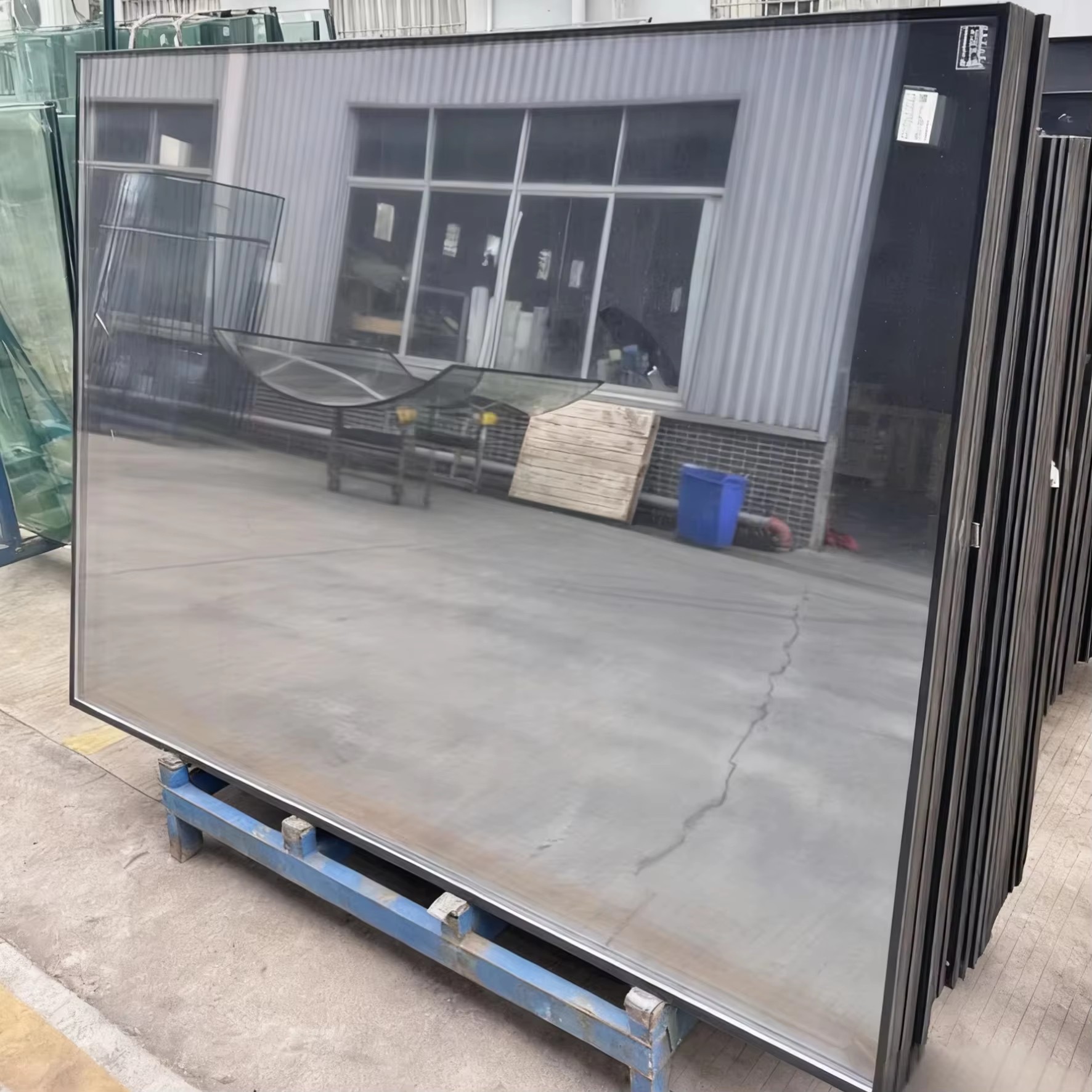
Cavity depth, spacer type and gas fill decide where a DY-ZK01 unit lands inside its 70%–89% transmittance band.
Question 3: How do PVB, spacer bar, low-E and argon change the selection?
PVB, SGP and EVA
DY-JJ01 offers PVB, SGP and EVA interlayers, with PVB thicknesses of 0.38 mm, 0.76 mm, 1.14 mm, 1.52 mm and 2.28 mm. Interlayer selection is not a cosmetic choice: it changes total panel thickness, adds mass, and shifts the finished transmittance. The family is described as tempered laminated safety glass and can be used for fire-resistant applications, with bulletproof laminated construction and fire-resistant laminated construction listed within the product type. Buyers asking about UV-blocking performance, blast resistance or overhead safety are therefore asking within the laminated family, where the interlayer is the functional layer between the two substrates.
Aluminium versus warm-edge spacer
DY-ZK01 offers aluminium spacer or warm edge spacer. The spacer defines the cavity and forms the edge seal of the unit. Warm-edge spacers are generally specified where the thermal bridge at the unit edge needs to be reduced; aluminium spacers remain the conventional choice where the priority is mechanical robustness of the edge assembly. Because both options sit inside the same product family, the decision is normally made once the project's thermal target is known.
Air, argon, krypton and xenon
DY-ZK01 lists air, argon, krypton and xenon as gas fill options. Heavier gases are used to improve the thermal behaviour of the cavity; air remains the baseline. The choice interacts with cavity depth — the 12A and 16A build-ups in the standard list — and with the spacer, which is why the three should be specified together rather than sequentially.
Low-E coating
Low-E coated glass is one of the listed glass types for DY-ZK01, alongside clear float, tempered and low-iron. A low-E option is the usual route when thermal performance is the driving requirement, and it is also one of the reasons the family's transmittance is quoted as a range rather than a single value.
Acoustic expectations
DY-JJ01 is rated at 35 dB to 45 dB and DY-ZK01 at 30 dB to 45 dB. The bands overlap, so a buyer cannot select an acoustic solution by family name alone. The build-up — interlayer thickness in the laminated case, cavity depth and gas in the insulating case — determines the result, and the specification should state the target rather than assume it from the product code.

Interlayer type and thickness change both the total panel thickness and the finished light transmittance of a laminated curved panel.
Question 4: Which CE certificate applies to which product family?
Compliance questions usually arrive as a single request — “send your CE certificate” — when what the buyer actually needs is the certificate that matches the model being purchased. The three families map to three different harmonised standards and three different certificate numbers.
| Model | Harmonised standard | Certificate number | Applies to |
|---|---|---|---|
| DY-GH01 | EN 12150-1 | BGTC20260403-02 | Curved tempered glass |
| DY-JJ01 | EN 1449 | BGTC20260403-03 | Curved laminated glass |
| DY-ZK01 | EN 1279-1 to -4 | BGTC20260403-05 | Curved insulated glass |
The mapping matters because the standards address different risks. EN 12150-1 is the harmonised specification for thermally toughened soda lime silicate safety glass, which is the relevant framework for a tempered single pane. EN 1449 addresses laminated safety glass, where the interlayer is the safety function. EN 1279-1 to -4 addresses insulating glass units across four parts, reflecting the fact that a sealed cavity introduces durability and gas-retention considerations that a single pane does not have.
What CE marking does and does not prove
CE marking is a declaration of conformity with a harmonised standard; it is not a project-specific performance guarantee. A certificate number confirms that the declared product family has been assessed against the named standard. It does not replace the project's own performance requirements — wind load, thermal transmittance, acoustic rating or fire classification still have to be checked against the specification and, where applicable, against project-specific test evidence.
Question 5: Which curved glass suits which application?
Application fit is decided by the functional layer each family provides, not by the shape of the panel. Shape capability is a separate question: DYGLASS processes multi-curved tempered glass, double curved tempered glass, triple curved tempered glass, trapezoid curved tempered glass, spherical curved tempered glass, pyramidal curved tempered glass, S-shape curved tempered glass, cylindrical curved tempered glass, and positive and negative curved tempered glass.
- Curtain wall and window systems. DY-ZK01 is specified for curtain wall and window systems, building construction and real estate, interior decoration and architecture projects. DY-GH01 also lists curtain wall among its applicable industries, so the deciding factor is whether an insulating cavity is required.
- Sightseeing elevator enclosures. Enclosures that require a safety-glass construction point toward DY-JJ01, where the interlayer retains fragments; single-skin enclosures with a tempered requirement point toward DY-GH01.
- Shower rooms. DY-GH01 lists the bathroom industry among its applications and is supplied in 3 mm to 19 mm thicknesses, with polished, grinded or beveled edge work.
- Coffee tables and furniture. DY-GH01 lists furniture among its applicable industries, and the edge work options — polished, grinded, beveled — are usually the specification detail that decides the visual result.
- Skylight and roof glazing. Overhead glazing places a premium on fragment retention, which is the function of the laminated family; where thermal performance also matters, a laminated or insulating build-up is specified instead of a single pane.
- Acoustic applications. Sound-insulated requirements are met within DY-JJ01 (35 dB – 45 dB) or DY-ZK01 (30 dB – 45 dB), depending on whether the project needs a laminated or an insulating construction.
- Low-iron and high-clarity work. Low-iron substrate is available in DY-JJ01 and as a glass type option in DY-ZK01; DY-GH01 is made from float glass with ≥91% transmittance.
- Heat-soaked and hot-bent work. The plant list includes a heat-soak furnace as well as two tempering lines — one flat and curved, one for concave, convex and irregular curved shapes — plus a dedicated double curved tempering line, an autoclave for lamination and an insulating line.
Question 6: How does curved glazing compare with flat glazing in specification terms?
The comparison is not about which is better; it is about where the risk sits. Flat glazing can be re-made from a drawing with comparatively little process setup, and its documentation is largely standard. A curved panel is a project-specific article: the bend depends on the tooling and the recorded curvature, replacement planning becomes a design-stage task rather than an afterthought, and the geometric tolerances must be agreed explicitly because they are not implied by the thickness tolerance.
The practical differences that show up in procurement are consistent:
| Consideration | Flat glazing | Curved glazing |
|---|---|---|
| Geometry definition | Size and thickness | Size, thickness, radius, chord and arc must all be defined |
| Tolerance clauses | Usually one thickness clause | Thickness tolerance and curvature tolerance must be agreed separately |
| Replacement | Re-made from a drawing | Depends on the original bending setup and recorded geometry |
| Post-processing | Cutting and drilling can follow later | Holes, cut-outs and edge profiles must be fixed before tempering and bending |
| Documentation | Standard product data | Model-specific certificate plus project-specific performance evidence |
Limits and boundaries buyers should accept before ordering
A credible specification states its boundaries. For the three families described here, the following limits are material:
- The ±0.5 mm figure is a thickness tolerance only. Curvature, chord and arc deviation are separate measurements and are not defined by the published product data.
- Tempered curved glass cannot be cut, drilled or re-edged after tempering. Every hole, notch, cut-out and edge profile has to be defined before bending; a late design change means a new panel, not a modification.
- Laminated and insulating build-ups add mass and thickness. A 50 mm laminated panel or an 8 mm + 16A + 8 mm unit is a heavier, deeper component than a single pane, and the façade interface, framing and handling arrangements have to reflect that.
- Higher transmittance and higher performance pull in opposite directions. Tinted laminated glass in the DY-JJ01 family ranges from 10% to 70% transmittance, and a DY-ZK01 unit ranges from 70% to 89%; the optical target and the solar or thermal target have to be reconciled in the specification, not after delivery.
- CE certification is a conformity declaration, not a performance guarantee. Project requirements for wind load, thermal transmittance, acoustics and fire behaviour still require separate verification.
- Application-level data is not publicly segmented. Third-party market research does not break curved glass down by end use, so buyers cannot benchmark their own project against a published segment benchmark.
Market context: what the published figures actually say
The demand backdrop is documented, though at a category level rather than at product level. Statifacts estimates the global curved glass market at USD 13.5 billion in 2025, with a forecast compound annual growth rate of 5.8% over 2025–2035. Grand View Research puts the glass curtain wall market at USD 62.4 billion in 2024, which situates curved architectural glazing inside a much larger façade category rather than as a standalone market.
The standards framework is equally traceable. ASTM C1464 covers bent glass for building construction, furniture and display. ISO 11485-3:2014 classifies curved tempered and curved laminated glass as safety glasses for buildings. Both are slow-changing references, which is why they remain useful anchors in a specification even as product ranges evolve.
Two caveats belong with these figures. First, they are third-party commercial estimates, not audited statistics. Second, none of them segment curved glass by application — shower room, elevator, curtain wall or furniture — so any claim about which segment is growing fastest is an inference rather than a published fact.
Future outlook
Three developments are likely to shape curved glass procurement over the next specification cycles. The first is documentation discipline: as buyers become more familiar with the difference between EN 12150-1, EN 1449 and EN 1279-1 to -4, the certificate number rather than the certificate image is likely to become the standard request in tender packs. The second is the normalisation of warm-edge spacers and gas-filled cavities in curved insulating units, which moves the specification conversation from “do you offer it” to “which build-up meets the target”. The third is traceability of geometry: because a curved panel cannot be modified after tempering, the drawing that produced it becomes the reference document for the life of the building.
For manufacturers, that means the differentiator is less about the bending line and more about how precisely the specification is captured before the glass enters the furnace. DYGLASS operates two tempering lines, a double curved tempering line, an autoclave, an insulating line, a heat-soak furnace and dedicated cutting, drilling and edge grinding lines within a 30,000 m² facility, with exports accounting for around 60% of output and served markets including the UAE, Bahrain, Saudi Arabia, the United States, the Philippines and Vietnam. The company is an Alibaba Verified Supplier and has passed an SGS test report, and it welcomes OEM and ODM orders.
Quick-answer FAQ for order confirmation
Can curved tempered glass be drilled or edge-worked after bending?
No. Holes, cut-outs and edge profiles must be defined before tempering and bending. DY-GH01 edge work options — polished, grinded and beveled — are therefore selected at the drawing stage, not at dispatch.
Which edge finishes are available on DY-GH01?
Polished, grinded and beveled. The product can be supplied as flat tempered glass, tempered glass with hole, or with polished edge.
Does the company accept OEM and ODM orders?
Yes. Shenzhen Dayang Special Glass Co., Ltd. welcomes OEM and ODM orders, and its processing scope covers multi-curved, double curved, triple curved, trapezoid, spherical, pyramidal, S-shape, cylindrical and positive/negative curved tempered glass.
Which certificate number should appear on the order documents?
BGTC20260403-02 under EN 12150-1 for DY-GH01, BGTC20260403-03 under EN 1449 for DY-JJ01, and BGTC20260403-05 under EN 1279-1 to -4 for DY-ZK01.
What information is needed to quote a curved insulating unit?
Glass type (clear float, low-E, tempered or low-iron), build-up such as 6 mm + 12A + 6 mm or 8 mm + 16A + 8 mm, spacer type (aluminium or warm edge), gas fill (air, argon, krypton or xenon) and the target transmittance band within 70%–89%.
Where can technical documents be requested?
Technical enquiries can be sent to info@dayangglass.com or raised by telephone on +86-136 9211 0212. The company brochure is available for download at the DYGLASS brochure PDF.
Есть вопросы или нужны дополнительные детали?
Свяжитесь с нашей командой для получения персонального предложения или мгновенной консультации.
Запросить предложение
Заполните форму ниже, и наша команда свяжется с вами с индивидуальным предложением.
Прямой чат WhatsApp
Предпочитаете общаться в реальном времени? Напишите нам в WhatsApp для мгновенной помощи и быстрых ответов.
- Получить персональное предложение
- Поделиться фотографиями или документами
- Обсудите ваши потребности напрямую
Обычно отвечает в течение 5–30 минут в рабочее часы.