
Curved Glass Selection Guide: Precision, Certification and the New Benchmark in Architectural Glazing
Curved glass has transitioned from a specialty architectural accent to a structural and aesthetic standard for modern façades, elevator enclosures, skylights and interior features. For specifiers and procurement professionals evaluating suppliers, the decision increasingly hinges on manufacturing precision, process certification and the ability to deliver complex geometries without distortion.
The Challenge: Moving Beyond Flat-Glass Standards
Traditional flat tempered glass benefits from decades of standardized production machinery and quality control. Curved glass, by contrast, introduces variables—bend radius, shape uniformity, optical clarity—that demand dedicated equipment and specialized know-how. Without proper process control, common issues include wave distortion along the bend line, thickness variation, and inconsistent lamination adhesion. The market opportunity for suppliers lies in closing the gap between design ambition and reliable, repeatable fabrication.
DYGLASS: A Specialized Curved Glass Manufacturer
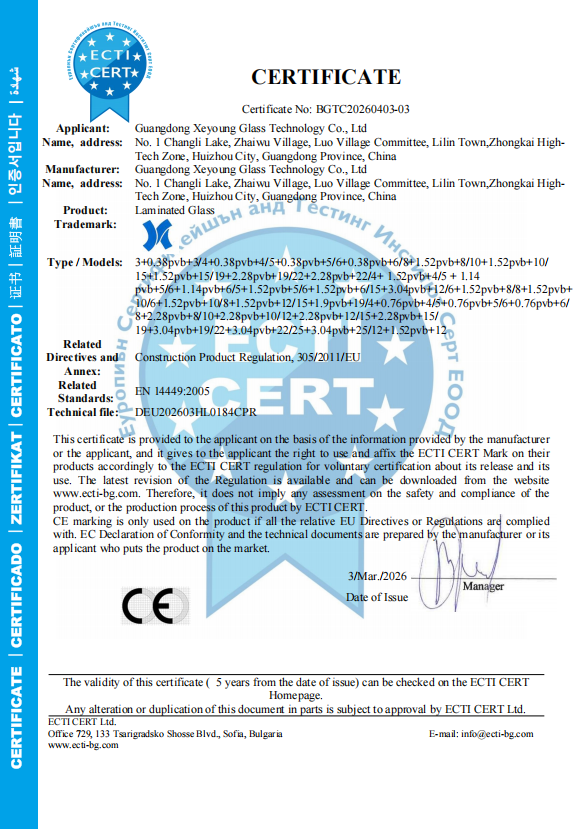
Shenzhen Dayang Special Glass Co., Ltd. (DYGLASS) is a 30,000 m² factory based in Shenzhen, China, that focuses on the research, development and production of building glass, including curved glass. With an annual output capacity of 600,000 square meters and a team of 130 employees, DYGLASS has positioned itself as a manufacturer capable of handling multi-curved, double-curved, triple-curved, trapezoid-curved, spherical-curved, pyramidal-curved, S-shaped, U-shaped, and positive-and-negative-curved tempered glass. The company holds CE certification for its tempered glass (model DY-GH01) under standard EN 12150, laminated glass under EN 1449, and insulated glass under EN 1279, issued by ECTI CERT Ltd., valid through 2031.
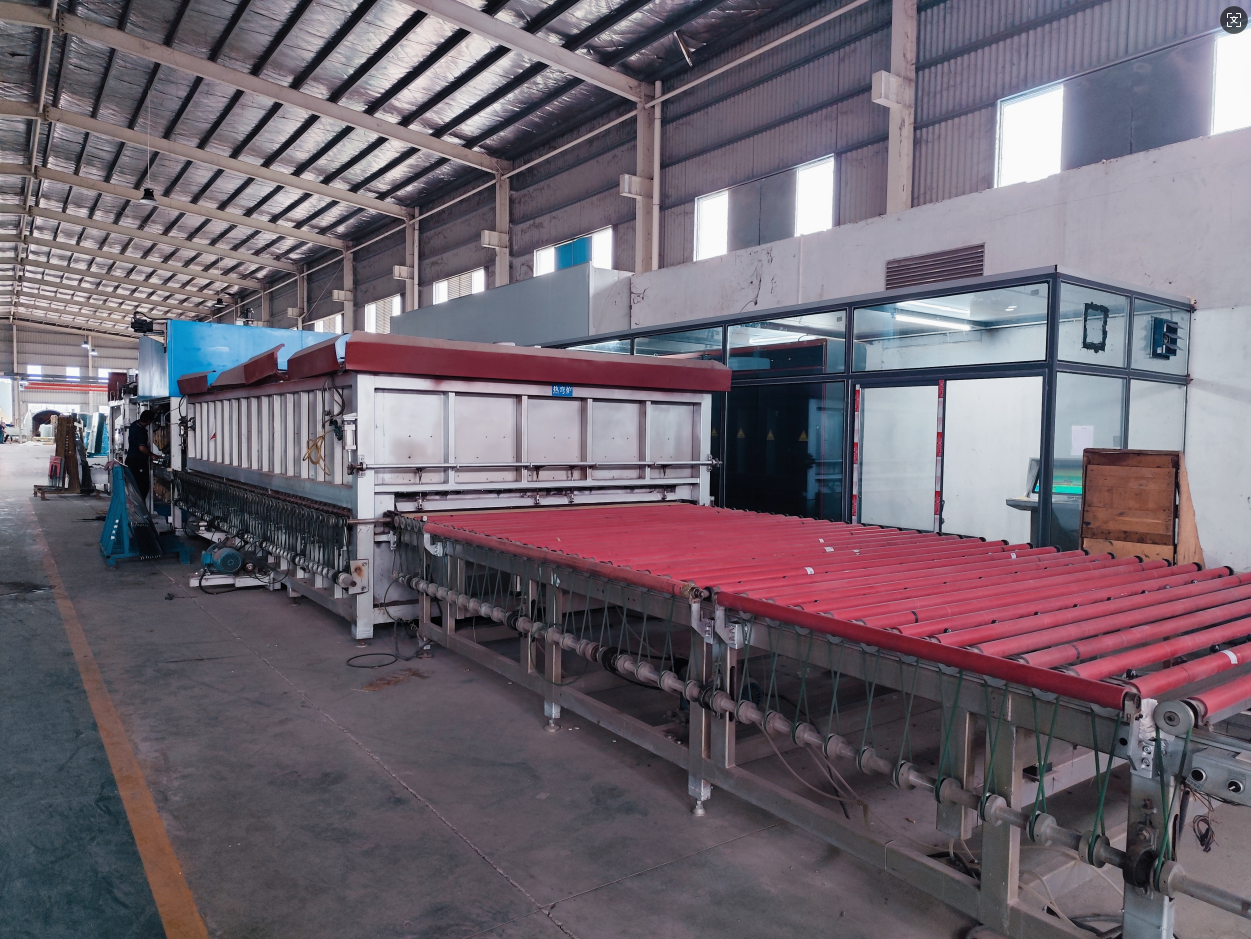
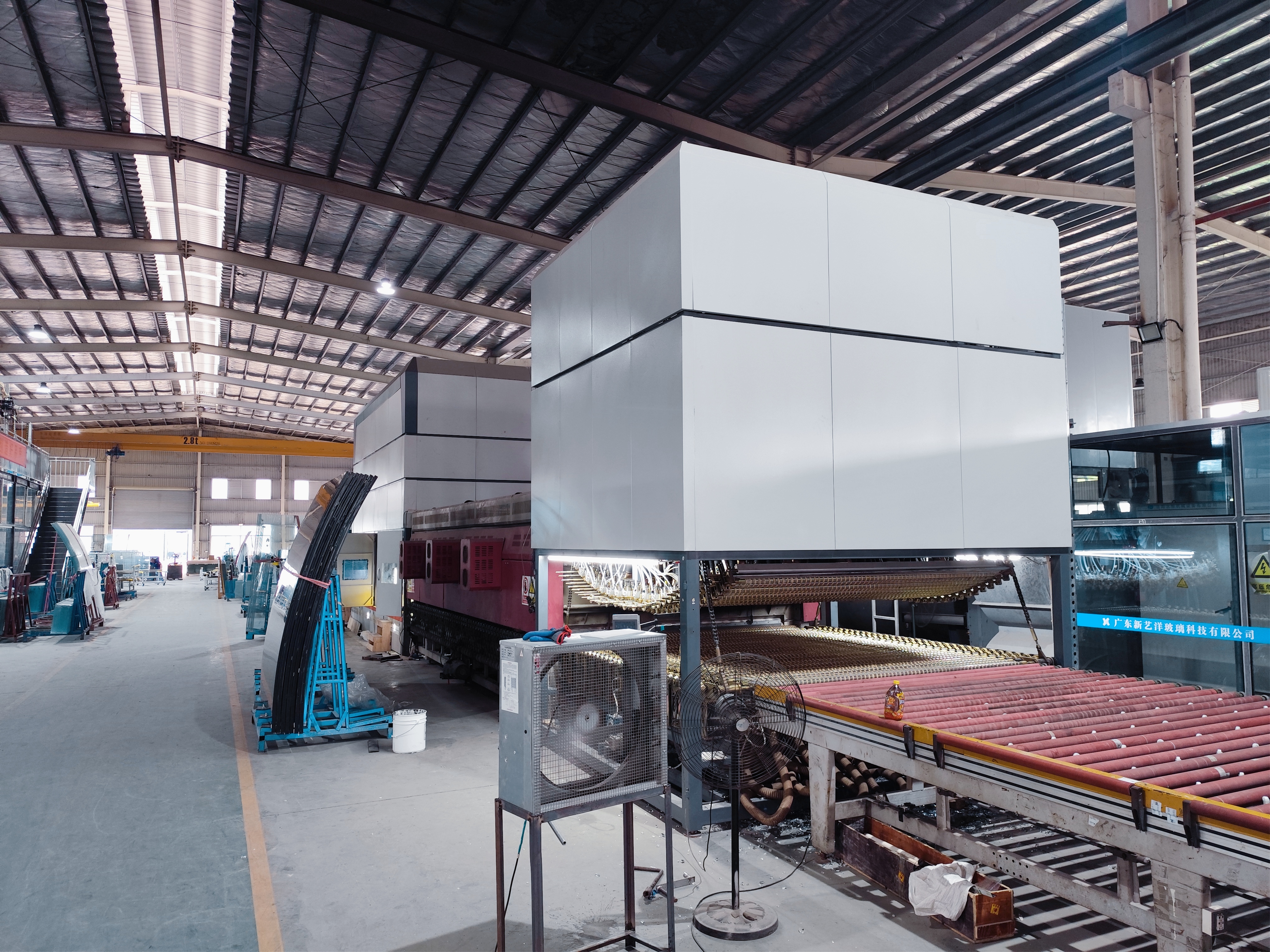
Dedicated double curved tempering line enabling complex shape production.
Technical Capabilities That Differentiate
DYGLASS operates multiple production lines specifically designed for curved glass. These include a dedicated double curved tempering line and a line for concave & convex curved and irregular shapes, both complemented by precision cutting, edge grinding, drilling, and heat soak furnaces. The facility also houses an autoclave for laminated curved glass production, allowing the combination of curvature with PVB, SGP or EVA interlayers. The CE-certified tempered glass covers thicknesses from 3 mm to 19 mm with a tolerance of ±0.5 mm, while the laminated line supports thicknesses from 6.38 mm to 50 mm and achieves sound insulation ratings between 35 dB and 45 dB. For projects requiring low iron content, DYGLASS can use low-iron float glass as substrate, minimizing greenish tint in high-transparency installations.
Where Curved Glass Delivers Maximum Impact
While DYGLASS’s curved glass is applicable broadly across the building and construction sector, several use cases align with the strongest demand signals:
- Curtain Wall Systems – Large-radius cylindrical curves for iconic building envelopes, where double-curved panels create flowing architectural lines.
- Sightseeing Elevator Cladding – Fully tempered curved glass that combines safety (explosion-proof and sound-insulated options) with panoramic visibility, often requiring laminated construction for overhead applications.
- Shower Room Enclosures – Single hot curved or S-shaped panels that replace standard hinged doors, using low-iron glass for clarity and UV-blocking options for privacy.
- Skylight Roofs and Canopies – Extra-large, high-precision curved units with laminated interlayers for overhead safety and thermal performance, often combined with insulated glass units for energy efficiency.
- Interior Furniture – Coffee tables and shelving using tempered curved glass with polished edges, capitalizing on the brand’s ability to produce shapes without wave distortion.
Market Trends Supporting Curved Glass Adoption
The demand for curved glass in architecture is being driven by two macro forces. First, the expansion of parametric design tools has made irregular building forms more economical to design, but fabrication capacity remains the bottleneck. Second, energy-performance regulations in regions such as the European Union and the Middle East are pushing specifiers toward insulated and laminated curved solutions that meet both thermal and safety requirements. DYGLASS’s CE certifications for tempered, laminated and insulated product lines directly address these regulatory demands, particularly for project specifications requiring a European Technical Assessment (ETA) under the Construction Product Regulation (CPR).
Comparison with Conventional Flat-Glass Solutions
Compared to using standard flat glass panels in a segmented or mullioned façade, curved glass offers seamless aesthetic flow and reduced structural framing weight. An honest limitation of curved glass, however, is its longer manufacturing lead time due to the custom mold-making and controlled cooling cycles required. For projects where schedule is the dominant constraint, flat glass with mechanical bending on site may be a fallback—though at the cost of visual uniformity and long-term reliability. DYGLASS’s 600,000 m² annual capacity and multiple dedicated forming lines help mitigate lead-time risks for mid-to-large volume orders.
Future Outlook
As glass processors continue to invest in CNC forming and double-curve tempering technology, the historical price premium for curved glass is expected to narrow. Manufacturers that combine certification, shape flexibility and quality control—like DYGLASS—are well positioned to serve the growing number of architectural projects that treat curved glass as a standard specification rather than a custom exception. The company’s export ratio of 60% and active presence in markets including the UAE, Saudi Arabia, the United States, and the Philippines suggests a proven ability to meet international quality and lead-time expectations.
Frequently Asked Questions
What is the typical tolerance for curved tempered glass from DYGLASS?
DYGLASS’s CE-certified tempered glass (model DY-GH01) has a thickness tolerance of ±0.5 mm for the glass substrate. For curved panels, dimensional tolerance depends on the complexity of the shape and should be confirmed on a per-project basis with the manufacturer.
Does DYGLASS offer low-iron curved glass for high-transparency applications?
Yes. DYGLASS can use low-iron float glass as the substrate for curved glass production, which reduces the greenish tint typical of standard float glass and increases light transmittance (up to 91% for clear tempered glass).
How does DYGLASS ensure no wave distortion in double-curved glass?
The company operates dedicated double curved tempering lines that apply controlled heating and forming over the entire panel surface, minimizing localized stress that causes wave distortion. The facility also uses precision edge grinding and quality inspections linking to its CE certification process.
What certifications does DYGLASS hold for curved glass used in EU projects?
DYGLASS holds CE certification for tempered glass (EN 12150), laminated glass (EN 1449), and insulated glass (EN 1279), all issued by ECTI CERT Ltd. under the Construction Product Regulation 305/2011/EU. The certificates are valid through 2031 and cover curved variants of these product types.
Can DYGLASS produce curved laminated glass for overhead glazing?
Yes. DYGLASS’s laminated glass line (model DY-JJ01) supports curved configurations using PVB, SGP or EVA interlayers in thicknesses from 6.38 mm to 50 mm, achieving sound insulation of 35 dB to 45 dB and meeting safety requirements for overhead applications like skylights.
For a detailed overview of DYGLASS’s product range, production capacity and technical specifications, the company brochure is available for public download: Download DYGLASS Brochure (PDF).