
Curved Glass Selection: Tempered, Laminated or Insulated?
Curved glass is no longer a one-off gesture reserved for landmark facades. It is now specified in curtain walls, sightseeing elevator enclosures, skylight roofs, curved shower rooms, office partitions, furniture such as coffee tables, and automotive glazing. That wider use has changed the buyer's question. Fewer projects ask whether curved glass can be produced at all; more ask which of the three common curved glass constructions — tempered, laminated or insulated — actually meets the performance and compliance brief for a specific opening, and what each choice costs in thickness, weight and light.
The three are different products rather than different grades of one product. A curved tempered pane is a single glass sheet that has been heated and rapidly cooled so that its surfaces go into compression. A curved laminated pane bonds two or more glass plies around a polymer interlayer. A curved insulating unit seals two panes around a spacer cavity that may be filled with air or an inert gas. Each decision changes thickness, structural weight, light transmittance, acoustic behaviour, safety classification and the certification route that applies in regulated markets.
This buyer comparison sets out published specification data for three DYGLASS curved glass models — DY-GH01 curved tempered glass, DY-JJ01 curved laminated safety glass and DY-ZK01 curved insulating glass — together with the CE certification each model holds for the European Union and European Economic Area (EU/EEA) market. It does not rank the three types, because the correct specification depends on what the glazing has to do in service.
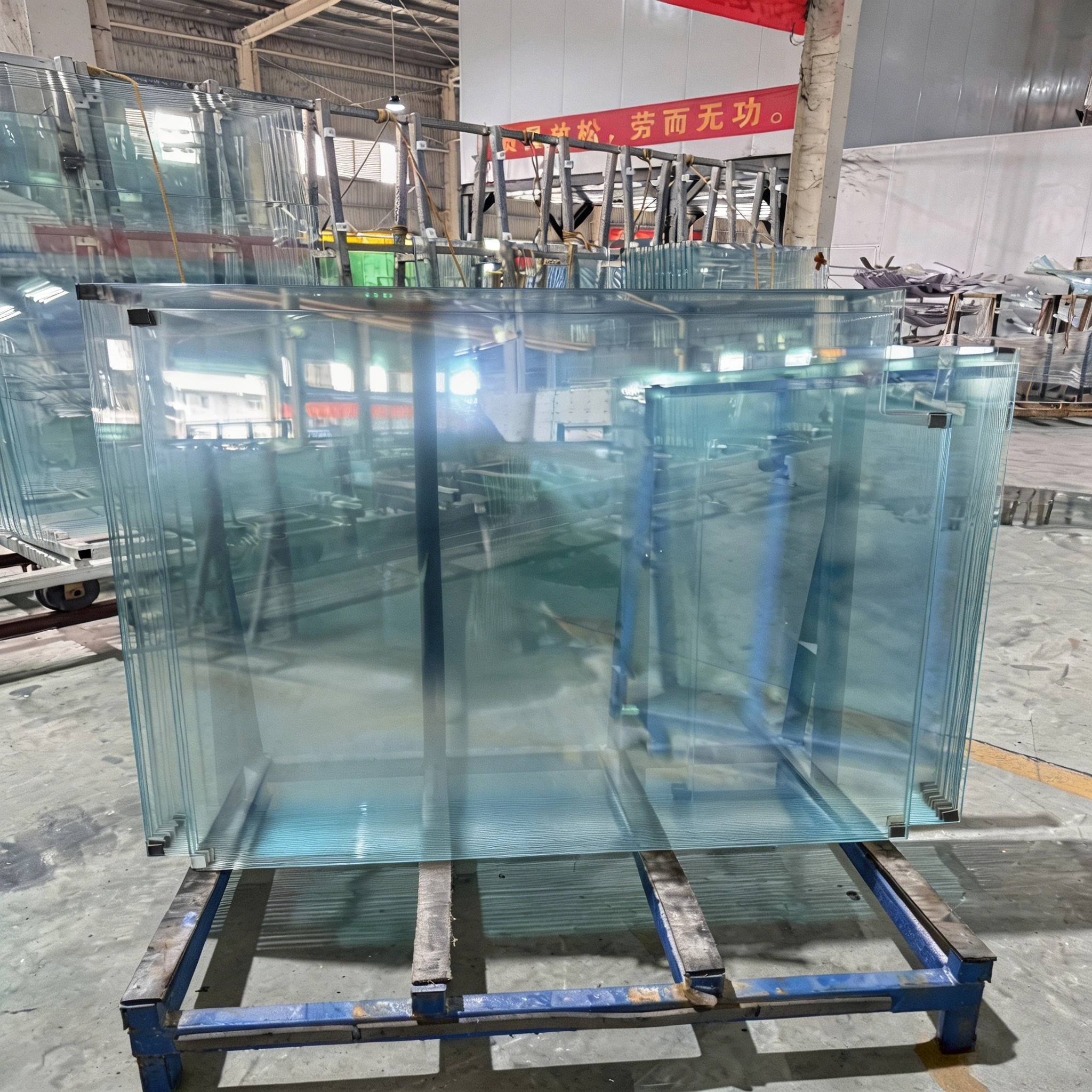
The Processor Behind the Three Models
DYGLASS is the brand of Shenzhen Dayang Special Glass Co., Ltd., an architectural glass processor founded in 2017 and based in Shenzhen, China, adjacent to Hong Kong. The company operates a 30,000 m² facility with 130 employees and an annual output of 600,000 square metres, and reports that approximately 60% of its production is exported to markets including the United Arab Emirates, Bahrain, Saudi Arabia, the United States, the Philippines and Vietnam. Its product range covers laminated glass, toughened glass, smart glass, insulated glass, curved glass and building glass. Forming capability includes multi-curved, double curved, triple curved, trapezoid, spherical, pyramidal, S-shaped, cylindrical and positive/negative curved tempered glass. The company is an Alibaba Verified Supplier, holds an SGS test report, and accepts OEM and ODM orders.
That context matters for the comparison that follows. Because all three models come from the same production base and the same forming capability, the differences described below are differences of construction rather than differences of manufacturing origin — which is precisely how a buyer should evaluate them.
Specification Comparison: Tempered, Laminated and Insulating Curved Glass
| Specification | DY-GH01 Curved Tempered Glass | DY-JJ01 Curved Laminated Glass | DY-ZK01 Curved Insulating Glass |
|---|---|---|---|
| Construction | Single tempered glass pane on a float glass substrate | Two or more glass plies bonded with a PVB, SGP or EVA interlayer | Two panes separated by an aluminium or warm-edge spacer, with air or gas fill |
| Thickness | 3, 4, 5, 6, 8, 10, 12, 15, 19 mm; tolerance ±0.5 mm | 6.38 mm – 50 mm overall; interlayer options 0.38, 0.76, 1.14, 1.52, 2.28 mm | 6 mm + 12A + 6 mm, or 8 mm + 16A + 8 mm; custom combinations available |
| Glass substrate options | Float glass | Tempered, float, low-iron or tinted glass | Clear float, Low-E, tempered or low-iron glass |
| Light transmittance | ≥91% | 85%–92% clear; 10%–70% tinted | 70%–89% |
| Published sound insulation | Not stated in the published specification | 35–45 dB | 30–45 dB |
| Edge work | Polished, ground or beveled | Not specified in published data | Not specified in published data |
| CE product standard | EN 12150-1:2015+A1:2019 | EN 1449:2005 | EN 1279-1:2018, EN 1279-2:2018, EN 1279-3:2018, EN 1279-4:2018 |
| CE certificate number | BGTC20260403-02 | BGTC20260403-03 | BGTC20260403-05 |
| Certifying body and validity | ECTI CERT Ltd.; issued 2026-03-03, valid to 2031-03-03 | ECTI CERT Ltd.; issued 2026-03-03, valid to 2031-03-03 | ECTI CERT Ltd.; issued 2026-03-03, valid to 2031-03-03 |
| Published application industries | Construction, furniture, bathroom, curtain wall, office partition | Building and construction, real estate, architecture, interior design, automotive, solar energy | Building construction, real estate, architecture, interior decoration, curtain wall, window systems |
| Available variants | Flat tempered, curved tempered, tempered with holes, polished edge | Tempered laminated safety, bulletproof laminated, fire-resistant laminated, curved laminated | Tempered insulated, Low-E coated, argon-filled, curved insulated |
Read as a set, the table explains why the three types rarely substitute for one another. The tempered model leads on light transmission and simplicity. The laminated model introduces an interlayer that changes safety behaviour, acoustic performance and available thickness. The insulating model introduces a sealed cavity that changes thermal and acoustic performance at the cost of overall build thickness and light transmission.
Curved Tempered Glass (DY-GH01): Single-Pane Strength and High Light Transmission
DY-GH01 is published with thickness options of 3 mm, 4 mm, 5 mm, 6 mm, 8 mm, 10 mm, 12 mm, 15 mm and 19 mm, held to a tolerance of ±0.5 mm, with a light transmittance of ≥91%. Edge work can be polished, ground or beveled, and the model range also covers flat tempered glass, curved tempered glass and tempered glass with holes and polished edges. The industries listed for this model are construction, furniture, bathroom, curtain wall and office partition.
For a buyer, the practical meaning is narrow and useful. Where the design intent is a thin curved pane with the highest light transmission in this comparison, curved tempered glass is the construction that matches that intent. The trade-off is process discipline: tempering is irreversible, so the shop drawing has to be final before processing begins. Hole positions for fittings, edge profiles for framed or frameless assemblies and the final edge finish must all be confirmed in advance, because tempered glass cannot be cut, drilled or re-edged afterwards.
Typical enquiries for this construction therefore tend to be geometry-led rather than thermal-led: curved partitions, shopfronts, bathroom enclosures, furniture panels and interior architectural elements where visibility and clean edges matter more than insulation values.
Curved Laminated Safety Glass (DY-JJ01): Performance Defined by the Interlayer
DY-JJ01 spans an overall thickness range of 6.38 mm to 50 mm and is built from two or more glass plies bonded with an interlayer available in PVB, SGP or EVA. Interlayer thickness options are 0.38 mm, 0.76 mm, 1.14 mm, 1.52 mm and 2.28 mm. The glass substrate may be tempered, float, low-iron or tinted. Published light transmittance is 85%–92% for clear builds and 10%–70% for tinted builds, and published sound insulation is 35–45 dB. Beyond the standard curved laminated configuration, the model is offered as tempered laminated safety glass, bulletproof laminated glass and fire-resistant laminated glass. Its listed industries include building and construction, real estate, architecture, interior design, automotive and solar energy.
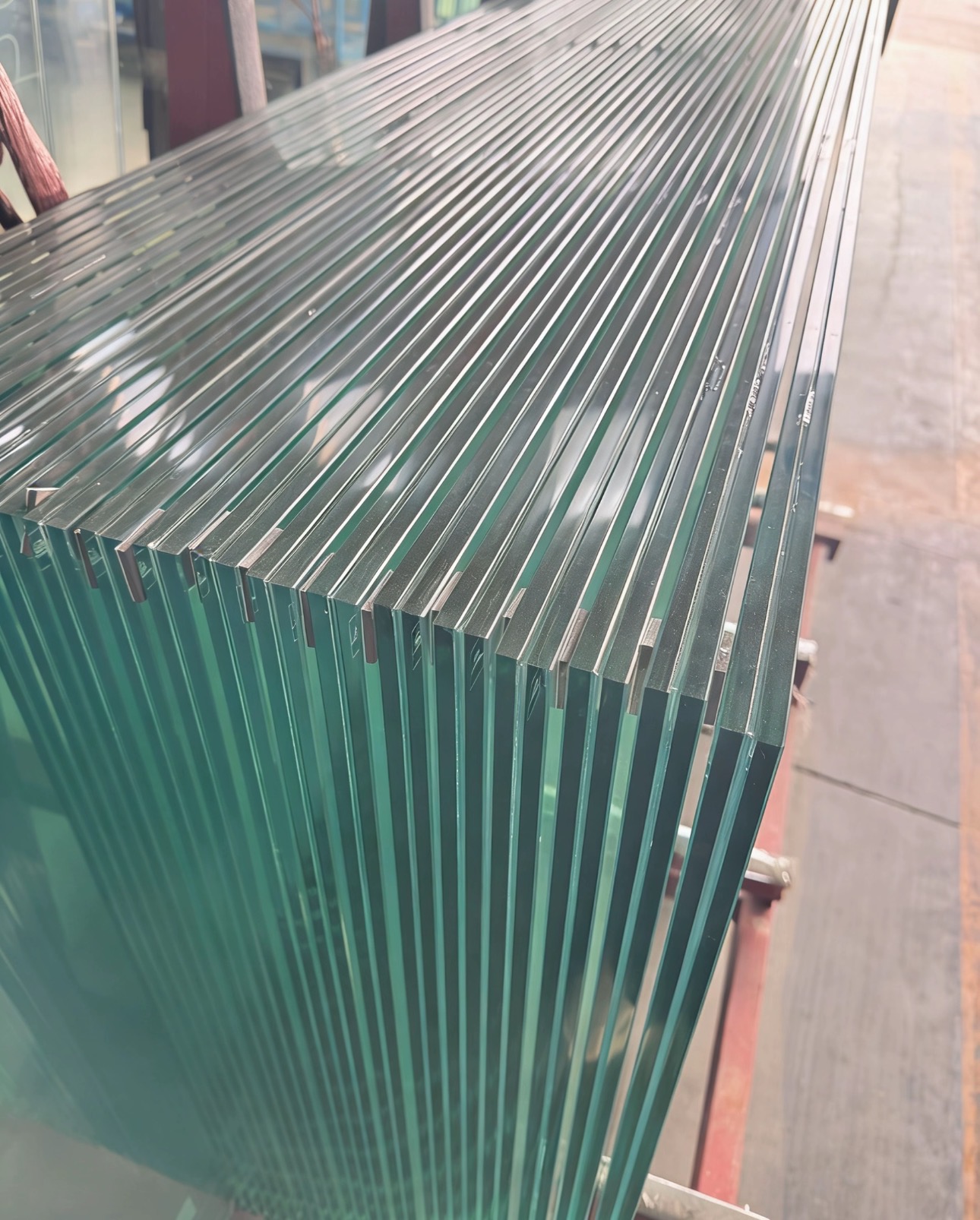
The interlayer is where the specification decisions concentrate. It is the layer that holds the assembly together if a ply breaks, and it is also the layer that most directly changes acoustic behaviour. Increasing interlayer thickness, or moving to a stiffer interlayer such as SGP, is a common way to raise the structural and post-breakage performance of a curved laminated build without changing the visible glass thickness. Because of that, laminated constructions are generally the type buyers examine first for overhead glazing, balustrades, security-relevant openings and any position where retained fragments matter after impact.
Two practical notes follow. First, clear laminated builds transmit slightly less light than the ≥91% published for single tempered glass — the interlayer and the second ply both absorb and reflect some light. Second, the available interlayer options are not interchangeable in cost or lead time; a 2.28 mm interlayer is a different commercial proposition from a 0.38 mm one, even when the finished glass looks identical.
Curved Insulating Glass (DY-ZK01): A Sealed Cavity for Thermal and Acoustic Control
DY-ZK01 is published in 6 mm + 12A + 6 mm and 8 mm + 16A + 8 mm builds, with custom combinations available. The cavity between the panes is maintained by an aluminium spacer or a warm-edge spacer, and the fill may be air, argon, krypton or xenon. Glass options include clear float, Low-E, tempered and low-iron. Published light transmittance is 70%–89% and published sound insulation is 30–45 dB. Variants include tempered insulated glass, insulated glass with Low-E coating, insulated glass with argon gas and curved insulated glass. The industries listed are building construction, real estate, architecture, interior decoration, curtain wall and window systems.
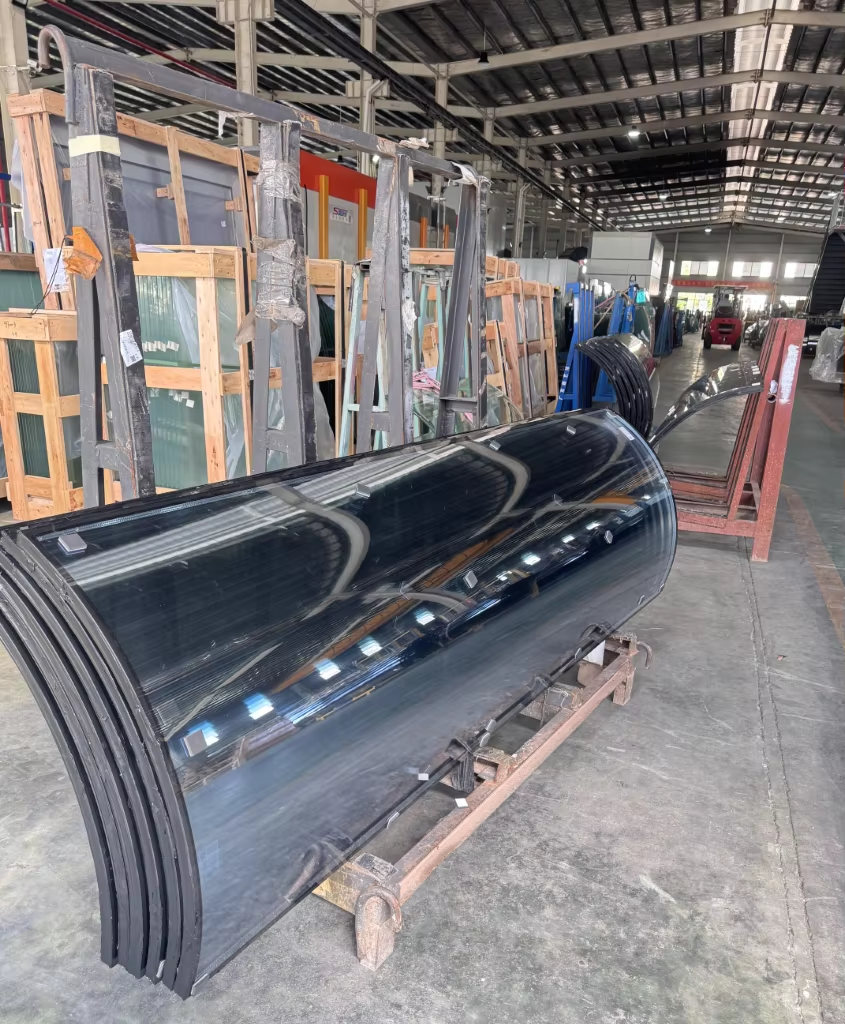
The cavity is the product. Spacer type, gas fill and coating choice determine the thermal behaviour of the unit, while the two panes and the sealed gap together determine much of its acoustic behaviour. Buyers comparing curved insulating glass with the other two constructions should note the direction of the trade-off: this is the construction with the lowest published light transmittance of the three (70%–89%) and the greatest overall build thickness, but it is the only one of the three that deliberately separates the two glass surfaces with a controlled, gas-filled void.
Because the unit is thicker and heavier than a single pane, the surrounding system — framing, gaskets, structural supports and handling equipment — has to be sized for the finished unit rather than for the nominal glass thickness alone.
CE Certification: What the Three Certificates Actually Cover
For buyers selling into the European Union or the European Economic Area, documentation is often the first filter applied to a supplier shortlist. All three DYGLASS models hold CE certification issued by ECTI CERT Ltd., with certificate validity running from 3 March 2026 to 3 March 2031:
- DY-GH01 curved tempered glass — certificate number BGTC20260403-02, issued under EN 12150-1:2015+A1:2019.
- DY-JJ01 curved laminated glass — certificate number BGTC20260403-03, issued under EN 1449:2005.
- DY-ZK01 curved insulating glass — certificate number BGTC20260403-05, issued under EN 1279-1:2018, EN 1279-2:2018, EN 1279-3:2018 and EN 1279-4:2018.
Two qualification points are worth noting before those numbers are used in a submittal. First, coverage is tied to the thickness combinations and configurations listed in each certificate, so a build outside that scope is not automatically covered and may require separate assessment. Second, the applicable standards differ by product family: tempered safety glass, laminated glass and insulating glass units are assessed under different European standards and therefore under different test regimes. A supplier's certification for one family does not transfer to another, which is exactly why a three-model comparison should be checked against three certificate numbers rather than one.
Where a project also references international or US practice, two further documents are commonly cited. ISO 11485-3:2014 classifies curved tempered and curved laminated glass as safety glasses for buildings. ASTM C1464 is the standard specification for bent glass and covers building construction, furniture and display applications.
Matching Curved Glass Type to Application
| Application | What usually drives the choice | Which published data applies |
|---|---|---|
| Curtain wall and window systems | Combination of light transmission, thermal performance and, at height, safety classification | DY-GH01 lists curtain wall; DY-ZK01 lists curtain wall and window systems; DY-JJ01 lists building and construction |
| Sightseeing elevator enclosure | Safety classification and post-breakage behaviour, alongside visibility | ISO 11485-3:2014 classifies curved tempered and curved laminated glass as safety glasses for buildings; DY-JJ01 is available as curved laminated glass |
| Skylight roof (overhead glazing) | Retention of fragments in an overhead position, plus unit weight and structural load | DY-JJ01 curved laminated configuration with PVB, SGP or EVA interlayer |
| Shower room and bathroom | Single-pane simplicity, edge quality and cleanability | DY-GH01 lists bathroom; edge work polished, ground or beveled |
| Office partition | Transparency plus acoustic separation between rooms | DY-GH01 lists office partition; DY-JJ01 publishes 35–45 dB; DY-ZK01 publishes 30–45 dB |
| Furniture and coffee tables | Thin, transparent panes with finished edges | DY-GH01 lists furniture; 3–19 mm thickness range |
| Automotive glazing | Laminated construction with controlled transmittance | DY-JJ01 lists automotive; clear 85%–92%, tinted 10%–70% |
| Fire-resistant glazing | A rated laminated build rather than a monolithic pane | DY-JJ01 includes fire-resistant laminated glass in its type range |
| Interior decoration with thermal control | Sealed cavity with Low-E coating and gas fill | DY-ZK01 lists interior decoration; 70%–89% transmittance |
Two caveats apply to any such mapping. Application lists describe the industries a model is published for; they do not replace project-specific structural or fire calculation. And for curved formats, geometry feasibility must be confirmed separately, because a shape that is routine in flat glass may not be producible within the forming limits of a given furnace.
Limits and Trade-offs Buyers Should Plan For
- Tempering is irreversible. Curved tempered glass cannot be cut, drilled or re-edged after processing, so hole positions and edge profiles must be finalised before the sheet enters the furnace. Late changes mean a new panel, not a modification.
- Multi-layer builds are heavier. A 6.38–50 mm laminated assembly and a 6 mm + 12A + 6 mm insulating unit both weigh more and occupy more depth than a single tempered pane. Framing, gaskets, supports and lifting equipment must be sized for the finished unit.
- Light transmission falls as layers are added. Published values run from ≥91% for the clear tempered model, through 85%–92% for clear laminated builds, to 70%–89% for the insulating unit. Where maximum daylight is the priority, that gradient is a real design constraint.
- Acoustic figures are assembly figures. The published 35–45 dB for laminated glass and 30–45 dB for insulating glass describe the glass build; final performance depends on the frame, seals, cavity depth and installation quality as well. Monolithic tempered glass has no published acoustic figure in this data set, and a single pane without an interlayer or cavity generally provides less airborne sound reduction than the multi-layer constructions.
- Curved geometry sets its own limits. Industry sources report curved glass formed to bending radii as small as 75 mm and panel lengths up to 12 metres, but these are reported capability ranges rather than guarantees. Radius, chord, panel size, coating compatibility and hole placement should be confirmed panel by panel before the order is released.
- Certification follows the configuration. CE coverage applies to the thickness combinations and configurations named in the certificate. A specification outside that scope is not covered by the same document, even where the product family is identical.
Market Context: Where Curved Glazing Demand Is Heading
Curved glazing is a specialised but meaningful part of the wider glazing market. Statifacts estimates the global curved glass market at USD 13.5 billion in 2025, with a forecast compound annual growth rate of 5.8% over 2025–2035. For scale, Grand View Research reports the glass curtain wall market at USD 62.4 billion in 2024. Curved glass is therefore not a niche curiosity inside architectural glazing; it is a recurring specification category in the facade segment that drives much of the demand.
Two standards shape how that demand is documented. ASTM C1464 defines bent glass requirements for building construction, furniture and display. ISO 11485-3:2014 provides the international classification of curved tempered and curved laminated glass as safety glasses for buildings. Together with European product standards, they explain a shift visible in buyer behaviour: enquiries increasingly arrive with a performance brief and a documentation checklist attached, rather than with geometry alone.
The practical consequence for suppliers and for procurement teams is that curved glass is being bought more like a specified engineered component and less like a commodity sheet. That favours suppliers who can present thickness ranges, transmittance values, interlayer or spacer options and traceable certification numbers at quotation stage.
Reference document: DYGLASS publishes a downloadable product brochure covering its curved glass and building glass range, including certification references, at DYGLASS product brochure (PDF).
Buyer Checklist Before Releasing a Curved Glass Order
- Name the performance driver. Daylight, safety, acoustics or thermal control — the primary driver usually eliminates one of the three constructions immediately.
- Match the thickness range to the design. Confirm whether the opening suits 3–19 mm tempered, a 6.38–50 mm laminated build, or a 6 mm + 12A + 6 mm / 8 mm + 16A + 8 mm insulating unit.
- Fix the interlayer or cavity configuration. For laminated glass, that means interlayer type (PVB, SGP or EVA) and interlayer thickness. For insulating glass, it means spacer type, gas fill and coating.
- Check transmittance against the daylight target. Compare the required value with ≥91%, 85%–92%, or 70%–89% depending on the construction chosen.
- State the acoustic target in dB. The published ranges — 35–45 dB for laminated, 30–45 dB for insulating — give a starting benchmark, subject to assembly effects.
- Verify certification line by line. Certificate number, applicable standard, certifying body and validity dates should all appear in the submittal, and the intended configuration should sit inside the certified scope.
- Confirm geometry feasibility. Radius, chord, panel size and hole placement should be validated by the fabricator before the order is placed.
- Decide whether OEM or ODM support is required. DYGLASS accepts OEM and ODM orders, operates as an Alibaba Verified Supplier and holds an SGS test report — all useful items for a supplier file.
Future Outlook
The direction of the curved glass market points toward more demanding specifications rather than simpler ones. As curved glazing spreads from signature facades into elevators, skylights, interiors and furniture, the same pane increasingly has to satisfy a structural requirement, a daylight requirement, an acoustic requirement and a compliance requirement at once. That pushes buyers toward constructions with documented, verifiable performance rather than toward a single default type.
For suppliers, the competitive ground is shifting toward documentation: thickness ranges published precisely, transmittance values stated per build, interlayer and spacer options enumerated, and certification traceable to a certificate number and standard. For buyers, the practical benefit is a shorter path from concept to approved submittal — and fewer late-stage surprises when a curved panel cannot be modified after processing, or when a 70% transmittance unit is asked to deliver the daylight performance of a 91% pane.
FAQ: Curved Tempered, Laminated and Insulating Glass
What thickness range does each curved glass type offer?
DY-GH01 curved tempered glass is published with thickness options of 3 mm, 4 mm, 5 mm, 6 mm, 8 mm, 10 mm, 12 mm, 15 mm and 19 mm, with a tolerance of ±0.5 mm. DY-JJ01 curved laminated glass covers an overall thickness range of 6.38 mm to 50 mm, with interlayer options of 0.38 mm, 0.76 mm, 1.14 mm, 1.52 mm and 2.28 mm. DY-ZK01 curved insulating glass is published in 6 mm + 12A + 6 mm and 8 mm + 16A + 8 mm builds, with custom combinations available.
Does lamination reduce light transmittance compared with tempered glass?
Published figures indicate yes. DY-GH01 tempered glass is published at ≥91% light transmittance. DY-JJ01 laminated glass is published at 85%–92% for clear builds and 10%–70% for tinted builds, reflecting the additional ply and the interlayer. DY-ZK01 insulating glass is published at 70%–89%, reflecting the second pane, the spacer cavity and any coating applied.
How much sound insulation do curved laminated and curved insulating glass provide?
Published sound insulation for DY-JJ01 curved laminated glass is 35–45 dB, and for DY-ZK01 curved insulating glass is 30–45 dB. No acoustic figure is published for DY-GH01 tempered glass. In practice, the finished acoustic performance of an opening depends on the complete assembly — frame, seals, cavity depth and installation quality — and not on the glass build alone.
Are all three curved glass models CE certified for the EU/EEA market?
Yes. DY-GH01 curved tempered glass holds certificate BGTC20260403-02 under EN 12150-1:2015+A1:2019. DY-JJ01 curved laminated glass holds certificate BGTC20260403-03 under EN 1449:2005. DY-ZK01 curved insulating glass holds certificate BGTC20260403-05 under EN 1279-1:2018, EN 1279-2:2018, EN 1279-3:2018 and EN 1279-4:2018. All three were issued by ECTI CERT Ltd., dated 2026-03-03 and valid to 2031-03-03, and certification coverage is tied to the thickness combinations and configurations listed in each certificate.
Can curved tempered glass be cut or drilled after it has been tempered?
No. Tempering is a one-way process; cutting, drilling or re-edging a tempered pane after processing is not possible without breaking the temper. Hole positions, edge profiles and the required edge finish — polished, ground or beveled for DY-GH01 — must therefore be finalised before the glass enters the furnace. Laminated and insulating builds likewise should have all fabrication requirements confirmed before assembly.
Which curved glass type suits interior applications such as shower rooms, partitions and furniture?
The published application industries give an indication rather than a rule. DY-GH01 curved tempered glass lists furniture, bathroom, office partition, curtain wall and construction, and is available with holes and polished edges. DY-JJ01 curved laminated glass lists interior design, building and construction, real estate, architecture, automotive and solar energy, and includes fire-resistant laminated glass in its type range. DY-ZK01 curved insulating glass lists interior decoration, curtain wall, window systems, building construction, real estate and architecture, and is offered with Low-E coating and argon fill. Final selection should be checked against the project's structural, acoustic and compliance requirements.
Есть вопросы или нужны дополнительные детали?
Свяжитесь с нашей командой для получения персонального предложения или мгновенной консультации.
Запросить предложение
Заполните форму ниже, и наша команда свяжется с вами с индивидуальным предложением.
Прямой чат WhatsApp
Предпочитаете общаться в реальном времени? Напишите нам в WhatsApp для мгновенной помощи и быстрых ответов.
- Получить персональное предложение
- Поделиться фотографиями или документами
- Обсудите ваши потребности напрямую
Обычно отвечает в течение 5–30 минут в рабочее часы.