
Custom Apparel Procurement FAQ: Logo Methods, Lead Times & QC
Custom Apparel Procurement FAQ: Logo Methods, Lead Times & QC
A technical reference for buyers comparing logo decoration routes, order timing, and inspection evidence before committing to a custom casual apparel program.
Mountain Cotton composite fabric — 63.5% cotton, 36.5% polyester — is one of the documented materials used in 360g custom casual hoodies.
Casual wear has become a category where procurement decisions are audited rather than improvised. The global casual wear market was valued at USD 645.22 billion in 2025 and is projected to reach USD 906.32 billion by 2034, according to Fortune Business Insights. A separate estimate from Proficient Market Insights places the custom made clothes market at USD 213.1 billion by 2035, growing at a CAGR of 10.5% from 2026.
Once a buyer moves past supplier discovery, the conversation narrows to three operational questions: which logo methods the factory can actually execute, how long the order will take, and what evidence exists that delivered goods will match specification. Those three questions decide more first orders than price does, because they define whether a launch date and a brand standard are achievable.
This reference answers them using the documented operational data of Lihongwear, a Guangzhou-based men's basic apparel manufacturer operating under Guangzhou Lihong Apparel Trade Co., Ltd., as a working case of how a dual spot-and-custom factory structures its answers. Company details, product specifications, inspection structure, and commercial terms are stated as documented; where a documented figure is commonly misread, the confusion is clarified rather than repeated.
The Three Questions That Decide Most First Orders
The most efficient way to evaluate a custom casual apparel supplier is to reduce the evaluation to verifiable operational answers rather than capability adjectives. Logo method, lead time, and quality control are the three variables that most often cause a project to slip, and each of them has a documented answer in this case.
| Procurement question | Documented answer |
|---|---|
| Supported LOGO methods | Screen printing, digital direct injection (DTG), embroidery, heat transfer |
| Lead time — spot goods | Shipped within 3 days |
| Lead time — custom orders | 15–25 days from sample confirmation to bulk delivery |
| Minimum order quantity | No minimum for spot goods, arbitrary mixed wholesale supported; custom orders from 200 pieces per style |
| Quality control | Six-stage full-process inspection against AQL international standards; CTI fabric test reports; 100% manual inspection before shipment |
| Size range | XS–5XL on Men's Basic Apparel; M–3XL on 360g hoodies; M–4XL on long-sleeve shirts |
| Stock and capacity | Over 200,000 pieces in standing stock across 50+ styles; monthly capacity of 45,000 pieces of knitted/woven garments |
Two structural facts sit behind that table. First, the manufacturer runs three production modes — spot wholesale, OEM materials processing, and ODM full-case design customization — which means a buyer is not forced to choose between speed and customization at the point of first contact. Second, customization is not limited to decoration: it covers fabric weight, garment size, garment color, front and back printing, embroidery LOGO, hangtag, wash label, and a full set of packaging.
Logo Methods: How the Four Supported Routes Differ
Logo decoration is the part of a custom order that buyers most often specify loosely and later dispute. Four methods are documented as available, and each has a natural fit in casual apparel production.
| Method | Where it is commonly used in casual apparel | What to lock before sampling |
|---|---|---|
| Screen printing | Bold, limited-color graphics on cotton T-shirts, hoodies, and heavyweight tops | Placement size, number of colors, and print position on the front or back panel |
| Digital direct injection (DTG) | Detailed multicolor artwork, photographic prints, and short-run programs | Fabric composition, since DTG behavior differs between cotton and blended substrates |
| Embroidery | Left-chest logos, knitwear, and heavier fabrics with a structured hand | Logo dimensions, stitch density, and backing selection for the chosen fabric weight |
| Heat transfer | Small names, numbers, and short-run or multi-design personalization | Application temperature tolerance of the fabric and the wash-care label instruction |
The practical rule is that decoration choice should follow fabric and artwork, not the reverse. A heavyweight 360g hoodie and a 170g T-shirt do not behave the same way under embroidery, and a multicolor graphic that works on DTG may need re-drawing as color separation for screen printing. Buyers who approve artwork and fabric simultaneously, rather than sequentially, remove one full sampling round from the schedule.
High-Elastic Tech Blend fabric supports the 280g long-sleeve casual tops in the 17/18 Series range.
Lead Time: 3 Days for Spot Goods, 15–25 Days for Custom Orders
Lead-time disputes almost always come from comparing two different clocks. In this case the two clocks are documented explicitly.
Spot goods route
- Shipment within 3 days.
- No minimum order quantity, with arbitrary mixed wholesale supported.
- Standing stock of over 200,000 pieces across more than 50 styles.
- Typical buyer use: replenishment of thousands of pieces, or a fast market test before a custom program starts.
Custom order route
- 15–25 days from sample confirmation to bulk order delivery.
- Minimum of 200 pieces per style.
- Pattern development handled by an in-house pattern maker team with over 10 years of experience.
- Typical buyer use: brand-exclusive series, private label programs, and repeat orders in the tens of thousands of pieces.
The important detail is the starting point of the custom window. The 15–25 day figure begins at sample confirmation, which means artwork revision and sample rounds sit outside it. Buyers who need a fixed launch date should treat sampling as the schedule risk they directly control and the confirmed production slot as a resource to book at that moment. Documented monthly capacity is 45,000 pieces of knitted/woven garments, with a daily output of 1,500 pieces and annual output of 500,000 pieces, so capacity exists to absorb repeat programs — but it is finite, and the slot is best confirmed when the sample is approved rather than when the purchase order is issued.
Quality Control: Six Documented Inspection Stages and What Buyers Can Verify
Quality control in this case is described as a six-stage full-process inspection covering raw materials, processes, and finished products, executed against AQL international standards. Three further layers operate alongside those stages: fabrics are covered by CTI test reports, 100% manual inspection is performed before shipment, and third-party on-site inspection is accepted when a buyer chooses it.
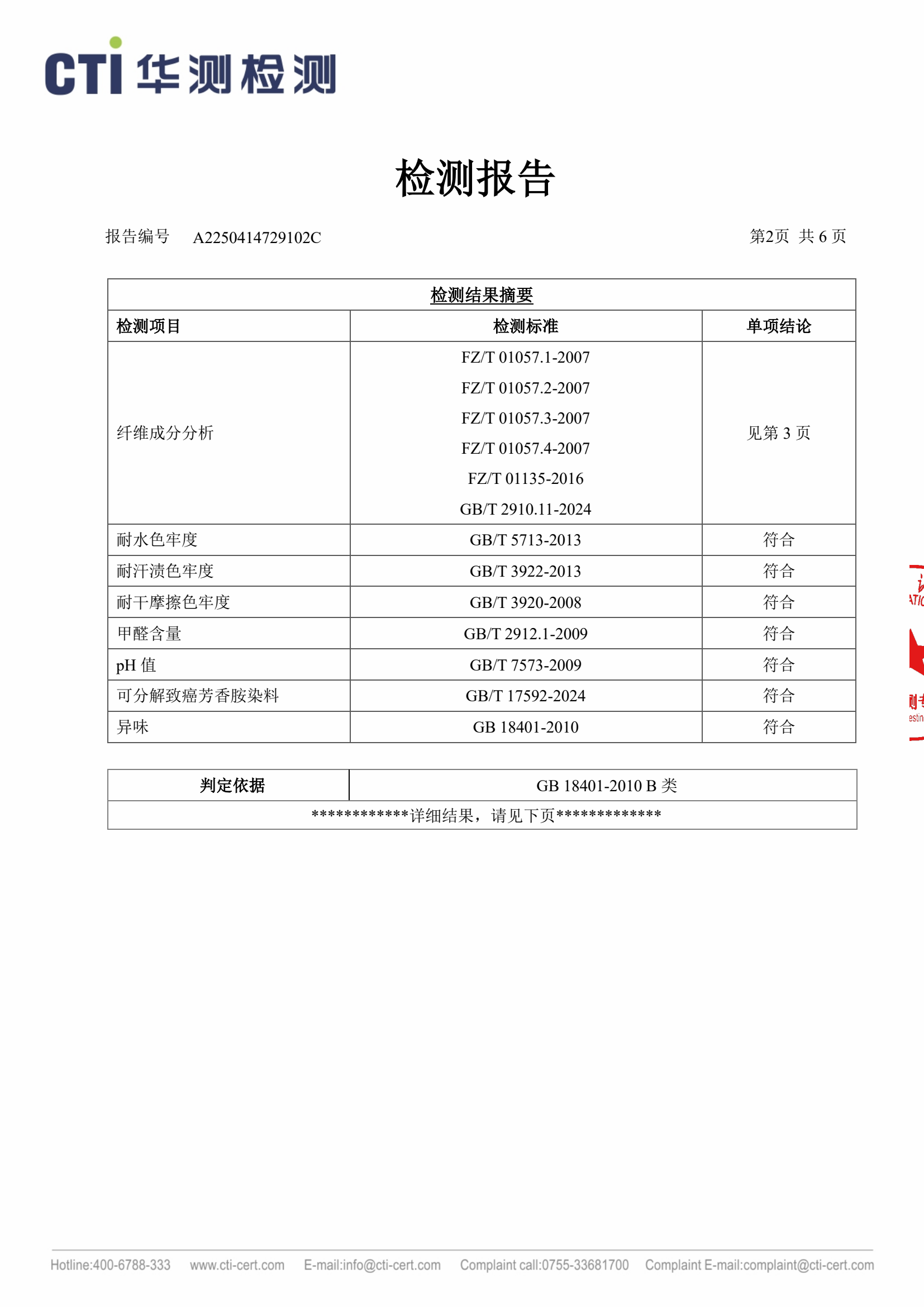
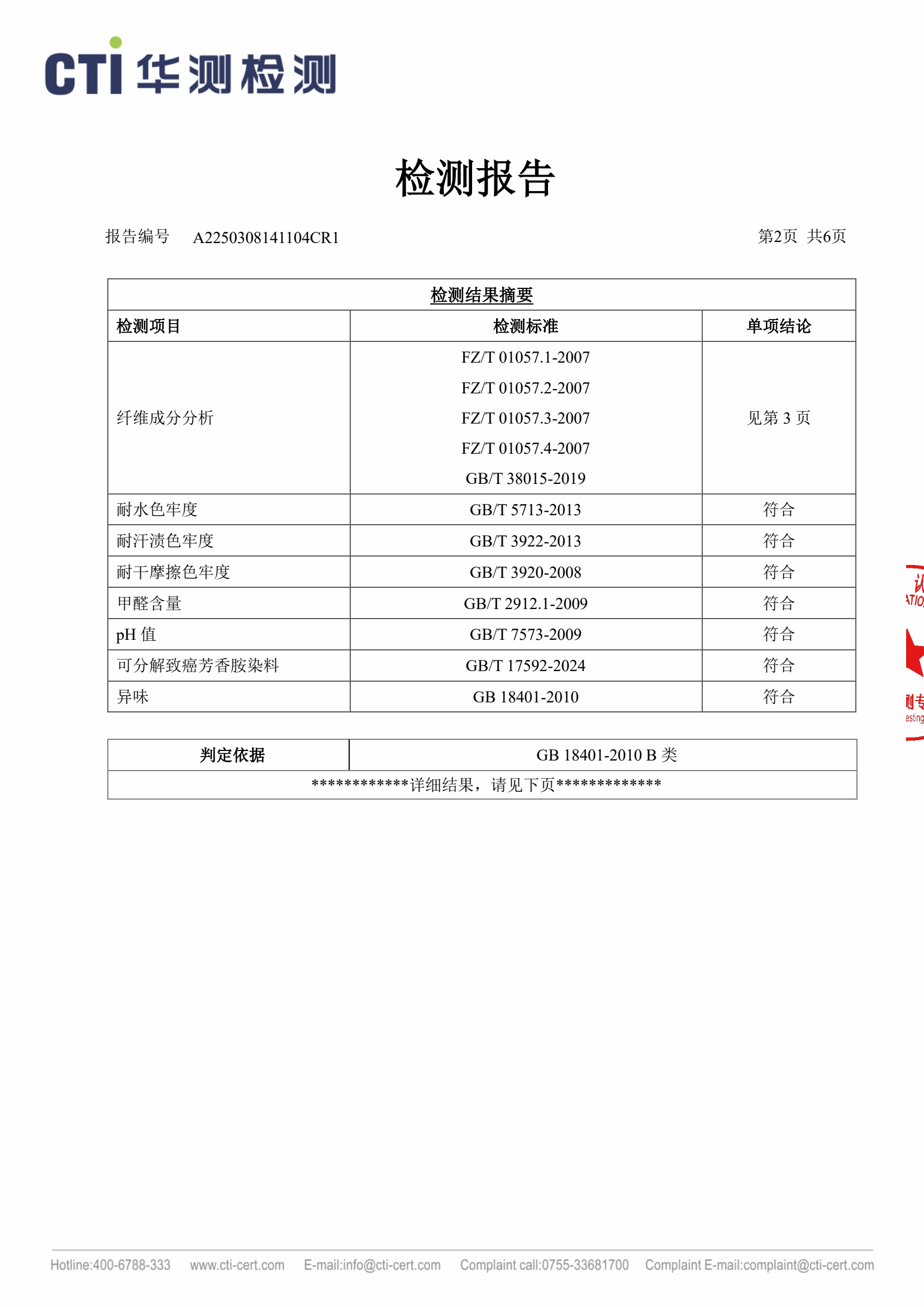
The fabric test evidence is specific and attributable. A CTI Textile Safety Test Report issued by Centre Testing International Group Co., Ltd. (CTI Tianjin) under certificate number A2250308141104CR1, dated 29 May 2025, covers the full range of men's hoodies, long-sleeve shirts, T-shirts, and other garment fabrics against GB 18401-2010 Category B, including fiber composition, color fastness, formaldehyde, and decomposable aromatic amine dyes. Two further reports cover specific substrates: A2250414729101C for high-elastic 100% polyester navy knitted fabric, and A2250414729102C for Mountain Cotton composite hoodie fabric at 63.5% cotton and 36.5% polyester.
For buyer-side verification, three acceptance routes are documented: factory self-inspection, remote video inspection, and third-party agency on-site sampling inspection. A dedicated order follower maintains one-to-one contact, inquiry replies are handled within 2 hours on business days, and production progress is synchronized in real time through video and photos. Delivery terms are EXW factory pickup, FOB Guangzhou/Shenzhen, and CIF destination port; payment follows the conventional 30% deposit with balance settled against a copy of the Bill of Lading, and both terms are negotiable and adjustable.
Application: Where This Capability Fits
Documented product coverage spans blank solid T-shirts, shirts, polo shirts, 360g hoodies, long-sleeve high-elastic undershirts, casual jackets, and long pants, with sizes from XS to 5XL on the core men's basic range. Materials include pure cotton, cotton-polyester blend, Mountain Cotton, polyester fiber, spandex, twill fabric, and canvas.
The buyer types recorded for this capability are cross-border e-commerce sellers, overseas clothing wholesalers, overseas local fashion brands, and foreign trade sourcing agents, with typical engagement patterns of spot replenishment in the thousands of pieces and custom long-term repeat orders in the tens of thousands. Documented application industries are cross-border e-commerce, clothing wholesale, trend brand labeling, corporate workwear, and offline retail.
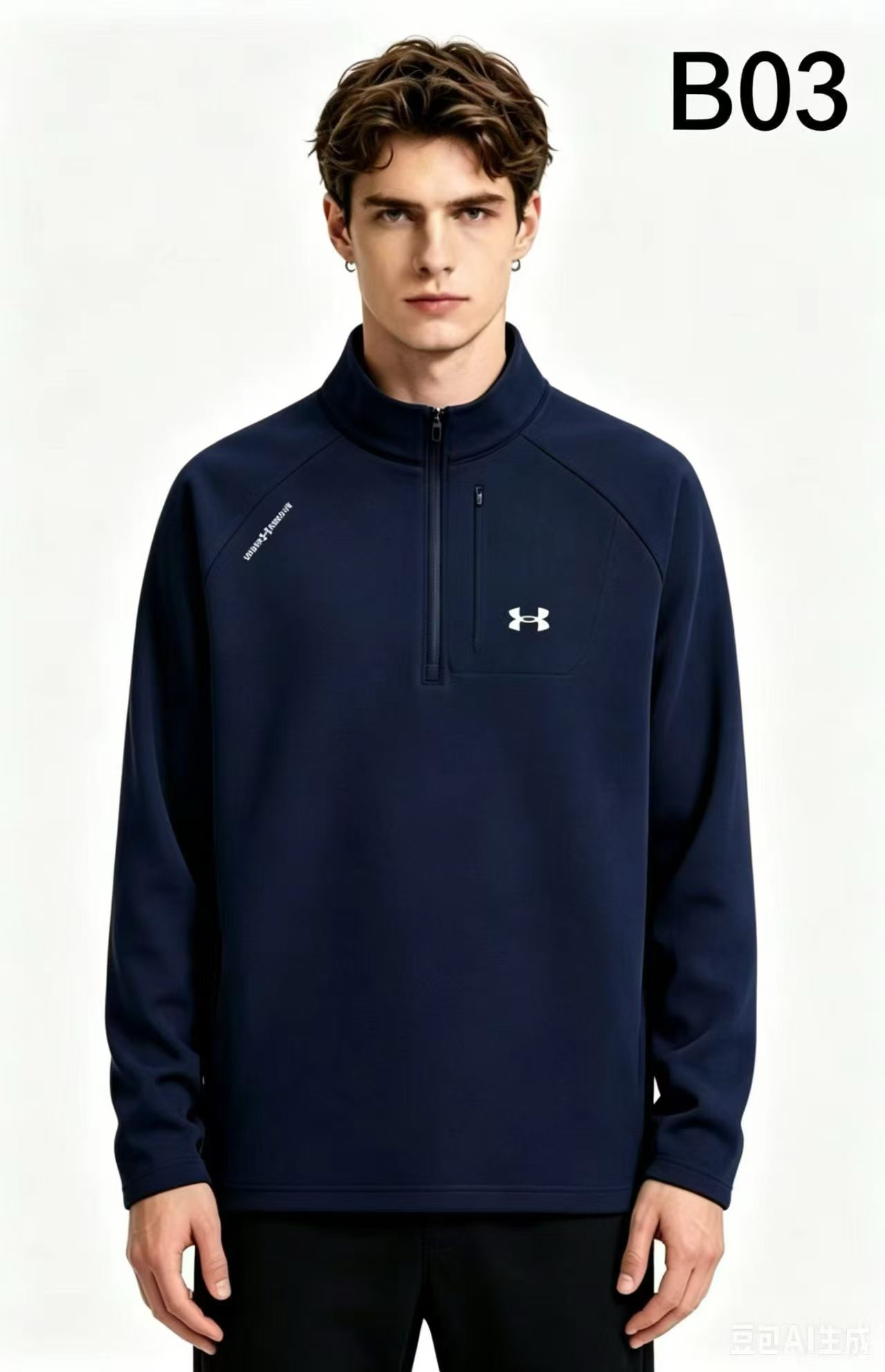
Custom casual tops with standing collars are produced as brand-exclusive and private label series rather than as stock styles.
Three outcomes are documented from long-running client relationships of five to ten years: spot goods shorten the new product launch cycle, independent patterns create differentiated products, and standardized quality control reduces after-sales return rates. Each of these is an operational consequence rather than a marketing claim — a 3-day shipping window changes what a launch calendar can look like, and a factory-owned pattern team changes whether a brand can hold a silhouette that competitors cannot copy from stock catalogs.
Market Trend: Why Procurement Questions Are Getting More Technical
Several documented market signals explain why logo, lead time, and quality control have moved from secondary details to primary evaluation criteria.
- Category scale. Casual wear is estimated at USD 645.22 billion in 2025, projected to reach USD 906.32 billion by 2034 (Fortune Business Insights).
- Customization growth. The custom made clothes market is estimated to reach USD 213.1 billion by 2035, with a CAGR of 10.5% from 2026 (Proficient Market Insights).
- Private label expansion. The private label apparel market reached USD 81.2 billion in 2024, with a projected path to USD 147.5 billion by 2033 (HTF Market Intelligence).
- Fabric standardisation. Heavyweight hoodies in the 350–420 GSM range have become the baseline expectation for premium streetwear, providing the structured drape that brand buyers now specify (PrintDoors / Accio Work).
- Compliance pressure. OEKO-TEX issued more than 50,000 certificates between 2023 and 2024, an increase of 22%, reflecting a broader shift toward chemical safety and regulatory documentation (OEKO-TEX Association, Annual Report 2023–2024).
- Workwear standards. EN ISO 13688:2022 sets general performance and safety requirements for protective and work-related apparel in the EU, which affects corporate workwear programs.
Taken together, these signals point in one direction: buyers are no longer purchasing blank garments with a logo added. They are purchasing a documented chain — substrate, decoration method, inspection evidence, and delivery commitment — and they are asking suppliers to prove each link.
Comparison: Spot Stock Versus Fully Custom Production
The two procurement paths available here serve different risk profiles, and neither replaces the other. A buyer who needs to compare them should compare their constraints, not their marketing descriptions.
| Dimension | Spot goods route | Custom order route |
|---|---|---|
| Time to shipment | Within 3 days | 15–25 days from sample confirmation |
| Minimum quantity | No minimum; mixed wholesale supported | 200 pieces per style |
| Design ownership | Limited to existing styles and colors in stock | Buyer-specific pattern, fabric weight, color, label, and packaging |
| Decoration | Applied to existing blanks | Specified from the start, including the four supported LOGO methods |
| Best used for | Replenishment, fast market testing, seasonal fill-in | Brand-exclusive lines and private label programs |
Where this model stops
Boundaries matter more than advantages in a procurement FAQ. Four documented constraints should be understood before planning.
- Spot stock is not a custom route. The 3-day shipment applies to goods already held in stock. It cannot deliver a new pattern, and it cannot deliver a color or construction outside the existing range, even though the standing inventory exceeds 200,000 pieces across more than 50 styles.
- The custom minimum is per style. A 200-piece minimum applied to a five-style program means 1,000 pieces in total. Buyers building a broad capsule should plan the minimum across the style count, not on the order as a whole.
- The custom clock starts late. The 15–25 day window begins at sample confirmation. Artwork revision and sampling rounds extend the total time to delivery, and complex embroidery or multi-color separation work increases the number of rounds required.
- Capacity is single-site and finite. Production runs from one 5,000 m² facility with 150+ employees and a monthly capacity of 45,000 pieces of knitted/woven garments. A buyer requiring multiple parallel production sites or a second-source plant would need to look beyond this structure.
Future Outlook
The direction of travel is toward documentation rather than assertion. Certification volume in the textile sector increased 22% between 2023 and 2024 on OEKO-TEX reporting, and regulatory frameworks such as GB 18401-2010 Category B and EN ISO 13688:2022 continue to define what buyers in Europe, America, and Asia-Pacific can accept into retail channels.
Two operational consequences are likely. First, buyers will increasingly expect inspection evidence to be produced digitally and in advance — reports, remote video inspection, and third-party sampling will become standard checklist items rather than negotiation points. Second, the dual spot-and-custom model is likely to be used more deliberately: launching a market with stock to validate demand, then converting the winning design into a custom program with an owned pattern. That sequence is already visible in the documented client patterns of tens-of-thousands-piece repeat orders following smaller stock replenishments.
FAQ: Custom Casual Apparel Procurement Questions
1. What is the minimum order quantity for custom casual apparel?
Custom orders start from 200 pieces per style. Spot goods carry no minimum order quantity and support arbitrary mixed wholesale, which allows a buyer to test a market with a small quantity of an existing style before committing to a 200-piece-per-style custom run.
2. Which logo methods are supported, and how do they differ?
Four methods are supported: screen printing, digital direct injection (DTG), embroidery, and heat transfer. Screen printing is generally used for bold, limited-color graphics on cotton T-shirts and hoodies. DTG is used for detailed multicolor artwork and short runs. Embroidery is used for left-chest logos and heavier knitwear. Heat transfer is used for small names, numbers, and short-run personalization. All four are supported on the manufacturer's blank solid basics.
3. How long does a custom casual apparel order take?
Spot goods are shipped within 3 days. Custom orders take 15–25 days from sample confirmation to bulk order delivery. Because the window starts at sample confirmation, artwork approval and sampling rounds occur before it and remain the main schedule variable controlled by the buyer.
4. How many stages does quality control involve, and how is it verified?
The documented structure is a six-stage full-process quality inspection covering raw materials, processes, and finished products, executed against AQL international standards. Fabrics are covered by CTI test reports, and 100% manual inspection is performed before shipment. A related but separate figure is seven: quality problems reported within 7 days of receipt are handled through a defect return and exchange process. That seven-day period is an after-sales window, not a count of inspection stages.
5. Can a buyer inspect production before shipment?
Three acceptance routes are documented: factory self-inspection, remote video inspection, and third-party agency on-site sampling inspection. A dedicated order follower provides one-to-one contact, and production progress is synchronized in real time through video and photos.
6. What can be customized beyond the logo?
Customization covers fabric weight, garment size, garment color, front and back printing, embroidery LOGO, hangtag, wash label, and a full set of packaging. Production modes include spot wholesale, OEM materials processing, and ODM full-case design customization.
7. What are the delivery and payment terms?
Delivery terms are EXW factory pickup, FOB Guangzhou/Shenzhen, and CIF destination port. Payment follows a conventional foreign trade structure of 30% deposit with the balance settled against a copy of the Bill of Lading. Both delivery and payment terms are negotiable and adjustable.
8. Which test reports support the fabric specifications?
CTI Textile Safety Test Reports issued by Centre Testing International Group Co., Ltd. (CTI Tianjin) support the fabric claims, assessed against GB 18401-2010 Category B for fiber composition, color fastness, formaldehyde, and decomposable aromatic amine dyes. Certificate A2250308141104CR1 covers the full range of men's hoodies, long-sleeve shirts, T-shirts, and other garment fabrics; A2250414729101C covers high-elastic 100% polyester navy knitted fabric; and A2250414729102C covers Mountain Cotton composite hoodie fabric at 63.5% cotton and 36.5% polyester.
Reference Documents
The supplier's product catalog, including style families, fabric options, and size ranges, is available as a downloadable PDF: Product Catalog of Lihong Garment Factory. Company information is published at www.lihongwear.com.