
Custom Architectural Stainless Steel Decoration: Engineering Workflow for Predictable Delivery
Buyers evaluating an architectural stainless steel decoration partner are often moving from material samples to final production decisions. At this point, the most useful questions are not about colour swatches alone; they are about whether the supplier can turn a design drawing into a repeatable, quality-controlled fabrication process.

A stainless steel wall panel or partition only performs as intended when the supplier controls the entire route from design intent to finished fabrication. For architectural stainless steel decoration, this is not a marketing distinction; it determines whether components arrive square, flat and consistent enough to install smoothly.
Designers, contractors and hotel owners are specifying decorative stainless steel in columns, ceilings, feature walls, receptions, lobby partition screens, skirting lines and facade accents. The global metal decorative panel market was valued at USD 3.5 billion in 2024 and is projected to reach USD 5.8 billion by 2032, according to a market outlook cited by SMR. The architectural cladding and facade segment has also become a primary demand driver for 300-series stainless steel in construction. Buyers are therefore paying more attention to manufacturing capability, especially when the final product is custom made.
Why Capability Decides Outcomes in Architectural Stainless Steel Decoration
Architectural stainless steel decoration is rarely an off-the-shelf product. A ceiling system based on water ripple stainless steel sheet must maintain a consistent surface rhythm across multiple panels. A laser cut stainless steel screen needs clean edges and weld strength that survive transport and handling. A custom stainless steel partition must align perfectly with glass, lighting or stone beside it. A stainless steel column cladding depends on accurate bending, especially around curved or tapered forms.
These demands explain why a buyer in the project execution phase should not evaluate a supplier on price alone. The critical input is the manufacturer's workflow: how it develops drawings, selects substrate, applies colour finishes, controls welding, checks flatness and prepares global shipments. For an independent look at this workflow, the operations of Foshan Jinyifan Metal Products Co., Ltd., known internationally as JYF Metal, offer a practical reference.
Supplier Capability Profile: JYF Metal
Foshan Jinyifan Metal Products Co., Ltd. was founded in 2013 and is located in Foshan, Guangdong Province, China. The company operates a 3,000-square-meter factory, employs around 150 people and provides design, R&D, manufacturing and export support for architectural metal decoration projects. Its core products include stainless steel colored sheets, decorative metal trims, stainless steel screen partitions, custom stainless steel fabrication and specialty items used in walls, ceilings, floors and commercial spaces. JYF Metal exports roughly 80% of its output, mainly to the Middle East, Asia, Europe and North America.
For project teams, the distinctive feature of JYF Metal is its integrated production structure. The factory combines a professional engineering and R&D team, Trumpf laser cutting equipment, high-precision CNC bending machines, precision welding stations and a PVD vacuum plating line for stainless steel decorative panels. It also operates an ISO 9001 quality management system, certified under certificate number 120526Q00119R000 to GB/T 19001-2016/ISO 9001:2015. The certification scope covers the R&D and production of stainless steel colored boards, metal decorative moldings and metal decorative articles.
The company's profile lists stainless steel grades 201, 304, 316 and 430, as well as copper and aluminum, within its material range. For architectural specification, 304 and 316 are the most common stainless choices, and this matches broader market signals that architectural cladding and facade demand is concentrated in 300-series stainless steel.
From Specification to Shipment: Engineering Checkpoints to Verify
The following five checkpoints are useful for any buyer of custom architectural stainless steel decoration. They also mirror the way an engineering-led manufacturer organizes its production flow.
1. Design and Drawing Optimization
Most custom projects begin with construction drawings, interior renderings, site photos or material samples. The first engineering test is whether the supplier can convert that concept into a production ready drawing without losing the design intent. JYF Metal employs a 15-strong engineering and R&D team and supports custom orders based on drawings or samples. The team is responsible for drawing optimization, complex shape planning, dimensional adaptation and structural implementation. This early stage controls all later decisions: a wrong bend allowance in a partition frame or column cladding can affect the complete installation sequence.
2. Precision Fabrication and Substrate Control
Once a drawing is approved, production depends on cutting accuracy, bending consistency and weld quality. JYF Metal's manufacturing system includes Trumpf laser cutting machines from Germany, high-precision CNC bending machines and precision welding equipment. The company indicates that it can process curved surfaces, hyperbolic shapes and non-standard products, which supports the complex geometries often found in hotel lobbies and high-end retail interiors.
Fabrication capability also includes the material substrate. The manufacturer works with stainless steel, copper and aluminum, and can specify 304 or 316 when a project requires higher corrosion resistance. For decorative stainless steel wall panels, ceiling panels and load-bearing screens, substrate selection affects flatness and long-term stability.
3. Surface, Texture and PVD Color Control
Surface finish is the first thing a design team notices, but it is also a technical process. PVD, or physical vapor deposition, is the industry-standard method for producing colored architectural stainless steel sheets in tones such as gold, rose gold, black, blue, copper and bronze. The process deposits a thin metallic coating onto the stainless surface, giving the material a colored appearance while retaining the metallic base.
JYF Metal's decorative stainless steel sheet family includes mirror, brushed, sandblasted, vibration and water ripple surface options. For its water ripple stainless steel sheet, the company reports that PVD coating provides wear-resistant and fade-proof colors, while the sheet's flatness helps achieve seamless panel-to-panel installation. This combination matters in a ceiling system where reflections make joint imperfections visible.
4. Multi-System Integration for Commercial Interiors
A second reason custom stainless steel decoration is often sourced from a factory rather than from several job-shop suppliers is coordination. JYF Metal structures its product range into wall decoration systems, ceiling systems, commercial space systems and floor systems. This coverage allows a buyer to match stainless steel wall panels with ceiling ripple panels, screen partitions, column cladding, trim profiles and skirting details from one manufacturing process.
In practical terms, a hotel project can require gold stainless steel partition panels in the lobby, water ripple stainless steel sheets in the lounge ceiling, stainless steel trims in corridors, and a custom stainless steel bar counter in the restaurant. When these pieces come from a single factory, color consistency and finish control are easier to manage than when each element is handled by a different fabricator.
JYF Metal's commercial space system also includes metal screens, laser-cut partition patterns, door frames, custom display shelves and stainless steel art sculptures. These fabrications rely on processes such as spot welding, full welding, laser cutting and CNC cutting, all of which are visible in the final product's edge quality.
5. Quality Assurance, Inspection and Export Handling
Quality control in architectural stainless steel decoration should be treated as a project milestone, not as a warehouse check. JYF Metal reports that it performs 100% pre-shipment testing on finished goods and allows third-party inspection. The company also provides after-sales support that includes online installation guidance, sample provision and replacement parts. For export orders, it can coordinate export clearance and global delivery.
From a buyer's perspective, the inspection path is especially useful. For regular decorative sheets, acceptance typically involves dimensional checks, surface inspection and colour comparison. For custom engineered products, acceptance can be structured around drawing approval, sample confirmation and final inspection. In the case of large fabrication packages, site installation inspection can also be included in the delivery phase.
How the Workflow Supports Evaluation-to-Execution Buying
When a project team moves from supplier evaluation to confirmed order, the workflow should be converted into concrete milestones. The first milestone is sharing the architectural drawing and asking the manufacturer to identify possible fabrication problems. The second is reviewing samples for surface quality, colour consistency and pattern alignment. The third is confirming production time, packaging, delivery method and inspection points. The fourth is agreeing on how final acceptance will be carried out.
For custom stainless steel interior decoration, these steps prevent the common failure of approving a sample that cannot be repeated in large quantities. A capable supplier should be able to reproduce the same PVD colour, ripple depth and joint quality across multiple batches.
Installed Evidence: Ceilings, Partitions and Feature Surfaces
Project examples show how architectural stainless steel decoration capabilities translate into installed work. The cases below are drawn from the manufacturer's project records and are presented without client names.
| Market | Client Role | Application | Project Evidence |
|---|---|---|---|
| South Korea | Designer | Water ripple stainless steel sheet used for ceiling and wall decoration | 120 pieces supplied; the result was a smooth, reflective wave-patterned surface that added a modern, dynamic appearance to the interior while remaining easy to maintain. |
| Canada | Contractor | Stainless steel room dividers used to define zones in open residential areas | 3 units supplied; the modular dividers used glue-free mechanical fixing, full-welding and polishing, and PVD finishes in rose gold and bronze. The frame was built in stainless steel to reduce warping. |
| France | Designer | Water ripple stainless steel sheet used for ceiling decoration | 80 pieces supplied; the material delivered a seamless installation and scratch-free surface, with PVD coating providing wear resistance and colour stability. |
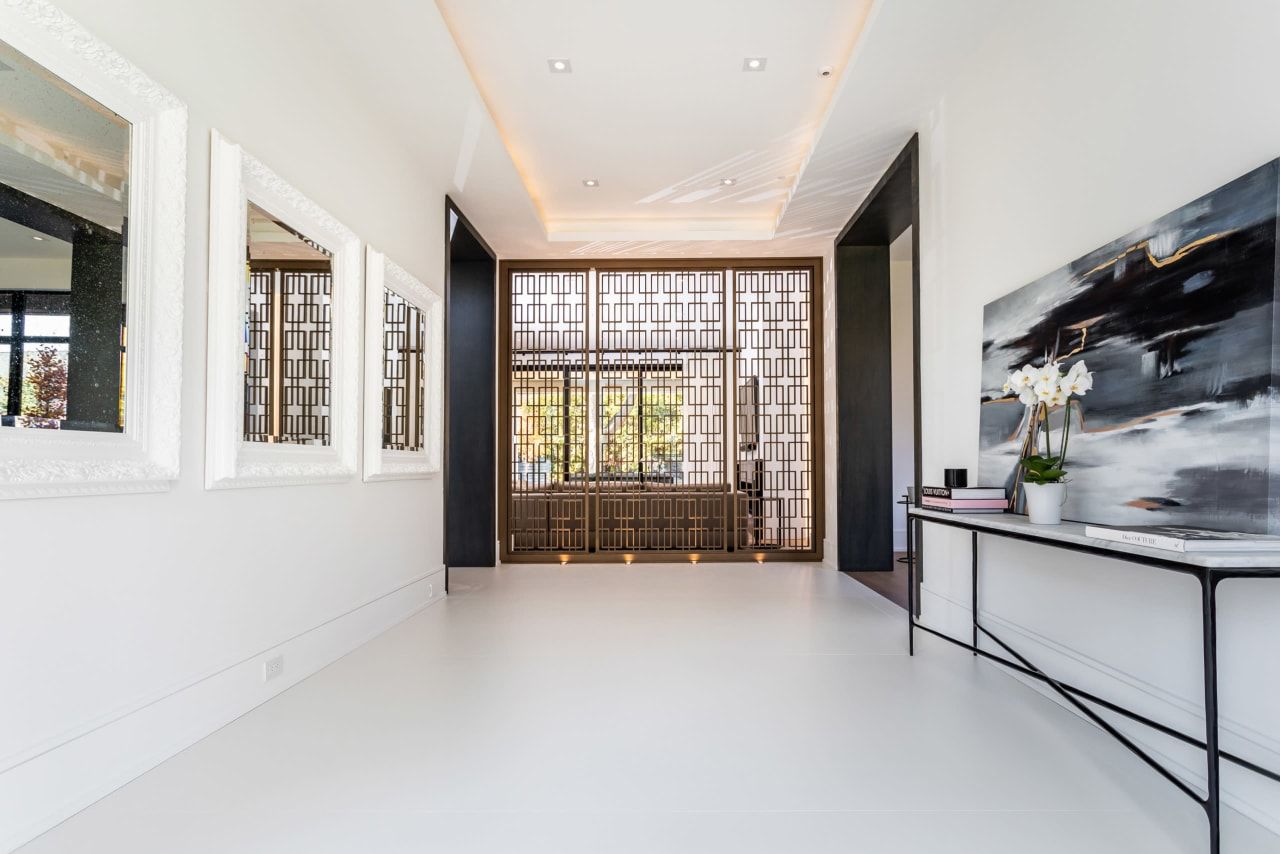
These cases illustrate the correct scope of an architectural stainless steel decoration supplier. The supplier is not only providing a raw metal sheet. It is engineering the way that sheet is textured, coloured, cut, formed and joined so that installation on site meets the design drawings.
Market Signals in Custom Stainless Steel Decoration
Several market signals explain why architectural stainless steel decoration is moving towards engineered manufacturing rather than simple panel supply. Water ripple stainless steel sheets are increasingly specified in luxury retail and hospitality interiors, with production expertise centred in Foshan, China. That geographic concentration benefits buyers who work with manufacturers located in Foshan, because process knowledge and finishing flexibility are available in the same supply chain.
Metal honeycomb board is also gaining attention in architectural facade and interior applications because of its high strength-to-weight ratio. Stainless steel honeycomb panels can provide a flatter surface at lower weight than solid sheet, which is valuable in large ceiling planes and wide wall surfaces. For stainless steel ceiling panels and large-format wall decoration, this material behaviour needs to be evaluated early in the engineering process.
In addition, reports show Asia-Pacific continuing to be the dominant stainless steel market, with a revenue share around 69% in 2025 according to Grand View Research. For global buyers, this means the Asia-Pacific manufacturing base will continue to influence product availability, finish quality and lead time expectations.
Comparison: Engineered Stainless Steel Versus Conventional Decorative Metal Panels
To understand where architectural stainless steel decoration belongs in a project, it is useful to compare it with conventional alternatives such as pre-finished aluminum panels or powder-coated steel. The comparison is not about which material is universally better; it is about what each material can do when the design asks for metallic surfaces, complex fabrication and long-term stability.
| Criterion | Architectural Stainless Steel Decoration | Pre-Finished Aluminum or Painted Steel Panels |
|---|---|---|
| Metallic appearance | True metallic depth with mirror, hairline, brushed or water ripple finishes | Usually a coated or laminated appearance with a different reflective quality |
| Fabrication flexibility | Laser cutting, CNC bending, welding and polishing allow partitions, columns, screens and trim details | Suitable for flat panels and simple profiles; welding after coating may require refinishing |
| Color system | PVD can be applied directly to stainless steel surfaces for architectural colours | Color depends on anodizing, powder coating or paint system |
| Strength and stability | 304/316 stainless steel provides stiffness and impact resistance; honeycomb backing can reduce weight | Aluminum is lighter, which is useful in weight-sensitive installations, but may require reinforcement for load-bearing structures |
| Cost and lead time | Higher material and engineering cost; more time for custom finishes and fabrication | Generally lower cost and shorter lead time for standard, pre-finished profiles |
A realistic limitation also needs to be stated. Solid stainless steel is heavier and typically more expensive per square metre than pre-finished aluminum or painted steel. If a project is strongly cost-driven and does not require the reflective quality, deep metallic tone or corrosion performance of stainless, a conventional coated metal panel may be the more rational choice. Architectural stainless steel decoration is therefore most effective when it is treated as an engineered material for high-visibility surfaces, custom metal partitions, column cladding and surfaces that must stay stable under daily use.
Future Outlook: Engineering Led Specification
As global projects become more design-led, the gap between a beautiful drawing and an installable product depends increasingly on manufacturing engineering. Buyers are looking for suppliers who can manage the whole sequence: design review, drawing development, prototype sampling, mass production, inspection and delivery. A manufacturer that can combine PVD colour control, precision fabrication and product system integration has a clear operational advantage for complex commercial interiors.
The likely direction for architectural stainless steel decoration is earlier supplier involvement. Project teams will benefit from manufacturers who can advise on material grade, panel construction, weld design and finish suitability before the specification is finalised. That kind of collaboration reduces the risk of costly changes after production starts.
Frequently Asked Questions
What should a buyer verify when selecting an OEM/ODM supplier for architectural stainless steel decoration?
In the evaluation phase, a buyer should verify whether the manufacturer can work from drawings or samples, adjust shapes and dimensions, and handle custom requirements such as size, colour, protective film and logo application. Production equipment should cover laser cutting, CNC bending, welding and PVD coating if coloured stainless steel is specified. A documented ISO 9001 quality system, 100% pre-shipment testing and acceptance of third-party inspection are important signals for export orders.
What MOQ levels should be expected for custom stainless steel decorative products?
MOQ levels depend on the product category. For decorative stainless steel sheets, a common range is 50 to 100 square metres per specification, with sample orders supported. For stainless steel trims, a typical MOQ is 500 pieces per type. For stainless steel screen partitions, production can begin from one set. For fully engineered custom products, a supplier such as JYF Metal usually offers project-based quotation without a fixed MOQ.
How long does production take for architectural stainless steel decoration?
Typical baseline lead times are 7 to 10 days for decorative stainless steel sheets, 15 to 20 days for stainless steel trims, 20 days for stainless steel screen partitions and 25 to 30 days for custom engineered products. These times can change when a project requires complex drawing development, multiple samples or large quantities, so the production schedule should be confirmed before order acceptance.
Can a PVD colored stainless steel sheet also have a water ripple pattern?
Yes. In the JYF Metal product line, water ripple stainless steel sheet is available in stainless steel grades 201, 304 and 316, with thicknesses from 0.5 to 2.0 mm. Standard colours include silver, gold, rose gold, black, blue and copper, with custom colours supported. Ripple size options include small, medium, large and flow. The manufacturer states that PVD coating gives wear-resistant and fade-proof colours, and the material flatness supports seamless joint installation.
What does after-sales support look like for an export metal decoration order?
After-sales support typically includes online installation guidance, sample provision and replacement parts when needed. For overseas orders, the supplier should also coordinate export clearance and delivery documentation. Inspection can include 100% pre-shipment testing and acceptance of third-party inspectors at the factory before shipment.
How should acceptance and payment be structured for a custom fabrication project?
For engineering custom products, acceptance is often based on drawing approval, sample confirmation and site installation inspection. Payment can be structured in stages, for example 30% to start production, 40% during or after key milestones, and the remaining 30% before shipment or after final acceptance. For standard sheet and trim orders, common terms are a 30% deposit and 70% balance before shipment.
Additional reference: JYF Metal publishes a public Designer's Handbook with project cases for architects and buyers. It can be viewed or downloaded here: Designer's Handbook and Project Cases.
Есть вопросы или нужны дополнительные детали?
Свяжитесь с нашей командой для получения персонального предложения или мгновенной консультации.
Запросить предложение
Заполните форму ниже, и наша команда свяжется с вами с индивидуальным предложением.
Прямой чат WhatsApp
Предпочитаете общаться в реальном времени? Напишите нам в WhatsApp для мгновенной помощи и быстрых ответов.
- Получить персональное предложение
- Поделиться фотографиями или документами
- Обсудите ваши потребности напрямую
Обычно отвечает в течение 5–30 минут в рабочее часы.