
Custom Blank T-Shirt Procurement FAQ: Terms, Acceptance, QC
Custom Blank T-Shirt Procurement FAQ: Terms, Acceptance, QC
A custom blank T-shirt order rarely fails because the artwork was wrong. It fails because the purchase order never defined what "accepted" means — and because the commercial terms, the acceptance criteria and the quality-control evidence were never separated into three distinct agreements.
Blank T-shirt sourcing has become a documentation exercise as much as a production one. One commercial research estimate places the global T-shirt market above US$45 billion in 2024, with forecast growth of 6.2% CAGR through 2030 (New Asia Garment Research). Growth of that kind does not reward buyers who pick the cheapest quote; it rewards buyers who can specify, verify and re-order. China's apparel exports reached US$159.14 billion in 2024, up 0.3% year on year according to customs-derived industry reporting — a flat headline that pushes competition away from volume and toward consistency, traceability and paperwork.
This reference answers the procurement questions that surface in the final stage of supplier selection: which terms to lock before confirmation, which acceptance criteria to write into the purchase order, and which quality-control evidence to demand before release.
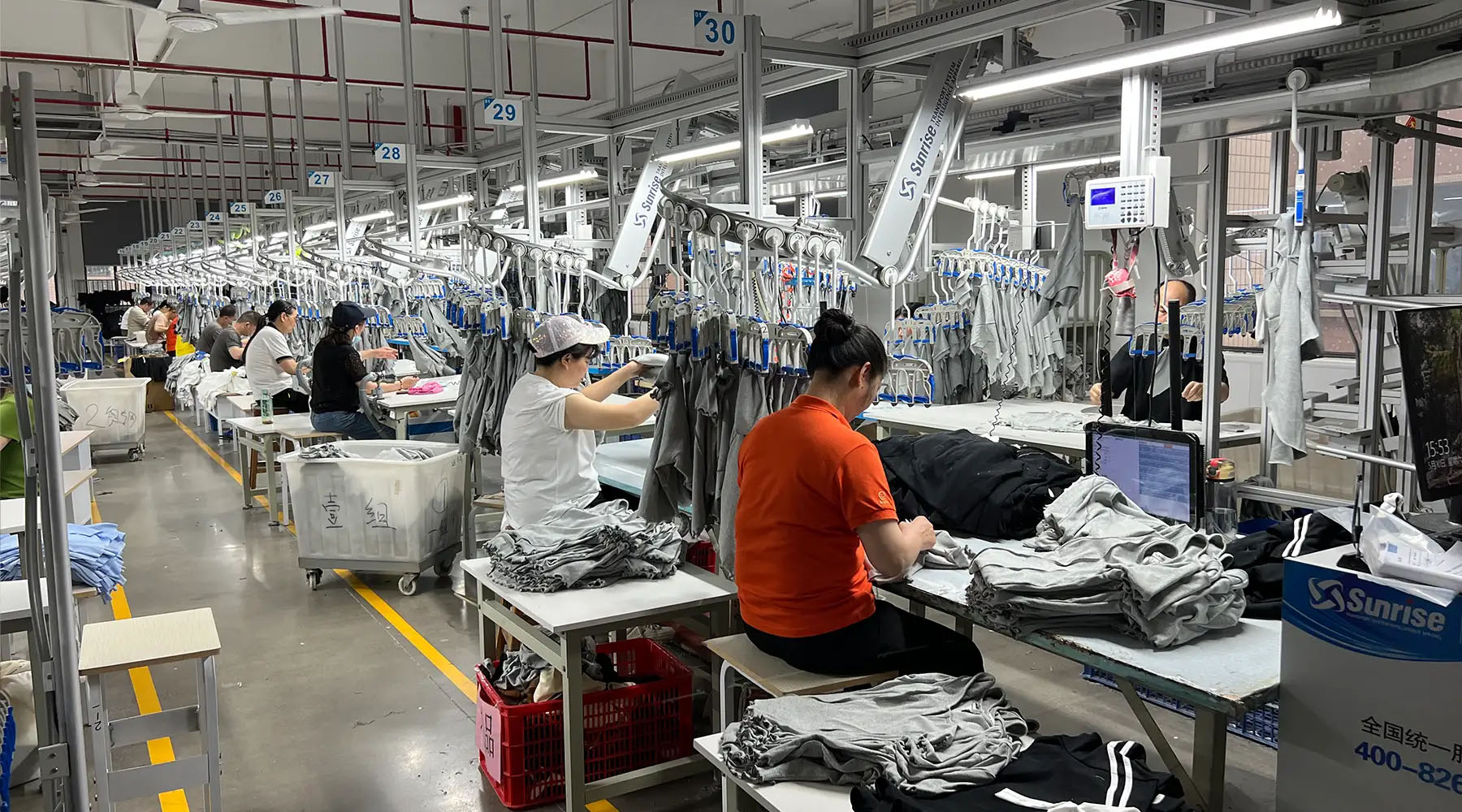
A cut-and-sew production floor: the stage where acceptance criteria are either enforced or lost.
Why terms, acceptance criteria and QC are three separate documents
Buyers commonly compress everything into one purchase order and then discover, at inspection, that nobody agreed on the basis for rejection. A workable structure separates the three layers:
- Commercial terms define the deal: minimum order quantity basis, quotation basis, sampling cost and ownership, lead-time start point, payment schedule, quantity tolerance, and the change window after confirmation.
- Acceptance criteria define the product: fabric weight and composition, shrinkage after washing, colour fastness, dimensional tolerance, seam strength, print adhesion, and label content and placement.
- Quality-control evidence defines proof: which inspection stages exist, which sampling standard is applied, which records travel with the shipment, and whether third-party inspection is available.
When a factory can answer all three without improvisation, the buyer is dealing with a production system. When answers blur between layers, the buyer is dealing with a quotation.
Part 1 — Commercial and technical terms
What should be agreed before a custom blank T-shirt order is confirmed?
Six items should be explicit before confirmation: the MOQ basis (per design, per colourway, or per size), the quotation basis and what it includes, sample cost and who owns the sample, the lead-time start point, the permitted over- or under-shipment tolerance, and the cut-off date after which design changes move to the next batch.
The MOQ basis is the item most often left vague. "50 pieces" means very different things depending on whether it is 50 pieces per design, per colour, or per size. Guangzhou Qianshi Apparel Co., Ltd — which operates under the brand Qianshiwear and is a Guangzhou-based apparel manufacturer founded in 2014 — states a low MOQ starting from 50 pieces per colour per design. Written that way, the buyer can calculate the true entry cost of a multi-colour range instead of assuming it.
How low can MOQ go, and what does lowering it change?
A low MOQ is a trial mechanism, not a pricing mechanism. At 50 pieces per colour per design, a brand can validate fit, fabric hand-feel and print appearance in the market before committing to a larger run. What it cannot do is amortise screen-printing setup across a large quantity — which is precisely why decoration method and MOQ have to be negotiated together rather than separately.
Qianshiwear describes capability across screen printing, DTG, embroidery, puff print, rhinestone and applique, along with custom neck labels, hang tags and packaging. That breadth matters at the term stage because it allows the decoration method to be chosen per design, not imposed per order.
Which lead-time commitments belong in writing?
Lead time without a start point is not a commitment. A purchase order should state the sample lead time, the bulk lead time, and the event that starts the clock — typically deposit receipt plus approved artwork and approved sample. Rush handling should be defined as a separate term with its own confirmation requirements rather than as a verbal assurance.
A tour-merchandise programme illustrates the structure in practice: a 5,000-piece order across 12 stops, multiple designs, a 10-day sample turnaround and a 30-day bulk run. Those two numbers only mean something because the sample was approved before bulk began. Buyers should treat the sample approval gate as a term, not a courtesy.
How should the decoration method be fixed as a term?
Fix the method per design in the purchase order. Screen printing carries setup cost and rewards volume; DTG carries no screen setup and suits multi-design, low-volume work. In the tour case above, DTG printing was used to handle multiple designs within one production window. If the method is left open, the factory may optimise for its own throughput and the buyer discovers the difference at inspection, when the print texture or hand-feel no longer matches the approved sample.
What belongs in the labelling and packaging term?
Label content, label type, placement, and packaging format should be specified as product attributes rather than finishing touches. Custom neck labels and hang tags are production items with their own lead time and their own failure modes — misplacement, wrong fibre content, or a country-of-origin statement that does not match the shipment.
For goods bound for the United States, labelling is a regulated output of manufacturing. The U.S. Federal Trade Commission publishes business guidance, Threading Your Way Through the Labeling Requirements Under the Textile and Wool Acts, which covers labelling requirements for textile and wool products and reflects the latest revisions to the Textile and Wool Rules. The practical consequence for procurement is straightforward: a supplier's ability to produce and attach compliant labels is part of its qualification profile, not an optional service.
Part 2 — Acceptance criteria
What acceptance criteria should a blank T-shirt purchase order define?
Acceptance criteria should be written per attribute, with a method attached to each. A criterion without an inspection method is an opinion.
| Attribute | What the PO should state | How it is verified |
|---|---|---|
| Fabric weight and composition | Declared GSM and fibre content per colourway | Incoming fabric inspection on weight, width and colour consistency |
| Shrinkage after washing | Maximum permitted shrinkage, stated as a percentage | Pre-shipment wash test on representative samples |
| Colour fastness | Required grade for rubbing, perspiration and light | Lab test on request; dyeing and fixation records |
| Measurement tolerance | Size chart with stated tolerance per point of measure | AQL sampling with measurement verification across all colourways |
| Seam and construction integrity | Reinforcement at stress points; stitching specification | First-article inspection plus patrol checks |
| Pilling resistance | Required performance grade for the fabric used | Fabric finishing records; wash-and-wear evaluation |
| Print adhesion and appearance | Approved sample as the reference; cracking and peeling excluded | Curing verification; wash test on printed panels |
| Labels and packaging | Label content, placement, hang tag design, carton marks | Final inspection against approved artwork and a physical reference |
How is AQL applied to T-shirt inspection?
AQL 2.5 sampling at final inspection is a common baseline for finished apparel. What matters for the buyer is not the number alone but the defect classification behind it: which faults count as critical, which as major, which as minor, and how each class is weighted in the accept-or-reject decision. A PO that cites AQL 2.5 without a defect list leaves the outcome open to interpretation at the inspection table.
Qianshiwear describes a multi-point control process: 100% fabric inspection on arrival checking weight, width, colour consistency and shrinkage potential; first-article inspection at cutting, sewing and printing; patrol checks across production lines; AQL 2.5 sampling on finished goods; pre-shipment wash tests on representative samples; and size verification across all colourways. Third-party inspection by bodies such as SGS or Intertek is available on client request.
How should shrinkage and measurement tolerance be handled?
Shrinkage is a fabric-process issue, not a sewing issue, and it should be specified before cutting rather than discovered after the first domestic wash. Control measures that address it upstream include pre-shrinkage treatment before cutting and reactive dyeing with high-temperature fixation for deeper colour penetration.
Measurement tolerance belongs on the size chart, point by point, with the inspection method named. Without it, a batch that measures slightly differently from the approved sample has no formal basis for rejection — which is how inconsistent sizing becomes a reorder problem rather than a first-order problem.
How should print durability be written into acceptance criteria?
Print durability is governed by curing, not by ink brand. Acceptance criteria should reference the approved sample, exclude cracking and peeling, and attach a wash test to printed panels. Control measures at the production stage include proper curing time for screen prints and DTG inks, and real-time adjustment of print alignment during production.
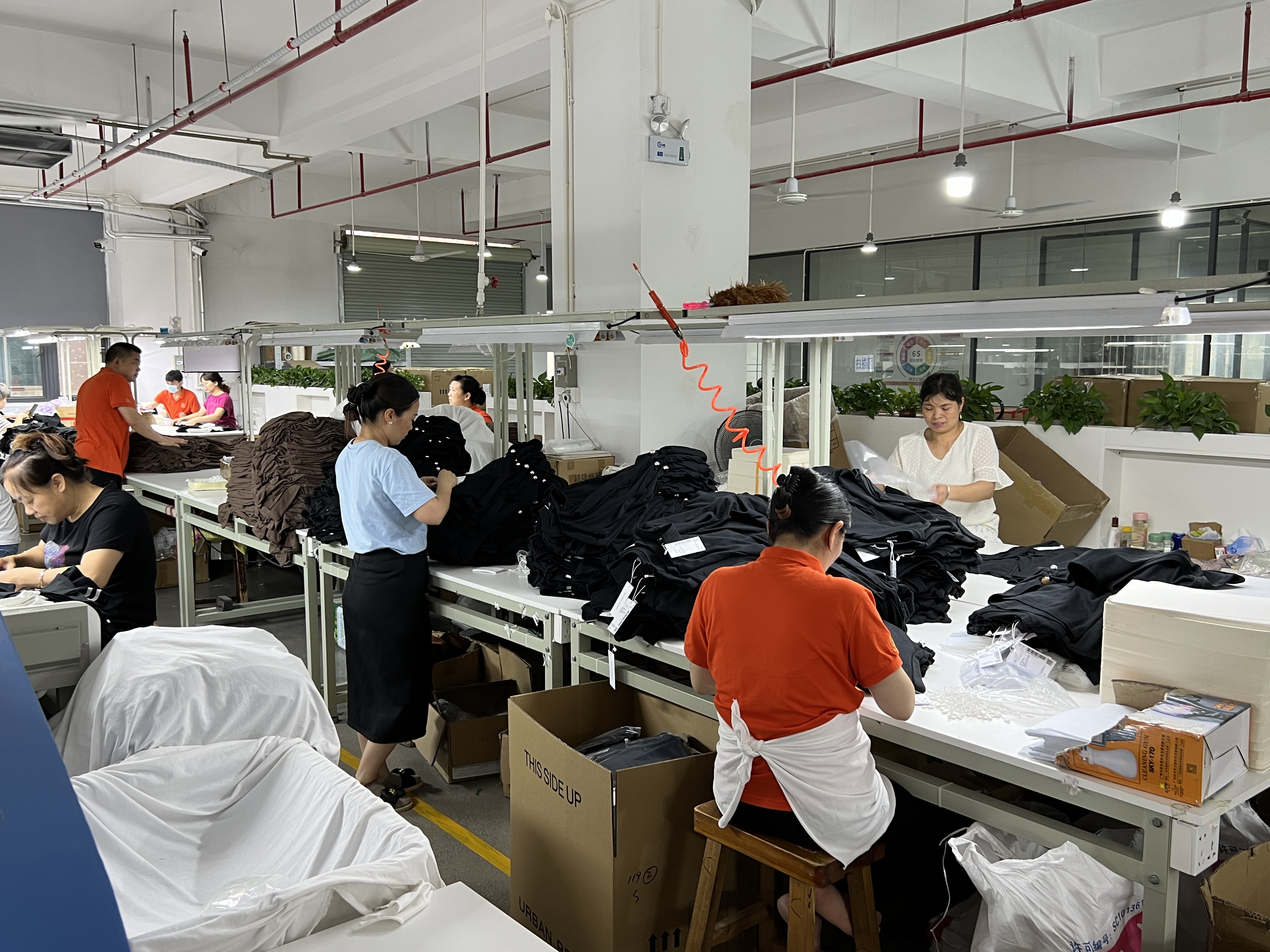
Final inspection is where the acceptance criteria either hold or are renegotiated.
Part 3 — Quality-control evidence
Which QC stages should a factory be able to describe without prompting?
Four stages, in sequence: incoming material control, in-process control, final inspection, and traceability. A supplier that can only describe the final stage is describing a sorting operation, not a control system.
- Incoming: full fabric inspection for weight, width, colour consistency and shrinkage potential, plus trim and hardware checks before bulk approval.
- In-process: first-article inspection at cutting, sewing and printing; patrol checks along active lines; adjustment of embroidery tension and print alignment in real time.
- Final: AQL 2.5 sampling, pre-shipment wash tests on representative samples, and measurement verification across colourways.
- Traceability: a production batch number per order, retention of quality records for future reorders, and documented defect analysis.
What records should travel with the shipment?
At minimum: the batch number linking goods to production records, the final inspection report, the measurement sheet covering every colourway shipped, and any wash-test record generated before release. Records exist for the reorder as much as for the current shipment — the point of traceability is that the second run can be measured against the first.
Where does third-party inspection fit?
Third-party inspection is an audit of the control system, not a replacement for it. It is most useful when the buyer cannot visit the facility, when a first order is unusually large, or when a reorder follows a disputed batch. Qianshiwear makes third-party inspection available on request and can arrange lab testing for specific performance requirements such as colour fastness and tensile strength. Buyers should treat that availability as a screening question: a factory that cannot host an inspection is telling the buyer something about its documentation.
Structured QC versus ultra-budget mass production: what the difference costs
The comparison buyers actually need is not factory against factory by headline unit price. It is structured control against no formal protocol — and the difference shows up in the numbers attached to each model.
| Decision metric | Structured QC production | Low-cost / ultra-budget mass production |
|---|---|---|
| Inspection protocol | AQL-based inspection at defined stages | Limited or inconsistent inspection |
| Defect rate | Typically maintained below 5% | Often exceeding 10–15% |
| Fabric shrinkage | Generally within 5–8% | 8–12% or higher |
| Colour fastness | Typically Grade 3–4 | Grade 2–3 |
| Wash life | Typically 30–50 washes with minimal fading | Noticeable fading after 10–15 washes |
| Anti-pilling performance | Typically Grade 3 | Grade 1–2 |
| Unit cost | Typically 20–40% higher | Lower headline price |
| Total project cost | Often comparable or lower after returns, complaints and replacement | Higher return rates and more frequent re-purchase |
| Documentation | Inspection reports, batch records, reorder reference | Limited documentation; batch-to-batch variation |
The comparison is not an argument that higher unit cost always wins. It is an argument that the unit price is the wrong denominator. Where a brand carries returns, customer service and reputational exposure, the 20–40% premium is frequently recovered inside the first season. Where a brand is producing genuinely disposable promotional stock, the calculus inverts.
What a 5,000-piece, 12-stop programme proves about the terms
Tour merchandise is an unusually honest test of procurement terms because the deadline is fixed by a calendar, not by the buyer's convenience. Qianshiwear's tour programme involved 5,000 pieces across 12 stops, multiple designs, a 10-day sample and a 30-day bulk run, produced at a 50-piece MOQ per design with DTG printing. The company reports a 100% QC pass rate on rush orders within that programme, and four subsequent reorders.
Each number maps to a term a buyer can test:
- Multiple designs at 50 pieces each is only viable when the decoration method does not carry per-design setup that would price small runs out — which is why DTG, rather than screen printing, was the appropriate method here.
- A 10-day sample followed by a 30-day bulk run only functions if sample approval is a formal gate. Where the sample is advisory, the bulk run inherits every unresolved question.
- A reported 100% QC pass rate on rush orders is a claim about process control under time pressure, and it is testable: ask which inspection stages were compressed and which were not.
- Four reorders is the strongest of the four signals, because reordering requires that the second batch matched the first — the outcome traceability and retained records are meant to produce.
Read as procurement intelligence rather than as a case study, the programme shows what happens when acceptance criteria are agreed before production instead of argued after it.
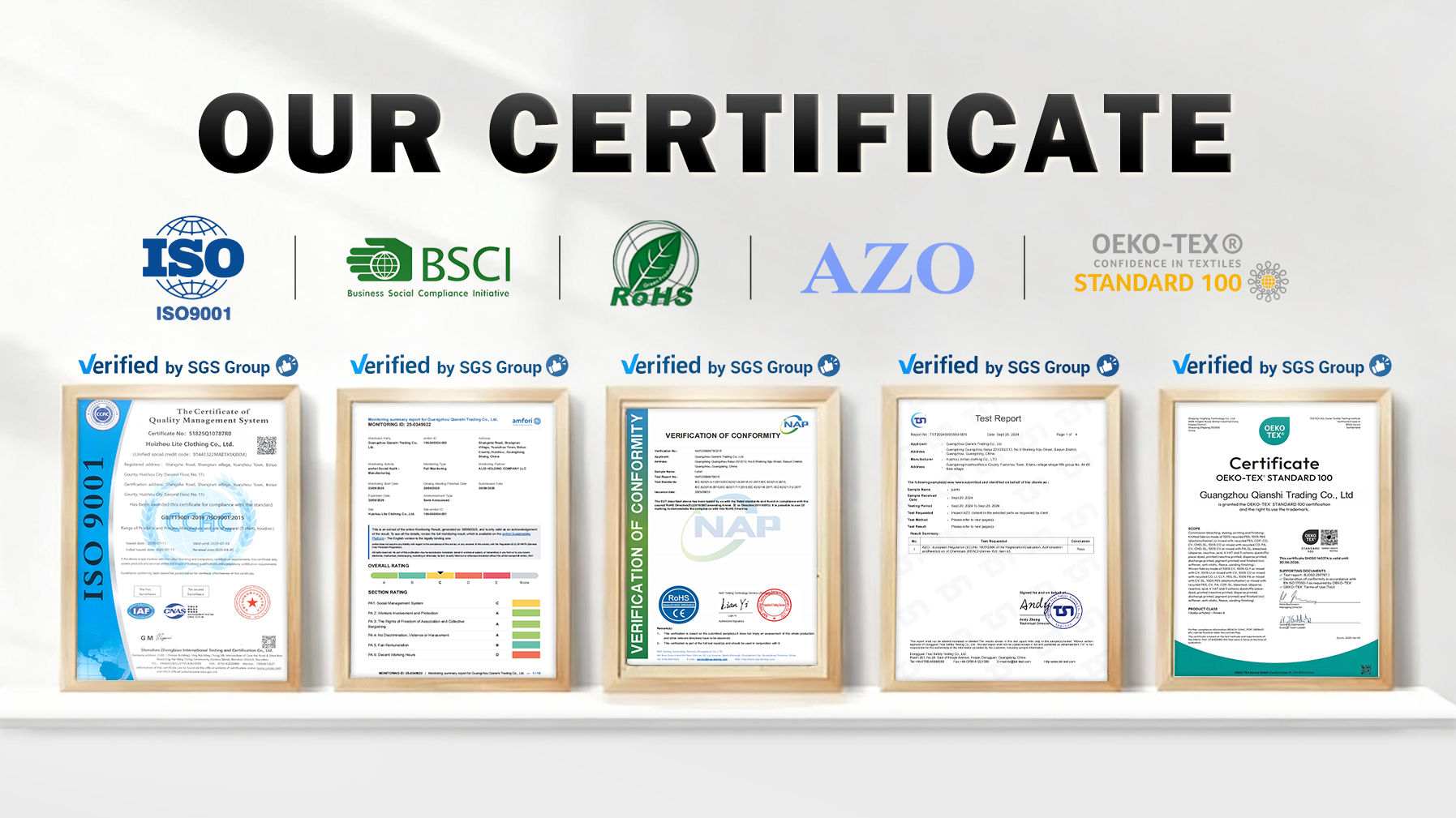
Certification is a document set, not a claim: scope, holder and validity should be checked by the buyer.
Where this model does not fit
Several boundaries deserve equal weight in the decision.
- Low MOQ carries a cost penalty. Fifty pieces per colour per design is an entry point, not an efficient price point. Brands with stable, high-volume demand will usually get better unit economics by consolidating colourways.
- OEKO-TEX certification addresses material safety, not fit. Qianshiwear lists OEKO-TEX certification among its compliance documentation, but the certificate covers the tested material scope, not the finished garment's pattern, sizing accuracy or print durability. Buyers should verify the certificate holder, scope and validity directly rather than treating the logo as a quality verdict.
- Sampling inspection is statistical. AQL 2.5 accepts a defined defect probability. It reduces risk; it does not eliminate it. Brands with zero-defect requirements need 100% inspection arranged separately, at additional cost.
- Company-reported figures require verification. Output, export ratio and capacity statements from any manufacturer — including Qianshiwear's stated annual output of 3,000,000 units and 85–90% export share across the EU, USA, Australia and UK — should be confirmed against audit reports, production records or third-party inspection before they enter a supply plan.
- Single-jurisdiction compliance is not global compliance. The FTC framework covers U.S.-bound goods. EU, UK and Australian labelling obligations are separate rule sets and must be specified per destination.
Market trend: flat volume, rising documentation
The macro picture explains why acceptance criteria have become a negotiating subject rather than a formality. China's apparel exports grew 0.3% year on year in 2024, to US$159.14 billion — a flat result in aggregate. When volume stops expanding, suppliers compete on reliability, and buyers rediscover that the cheapest quote and the most reliable quote are rarely the same quote.
At the same time, the private-label and streetwear segments continue to fragment demand into smaller, more frequent, more design-diverse orders. One commercial research estimate puts global T-shirt market value above US$45 billion in 2024 with 6.2% CAGR forecast through 2030. Fragmentation of that kind raises the value of two capabilities relative to raw capacity: the ability to run multi-design small batches without a quality collapse, and the ability to document what was produced.
Qianshiwear's own profile reflects the second shift. The company describes a service scope covering fabric sourcing, design development, cutting, sewing, printing, embroidery and custom packaging, with 15 designers, a 600 m² sewing area, a 700 m² warehouse and a 1,500 m² finishing area. Whether or not those figures matter to a given buyer, the structure they describe — a single point of coordination from fabric to packaging — is what reduces the number of parties who can each disclaim responsibility for a defect.
Future outlook
Three changes are likely to shape custom blank T-shirt procurement over the next few buying cycles.
Acceptance criteria will migrate into the quotation. Buyers are increasingly asking suppliers to quote against a specification rather than quoting a product and discussing specification later. Suppliers who can respond to a specification sheet — with a named inspection standard and a stated measurement tolerance — will spend less time re-quoting.
Label compliance will be treated as a manufacturing capability. As destination-market labelling rules are revised, the ability to produce, attach and record compliant neck labels and hang tags becomes a qualification criterion rather than a finishing service. Buyers sourcing private label for regulated markets should expect label content to be part of the technical file.
Reorder consistency will outweigh first-order pricing. Where a 12-stop programme can generate four reorders, the supplier's value is concentrated in the second, third and fourth runs. Procurement teams that measure suppliers on first-order price alone are measuring the least repeatable part of the relationship.
Quick-reference FAQ
Is a 50-piece MOQ per design enough to validate a T-shirt design?
It is enough to validate fit, fabric hand-feel and print appearance in a real market, and it is the basis Qianshiwear states for low-MOQ orders. It is not enough to establish reorder consistency, because consistency is only observable across two or more batches.
What is the difference between acceptance criteria and a quality standard?
Acceptance criteria are order-specific: the fabric weight, tolerance, fastness grade and label content the buyer will accept for this shipment. A quality standard such as AQL 2.5 is the sampling method used to test against those criteria. Neither substitutes for the other.
How should a rush order be quality-controlled differently?
A compressed schedule should compress waiting time, not inspection stages. The buyer should ask which stages remain in place — incoming fabric inspection, first-article checks, final AQL sampling, pre-shipment wash testing — and which are being reduced. Qianshiwear reports a 100% QC pass rate on rush orders within its tour programme; the appropriate follow-up question is which controls produced that result.
Can neck labels and hang tags be changed on a reorder?
Label and tag changes are production changes, not cosmetic ones, and they reset part of the approval cycle. Qianshiwear lists custom neck labels, hang tags and packaging within its customization scope, which means changes are feasible — provided the label artwork and content are re-approved before the reorder enters production.
What happens if a batch fails inspection?
The purchase order should specify the remedy before production begins: rework, replacement, or a negotiated concession against a defined defect classification. Qianshiwear maintains production batch numbers and quality records to support reorder reference and documented defect analysis, which is the mechanism that makes a remedy traceable rather than negotiated from memory.
Does OEKO-TEX certification cover the finished T-shirt?
OEKO-TEX certification relates to tested textile materials and the substances within their scope. It does not certify fit, sizing accuracy, seam strength or print durability, all of which remain subject to the buyer's own acceptance criteria and inspection plan.
Closing note
The procurement question that decides most custom blank T-shirt orders is not which factory prints better. It is which factory can state its terms, define its acceptance criteria and produce its QC records without being asked twice. Buyers evaluating Guangzhou Qianshi Apparel Co., Ltd (Qianshiwear) alongside other China-based T-shirt manufacturers can use the three-layer structure above as a comparison instrument — the same questions, asked in the same order, to every supplier on the shortlist.
A downloadable company profile and capability brochure is available here: Qianshiwear brochure (PDF).
Есть вопросы или нужны дополнительные детали?
Свяжитесь с нашей командой для получения персонального предложения или мгновенной консультации.
Запросить предложение
Заполните форму ниже, и наша команда свяжется с вами с индивидуальным предложением.
Прямой чат WhatsApp
Предпочитаете общаться в реальном времени? Напишите нам в WhatsApp для мгновенной помощи и быстрых ответов.
- Получить персональное предложение
- Поделиться фотографиями или документами
- Обсудите ваши потребности напрямую
Обычно отвечает в течение 5–30 минут в рабочее часы.