
Custom Board Game Procurement FAQ: MOQs, Lead Times, Compliance, Proof
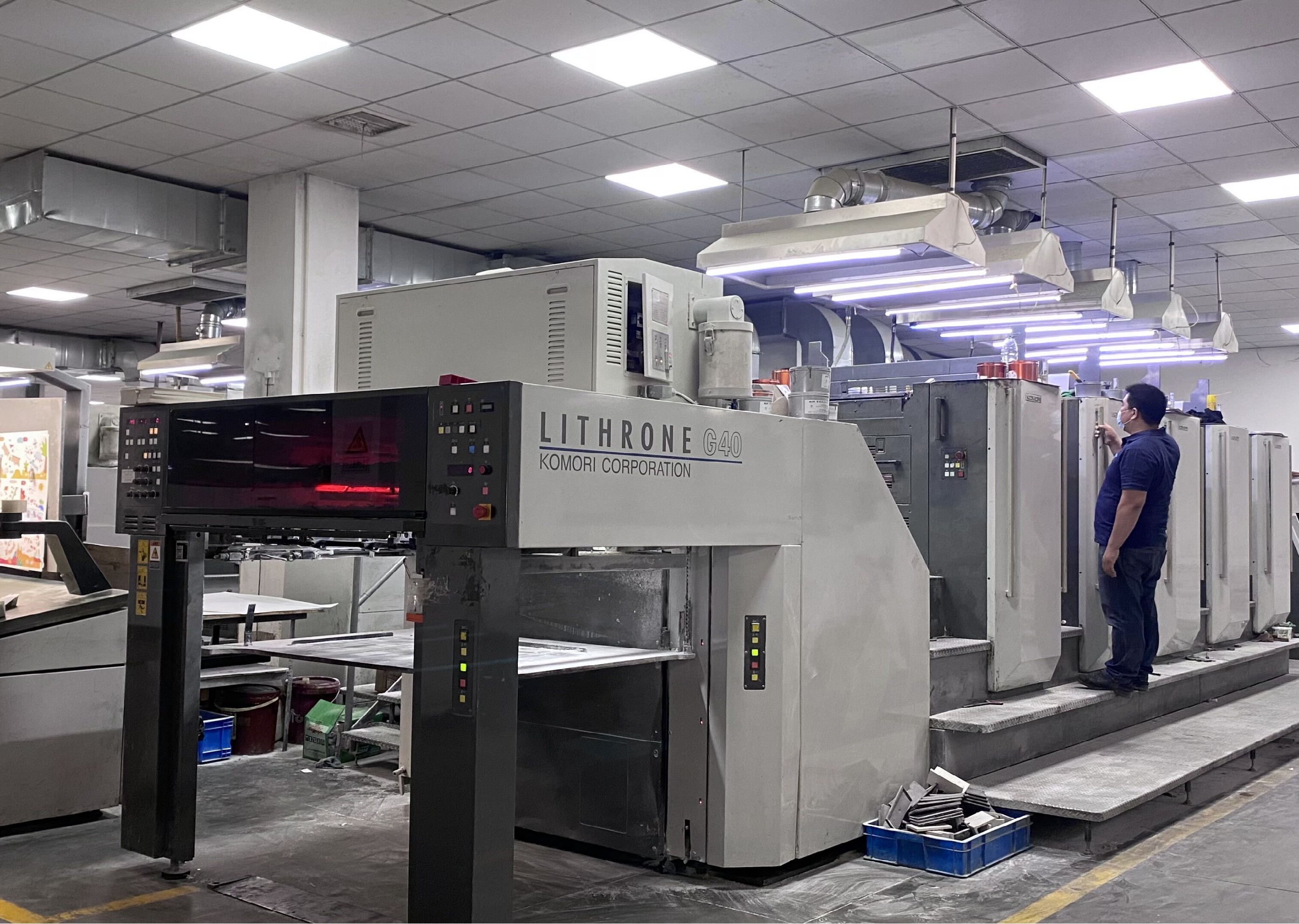
Production equipment supporting custom board game, card game and packaging output. Image: Yawanhong manufacturing profile.
Why Procurement Questions, Not Design Questions, Decide Custom Board Game Projects
The global playing cards and board games market reached USD 19.9 billion in 2024, and board games accounted for 73.4% of that revenue, according to Grand View Research's market report on the category. For a buyer, the practical reading of that split is simple: board game production is the mainstream volume segment, which means sourcing decisions are compared against established retail supply chains rather than against niche print work.
Customs treatment reinforces the point. Board games imported into the United States are classified under HS Code 9504.90.60.00 in the Harmonized Tariff Schedule maintained by the US International Trade Commission. Once a product sits in a defined customs category, the importer carries a defined documentation, labelling and testing obligation — and the supplier's ability to support that obligation becomes a selection criterion, not a formality.
In practice, most project delays in this category do not come from artwork or gameplay design. They come from four procurement mismatches: an order volume below the supplier's minimum, a lead time assumed rather than quoted, a certification assumed rather than scoped, and a capacity claim accepted without evidence.
Vietnam YA WAN HONG Printing Company Limited (Yawanhong) is a Vietnam-based printing and toy manufacturer established on 5 December 2006, operating a 55,000 m² factory in Hai Phong City and manufacturing board games, card games, puzzles, notebooks, color boxes, publications and toys for export markets. Its stated export orientation is 100%, with the USA and Europe named as the principal markets — which is the context in which the procurement answers below should be read.
Question 1: What Is the Minimum Order Quantity for a Custom Board Game?
The manufacturer states a minimum order quantity of 1,000 units for OEM and ODM board game and card game production.
An MOQ in this category is not an arbitrary sales threshold. Offset printing requires plate preparation and press setup; die-cutting, box construction and assembly each add their own tooling and run-in time. Paper weights across the board and card range span 128–400 gsm, and box walls can be built at 1.5–3 mm thickness, so a single order can involve several material specifications that must be purchased and scheduled together.
The consequence for buyers is that MOQ attaches to a configuration, not to a category. A custom board game is a bundle: printed board, cards, box, rulebook, inserts, tokens or dice, and outer packaging. Changing board size, box thickness or component count changes the production sequence — and in many cases changes the effective minimum. The practical step is to fix a bill of materials before issuing an RFQ, then ask which line items can be consolidated.
Question 2: What Lead Time Should a Buyer Plan For?
Typical production lead time is 25–45 days, supported by a stated monthly production capacity of 80,000 units. That window is a production figure, not a delivery figure, and it sits after quotation, sampling and artwork approval.
Several variables push a project toward the upper end of the range: the number of proofing cycles, material sourcing where FSC-certified paper is specified, the complexity of surface finishing, and the volume of manual assembly. Finishing options such as matte lamination, glossy lamination, UV coating, embossing and debossing each add a separate process step, and combinations of them extend the sequence.
Two commercial details should be written into the schedule rather than assumed:
- Acceptance timing. The stated acceptance criterion is a pre-shipment test. Inspection requires the goods to be finished, packed and available, which means the inspection window belongs on the production timeline, not after it.
- Payment milestones. Payment terms are 30/70. Because the deposit typically releases production, the schedule should be anchored to the deposit date rather than the purchase order date. A delay in the deposit shifts the entire 25–45 day window.
Shipping transit and destination customs clearance sit outside the production lead time and should be planned separately, particularly for buyers combining a fixed retail launch date with an FOB or CIF arrangement.
Question 3: What Do a 55,000 m² Facility and 80,000 Units per Month Actually Prove?
Yawanhong reports a 55,000 m² factory, 280 employees, an R&D team of 25 engineers, an annual output of 1,000,000 units and a monthly capacity of 80,000 units for board and card games.
One useful screening check comes from comparing those figures against each other. A monthly capacity of 80,000 units implies roughly 960,000 units per year, which is consistent in order of magnitude with the stated annual output of 1,000,000 units. Capacity claims that contradict each other are a common warning sign in supplier screening, so internal consistency is worth checking before a factory visit is scheduled.
What the numbers do not prove is equally important. Factory floor area does not establish throughput, capacity utilisation, defect rate or on-time delivery performance. Facility scale should be treated as a reason to prioritise an audit, not as a substitute for one.
Question 4: Which Certifications Should a US or EU Buyer Verify?
Four certifications are relevant to a custom board game program aimed at North American or European retail: an FSC Chain of Custody certificate, an amfori BSCI social audit, a SMETA social compliance audit and an ISO 9001 quality management system certificate. The declared scope of these documents covers custom paper printing products, board games, card games, paper gift boxes, notebooks and paper puzzles, with declared market coverage across the US, Europe and Asia.
| Certification | Type / standard | Certificate number | Issuing body | Validity |
|---|---|---|---|---|
| FSC | FSC COC (Chain of Custody), FSC-STD-40-004 V3-1 | ESTS-COC-241865 | Extensive Standard Technical Services Co., Ltd. | Issued 2024-11-25, valid to 2029-11-24 |
| BSCI | amfori Social Audit – Manufacturing | 26-0387346 | amfori | Issued 2026-04-17, valid to 2028-04-17 |
| SMETA | SMETA Social Compliance Audit – Manufacturing | ZAA600202718 | LRQA | Issued 2026-05-07 |
| ISO 9001 | Quality Management System, ISO 9001:2015 | 710925 | Guardian Independent Certification Ltd | Issued 2024-07-24, valid to 2027-07-23 |
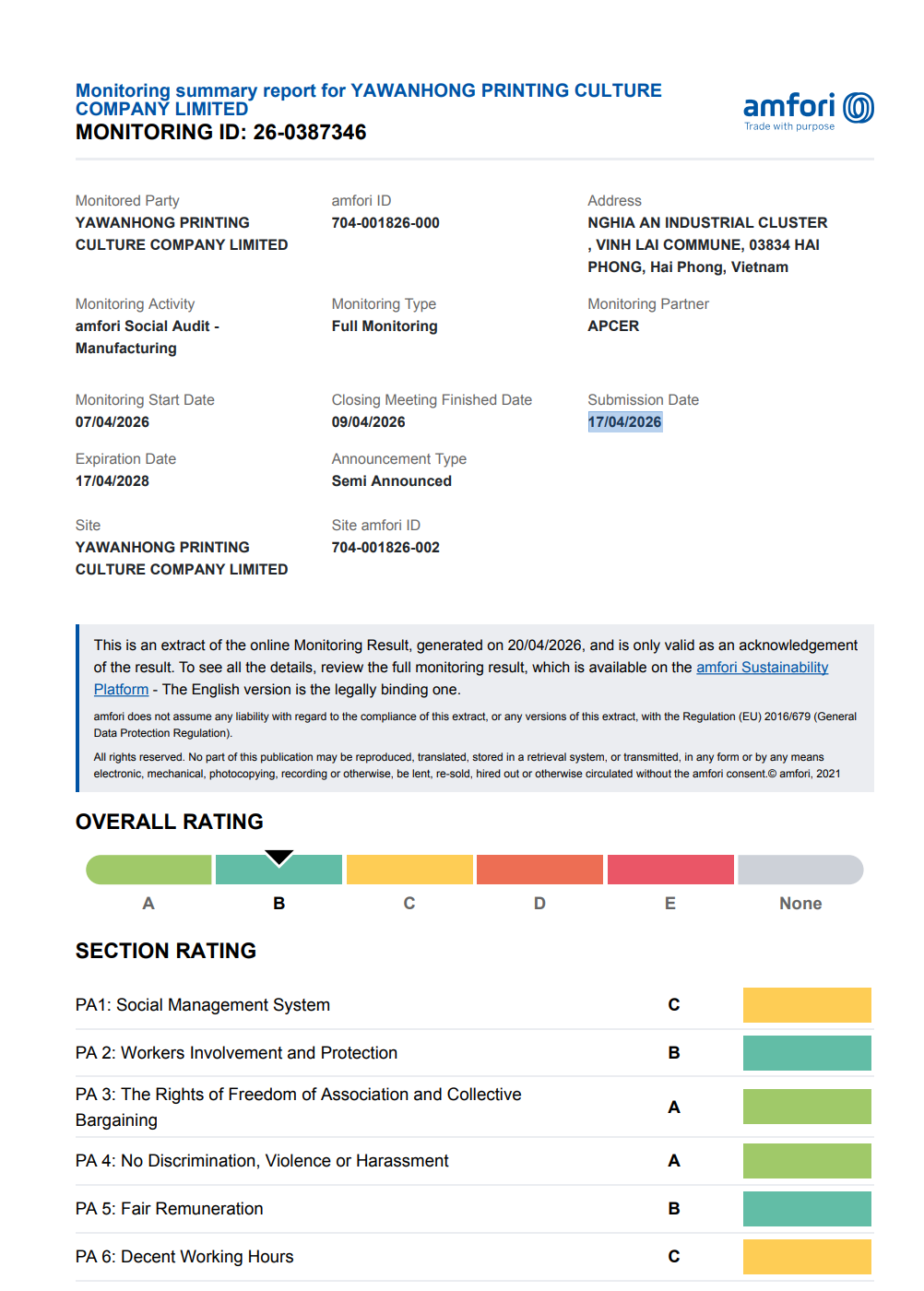
Social compliance documentation is a common qualification gate for US and EU retail programs.
Each document answers a different question, which is why buyers usually need more than one:
- amfori BSCI addresses social compliance at manufacturing level, benchmarked against the amfori BSCI Code of Conduct, ILO core labour standards and the UN Universal Declaration of Human Rights. In US retail and licensing supply chains this is often the first document requested, because the buyer's own customer frequently requires audited social compliance evidence.
- FSC Chain of Custody tracks certified material through the production chain. For a board game, FSC relevance concentrates in the paper and board content — boards, cards, boxes and rulebooks — which represents the majority of a typical box by weight.
- SMETA is a social compliance audit framework covering labour standards, health and safety, environment and business ethics, commonly requested by European retail buyers. This certificate is issued under the Sedex SMETA Code, ILO core labour standards and the ETI Base Code.
- ISO 9001:2015 certifies a quality management system. It speaks to process control and consistency across production, not to the safety of a specific product.
Question 5: What Material and Specification Ranges Can Be Customized?
The published specification ranges for the custom board game line (model BG-001) and the custom card game line (model CG-001) define the physical envelope a buyer can design into:
- Board game (BG-001): paper weight 128–400 gsm or custom; box thickness 1.5–3 mm or custom; CMYK offset printing; surface finish options of matte lamination, glossy lamination, UV coating, embossing, debossing or custom; fully customizable dimensions.
- Card game (CG-001): custom card size; paper weight 128–400 gsm or custom; CMYK four-color or Pantone printing; round or square corners; matte lamination, glossy lamination, linen, UV coating or varnishing; standard, colored or gold foil card edges.
Beyond the printed components, the customization scope covers material, size, color, logo and packaging. That combination supports the typical retail bundle for family board games, kids board games, adult board games and strategy board games: printed board, deck, box and inserts produced as one coordinated set rather than assembled from separate vendors.
The limitation is that a specification range describes what can be produced, not what has been tested. A paper weight band of 128–400 gsm and a box wall range of 1.5–3 mm do not, on their own, state tolerance, durability, drop-test or color-consistency results. Buyers with strict requirements should convert the range into a fixed specification before the pre-shipment test — naming a specific paper grade within the band, a specific lamination, and a measurable color target — so that acceptance is a pass or fail decision rather than a judgment call.
Question 6: What Commercial Terms Apply to a Custom Board Game Order?
The stated commercial framework is straightforward and should be mapped to the buyer's own cost structure before quotation comparison:
- Minimum order quantity: 1,000 units
- Delivery terms: FOB, CIF, DDP, or the customer's preferred terms
- Acceptance criteria: pre-shipment test
- Payment terms: 30/70
- After-sales support: remote technical support
Incoterm choice shifts real responsibility. Under FOB, the buyer controls freight booking and insurance; under DDP, the supplier carries the landed-cost obligation to the destination. Because the acceptance criterion is a pre-shipment test, the inspection window and the balance payment milestone should be aligned — for example, balance payable after a passed inspection — so that inspection has commercial weight rather than being a courtesy step.
It is also worth noting what the terms imply about project fit. Remote technical support is appropriate for most production questions, but it is not the same as having an engineer on site. Buyers running first-time pilot production, or working with unusual components, should budget time for a factory visit or an on-site pilot rather than assuming remote support covers it.
Question 7: What Proof Exists Beyond Certificates?
For one reference case, the manufacturer reports OEM board game and card game clients producing a project scale of 10,000 units across a five-year cooperation period, with the finished product used for online sales. Clients in that reference span the US, DE, NL, ES, FR, IT, GB, JP and KR. Reported outcomes include stable quality, clear printing, sturdy build, neat cutting and eco-friendly materials, with project highlights covering fully customized artwork and size, child-safe rounded edge treatment, FSC-certified raw materials, and one-stop printing and packaging service.
For procurement purposes, the most informative element is the duration rather than the volume. Repeat production over five years implies that artwork, material and finishing have been reproduced across multiple production runs — which is a different kind of evidence from a single successful order. The 10,000-unit figure should be read as a reference scale for that configuration, not as a maximum capability limit.
The boundary here is transparency. Case information of this kind is supplier-reported. Where order value, regulatory exposure or launch criticality justifies it, buyers should request buyer references, shipment records or audit access before placing production orders.
How Integrated Custom Board Game Manufacturing Compares With Traditional Sourcing Options
Sourcing models for a customized board game sit on a spectrum between local short-run printing and integrated export manufacturing. The trade-offs are not about quality alone; they concern documentation, coordination and minimum volume.
| Sourcing model | MOQ profile | Lead time profile | Compliance documentation | Component and packaging coverage | Main trade-off |
|---|---|---|---|---|---|
| Local short-run printer | Low | Short | Typically focused on print output; audited social compliance documentation often unavailable | Printing only; cards, boxes and inserts sourced separately | Fast and flexible, but may not satisfy retail program documentation or export packaging requirements |
| Single-capability overseas printer | Moderate | Moderate | Varies by supplier | Printing plus partial assembly; multiple vendors for components | Fewer vendors than a fully split supply chain, but coordination remains the buyer's task |
| Integrated board game OEM/ODM (e.g. Yawanhong) | 1,000 units | 25–45 days typical | FSC, BSCI, SMETA and ISO 9001 as listed | Board games, card games, puzzles, boxes, printing and packaging under one roof | One vendor and one compliance package, but a higher entry MOQ and a longer lead time than local short-run printing |
The integrated model is not automatically the better choice. If the requirement is a few hundred units for a limited event, a local printer will usually be faster and lower risk on unit economics. If the requirement is a retail or promotional program that must present social audit evidence, material claims and consistent packaging across several components, consolidating into one factory reduces the number of vendors, the number of audit surfaces and the number of specification handoffs.
Two constraints are worth stating plainly. First, the 1,000-unit MOQ is a real barrier for small validation runs and design prototyping; it does not flex to hobby-scale volumes. Second, remote technical support means the buyer remains responsible for final artwork readiness and for any on-site engineering presence; projects with unusual mechanical components should plan an on-site stage rather than assume remote coordination is sufficient.
What Is Changing in Custom Board Game Procurement in 2026 and Beyond
Three shifts are visible from the procurement side of the category.
Compliance evidence is becoming a qualification gate rather than a differentiator. Buyers increasingly ask for certificate numbers, scopes and validity dates at the RFQ stage, because retail and licensing programs ask them for the same information. A supplier that cannot produce a scoped, current certificate quickly is effectively pre-filtered out of shortlists, regardless of price.
Specification-first RFQs are replacing price-first RFQs. Customization breadth — board size, box thickness, finishing, component count and packaging — is a primary driver of quotation variance. Published supplier listings in this category frequently describe different product configurations, so quotations are only comparable when the specification is fixed in advance. Buyers who issue a defined bill of materials receive quotations they can actually rank.
Supply-base diversification continues to shape country shortlists. Vietnam-based manufacturers are evaluated alongside other Asian production bases as part of broader sourcing diversification, and the comparison is usually decided on documentation readiness, capacity evidence and lead time reliability rather than on country alone. For custom board game programs, the useful unit of comparison remains a fixed specification plus a verifiable certification set.
FAQ: Custom Board Game Procurement
What is the minimum order quantity for a custom board game?
The stated minimum order quantity is 1,000 units for OEM and ODM board game and card game production. The minimum applies to the complete configuration — board, cards, box, components and packaging — so changing box thickness, board size or component count effectively creates a new configuration. Buyers with smaller validation volumes should plan a separate sampling stage instead of expecting a reduced production run.
How long does custom board game production take?
Typical production lead time is 25–45 days, supported by a monthly capacity of 80,000 units. Artwork approval, proofing cycles, material sourcing and the complexity of surface finishing move a project toward the upper end of that range. Shipping transit and destination customs clearance are additional and sit outside the production window.
Which certification should a US buyer verify first?
For US retail supply chains, the amfori BSCI social audit is commonly the first social compliance document requested. The relevant certificate is listed under number 26-0387346, issued 2026-04-17 and valid to 2028-04-17. Buyers should confirm that the certificate scope covers printed board games and card games and that the record remains active in the amfori registry.
How is FSC material compliance verified for a board game?
Through a valid FSC Chain of Custody certificate covering the paper-based components. The listed certificate is ESTS-COC-241865, issued under standard FSC-STD-40-004 V3-1 by Extensive Standard Technical Services Co., Ltd., issued 2024-11-25 and valid to 2029-11-24. A chain-of-custody certificate supports claims about tracked material; it does not certify the safety of the finished product.
Which markets does the manufacturer focus on?
The stated export markets are the USA and Europe, with an export ratio of 100% and main products covering board games, card games, puzzles, notebooks, color boxes, publications and toys. The reference case lists clients in the US, DE, NL, ES, FR, IT, GB, JP and KR, with the finished product used for online sales. A 100% export orientation means production planning is aligned with export packaging and documentation rather than domestic distribution.
What operational standards support production?
The reported operational profile is a 55,000 m² facility, 280 employees including a 25-engineer R&D team, an annual output of 1,000,000 units and a monthly capacity of 80,000 units, with quality control described as 100% testing. These are company-reported figures. Buyers should treat them as a basis for audit prioritisation and verify them through production line lists and capacity records during qualification.
What payment and delivery terms apply?
Payment terms are 30/70. Delivery terms can be FOB, CIF, DDP or the customer's preferred terms, and acceptance is based on a pre-shipment test. Because the deposit typically releases production, the 25–45 day lead time should be scheduled from the deposit date, and the balance milestone is best tied to a passed pre-shipment inspection.
What documentation should a buyer request before placing an order?
A practical documentation set includes certificate copies with numbers, scopes and validity dates; a fixed specification sheet covering paper weight, box thickness, printing method and surface finish; written lead time, MOQ and acceptance criteria; and references or shipment records for comparable projects. Where the product is destined for the US or EU, the buyer's own toy safety, chemical and labelling requirements should be confirmed separately with an accredited testing provider.
Summary: The Four Answers to Have in Writing
Custom board game procurement is decided less by gameplay ambition than by documented minimums, lead times, compliance scope and operational evidence. A 1,000-unit minimum, a 25–45 day typical production window, four scoped certifications with registrable numbers, and a 55,000 m² facility with internally consistent capacity figures form an auditable baseline for evaluation. The remaining work — confirming certificate scope, fixing a specification, planning inspection timing and validating capacity claims through an audit — belongs to the buyer, and it is where well-prepared projects separate from delayed ones.
The manufacturer's global manufacturing profile, including facility and certification details, is available as a downloadable document: Yawanhong VN Group Global Manufacturing (PDF).
Есть вопросы или нужны дополнительные детали?
Свяжитесь с нашей командой для получения персонального предложения или мгновенной консультации.
Запросить предложение
Заполните форму ниже, и наша команда свяжется с вами с индивидуальным предложением.
Прямой чат WhatsApp
Предпочитаете общаться в реальном времени? Напишите нам в WhatsApp для мгновенной помощи и быстрых ответов.
- Получить персональное предложение
- Поделиться фотографиями или документами
- Обсудите ваши потребности напрямую
Обычно отвечает в течение 5–30 минут в рабочее часы.