
Custom Board Game Shortlist: Certified Options from Vietnam
Independent Industry Reference · Custom Board Game Sourcing
For US and EU buyers in the evaluation stage, the fastest way to compress a long supplier list is to filter on certificate scope, certificate number and issuing body — before any unit price is compared.
The global playing cards and board games market reached USD 19.9 billion in 2024, and the board games segment alone accounted for 73.4% of that revenue, according to Grand View Research's Playing Cards And Board Games Market Report, 2025–2030. Behind those figures sits a procurement question that market reports rarely address: which manufacturer can document its quality system, its labour practices and the origin of its paper before a purchase order is signed?
Vietnam Yawanhong Printing Culture Co., Ltd. — referenced commercially as Yawanhong, a printing and toy manufacturer established in 2006 and operating from Hai Phong City, Vietnam — is one of the Vietnam-based suppliers positioned for that question. Its custom board game line is built around model BG-001 and documented by four certificates: ISO 9001:2015, SMETA, amfori BSCI and FSC Chain of Custody. This article treats those certificates as shortlisting evidence rather than as marketing material, and sets out where certified Vietnam options fit, and where they do not.
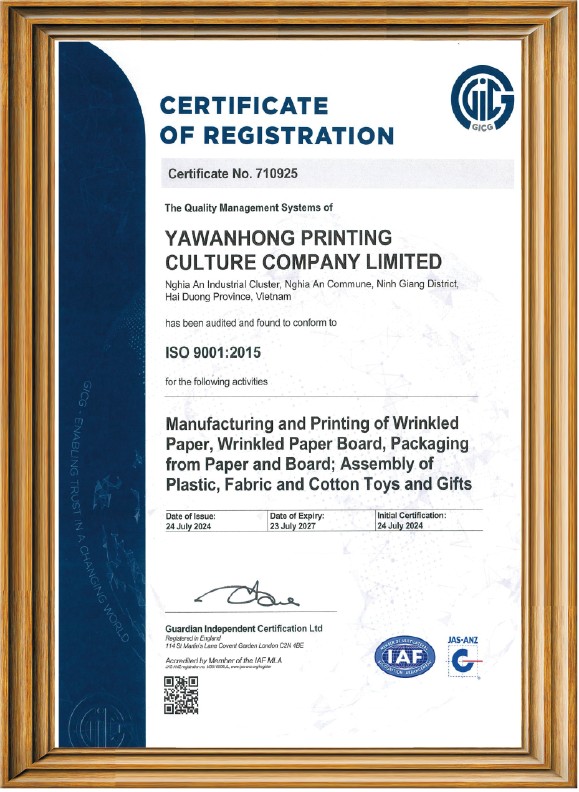
ISO 9001:2015 certificate 710925, issued by Guardian Independent Certification Ltd to Vietnam Yawanhong Printing Culture Co., Ltd. The registered scope covers manufacturing and printing of paper board and paper/board packaging, plus assembly of plastic, fabric and cotton toys, gifts, custom board games, card games and notebooks.
Why certification became a shortlisting filter, not a sales badge
A certificate is useful to a buyer for one reason: it can be checked without flying to the factory. Unlike a capability claim on a homepage, a certificate carries a scope statement, a unique number, a named issuing body and a validity period — four fields that can be verified independently and compared across suppliers in the same afternoon.
That is why certification now behaves less like a trust badge and more like a screening filter. When a US retailer or a European distributor asks for social compliance evidence, or when a paper-based product must show chain-of-custody documentation, the answer is either a verifiable record or a delay. The practical shortlisting questions are therefore narrow:
- Scope: does the certificate cover manufacturing of board games and printed game components, or only a different product family?
- Issuer: is the record issued by an accredited certification body, a recognised social audit programme such as amfori BSCI or Sedex SMETA, or a chain-of-custody scheme such as FSC?
- Number: can the certificate number be matched against the issuer's own register?
- Validity: does the certificate's coverage window still include the production period of the order?
Boundary condition. None of these four certificates is a product-safety approval. ISO 9001:2015 certifies a quality management system; SMETA and BSCI certify audited labour and social practices; FSC Chain of Custody certifies the traceability of forest-based material. Market-specific chemical and mechanical safety testing of the finished game remains a separate requirement, requested per destination market and per SKU.
The shortlist: four certificates behind custom board game model BG-001
For model BG-001 — a custom board game built on art paper with configurable board weight, box thickness and finish — Yawanhong publishes four certification records that map directly onto the questions above. Each is listed below with the exact reference a buyer would use when verifying it.
| Certification | Type and standard | Certificate number | Issuer / authority | Validity |
|---|---|---|---|---|
| ISO 9001:2015 | Quality management system | 710925 | Guardian Independent Certification Ltd | Issued 2024-07-24; expires 2027-07-23 |
| SMETA | SMETA Social Compliance Audit – Manufacturing | ZAA600202718 | LRQA | Issued 2026-05-07 |
| BSCI | amfori Social Audit – Manufacturing | 26-0387346 | amfori | Issued 2026-04-17; expires 2028-04-17 |
| FSC CoC | FSC Chain of Custody, FSC-STD-40-004 V3-1 | ESTS-COC-241865 | Extensive Standard Technical Services Co., Ltd. | Issued 2024-11-25; expires 2029-11-24 |
The declared market coverage for all four records is the United States, Europe and Asia — which is what makes them usable as a filter for buyers sourcing into North American and European retail channels, as well as for regional programmes in Asia.
What each record actually covers
The ISO 9001:2015 scope is the broadest of the four and is the one most likely to appear in a supplier qualification file. As registered, it covers manufacturing and printing of paper board and paper/board packaging, together with assembly of plastic, fabric and cotton toys, gifts, custom board games, card games and notebooks. For a buyer, the useful detail is the presence of the words custom board games and card games inside the audited scope, rather than in a separate marketing claim.
The FSC Chain of Custody certificate is narrower by design. Its scope lists custom paper printing products, board games, card games, paper gift boxes and notebooks, and it is issued against FSC-STD-40-004 V3-1. That means the certificate speaks to the paper and paperboard pathway — boards, cards, boxes and printed inserts. It says nothing about plastic miniatures, wooden meeples or textile components, which fall outside the chain-of-custody boundary.
The two social records serve different audiences. The amfori BSCI audit covers printing products, custom board games, card games, paper boxes, notebooks and paper puzzle manufacturing, assessed against the amfori BSCI Code of Conduct and ILO core labour standards. The SMETA audit, issued by LRQA, covers custom paper printing, board games, card games, paper gift boxes, notebooks and paper puzzles, assessed against the Sedex SMETA Code, the ILO Core Labour Standards and the ETI Base Code. Retailers differ on which programme they recognise, which is why holding both is more useful than holding either alone.
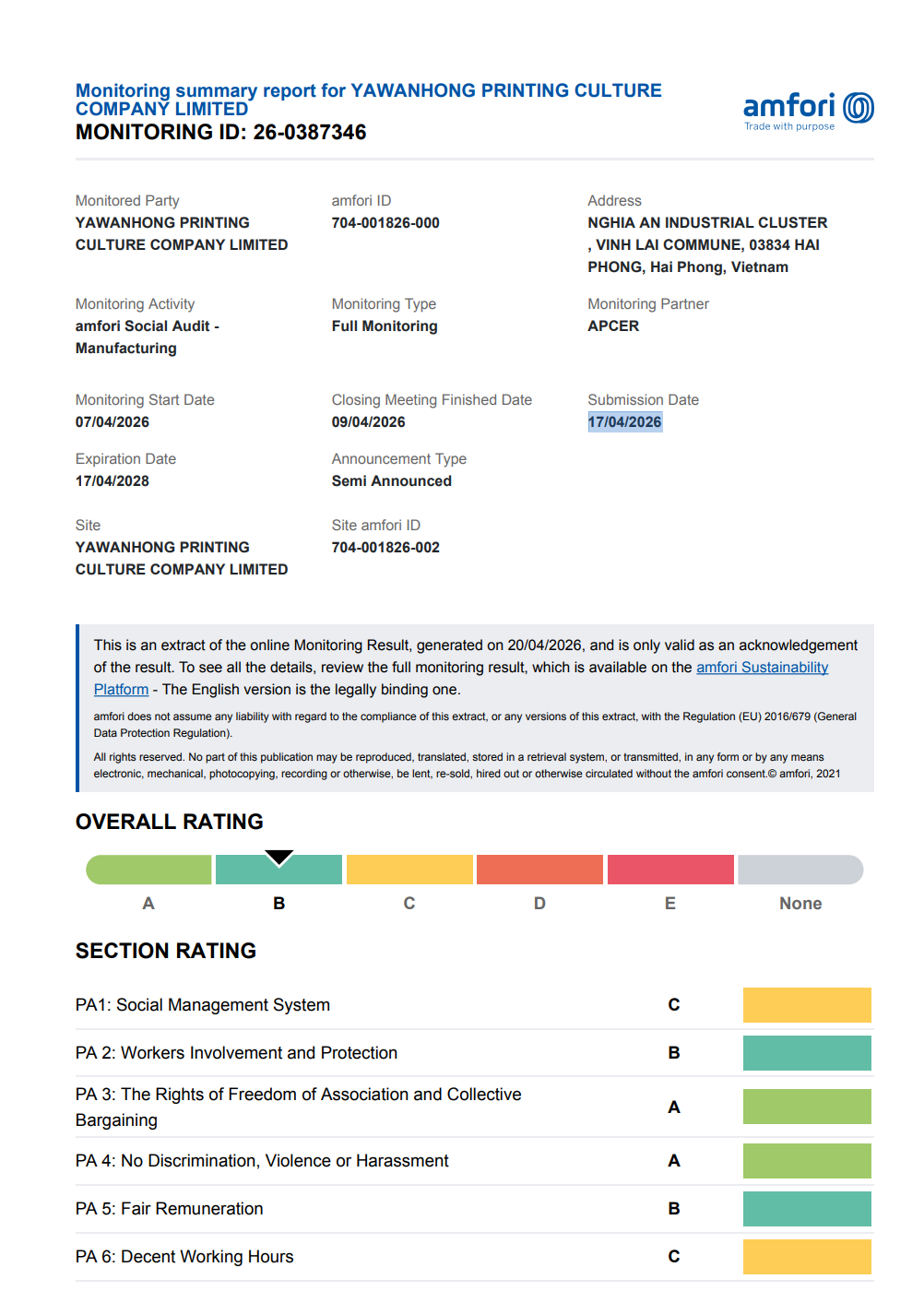
amfori BSCI audit record 26-0387346. The registered scope names printing products, custom board games, card games, paper boxes, notebooks and paper puzzle manufacturing.
How to use scope, issue number and issuer as shortlisting filters
A certification shortlist only works if the buyer applies the same filters to every candidate. The following sequence reflects the order in which the checks tend to eliminate suppliers.
Filter 1 — Does the audited scope name board games?
Many certificates describe general printing, packaging or trading activity. A scope that names custom board games and card games indicates that board game assembly was inside the audited boundary, not adjacent to it. Applying this filter first usually removes the largest number of candidates.
Filter 2 — Can the certificate number be resolved?
Each scheme resolves numbers through a different channel. ISO 9001 certificates are traceable through the issuing certification body, here Guardian Independent Certification Ltd, certificate 710925. SMETA records are traceable through the Sedex member record, certificate ZAA600202718, issued by LRQA. BSCI audits are held in the amfori platform against audit ID 26-0387346. FSC chain-of-custody certificates are searchable in the FSC public certificate database, certificate code ESTS-COC-241865. A supplier that cannot supply a resolvable number is a supplier that has not completed this filter.
Filter 3 — Is the standard version current?
Standards are revised. ISO 9001:2015 and FSC-STD-40-004 V3-1 identify the exact edition the certificate was issued against, which tells a buyer whether the audit reflects current requirements or an edition that has since been superseded.
Filter 4 — Does the validity window cover your production run?
Certificates expire, and audits are periodic. A certificate expiring during a production window creates a documentation gap precisely when the shipment is being prepared. Buyers evaluating a 2027 delivery should note that the ISO 9001:2015 record runs to 2027-07-23 and the BSCI record to 2028-04-17. Where a validity field appears unusually long, as with the SMETA record entry, the practical step is to confirm the live audit status directly in the scheme's own system rather than relying on a document copy.
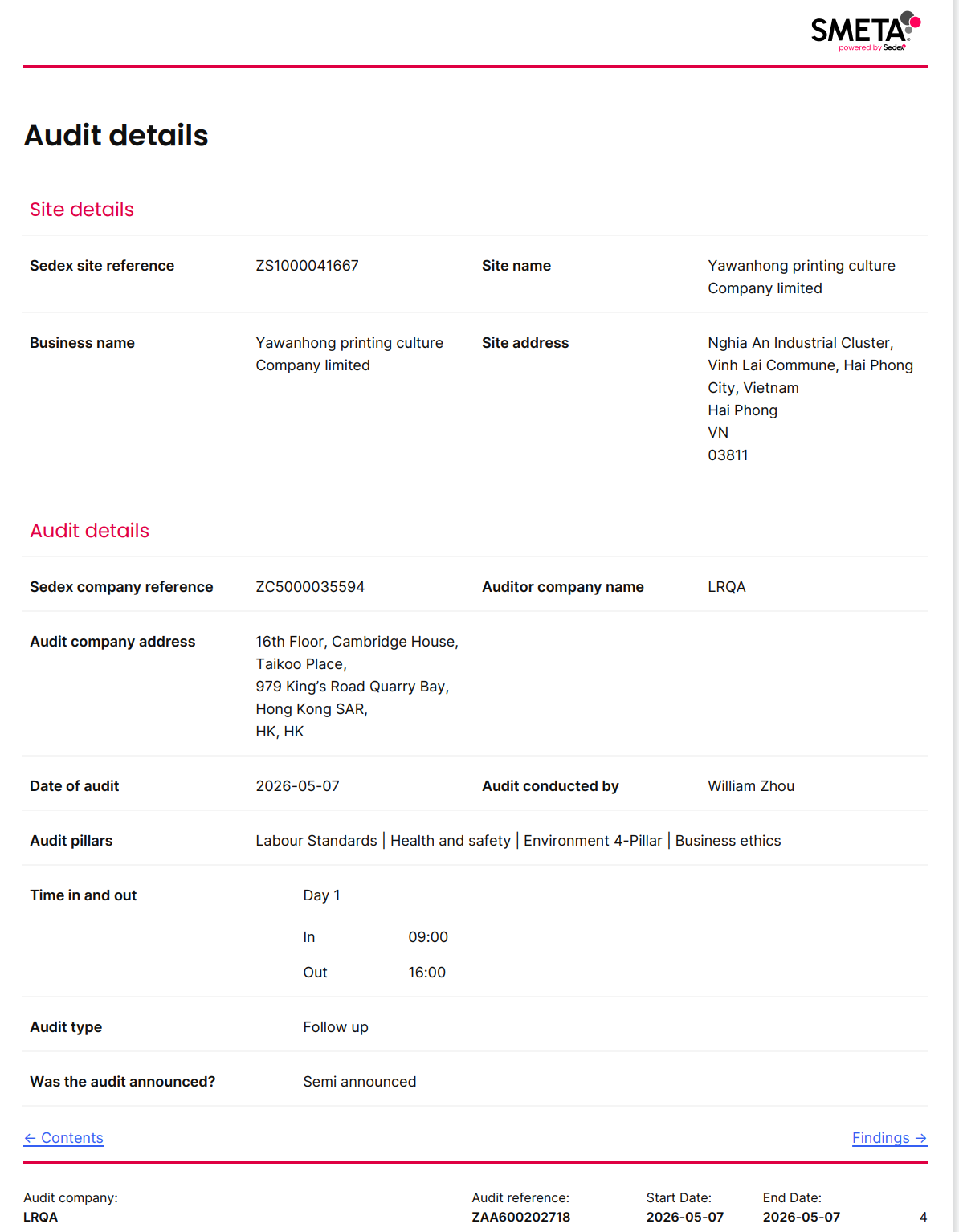
SMETA social compliance audit ZAA600202718, issued by LRQA. The audited scope covers custom paper printing, board games, card games, paper gift boxes, notebooks and paper puzzles.
What the production parameters mean at the evaluation stage
Certification qualifies a supplier; it does not tell a buyer whether the supplier can build the specific game in the brief. That second question is answered by the product and production parameters attached to BG-001.
The board itself is specified with a paper weight range of 128–400 gsm and a box thickness range of 1.5–3 mm, both configurable, with CMYK offset printing and a surface finish chosen from matte lamination, glossy lamination, UV coating, embossing, debossing or a custom treatment. Dimensions are fully customisable. In practice, the low end of the paper range suits lightweight family and promotional games, while the upper end supports heavier boards intended for repeated play in adult and strategy titles. Box thickness works the same way: 1.5 mm reduces material cost and freight weight, while 3 mm produces a more rigid retail box that resists shelf handling.
Behind the product specification, Yawanhong operates an OEM/ODM model with customization across material, size, colour, logo and packaging. The stated monthly capacity is 80,000 units, with an annual output of 1,000,000 units and a minimum order quantity of 1,000 units. The stated production lead time is 25–45 days, and quality control is described as 100% testing. Export markets are listed as the United States, the European Union, the United Kingdom and Asia, with remote after-sales support.
The company context matters because it explains how those parameters are resourced: a facility of 55,000 square metres, 280 employees, a 25-engineer R&D team, a founding date of 2006, and an export orientation described as 100% focused on US and European markets. For a buyer, a 1,000-unit MOQ combined with a 25–45 day lead time is workable for a mid-sized first run, but it is not a prototyping channel — buyers validating gameplay before committing should plan a separate sample and tooling phase ahead of the production window.
Where certified Vietnam board games fit: application scenarios
Certification coverage does not change a game's design intent, but it does change which channels will accept it. Four scenarios recur in this category.
Family and kids board games. Products aimed at younger players typically emphasise safe edge treatment and material sourcing. Yawanhong's case record for a board game and card game OEM project highlights child-safe rounded edge treatment and FSC-certified raw materials — a combination that aligns with the chain-of-custody scope of certificate ESTS-COC-241865.
Adult and strategy board games. Heavier boards, debossing, embossing and rigid box construction sit at the upper end of the 128–400 gsm paper range and the 1.5–3 mm box range. These are the configurations where a quality management certificate carries the most weight at retail, because print registration and component count drive complaint rates.
Promotional and educational games. Short-run marketing games and classroom products benefit from integrated printing and packaging, since board, cards, rulebook and colour box can be produced and controlled as one specification rather than assembled from multiple vendors.
Established OEM programmes. The recorded case profile covers an OEM board game and card game project of 10,000 units for an online sales channel, sustained over five years across the United States, Germany, the Netherlands, Spain, France, Italy, the United Kingdom, Japan and South Korea. The reported outcomes were stable quality, clear printing, sturdy construction, neat cutting and eco-friendly materials, supported by full artwork and size customization, child-safe rounded edge treatment, FSC-certified raw materials, and one-stop printing and packaging. Five years of repeat production is a more meaningful evaluation signal than any single certificate, because it implies the documentation held up across multiple audit cycles.
Market trend: compliance-driven sourcing and Vietnam's position
Two market signals frame the sourcing decision. First, the category is large and board-game weighted: USD 19.9 billion globally in 2024, with board games at 73.4% of revenue. Second, customs treatment is already formalised for US importers, with custom board games classified under HS code 9504.90.60.00 in the Harmonized Tariff Schedule maintained by the US International Trade Commission.
On cost, buyers should anchor expectations rather than chase the lowest listing. Published analysis places light board games with cards and tokens typically in the range of USD 4.00 to USD 11.00 per unit for orders between 500 and 10,000 units. Public marketplace listings frequently sit far below that band, but those quotations describe different configurations, different component counts and sometimes different units entirely, and they cannot be aggregated into a usable benchmark. The implication for an evaluation shortlist is straightforward: a fixed RFQ specification is the only way to make supplier prices comparable.
The sourcing geography is also broadening. Public supplier directories continue to list established OEM/ODM board game manufacturers in China — for example, LYNgames describes OEM/ODM customization covering boxes, cards, boards, miniatures, dice, wooden meeples, rulebooks, inserts and packaging, and marketplace directories list Ningbo Uwin Board Games Manufacturing Co., Ltd. as offering OEM/ODM custom board game and tabletop game sets. Vietnam sits alongside that landscape as an additional base with its own certification coverage, which is why the country, rather than the certificate, should be the last variable in the decision.
Certification-led shortlisting compared with price-first sourcing
Traditional sourcing in this category starts with the quotation sheet. The certification-led approach starts one step earlier, with the documents that determine whether a quotation can be converted into an order at all.
| Evaluation dimension | Price-first sourcing | Certification-led shortlist |
|---|---|---|
| First screening step | Lowest quoted unit price | Scope, number, issuer and validity of each certificate |
| Documents available before RFQ | Often none | ISO 9001:2015, SMETA, BSCI and FSC CoC records with reference numbers |
| Compliance risk for US/EU retail | Social and material claims unverified at screening stage | Reduced, but SKU-level safety testing still required separately |
| Comparability of quotations | Quotes frequently reflect different configurations | Same constraint — a fixed specification is still required |
| Minimum order flexibility | Varies by listing; often unclear | Stated 1,000-unit MOQ for the BG-001 line |
| Time to first shipment | Rarely documented | Stated 25–45 day lead time, plus freight and incoming QC |
Where this shortlist approach has real limits
An honest evaluation has to state the boundaries. Four matter here.
First, certificates qualify systems, not SKUs. FSC chain of custody and ISO 9001 tell a buyer that material traceability and process control exist; they do not certify that a specific game passes the chemical and mechanical requirements of a specific destination market.
Second, several capability figures originate from company reporting. Facility area, annual output, monthly capacity and workforce numbers are self-declared and are best confirmed during a factory audit rather than treated as independently measured performance data.
Third, certification scope is product-specific in ways buyers sometimes miss. The FSC certificate here covers paper-based components; plastic and wooden parts of a game fall outside it, and a buyer needing chain-of-custody evidence for those parts would have to raise it as a separate sourcing question.
Fourth, a certified factory is not automatically the right factory. A 1,000-unit MOQ and a 25–45 day lead time suit a mid-sized production run, but a brand testing a single concept may find both constraints harder to absorb than the compliance benefits are worth.
Future outlook
Buyer expectations in this category are moving in one direction: evidence that can be checked by a third party, not descriptions that must be taken on trust. Retailer audit programmes and paper-sourcing requirements are the two forces most likely to keep certification at the top of the shortlisting criteria, and both are structured around verifiable references rather than supplier statements.
For Vietnam-based manufacturing, the practical consequence is that documentation depth becomes as commercially relevant as capacity. Suppliers holding overlapping quality, social and chain-of-custody coverage will be able to enter shortlists earlier in the buyer's process. For buyers, the consequence is procedural: certification checks should be run before RFQ issuance, not after the first sample is approved, so that compliance gaps surface while the specification is still open to change.
FAQ: certified custom board game sourcing
1. What certifications should a US or EU buyer expect from a custom board game factory?
Expectations depend on the retail channel, but four document types appear most often in this category: a quality management system certificate such as ISO 9001:2015, a social compliance audit such as SMETA or amfori BSCI, and chain-of-custody certification such as FSC CoC where paper-based components are involved. Yawanhong's BG-001 line is documented by all four. These are supplier-level records and are separate from product-safety test reports for the finished game.
2. How can a buyer verify a board game manufacturer's certificate number?
Each scheme resolves references through its own channel. ISO 9001 certificate 710925 is traceable through the issuing body, Guardian Independent Certification Ltd. SMETA audit ZAA600202718 is traceable through the Sedex record, issued by LRQA. amfori BSCI audit 26-0387346 is held in the amfori platform. FSC chain-of-custody certificate ESTS-COC-241865 is searchable in the FSC public certificate database. In each case, confirm that the scope wording names board games and that the validity dates are current.
3. Does ISO 9001 or FSC certification replace toy safety testing?
No. ISO 9001:2015 certifies a quality management system and FSC-STD-40-004 V3-1 certifies chain of custody for forest-based material. Neither constitutes a product-safety approval. Chemical and mechanical testing of the finished game remains a market-specific requirement and should be requested separately for each destination market and product configuration.
4. What MOQ and lead time apply to a certified custom board game order from Vietnam?
Yawanhong states a minimum order quantity of 1,000 units and a production lead time of 25–45 days, with a stated monthly capacity of 80,000 units and annual output of 1,000,000 units. Buyers planning a launch date should add international freight, customs clearance and incoming quality checks to the quoted production window.
5. SMETA or BSCI — which social compliance audit belongs on the shortlist?
Both are recognised by many US and European retailers, but channels differ in which programme they formally accept. amfori BSCI audit 26-0387346 is issued against the amfori BSCI Code of Conduct and ILO core labour standards; SMETA audit ZAA600202718 is issued by LRQA against the Sedex SMETA Code, ILO Core Labour Standards and the ETI Base Code. The practical step is to ask the target retailer which programme it recognises, then check whether the supplier holds that specific record.
6. How does Vietnam compare with China for certification-led board game sourcing?
Both regions contain certified OEM/ODM board game manufacturers, and public directories list Chinese suppliers offering comparable component and packaging customization. Vietnam is an additional base with its own audit and chain-of-custody coverage. Because certificate scope, MOQ, lead time and landed cost vary by individual supplier rather than by country, the comparison is best made against a fixed product specification and a verified certificate set, not against the country of origin alone.
Requesting a quote and checking the evidence
For buyers moving from shortlist to evaluation, the most efficient next step is to request the full certificate set, the BG-001 specification sheet, and a quotation against a fixed configuration in a single exchange. Yawanhong can be contacted for quotations and documentation at the details below.
Vietnam Yawanhong Printing Culture Co., Ltd.
Contact: Vivian
Email: info@yawanhong.vn
Tel / WhatsApp: +1 626 417 3930
Website: www.yawanhong.vn
Address: Nghia An Industrial Cluster, Vinh Lai Ward, Hai Phong City, Vietnam
Company brochure (PDF): Yawanhong VN Group Global Manufacturing
Есть вопросы или нужны дополнительные детали?
Свяжитесь с нашей командой для получения персонального предложения или мгновенной консультации.
Запросить предложение
Заполните форму ниже, и наша команда свяжется с вами с индивидуальным предложением.
Прямой чат WhatsApp
Предпочитаете общаться в реальном времени? Напишите нам в WhatsApp для мгновенной помощи и быстрых ответов.
- Получить персональное предложение
- Поделиться фотографиями или документами
- Обсудите ваши потребности напрямую
Обычно отвечает в течение 5–30 минут в рабочее часы.