
Custom Board Game Sourcing: Certifications and Specs That Matter
The Board Game Market Is Growing — So Is the Need for Verifiable Supplier Compliance
The global board games market was valued at approximately USD 15.71 billion in 2024, according to Grand View Research, and Credence Research projects a compound annual growth rate of 10.38% from 2025 to 2032, reaching an estimated value of USD 31.58 billion. For importers, publishers, and retail chains, this growth brings a less visible but equally important challenge: distinguishing between custom board game manufacturers who can document their certifications and specifications, and those who only claim them.
This article serves as an independent sourcing reference for procurement teams and brand owners evaluating custom board game suppliers. It concentrates on the constraint layer of buying decisions — certifications, material parameters, MOQ, lead time, and compliance boundaries — and uses Vietnam Yawanhong Printing Culture Co., Ltd. as a traceable example of how those factors can be verified in practice.
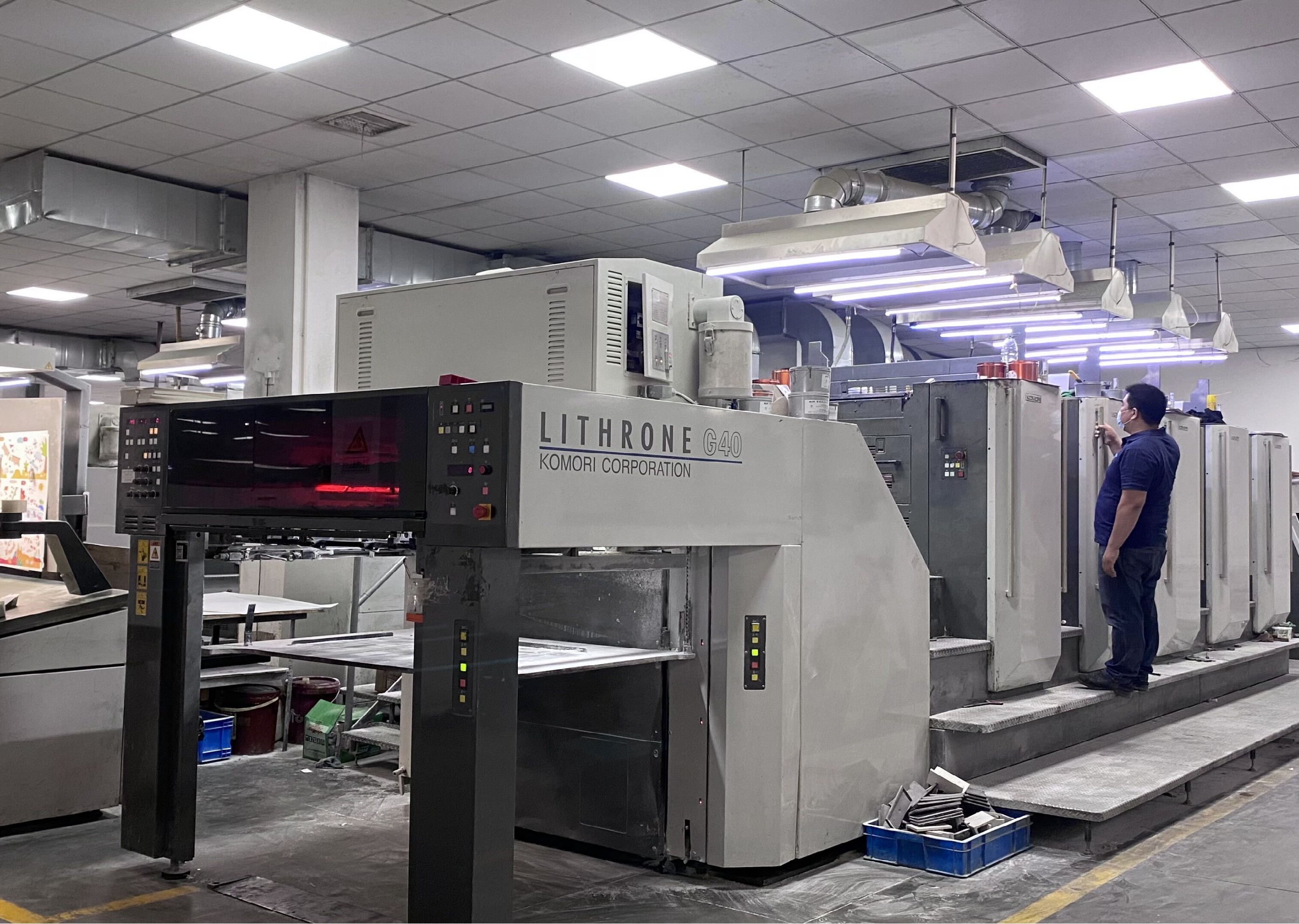
Printing, lamination, and die-cutting equipment form the technical backbone of certified custom board game production.
Why Certification Verification Has Become a Sourcing Bottleneck
Market data explains why compliance has moved to the center of board game procurement. North America held the largest share of global board game demand in 2024, accounting for approximately 42.06% — a value of around USD 6.66 billion, according to Fortune Business Insights. Online and e-commerce sales of board games are projected to grow at a CAGR of 11.53%, with a significant share of purchases already occurring through online platforms in several regions.
The growth of digital retail channels has lowered market entry barriers for new game brands. At the same time, it has made formal compliance documentation harder to ignore: Amazon, Walmart, Target, and major European retail groups routinely require suppliers and brands to present testing reports, safety certificates, and social compliance evidence before products can be listed or reordered.
The regulatory framework is well defined. Board games sold in the European Union must comply with the Toy Safety Directive 2009/48/EC and harmonized EN 71 standards, including EN 71-1 for mechanical properties and EN 71-13 for olfactory games. In the United States, board games intended for children under 14 must satisfy ASTM F963-23 safety requirements, which are mandatory under 16 CFR part 1250. Importers who skip the verification step may face customs holds, marketplace listing suspensions, or product recalls.
The practical problem is that many factories claim to hold certifications, but only some can present certificate numbers, issuing bodies, scope details, and current validity. For a procurement team, the difference between a verifiable certification and a marketing mention is the difference between a defensible sourcing decision and a compliance risk.
Reading a Manufacturer's Certification Profile: A Documented Example
Vietnam Yawanhong Printing Culture Co., Ltd. illustrates how an export-oriented board game manufacturer can document its compliance position. The company was established on December 5, 2006, and operates a 55,000 m² factory in the Nghia An Industrial Cluster, Vinh Lai Ward, Hai Phong City, Vietnam. It employs 280 people, including a 25-engineer R&D team, and maintains an annual output capacity of 1,000,000 units. All products are exported, with the United States and Europe as the primary markets.
The certification profile for its custom board game line includes four externally audited standards:
| Certification | Certificate Number | Issuing Body | Applicable Markets |
|---|---|---|---|
| FSC Chain of Custody (FSC-STD-40-004 V3-1) | ESTS-COC-241865 | Extensive Standard Technical Services Co., Ltd. | US, Europe, Asia |
| ISO 9001:2015 (QMS) | 710925 | Guardian Independent Certification Ltd | US, Europe, Asia |
| amfori BSCI (Social Audit) | 26-0387346 | amfori | US |
| SMETA (Social Compliance Audit) | ZAA600202718 | LRQA | US, Europe, Asia |
FSC Chain of Custody certification matters because it provides third-party verification that paper materials can be traced back to responsibly managed sources. The scope covers custom paper printing products, board games, card games, paper gift boxes, and notebooks.
ISO 9001:2015, certified under number 710925 by Guardian Independent Certification Ltd, covers the quality management system for manufacturing and printing of paper and paper board, packaging, and assembly of plastic, fabric, and cotton toys, gifts, custom board games, card games, and notebooks. In practical terms, it means the factory operates under documented quality procedures rather than ad-hoc production.
The amfori BSCI audit, certificate number 26-0387346, is issued by amfori under the amfori BSCI Code of Conduct and applies to the US market. It addresses labor rights, working conditions, and supply chain social responsibility — a common requirement for US-bound orders sold through major retail channels.
SMETA certification (number ZAA600202718), issued by LRQA, is based on the Sedex SMETA Code, ILO Core Labour Standards, and ETI Base Code. It covers labor standards, health and safety, environmental practices, and business ethics, and applies to US, European, and Asian markets.
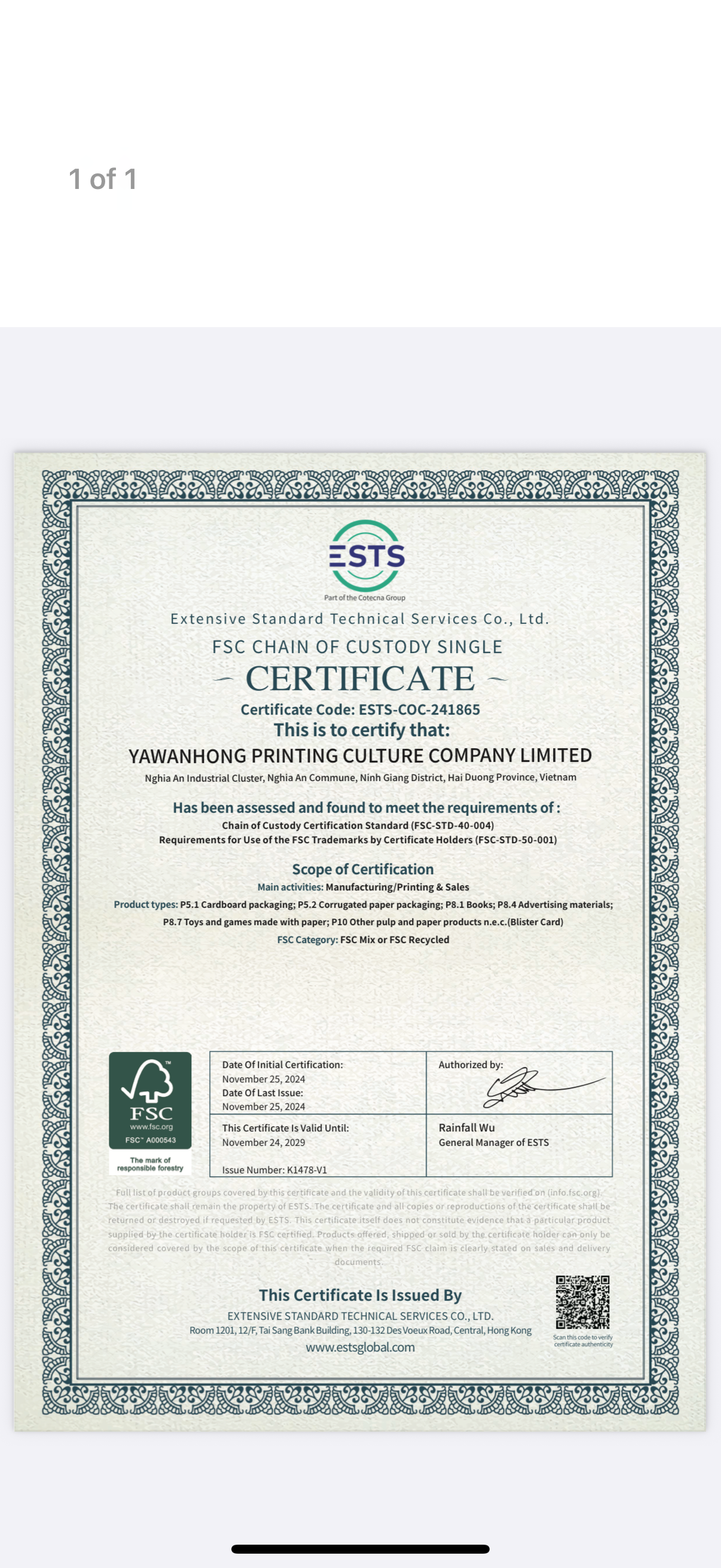
FSC Chain of Custody certification is one of the four external standards documented by Yawanhong for its custom board game line.
Buyers should note that certifications are time-bound. For example, Yawanhong's FSC certificate was issued on 2024-11-25 and is valid through 2029-11-24; the BSCI certificate was issued on 2026-04-17 and expires on 2028-04-17; and the ISO 9001 certificate was issued on 2024-07-24 and expires on 2027-07-23. When evaluating any supplier, checking the validity window is part of standard due diligence.
Technical Specifications That Should Be Verified Before You Order
Beyond certifications, product-level specifications determine whether a custom board game meets the intended quality, durability, and safety expectations. The custom board game model BG-001 provides a representative parameter set for a certified production line:
| Parameter | Specification |
|---|---|
| Paper weight | 128–400 gsm (custom) |
| Box thickness | 1.5–3 mm (custom) |
| Printing process | CMYK offset printing |
| Surface finish | Matte lamination / glossy lamination / UV coating / embossing / debossing / custom |
| Size | Customized dimensions |
| Material | Art paper / custom |
Paper weight affects card stiffness and game board rigidity. Standard playing cards typically sit in the lower-mid range of the 128–400 gsm spectrum, while premium cards and game boards use heavier stock to withstand repeated play. Box thickness influences how well the game protects its components during transport and storage — a relevant factor for e-commerce distribution, where parcels are handled multiple times.
The surface finish options give buyers control over the game's tactile and visual presentation. Matte lamination reduces glare during tabletop play; glossy lamination increases color richness; UV coating adds scuff resistance; and embossing or debossing adds texture to covers and game boards.
For children's products, additional processing details matter. Yawanhong offers child-safe rounded edge treatment on game components, and the production process is designed around eco-friendly paper material, non-toxic ink, and FSC-compliant raw materials. The standard operating environment is a normal-temperature, dust-free indoor workshop, which supports print consistency.
Capacity and production constraints are equally important. Yawanhong's OEM/ODM capability includes a monthly capacity of 80,000 units, a standard lead time of 25–45 days, a minimum order quantity of 1,000 units, and 100% inspection as the quality control standard. Export coverage includes the US, EU, UK, and Asian markets, with remote after-sales support.
Use Cases: What Certified Production Looks Like in Practice
One documented case in Yawanhong's production history involves an OEM board game and card game client relationship maintained over five years, serving customers in the United States, Germany, Netherlands, Spain, France, Italy, United Kingdom, Japan, and South Korea, with a typical order quantity of 10,000 units. The outcomes cited in the case record include stable quality, clear printing, sturdy construction, neat cutting, and eco-friendly material use.
For a buyer, a long-running relationship of this kind signals process stability: the same supplier has produced repeat orders across multiple markets with different regulatory environments and packaging requirements. The service scope includes fully customized artwork and sizing, child-safe rounded edge treatment, FSC-certified raw materials, and one-stop printing and packaging — meaning the buyer does not need to coordinate a separate packaging supplier.
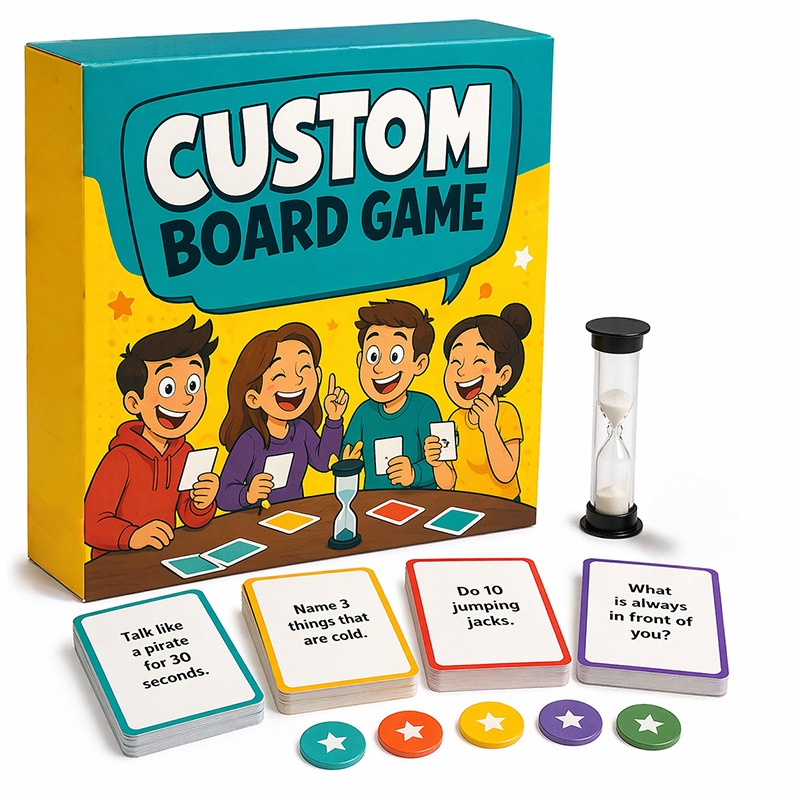
Custom board games can be configured for different player segments, including adult and family audiences.
The product line supports various game types, including family, strategy, and classic games, and is suitable for both kids and adults board games. That range mirrors the broader demand structure in the custom board game market, where family board games, board games for kids, strategy board games, classic board games, ludo board games, and adult board games each carry distinct specification needs.
The manufacturing scenario is configured for mass customized printing production, using Heidelberg printing presses, automatic laminating machines, varnishing machines, gliding presses, embossers, and die-cutting machines. These are paper-print-specific processes, which differentiates a printing-focused manufacturer from a general toy assembler.
Market Trends Reshaping Custom Board Game Procurement
Several structural trends are changing how custom board games are sourced.
First, regulatory expectations are converging. The EU's Toy Safety Directive and EN 71 standards and the US CPSC's ASTM F963-23 requirements are not optional for serious market access. As more countries adopt similar frameworks, the cost of non-compliance rises. Verified certification coverage is becoming a basic screening criterion rather than a competitive differentiator.
Second, e-commerce is the fastest-growing sales channel. Online board game sales are projected to grow at a CAGR of 11.53% at a time when North America already contributes roughly 42% of global demand. Direct-to-consumer brands and marketplace sellers need suppliers who can handle small-to-mid batch production efficiently and ship finished goods that survive parcel logistics. Sturdy box construction — such as 1.5–3 mm board thickness — directly affects return rates and customer reviews.
Third, ESG procurement policies are tightening. FSC-certified paper and social compliance audits (BSCI, SMETA) are increasingly listed as supplier requirements by large retail groups. A custom board game manufacturer without these documents may be excluded from tenders even if product quality is high.
Fourth, the publishing side of the market is concentrated among a small number of major game companies — Hasbro, Mattel, Asmodee, Ravensburger, and Spin Master are among the leading publishers — while the manufacturing layer remains fragmented. That structure creates an opening for specialized manufacturers that combine printing capability with certification coverage. Rather than competing with global brands, custom board game manufacturers enable smaller publishers, educational toy companies, and promotional buyers to bring their own game concepts to market.
Certified Manufacturing vs. Conventional Toy Production: Trade-offs and Boundaries
Compared with a general toy factory that produces board games as a minor product line, a certified print-focused manufacturer offers structural advantages: dedicated paper printing equipment calibrated for board game components, FSC-traceable material sourcing, integrated packaging, and documented quality and social compliance systems.
But the same profile carries limitations that buyers should factor into sourcing decisions.
First, the MOQ is 1,000 units. This is practical for established brands and mid-sized publishers, but too high for a micro-indie designer launching a first small test run. Buyers planning a pilot batch below this level would need to negotiate sampling terms or work with a different supplier.
Second, the standard lead time is 25–45 days. This makes certified custom board game production unsuitable for emergency replenishment or rush seasonal orders. Buyers should align inventory planning with the supplier's production calendar.
Third, certification scope is tied to the paper-printing category. Yawanhong's certificates cover paper printing products, board games, card games, paper gift boxes, notebooks, and paper puzzles. If a game design includes significant non-paper items — such as injection-molded plastic miniatures or electronic components — those parts fall outside the certified paper scope and may require a separate supplier audit.
Fourth, certifications expire. A certificate valid today may not be valid at the time of shipment. Buyers should request current certificates during the evaluation process and build renewal monitoring into ongoing supplier management.
Future Outlook: Compliance as a Partnership Criterion
The direction of travel is clear. In the coming years, certification documentation will likely move from a "nice-to-have" to a pre-qualification criterion in custom board game procurement. Retailers will continue to integrate environmental and social standards into supplier codes, and FSC-certified materials combined with BSCI or SMETA social audits will form the baseline for selling through major US and European channels.
At the manufacturing level, the suppliers that are well positioned for long-term relationships are those that can integrate printing, component production, assembly, and packaging in a single certified flow. This reduces logistics complexity and quality dispersion for the buyer. The broader market trend points toward deeper OEM/ODM partnerships rather than transactional one-off orders, with lead time, MOQ, and certification validity being negotiated as part of a multi-year framework.
Frequently Asked Questions
What certifications should a custom board game manufacturer hold for the US and European markets?
The most relevant certifications cover quality management, responsible material sourcing, and social compliance. ISO 9001:2015 addresses quality management systems; FSC Chain of Custody verifies traceability of paper materials to responsibly managed sources; amfori BSCI and SMETA cover labor and social standards. The game product itself must also meet destination-market safety rules: the EU requires compliance with Toy Safety Directive 2009/48/EC and harmonized EN 71 standards, while the US requires ASTM F963-23 for toys intended for children under 14, mandatory under 16 CFR 1250.
What is FSC certification and why does it matter for custom board games?
FSC (Forest Stewardship Council) Chain of Custody certification verifies that paper and wood-based materials can be traced back to responsibly managed forests. For a board game manufacturer, holding FSC certification means the factory has passed a third-party audit covering material tracking and segregation. Yawanhong, for example, holds FSC certificate number ESTS-COC-241865 under standard FSC-STD-40-004 V3-1, issued by Extensive Standard Technical Services Co., Ltd., covering paper printing products and board games in US, European, and Asian markets.
What material specifications should buyers check when sourcing custom board games?
Key specifications include paper weight, box thickness, printing process, surface finish, and material type. A representative range is 128–400 gsm paper weight and 1.5–3 mm box thickness, with CMYK offset printing and finish options such as matte lamination, glossy lamination, UV coating, embossing, or debossing. For children's products, child-safe rounded edge treatment and non-toxic ink are also important.
What is the typical MOQ for custom board game OEM production?
MOQ varies by supplier. Yawanhong sets its OEM/ODM MOQ at 1,000 units, which suits established brands, online sellers, and mid-sized publishers planning commercial runs. Buyers planning smaller pilot batches should confirm sampling options with the supplier before committing.
What lead time should buyers expect from a custom board game manufacturer?
Yawanhong quotes a lead time of 25–45 days, depending on order complexity and customization requirements. Some B2B industry sources place typical lead times at 30–45 days for standard orders from one-stop custom board game suppliers. Buyers should clarify whether the quoted lead time includes artwork proofing, material sourcing, production, and packaging.
Reference resource: For procurement teams seeking the full manufacturing profile, Yawanhong's Global Manufacturing brochure is publicly available for download: Yawanhong VN Group Global Manufacturing PDF.