
Custom Capacitive Touch Display Modules: A Buyer's Guide
Industrial equipment buyers rarely purchase a touch panel. What they purchase is a sealed, bonded, tested assembly that has to keep working through temperature swings, cleaning cycles, dust, vibration and gloved contact for years. That assembly is the capacitive touch display module — a projected-capacitive (PCAP) touch panel, a TFT display, the optical bonding between them and the driver electronics, supplied as one specified part. In practice, the module-level specification decides field reliability far more than the resolution figure printed on a datasheet.
This guide is written for the awareness and research stage of a sourcing project: engineers and procurement teams who have decided that a custom touch display module is the right component category, but who have not yet decided which configuration, which construction, or which supplier. It explains what the category contains, where the technical risk sits, and which questions are worth asking before a first sample is cut.
What a Capacitive Touch Display Module Actually Is
A capacitive touch display module is a pre-integrated display assembly in which a projected-capacitive touch sensor is bonded to a TFT display panel and delivered as a single unit with a defined interface. The touch sensor detects the change in capacitance caused by a conductive object — a fingertip, or a thin glove — approaching the sensor grid, which is why capacitive modules support multi-point gestures, do not require pressure, and can be sealed behind a flat glass front.
The construction matters more than the definition. In the modules discussed here, the touch panel uses a G+G structure: a glass cover lens plus a glass sensor substrate. The cover glass is aluminosilicate chemically strengthened glass; the touch sensor material is ITO (indium tin oxide); the display stack includes a TFT glass substrate, a colour filter (CF) and PVA/TAC film; and the touch layer is bonded to the display with OCA (optically clear adhesive) optical film. Each of those choices maps to a failure mode the buyer is trying to avoid — scratch resistance, sensor durability, light loss, moisture ingress, or delamination after thermal cycling.
The practical consequence is that a custom touch display module is a specification exercise, not a catalogue selection. Size, brightness, bonding method, surface treatment, sealing grade and interface all interact. A module that is correct for a medical trolley is usually wrong for a charging pile.
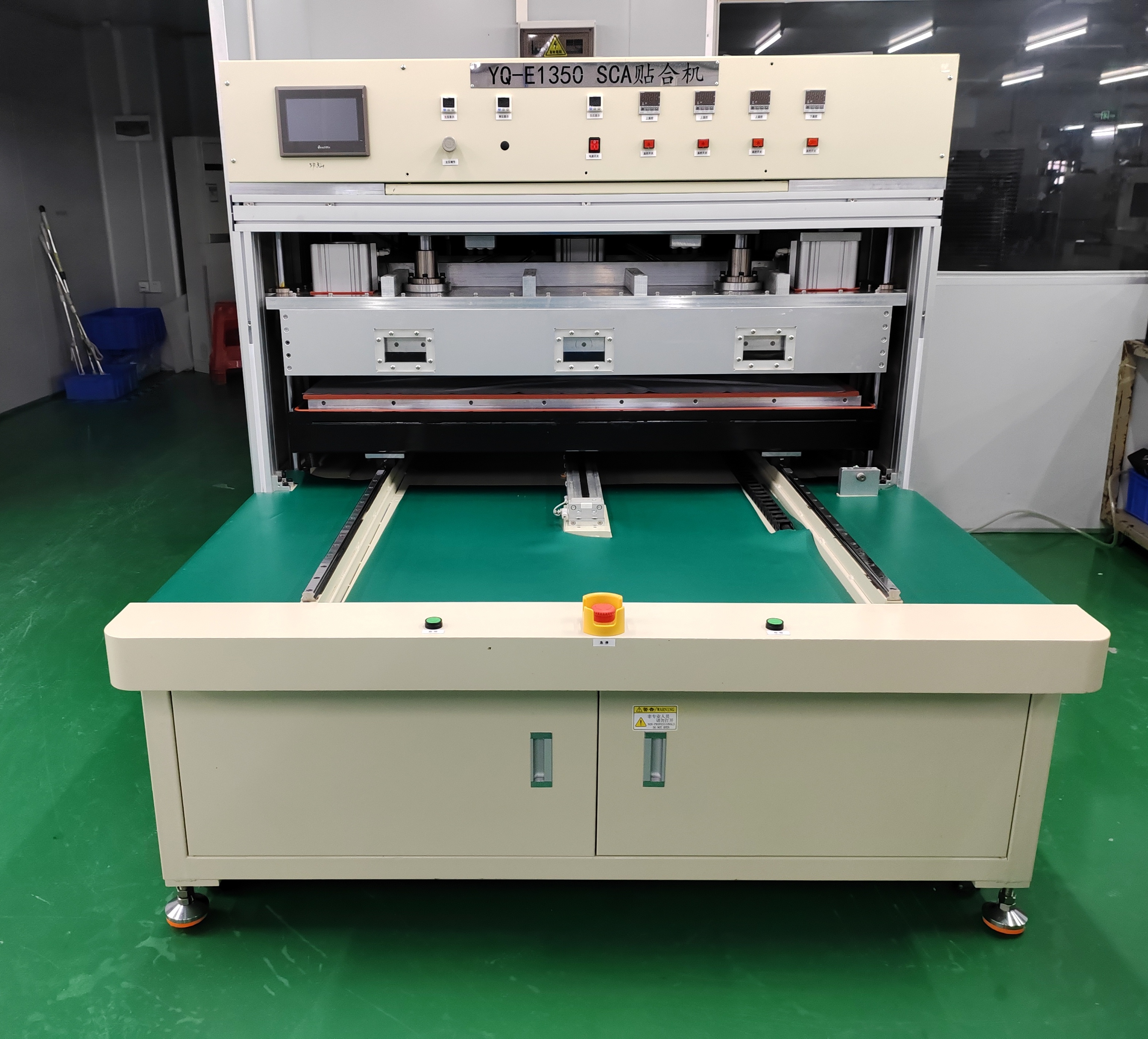
Optical bonding equipment used to laminate the touch panel to the display stack — the step that determines contrast, dust resistance and long-term delamination risk.
Why the Category Keeps Expanding
Capacitive technology is no longer the premium alternative to resistive touch — it is the default. According to market research published by Business Research Insights in 2026, capacitive touch modules held nearly 71% of touch screen module market value in 2025, while resistive modules accounted for about 19%. The remainder is split across other sensing approaches.
The wider commercial touch display market is also forecast to grow rather than consolidate. Future Market Insights projects the commercial touch display market to move from USD 6.9 billion in 2025 to USD 16.3 billion by 2035, a compound annual growth rate of approximately 9.0%. Growth of that shape is normally driven less by consumer replacement cycles than by equipment digitisation: more machines, terminals and instruments now carry an interactive front panel where a membrane keypad or a passive display used to sit.
For buyers, the strategic reading is straightforward. Capacitive modules are mainstream enough that pricing and supply are competitive, but the 19% still held by resistive modules signals something important: a meaningful share of industrial demand cannot be served by standard capacitive glass at all. That residual demand — thick gloves, heavy oil, single-point operation under contamination — is where the selection decision actually begins.
Capacitive or Resistive? The Decision That Comes First
Before a buyer compares suppliers, the buyer has to compare sensing technologies. The two are not interchangeable, and choosing the wrong one cannot be corrected later by adjusting brightness or adding a coating.
Resistive touch works by physical pressure closing a gap between two conductive layers. It accepts a hard stylus, works through very thick work gloves, and tolerates heavy oil contamination and liquid splashing. It is also, generally, the lower-cost option. The trade-offs are single-point operation, lower optical performance, and a softer, recessed front surface.
Projected-capacitive touch detects a conductive object without requiring force. That yields multi-touch gestures, better display performance, a flush and flat front surface, longer service life under high-frequency interaction, and better behaviour in bright ambient light. The trade-offs are sensitivity to very thick or heavily insulated gloves, and a greater need to manage water films, false triggering and electromagnetic interference at the design stage.
| Operating condition | 5-wire resistive is usually preferred | Projected capacitive is usually preferred |
|---|---|---|
| Glove use | Heavy-duty work gloves, hard-object pressing | Bare hand or thin-glove operation |
| Contamination | Heavy oil contamination, dust, splashing liquid | Cleaning-oriented surfaces with flush sealing |
| Interaction model | Single-point operation only | Multi-point gestures, curve and drawing review |
| Environment | Budget-sensitive, tolerant of a recessed front | High-brightness workshops, outdoor strong light, long service life, flat appearance |
A single piece of equipment can require both. Medical device manufacturers, for example, typically specify capacitive modules for imaging and monitoring equipment that demands gesture control and repeated disinfection, while retaining resistive modules for simple bedside controllers and handheld detectors operated with thick nitrile gloves on a limited budget. That split is a rational engineering decision, not a technology preference.
The Specifications That Decide Field Performance
Once the sensing technology is settled, six specification layers determine whether a capacitive touch display module survives its application.
Bonding. OCA full lamination (G+G full lamination) fills the gap between the touch panel and the display, which raises contrast, removes an air gap, and reduces dust and fogging between layers. Frame bonding is an alternative that lowers cost but retains an air gap, with the optical and contamination consequences that follow. Buyers should treat these as two distinct price/performance tiers rather than as a manufacturing detail.
Surface treatment. AF (anti-fingerprint), AG (anti-glare) and AR (anti-reflection) treatments can be combined, and each addresses a different complaint: smeared fronts on self-service terminals, reflected ceiling lighting on factory HMIs, and washed-out images under strong sunlight.
Brightness. Module brightness in the reference configurations ranges from 700 cd/m² to 1000 cd/m², with the larger 21.5-inch format offered across multiple brightness options — standard 300 cd/m², and high-brightness versions at 500, 700 and 1000 cd/m² — so that indoor cabinets and semi-outdoor enclosures can be served from the same platform.
Temperature range. Modules in this class are specified for operation from -20°C to +70°C and storage from -30°C to +80°C, with wide-temperature variants intended for harsh workshop, cold-chain and charging-pile scenarios.
Sealing and impact. IP68 protection and IK10 impact resistance are specified across the range, with IK10 customizable according to project requirements. The IK10 threshold is worth understanding rather than quoting: under IEC 62262, IK10 requires an enclosure to withstand an impact energy of 20 joules, equivalent to a 5 kg object dropped from 40 cm.
Electrical and interface behaviour. ESD protection can be specified to meet industrial EMC requirements, which matters in workshops with strong electromagnetic interference. Driver electronics are available with MIPI, LVDS or HDMI interfaces on the 21.5-inch platform, and the capacitive panels support Android, Linux and Windows operating systems — a detail worth confirming early, because it determines integration effort more than the panel itself does.
Where These Modules Are Actually Deployed
Capacitive touch display modules of this type are used in industrial control equipment, automation equipment, environmental protection equipment, medical devices, smart home devices, self-service intelligent service equipment and new energy equipment. Typical physical integration points include all-in-one enclosures, open frames, self-service cabinets and medical trolleys.
The operating conditions behind those categories are concrete. Industrial control and automation equipment runs continuously, often 24/7, in wide-temperature, high-humidity and dusty environments, and requires glove touch support, stable touch without drift, single-point priority, anti-false-touch logic, high precision, vibration and shock resistance, plus EMC and ESD performance. Self-service terminals add a different constraint set: resistance to water stains and rain interference, tolerance of bare-hand, wet-hand and thin-glove operation, low drift, protection against violent false triggering, touch-lock support, and IP67/IK08-class sealing expectations. Medical equipment adds repeated disinfection, resistance to volatile and corrosive liquids, non-porous surfaces that do not encourage bacterial growth, and high coordinate stability. New energy equipment adds anti-condensation behaviour, damp-heat ageing resistance and high brightness.
Because these requirement sets differ so much, a module purchased for one segment rarely transfers cleanly to another. That is the strongest argument for specifying against the application environment rather than against a generic “industrial grade” label.
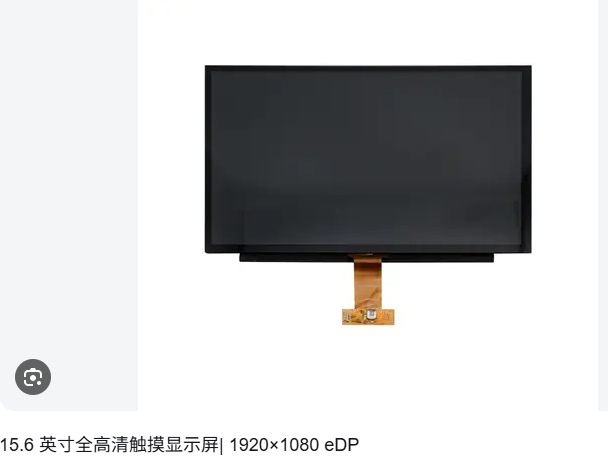
15.6-inch capacitive touch display module, model XRCGG156-0186-A0 — G+G glass lens, 1920 × RGB × 1080, 1000 cd/m², operating range -20°C to +70°C.
A Reference Set of Module Configurations
Guangzhou Xiangrui Optoelectronics Technology Co., Ltd. — trading as Xiangrui Optoelectronics — is a touch screen and touch display module manufacturer based in Guangzhou, China, developing, producing and customising resistive touch screens, capacitive touch screens, touch panels, touch screens and touch display cover glass. Its published module range illustrates how the specification layers above combine in practice.
| Model | Size | Resolution | Brightness | Operating temperature |
|---|---|---|---|---|
| XRCGG070-0108-TPM-D1 | 7.0-inch TFT | 1024 × RGB × 600 | 700 cd/m² | -20°C to +70°C |
| XRCGG101-0340-R1 | 10.1-inch TFT | 1280 × RGB × 800 | 800 cd/m² | -20°C to +70°C |
| XRCGG133-0040-OB-A0 | 13.3-inch TFT | 1920 × RGB × 1080 | 1000 cd/m² | -20°C to +70°C |
| XRCGG156-0186-A0 | 15.6-inch TFT | 1920 × RGB × 1080 | 1000 cd/m² | -20°C to +70°C |
| XRCGG215-0106-A0 | 21.5-inch TFT | 1920 × RGB × 1080 | 1000 cd/m² | -20°C to +70°C |
All five models share a G+G glass lens construction and a -30°C to +80°C storage range. The 21.5-inch module carries a standard 16:9 Full HD active area, a format that matches the cutouts of most all-in-one enclosures, open frames, self-service cabinets and medical trolleys, and reduces the structural development work a buyer would otherwise have to fund. It also offers 10-point multi-touch, optional thin-glove touch support, combinable AF/AG/AR surface treatments, and ESD protection for industrial EMC environments.
The manufacturing context behind that range is a 5,000 m² facility, approximately 60 employees including 15 engineers, and a reported annual production capacity of 300,000 units. The company holds ISO 9001 and ISO 14001 certification and National High-Tech Enterprise status, and reports 16 utility model patents. Engineering support covers product customisation, technical evaluation, design optimisation and application-specific touch solutions, including OEM and ODM-style customisation against equipment design, interface requirements and application environment.
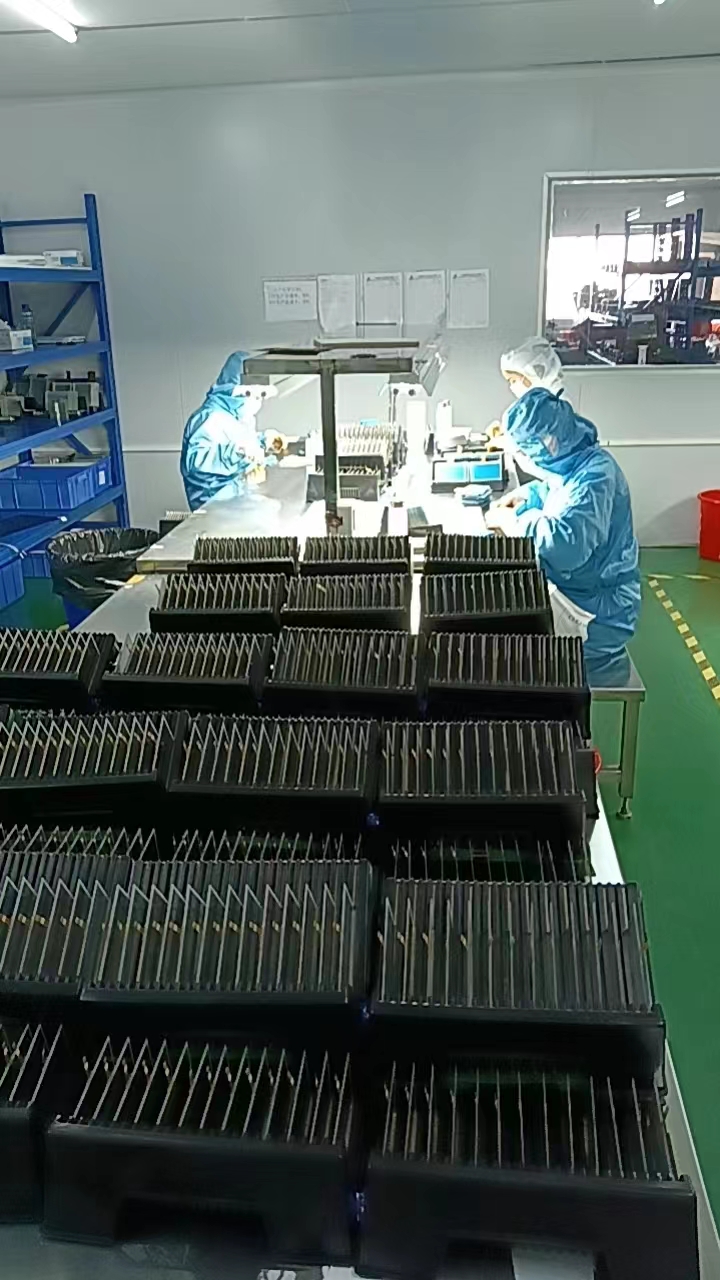
Final quality control on touch display modules. Inspection scope and sampling plan are among the points buyers should agree before volume release.
Where Capacitive Modules Stop Being the Right Answer
A credible sourcing decision includes the boundary conditions. Capacitive touch is the majority technology, but it is not universally the correct one, and buyers should be suspicious of any supplier that presents it as such.
The first boundary is glove thickness and contamination. Where operators wear heavy-duty work gloves, press with hard objects, work under heavy oil contamination or consistent coolant splashing, and only need single-point input on a tight budget, a 5-wire resistive touch screen remains the more appropriate choice. Capacitive sensing depends on a conductive coupling through the front surface, and no amount of tuning fully removes that physical constraint.
The second boundary is the bonding trade-off. OCA full lamination delivers the optical and sealing benefits described earlier, but it is the higher-cost tier. Buyers who select frame bonding to hit a cost target accept an air gap and the optical and contamination behaviour that comes with it. That is a legitimate decision as long as it is made deliberately.
The third boundary is customisation scope. IP68 and IK10 are specified across the range, but IK10 is customisable, meaning the final grade is a project-level agreement rather than an automatic property of every unit. Glass cover thickness is similarly customisable, up to a maximum of 10 mm — beyond that, the request falls outside the standard capability. And lead times depend on product specification and order quantity, so a quoted figure should always be tied to a defined configuration.
A Short Procurement Checklist
Reduced to a sequence, the research-stage questions look like this: confirm the sensing technology against glove, contamination and interaction requirements; define the bonding method and accept its cost consequence; select brightness against the actual ambient light level rather than a preference; confirm the operating and storage temperature range against the installation environment; agree the sealing and impact grade explicitly, including whether IK10 is required as standard or as a customisation; confirm the interface (MIPI, LVDS or HDMI) and the host operating system; confirm the cover glass thickness and any surface treatment combination; and only then compare quotations, because a quotation is only comparable against a defined specification.
Outlook
Two directions look durable. The first is ruggedisation of the capacitive platform itself — wider temperature operation, higher sealing grades, impact resistance and ESD capability migrating from premium options into standard configurations, because the equipment categories driving market growth are industrial and semi-outdoor rather than consumer. The second is configuration flexibility: as the commercial touch display market expands toward the forecast size described by Future Market Insights, buyers increasingly expect a module platform to cover several brightness tiers, bonding methods and surface treatments without a full custom development cycle each time.
For sourcing teams, the practical implication is that supplier evaluation should focus less on whether capacitive technology is offered — almost everyone offers it — and more on how precisely a supplier can define, document and repeat a configuration across production batches.
FAQ
Should capacitive or resistive touch be chosen for the HMI of industrial control equipment?
Where heavy-duty work gloves are required, hard objects are used for pressing, heavy oil contamination, dust and splashing liquid are present, only single-point operation is needed and the budget is constrained, a 5-wire resistive touch screen is preferred. Where multi-point gestures are needed, display performance matters, a flat appearance is required, interaction frequency is high, or the unit operates in outdoor strong-light conditions, an industrial-grade projected-capacitive touch screen is the appropriate choice.
What operating systems do capacitive touch panels support?
The capacitive touch panels support multiple operating systems, including Android, Linux and Windows. Specific integration details should be confirmed with the supplier for the exact configuration.
Is there a thickness limit for the glass cover plate of the touch screen?
Yes. The thickness of the glass cover plate can be customised, with a maximum thickness of 10 mm.
Should resistive or capacitive touch screens be selected for medical devices?
Capacitive screens are generally preferred for new-generation medical equipment such as monitors, ultrasound devices, high-end ventilators and medical self-service terminals. Resistive screens are generally preferred for simple bedside controllers and portable handheld detectors that require operation with thick gloves, frequent splashing of disinfectant and basic single-point operation.
For readers who need the full configuration detail rather than the summary above, Xiangrui Optoelectronics publishes its English-language company brochure as a downloadable reference.
Есть вопросы или нужны дополнительные детали?
Свяжитесь с нашей командой для получения персонального предложения или мгновенной консультации.
Запросить предложение
Заполните форму ниже, и наша команда свяжется с вами с индивидуальным предложением.
Прямой чат WhatsApp
Предпочитаете общаться в реальном времени? Напишите нам в WhatsApp для мгновенной помощи и быстрых ответов.
- Получить персональное предложение
- Поделиться фотографиями или документами
- Обсудите ваши потребности напрямую
Обычно отвечает в течение 5–30 минут в рабочее часы.