
Custom Card Game Orders: MOQ, Payment and Acceptance Criteria
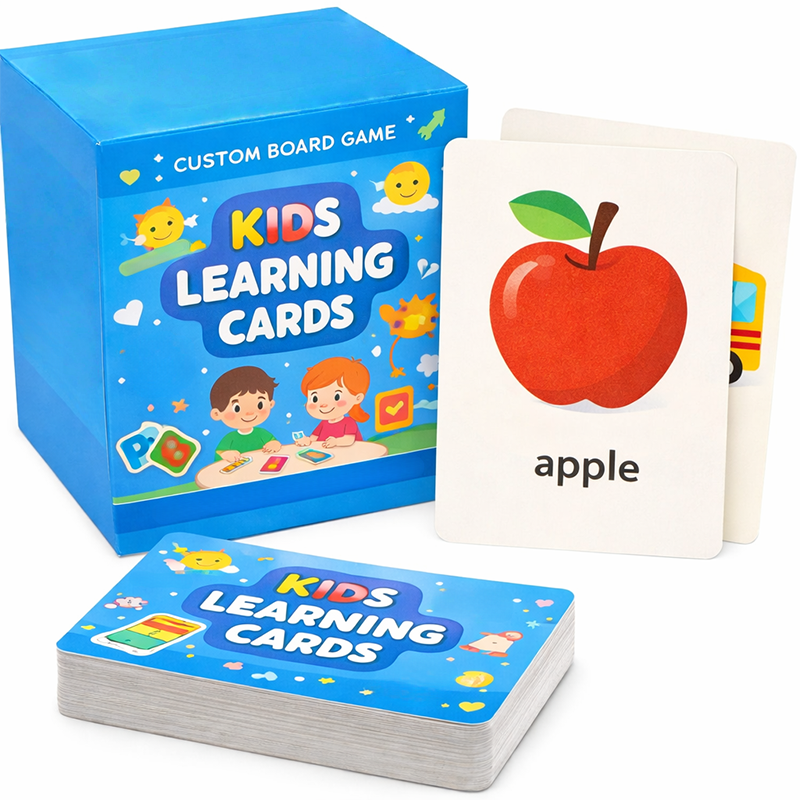
A custom deck is judged on its commercial terms as much as on its artwork: card count, paper weight, finish, and the inspection criteria attached to shipment.
Custom card game sourcing rarely fails on artwork. It fails on terms: a deck count that was never defined, a balance payment released before inspection, a certificate promised for one site and issued for another. The questions that decide whether a deck order lands cleanly are the same ones experienced buyers ask before the first proof is approved: minimum order quantity, payment structure, delivery term, acceptance criteria, and the scope behind each compliance document.
The category is large enough that these questions are now routine rather than specialist. Grand View Research sizes the combined playing cards and board games market at USD 19.9 billion in its 2024 base year, with Asia Pacific holding a 39.5% revenue share in 2024. Custom Market Insights, working with a narrower trading-card-game definition, projects that segment at USD 14.12 billion for 2025. The two figures rest on different product scopes and should not be added or compared directly, but they support one practical observation: a high share of decks sold into Western markets are printed in Asia, which means most buyers are negotiating across borders, currencies and legal systems.
Distance is exactly why procurement language matters. Once production starts, the only things a buyer can hold a supplier to are the written terms, the approved specification, and the certificates that can be traced back to a registry.
The reference case used in this article
Vietnam Yawanhong Printing Culture Co., Ltd. (Yawanhong) is a printing and manufacturing company based in Hai Phong City, Vietnam, established on 5 December 2006. The company produces board games, card games, puzzles, notebooks, colour boxes and publications across a 55,000 m² facility with 280 employees and a 25-engineer R&D team, and exports to markets including the United States, Europe and Asia. Its custom card game product line is listed under model CG-001.
The terms below are the ones Yawanhong publishes for custom card game work. They are presented as a worked example of a complete answer set, not as an industry benchmark: the purpose is to show what a buyer should expect to see written down, and which parts of a supplier's answer still need to be confirmed in the quotation.
1. Minimum order quantity: 1,000 units per custom deck
Yawanhong states a minimum order quantity of 1,000 units for custom card game production. That figure is the threshold at which the fixed costs of a run — printing plates, die cutting tools, paper purchase and machine set-up — can be absorbed across enough decks to keep unit pricing rational.
How the MOQ interacts with capacity and lead time
The same capability statement lists a monthly capacity of 80,000 units and a lead time of 25–45 days. The company's separately published annual output of 1,000,000 units is broadly consistent with that monthly figure. Read together, a 1,000-unit order represents roughly one and a quarter percent of a month's stated output: small enough to be scheduled alongside larger runs, but still subject to the same tooling and material lead times as any other job.
Where a 1,000-unit floor does not fit
A 1,000-unit minimum excludes several legitimate use cases. Market tests of 200–300 decks, single-event promotional decks, and prototype rounds for crowdfunding campaigns sit below this threshold and generally require short-run digital printing instead. Buyers in that position have two options: aggregate several SKUs into one production order, or accept a different supply route for validation and return to volume production once demand is confirmed.
One detail deserves explicit confirmation in the quotation: whether the 1,000-unit minimum applies per design or per order. A publisher launching three decks simultaneously will want that stated in writing before comparing quotes, because it changes the commercial picture considerably.
2. Payment terms: 30/70 T/T
Yawanhong documents payment on a 30/70 T/T basis — a 30% deposit with the 70% balance settled by telegraphic transfer. The deposit exists for a structural reason: paper, board and tooling are committed before the first sheet is printed, and a card game run is difficult to resell if the buyer withdraws after materials are cut.
What the headline split does not settle is the trigger for the balance. Three points should be agreed in the sales contract rather than in email:
- Balance release condition. Whether the 70% becomes due on presentation of a pre-shipment inspection report, on production completion photographs, or against the bill of lading. Paying the balance before inspection removes the buyer's last point of leverage.
- Bank charges and currency. Whether charges are shared (SHA) or borne by the remitter (OUR), and which currency the invoice is denominated in. On a multi-SKU order, wire fees and FX spread can be material.
- Deposit treatment if artwork stalls. If files arrive late or proofs cycle repeatedly, the point at which the deposit is consumed by committed materials should be written down in advance.
A payment schedule is only as strong as the inspection clause attached to it. A 30/70 split with a defined pre-shipment inspection gate protects both sides better than a 20/80 split with no acceptance criteria at all.
3. Delivery terms: FOB and CIF
Yawanhong quotes delivery on FOB and CIF terms. The distinction matters more than the price difference it produces, because it determines where risk passes.
Under FOB, the seller delivers the goods on board the vessel at the named port of shipment, and risk passes to the buyer at that point. The buyer arranges and pays for ocean freight and insurance. Under CIF, the seller arranges and pays cost, insurance and freight to the named destination port, but risk still passes at the port of shipment — the seller's insurance obligation is minimum cover, so buyers shipping high-value or time-critical cargo often prefer to insure on their own open policy.
Printed cards are heavy relative to their value, which makes freight configuration a real cost driver. Before confirming a CIF or FOB quote, ask for carton dimensions, decks per carton, cartons per pallet and gross weight, then check whether the quoted freight assumes full-container or less-than-container loading. Disputes over destination terminal handling charges are common under CIF and are best resolved before the order is placed.
4. Acceptance criteria: what a buyer is entitled to inspect
Yawanhong lists 100% testing as its quality-control approach. That is a statement about process, not a product specification, and it does not by itself tell a buyer what will be measured. Acceptance criteria have to be countable, agreed before production, and attached to the balance payment.
A pre-shipment acceptance framework
| Inspection point | What to measure | Why it matters |
|---|---|---|
| Deck composition | Card count per deck against the bill of materials; no missing or duplicated cards | A 54-card deck short by one card is a defect, not a rounding error |
| Print fidelity | Comparison against the signed-off proof under agreed lighting; Pantone references where spot colours are used | Colour drift is the most common source of rejection on illustrated decks |
| Cutting and registration | Border width equal on all four sides; corner radius matching the approved die | Uneven borders are visible on every card in the deck, not just one |
| Surface finish | Lamination adhesion, no lifting at edges, even UV or varnish coverage | Edge lifting appears after shuffling, often in the customer's hands |
| Core opacity | Light transmission test on a sample card held against a light source | A manufacturer-authored technical guide identifies black or blue opaque card cores as the benchmark for preventing light from showing through a card |
| Box and packaging | Fit and closure of the tuck or rigid box, shrink wrap, barcode placement, carton count and gross weight | Packaging faults create retail rejections that have nothing to do with the cards |
| Version control | Correct artwork version on the correct SKU | Multi-deck launches are where version mix-ups happen |
What "100% test" does not tell you
The phrase does not specify whether the test is a visual check, a count check, a functional check, or all three; whether records are retained per batch; or what defect rate triggers rework. Buyers should request the quality-control checklist, the sampling plan used for the final inspection, and the inspection record from the previous two production runs in the same product category. A supplier who can supply those documents is describing a system; one who cannot is describing an intention.
5. Certifications: four documents, four different jobs
Yawanhong provides four compliance references for its manufacturing operation: ISO 9001:2015 (certificate 710925), SMETA (ZAA600202718), BSCI (26-0387346), and FSC chain of custody (ESTS-COC-241865, FSC-STD-40-004 V3-1). Each covers a different question, and none of them substitutes for another.
| Document | Category | What it actually supports | Reference stated |
|---|---|---|---|
| ISO 9001:2015 | Quality management system certification | Evidence that a documented process system exists for production and corrective action | 710925 |
| SMETA | Sedex members ethical trade audit | Labour standards, health and safety, environment and business ethics at a named site | ZAA600202718 |
| BSCI | amfori social compliance audit | Social compliance performance, with an audit cycle and follow-up actions | 26-0387346 |
| FSC chain of custody | Forest fibre certification | Traceability of certified wood fibre through the supply chain to the finished printed product | ESTS-COC-241865; FSC-STD-40-004 V3-1 |
Reading scope rather than logos
A quality management certificate confirms that processes are documented; it does not certify a product, and it does not prove a print tolerance or a paper weight. A SMETA or BSCI audit addresses working conditions at a specific site on a specific audit cycle, and the report will carry corrective actions that may still be open. An FSC chain-of-custody certificate covers the flow of certified fibre for defined product categories at defined sites — it says nothing about ink chemistry or child-safe edge treatment, which are separate questions.
Market access sits outside this set entirely. In the United States, ASTM F963-23 is the mandatory toy safety standard, covering mechanical, chemical and flammability testing for products intended for use in play by children, which includes card games. European buyers typically ask for EN 71 test reports. These are test reports tied to a specific product and production batch, not company-level certificates, and they should be requested as documents with a laboratory name and a test date attached.
Verifying a certificate in a single working session
- Look up each reference number on the issuing registry: the certification body for ISO 9001, the FSC public certificate database for chain of custody, Sedex for SMETA, amfori for BSCI.
- Confirm the legal entity named on the certificate matches the entity on the sales contract.
- Confirm the manufacturing site listed in the scope matches the address the goods will ship from — for Yawanhong, the Nghia An Industrial Cluster site in Hai Phong City.
- Check validity dates and, for social audits, the audit cycle and any open corrective actions.
- Confirm the product category in scope covers printed paper games rather than, for example, packaging only.
Certification, social audit and licensing approval are different evidence types and should never be presented as one combined compliance level. Buyers who verify each document separately avoid the most common sourcing error in this category: accepting a bundle of logos as proof.
6. What a comparable RFQ must contain
Quotes for custom card games are frequently incomparable because each supplier answers a different question. The specification fields documented for Yawanhong's CG-001 line provide a usable template; issuing the same table to every supplier makes responses comparable line by line.
| RFQ field | Documented options (CG-001) |
|---|---|
| Card size | Custom |
| Material | Coated paper, art paper |
| Paper weight | 128–400 gsm, or custom |
| Printing | CMYK four-colour, Pantone colour printing, or custom |
| Corner style | Round corner, square corner, or custom |
| Surface finish | Matte lamination, gloss lamination, linen, UV coating, varnishing, or custom |
| Card edge | Standard, coloured, gold foil, or custom |
| Customisation scope | Material, size, colour, logo and packaging; OEM/ODM production |
| Order terms | MOQ 1,000 units; lead time 25–45 days; monthly capacity 80,000 units; 100% test quality control |
| After-sales | Remote support |
A quote that omits paper weight, card count, finish and packaging format is not a quote — it is a starting position. Adding three further lines to the RFQ closes most of the gap: the destination market and age group the deck is intended for, the compliance documents required at delivery, and the delivery term with a named port.
7. How the deck's purpose changes the specification
Custom card game covers a wide product family, and the same factory line produces very different objects depending on who will play with them. Yawanhong's card game production runs in a normal-temperature, dust-free indoor workshop environment, supported by equipment that includes a Heidelberg printing press, automatic laminating machine, varnishing machine, gliding press, embosser and die cutting machine. Which of those processes a deck actually needs is decided by its end use.
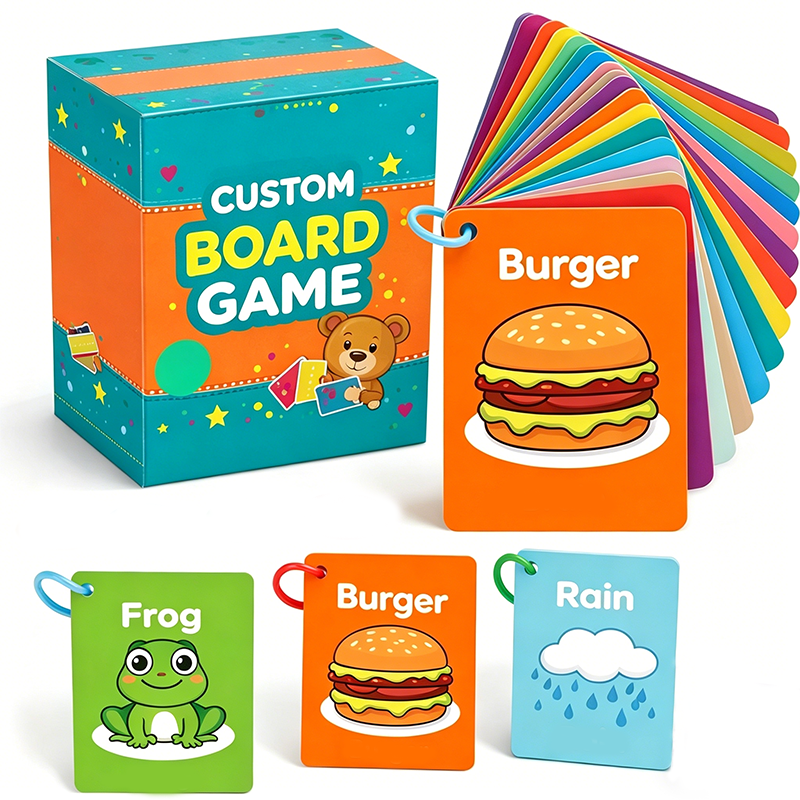
Decks aimed at children carry additional specification requirements: rounded corners, non-toxic ink and certified paper stock, documented through test reports rather than brand claims.
- Kids card games. Rounded corners, child-safe edge treatment, non-toxic ink, eco-friendly paper and FSC-compliant raw materials are the relevant requirements here, supported by EN 71 or ASTM F963-23 test reports for the destination market.
- Party games, adult card games and drinking games. Opacity and surface durability matter more than edge decoration. A linen or matte finish resists fingerprints and glare across a long evening of play, and an opaque core prevents held cards from being read from behind.
- Tarot cards. Larger formats, image fidelity on illustrated faces and premium edge treatments such as gold foil matter more than high-volume economies, and the heavier end of the 128–400 gsm range is typically specified.
- Travel games. Compact formats and lighter stock reduce weight and pack size, but the deck still needs to survive repeated shuffling in a bag — finish selection is the usual compromise point.
- Family games, couples card games and poker cards. Standard poker dimensions, accurate card counts and consistent cutting registration dominate; these are the decks where a single miscut card is most visible in play.
A manufacturer-authored guide benchmarks 300 gsm as a standard for custom playing cards, which places most commercial decks in the middle of the documented range rather than at either extreme. The practical rule is that the deck's play pattern, not its price, should drive the specification — then cost is optimised within a specification the buyer has consciously chosen.
8. Lead time: what 25–45 days includes and excludes
The 25–45 day lead time refers to production. It does not include the sampling round, and it does not include ocean transit, port handling or customs clearance at destination. The single most useful question a buyer can ask is where the clock starts: from deposit receipt, from artwork approval, or from proof sign-off. On a fully illustrated deck with foil edges, a two-week spread between those three starting points is entirely normal.
Two further clarifications are worth requesting in writing. First, whether the stated capacity of 80,000 units per month is measured in single decks or in packed game units — a figure that looks generous in decks can be considerably tighter once boxes, inserts and shrink wrap are included. Second, whether peak-season scheduling affects the upper end of the lead-time window, and at what order size a booking should be placed to protect a fixed retail launch date.
Comparison: offshore OEM runs versus local short-run printing
Neither route is universally correct. The comparison below uses general characteristics of each supply model alongside the documented terms of the Yawanhong reference case.
| Aspect | Local or short-run digital printing | Offshore OEM at 1,000+ units |
|---|---|---|
| Typical batch size | Hundreds of decks, single or few SKUs | 1,000 units upward per production order |
| Tooling | Minimal set-up cost | Plates and dies amortised across the run |
| Transit time | Days by road | Weeks by sea, plus port and customs time |
| Finishing depth | Core finishes, limited edge treatments | Lamination, linen, UV, varnish and coloured or gold-foil edges |
| Compliance documentation | Varies by printer; must be requested | Company-level certificates plus market-specific test reports, verifiable against registries |
| Best fit | Prototypes, market validation, events | Commercial launches, licensed lines, retail programmes |
The limits of the offshore model are worth stating plainly. A 1,000-unit floor rules out genuine market testing; the 25–45 day production window plus sea transit requires artwork lock earlier than a domestic run would; and after-sales is described as remote support, which means inspection has to happen before shipment rather than after the containers are opened in a warehouse. Buyers planning a fixed retail date should treat the lead time as the last step in a chain that begins with specification, not as the whole chain.
Market context: documentation is becoming the differentiator
Asia Pacific's 39.5% revenue share of the global playing cards and board games market in 2024 reflects production concentration as much as consumption. The same concentration is visible in how buyers structure supplier relationships: Yawanhong's case record describes a five-year OEM relationship with clients across the United States, Germany, the Netherlands, Spain, France, Italy, the United Kingdom, Japan and South Korea, at volumes of around 10,000 units for online sales, with reported consistency in print clarity, cutting neatness, structural sturdiness and eco-friendly material use. The stated highlights of that relationship — fully customised artwork and sizing, child-safe rounded edge treatment, FSC certified raw materials, and one-stop printing and packaging — describe the bundle buyers increasingly expect from a single supplier rather than from three.
The procurement implication is straightforward. As suppliers consolidate, the qualification work moves from comparing factories on price to comparing documentation on scope: which site is certified, which product category sits inside the FSC scope, which test reports exist for the exact deck being ordered, and which of those documents will still be valid at the shipping date.
Future outlook
Three developments are likely to shape custom card game procurement through 2027. Registry-verifiable compliance is becoming the default expectation, with buyers checking certificate numbers directly rather than accepting scans, and suppliers responding by publishing scope statements alongside logos. Specification standardisation is likely to follow, as buyers issue the same RFQ template across multiple factories and push suppliers to state unit definitions, defect thresholds and inspection sampling in their quotations. And compliance documentation is increasingly moving to the product level, where a company certificate establishes eligibility to quote while a batch-specific test report establishes eligibility to ship.
None of this changes the underlying economics of a printed deck. It changes what a buyer needs on file before releasing the balance payment — and that is where sourcing outcomes are actually decided.
Frequently asked questions
What is the minimum order quantity for a custom card game?
Yawanhong states a minimum order quantity of 1,000 units for custom card game production. The figure should be confirmed as applying per design or per production order, since a buyer launching multiple decks at once will face a different total. Orders below 1,000 units are generally served by short-run digital printing rather than offset production.
What payment terms apply to a custom card game order?
Yawanhong documents a 30/70 T/T structure: a 30% deposit with the 70% balance paid by telegraphic transfer. The contract should state precisely what triggers the balance — a pre-shipment inspection report, production completion photographs, or the bill of lading — along with the currency, the treatment of bank charges, and the point at which the deposit is absorbed by committed materials if artwork approval is delayed.
Are FOB or CIF terms used for delivery?
Both are quoted. Under FOB, risk passes when the goods are on board at the named port of shipment and the buyer arranges freight and insurance. Under CIF, the seller arranges and pays cost, insurance and freight to the named destination port, while risk still passes at the port of shipment; the seller's insurance obligation is minimum cover, so buyers may prefer to insure separately. The named port, carton configuration and responsibility for destination terminal charges should all appear in the quotation.
How long does production take, and when does the clock start?
The stated production lead time is 25–45 days. That window refers to manufacturing and excludes sampling, ocean transit, port handling and customs clearance. Because the starting point — deposit receipt, artwork approval, or proof sign-off — materially changes the delivery date, it should be defined in the contract rather than assumed.
Which certifications should a buyer request, and what does each one cover?
Yawanhong provides ISO 9001:2015 (certificate 710925) for quality management systems, SMETA (ZAA600202718) and BSCI (26-0387346) for social compliance audits, and FSC chain of custody (ESTS-COC-241865, FSC-STD-40-004 V3-1) for certified fibre traceability. Market access is a separate matter: US buyers of children's products will require ASTM F963-23 testing, and European buyers typically require EN 71 test reports, both tied to the specific product and batch rather than to the company.
Can material, size, colour, logo and packaging be customised?
Yes. The documented customisation scope for the CG-001 line covers material, size, colour, logo and packaging, within an OEM/ODM production model. Available specification options include custom card sizes, coated or art paper at 128–400 gsm, CMYK or Pantone printing, round or square corners, matte or gloss lamination, linen, UV coating and varnishing, and standard, coloured or gold-foil card edges.
What should happen if a pre-shipment inspection fails?
The remedy should be written into the contract before production begins, not negotiated after a failed inspection. A workable clause defines the acceptance criteria in measurable terms, states who bears the cost of re-inspection, sets a deadline for rework or replacement, and links the balance payment to a passed inspection. Because after-sales support is remote, resolving defects before shipment is materially cheaper than resolving them after arrival.
Reference material
Facility details, production equipment and process descriptions for Yawanhong's board game and card game manufacturing operation are collected in the company's downloadable profile, available here: Yawanhong VN Group Global Manufacturing profile (PDF).
Есть вопросы или нужны дополнительные детали?
Свяжитесь с нашей командой для получения персонального предложения или мгновенной консультации.
Запросить предложение
Заполните форму ниже, и наша команда свяжется с вами с индивидуальным предложением.
Прямой чат WhatsApp
Предпочитаете общаться в реальном времени? Напишите нам в WhatsApp для мгновенной помощи и быстрых ответов.
- Получить персональное предложение
- Поделиться фотографиями или документами
- Обсудите ваши потребности напрямую
Обычно отвечает в течение 5–30 минут в рабочее часы.