
Custom Casual Apparel Comparison: 360g Hoodies vs 280g Long Sleeve Shirts
Two garments usually compete for the same slot in a first private-label order: a heavyweight hoodie and a high-elastic long sleeve shirt. Both are sold as custom casual apparel, both run through the same cut-and-sew lines, and both accept the same branding methods — screen printing, DTG, embroidery and heat transfer. Their real differences appear later, in fabric weight, stretch behaviour, size ceiling, seasonal positioning and stock depth, which are the variables that decide whether an item actually sells in a given market.
Lihongwear, the export-facing name of Guangzhou Lihong Apparel Trade Co., Ltd., is a Guangzhou-based menswear OEM/ODM supplier serving wholesalers, offline brands and cross-border e-commerce sellers. Its production base covers a 5,000 m² plant, more than 150 employees, an annual output of 500,000 pieces and roughly 80% of volume exported to Europe, the Americas, Southeast Asia, the Middle East and Australia.
This buyer-side comparison works from the published specifications of two programs in that range: the 360g hoodie (1901 Series) and the 280g high-elastic long sleeve shirt (1801/1701 Series). Every figure below traces to those specification sheets and to the supplier’s stated commercial terms. Where a boundary exists, it is stated as a boundary rather than smoothed over.
Why These Two Programs Get Compared
Buyers rarely weigh a hoodie against a long sleeve shirt on aesthetics alone. The two garments occupy overlapping roles inside the same casualwear line, which is why they so often end up in the same sourcing conversation.
- The hoodie works as an outer layer: structured, loose in the body, built around a double-layer composite for heat retention.
- The long sleeve works as a close-to-body layer: lighter, high-elastic, worn alone in warmer months or as a base under the hoodie.
- Both accept identical private-label treatments. Fabric weight, garment size, garment colour, front-and-back printing, embroidery logo, hangtag, wash label and packaging can all be specified.
- Both are produced for the same end channels: online store sales, offline supermarket retail, brand exclusive series and corporate workwear.
The overlap is widest in spring and autumn, when a buyer has to decide whether a single stock position should carry the heavier garment or the lighter one. That decision is usually better made on specification than on catalogue photography.
Spec Sheet Comparison: 1901 Series Hoodie vs 1801/1701 Series Long Sleeve
| Comparison point | 360g Hoodie (1901 Series) | 280g Long Sleeve (1801/1701 Series) |
|---|---|---|
| Fabric weight / type | 360g hoodie; double-layer composite | 280g high-elastic tech blend long sleeve shirt |
| Body composition | Mountain Cotton: 63.5% cotton, 36.5% polyester; lining 100% polyester | 79.7% polyester, 20.3% spandex; four-way stretch |
| Construction | Double-layer composite with polyester lining for heat retention | Single-layer four-way stretch knit; a separate 18 Series variant uses 280g high-elastic smooth polyester (100% polyester thin sweatshirt) |
| Stretch behaviour | Structure comes from the composite build, not from spandex | Four-way stretch; holds shape after repeated stretching, no shedding or snagging |
| Fit | Loose fit, plus-size friendly, sized to accommodate European and American body types | Slim fit without being tight; allows unrestricted movement |
| Size range | M–3XL | M–4XL |
| Surface behaviour | Stiff and durable; resistant to pilling and sagging after repeated washes | Smooth drape without wrinkles, no ironing required |
| Seasonal positioning | Worn alone in spring and autumn, or as an inner layer in winter | Lightweight and highly resilient; positioned for spring and summer |
| Typical role | Daily casual wear, outer layer, blank base for printing and embroidery | Daily casual wear, slim-fit inner layer, blank base for printing and embroidery |
| Custom MOQ | Custom orders start from 200 pieces per style; no minimum order for spot goods, with support for arbitrary mixed wholesale | |
| Lead time | Spot goods shipped within 3 days; custom orders 15–25 days from sample confirmation to bulk delivery | |
| Compliance reference | GB 18401-2010 Category B; fabrics supplied with CTI test reports | |
| Quality control | 7-stage quality control process executing AQL international standards; 100% manual inspection before shipment | |
What a 360g Double-Layer Composite Actually Does
The 360g figure describes a fabric weight, but the function of the 1901 Series hoodie comes from how that weight is assembled. The body uses Mountain Cotton at 63.5% cotton and 36.5% polyester, paired with a 100% polyester lining in a double-layer composite construction. The composite is what produces heat retention, and it is also why the garment can be worn as a single layer in spring and autumn and then as an inner layer once winter arrives.
The cotton base matters for skin contact: it is described as soft and non-irritating, while the fleece lining is designed to retain heat and to prevent the wearer from feeling cold once perspiration starts. The same construction supports the durability claims attached to the series — a stiff hand feel that resists pilling and sagging across repeated washes, with a loose cut that accommodates plus sizes and European and American body types. Breathability is part of the specification as well, which is why the range is positioned across mountaineering, hiking and everyday home use rather than only urban streetwear.
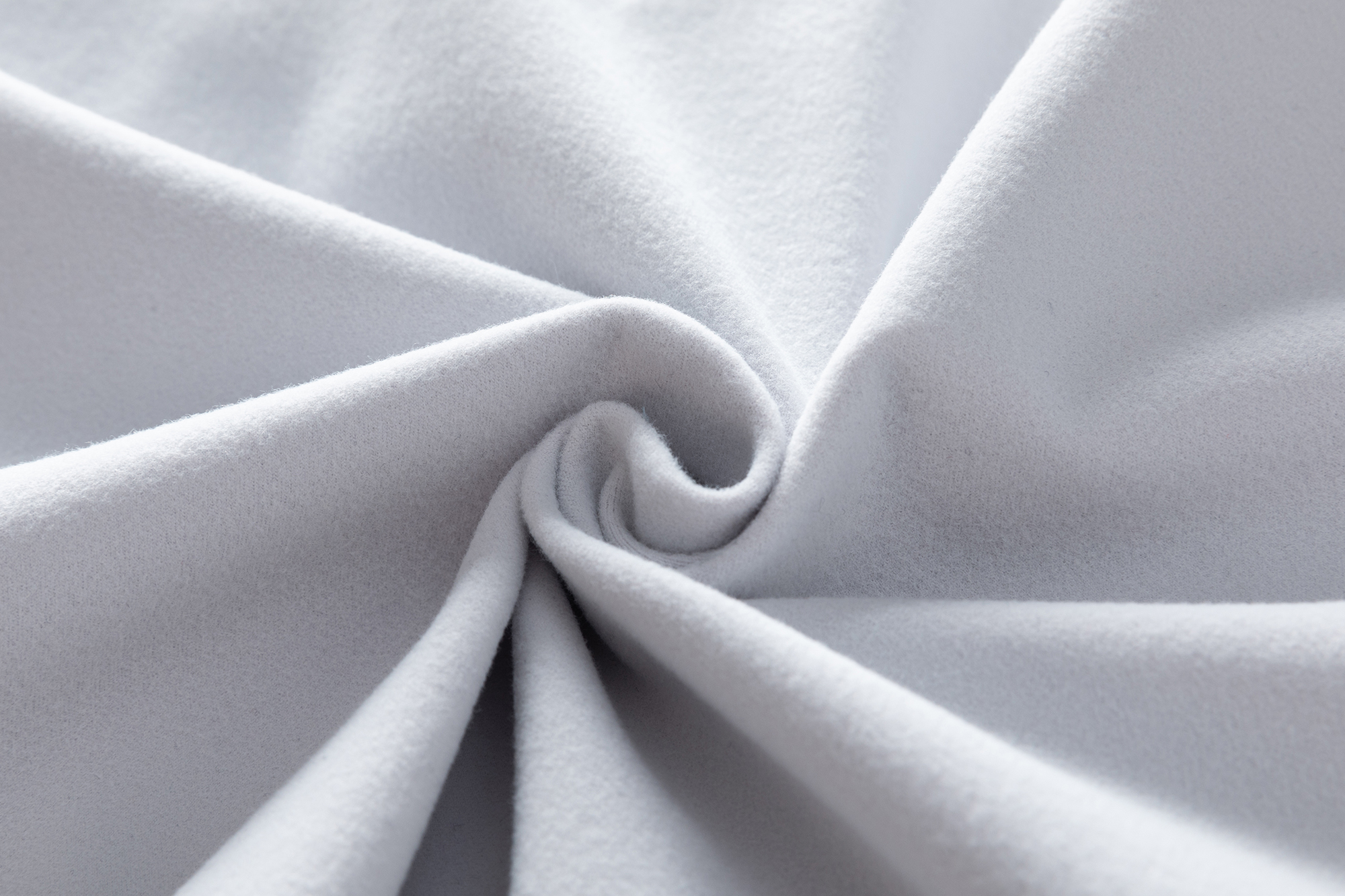
Double-layer composite construction shown in fabric fold detail — the 360g hoodie body, 1901 Series.
What 280g Four-Way Stretch Delivers
The long sleeve program solves a different problem. Its high-elastic tech blend is 79.7% polyester and 20.3% spandex, engineered as a four-way stretch knit. Stretch in four directions is what allows a slim fit without tightness: the garment follows movement instead of restricting it, which is why the specification frames it around unrestricted movement rather than around structure.
Behaviour over time is stated explicitly. Elasticity is described as long-lasting, holding shape after repeated stretching without shedding or snagging. The surface drapes smoothly without wrinkles and requires no ironing, which matters for buyers whose stock sits in storage before it reaches retail, and for end users who want an everyday garment rather than a maintained one. At 280g the fabric stays lightweight yet opaque, so it works as a standalone piece or as a base layer, and the quick-drying, breathable behaviour is positioned for daily commutes and light exercise rather than for thermal protection.
Buyers who want the weight without the spandex have a separate option inside the same family: the 18 Series uses 280g high-elastic smooth polyester, described as a 100% polyester thin sweatshirt. It keeps the weight profile of the long sleeve range while changing the fibre story, which is a meaningful distinction for markets that specify composition on the care label.
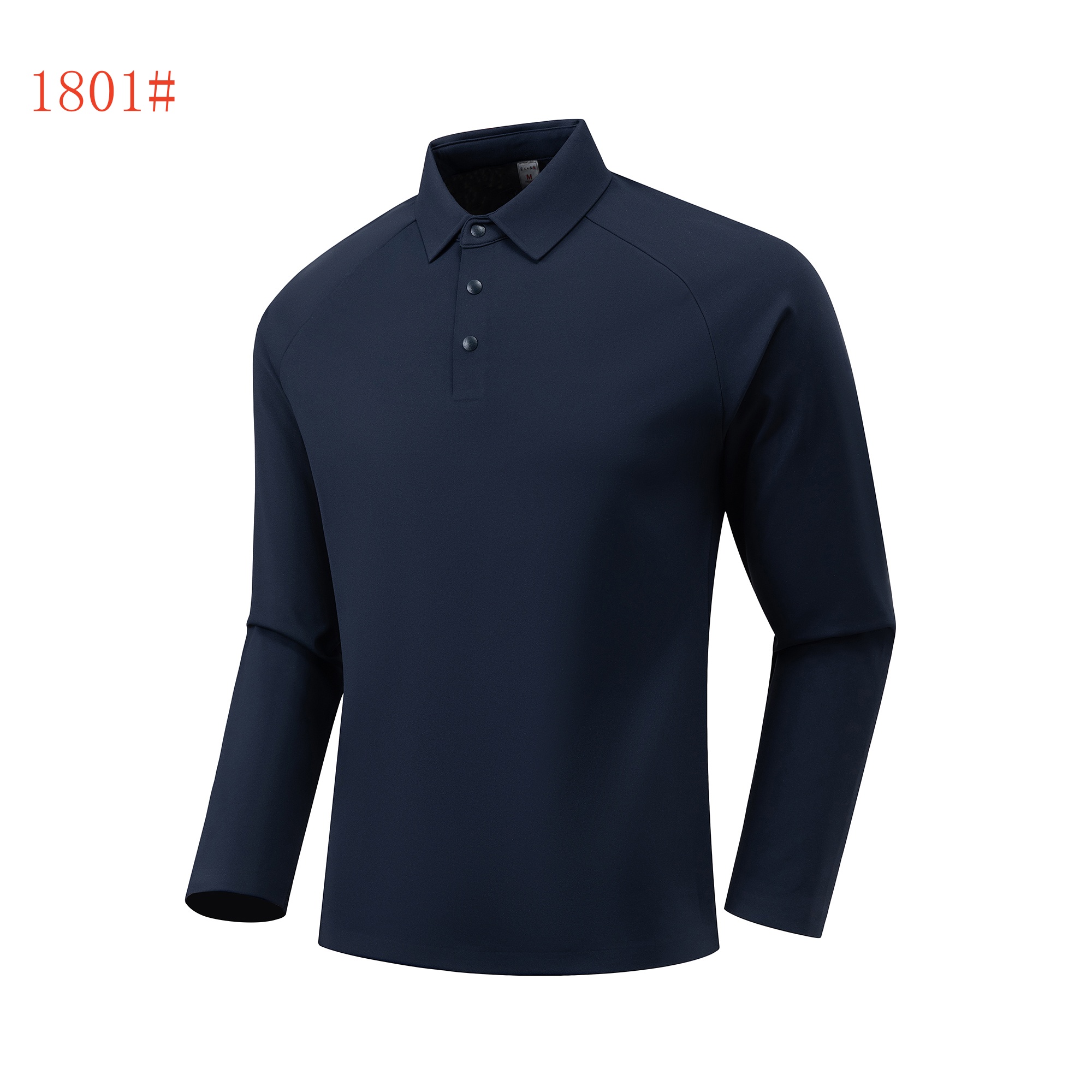
280g high-elastic four-way stretch long sleeve shirt — 79.7% polyester, 20.3% spandex, 1801 Series.
Fit and Sizing: M–3XL Loose vs M–4XL Slim-Stretch
The two programs do not share a size ceiling, and that gap is commercially relevant. The 1901 Series hoodie is offered in M–3XL with a loose fit; the 1801/1701 Series long sleeve is offered in M–4XL. Across the wider men’s basic apparel program the supplier runs XS–5XL, but for these two specific garments the stated ranges are M–3XL and M–4XL respectively.
In practice this means a buyer whose market generates demand above 3XL in a hoodie-shaped garment cannot meet that demand from the 1901 Series alone. Conversely, a buyer whose line depends on a close-fitting, stretch base layer gets one additional size at the top of the range from the long sleeve program. Sizing is therefore not a neutral comparison point — it is one of the two or three variables that can decide which program becomes the core item and which becomes the companion.
Purchasing Terms That Decide the First Order
Specification only becomes useful once commercial terms are attached to it. For both programs, the same terms apply, and they define two distinct routes rather than one.
| Commercial term | What it means for a buyer |
|---|---|
| Custom MOQ: from 200 pieces per style | Specification freedom — fabric weight, size, colour, printing, embroidery logo, hangtag, wash label and packaging can be set by the buyer |
| No minimum order for spot goods | Quantity is unrestricted and arbitrary mixed wholesale is supported, but specification is fixed to what is in stock |
| Spot lead time: within 3 days | Suitable for replenishing proven sellers or testing a market before committing to a custom run |
| Custom lead time: 15–25 days | Measured from sample confirmation to bulk order delivery, with a fully traceable production process |
| Standing stock: over 200,000 pieces, over 50 styles | Program-level depth rather than a guarantee that any single colour and size combination is available at the moment of enquiry |
| Capacity: 45,000 pieces monthly; 1,500 pieces daily; 500,000 pieces annually | Relevant when a buyer needs to plan repeat orders rather than a single shipment |
Certification and Quality Control: What to Verify, Not Assume
For both the 360g hoodie and the 280g long sleeve, the compliance reference is GB 18401-2010 Category B, and fabrics are supplied with CTI test reports. The stated fabric requirements include freedom from formaldehyde and no carcinogenic dyes, with colour fastness meeting standard. These are the documentable points a buyer can ask to see rather than infer from a swatch.
Quality control is structured rather than ad hoc. Production runs through a 7-stage quality control process executing AQL international standards, covering raw materials, processes and finished products, with 100% manual inspection before shipment. Third-party on-site inspection is supported, and the production process is traceable through video and photos. Order handling adds a dedicated order follower for one-to-one contact, an enquiry reply within 2 hours on business days, real-time production progress synchronisation, and quick handling of defect returns and exchanges for quality problems reported within 7 days of receipt.
This level of documentation is no longer an outlier in the wider industry. OEKO-TEX issued more than 50,000 certificates between 2023 and 2024, an increase of 22%, which the association itself reads as a sector-wide shift toward chemical safety and regulatory compliance. Buyers comparing suppliers can reasonably treat certification documentation as a baseline expectation rather than a differentiator, and instead compete suppliers on how quickly and consistently that documentation is produced.
Application Fit: Where Each Garment Earns Its Place
Both programs are used across online store sales, offline supermarket retail, brand exclusive series and corporate workwear. The industries served include cross-border e-commerce, clothing wholesale, trendy private customization, corporate group workwear and offline clothing retail. Operating conditions are stated as four-season daily wear with repeated washing, adapted to high-temperature and humid overseas climates and suitable for long-term warehousing.
The functional roles differ, and that is where the buying decision usually resolves:
- Daily casual wear: both qualify, but the hoodie carries the cooler half of the calendar and the long sleeve the warmer half.
- Blank base for printing and embroidery: both qualify, with the hoodie offering a structured, boxy surface and the long sleeve offering a smooth, wrinkle-resistant one.
- Slim-fit inner layer: this is the long sleeve’s specific role, supported by four-way stretch and a slim fit that is not tight.
- Brand image workwear and corporate group workwear: the long sleeve suits uniform and layering use, while the hoodie works as a branded outer layer in cooler seasons.
Packaging and trim can be aligned across both programs, since custom hangtags, wash labels, brand packaging bags and gift colour boxes are supported. For a brand launching a coordinated capsule, that consistency is often worth more than a marginal difference in unit specification.
Market Context Behind the Comparison
The two programs sit inside a category that is still expanding. Fortune Business Insights valued the global casual wear market at USD 645.22 billion in 2025 and projected USD 906.32 billion by 2034. Proficient Market Insights estimated that the custom made clothes market would reach USD 213.1 billion by 2035, at a CAGR of 10.5% from 2026. HTF Market Intelligence put the private label apparel market at USD 81.2 billion in 2024, growing to a projected USD 147.5 billion by 2033.
Those figures should be read with one caution: estimates for the custom apparel market vary widely depending on methodology. Third-party reviews show materially different values depending on whether made-to-measure tailoring or simple printing services are included, with published figures ranging from a few billion dollars for the printing segment to tens of billions for the broader custom-made clothing category. The direction of growth is consistent across sources; the absolute size is not. Buyers should therefore treat market size as context for category confidence rather than as a planning input.
Comparing Against Conventional Sourcing Routes — and Where These Programs Have Limits
Conventional sourcing usually forces a choice between three imperfect routes. Buying finished stock from a trading intermediary is fast but fixes the specification entirely. Committing to a large-volume custom order through an agent buys specification freedom but often at a higher minimum and with less visibility into the line. Domestic in-house production gives control but is generally uneconomic at trial volumes.
The dual-mode model behind these two programs — spot goods and custom production running from the same 5,000 m² plant — removes part of that trade-off, but not all of it. The limits are specific and worth stating plainly:
- The 200-piece custom minimum is a real commitment. A buyer testing six styles is committing to 1,200 pieces, not a sample run.
- Custom lead time starts after sample confirmation. The 15–25 day window cannot fill an immediate gap; only items held in standing stock can ship within 3 days.
- The hoodie stops at 3XL. Markets with meaningful demand above that size need a different garment or the wider men’s basics program, which runs XS–5XL.
- The 360g double-layer composite is a cool-weather construction. Where year-round heat and humidity dominate, the 280g four-way stretch long sleeve is the more appropriate core item, and the hoodie becomes a seasonal add-on rather than a volume driver.
- Standing stock figures are program-level. Over 200,000 pieces across more than 50 styles is a depth indicator; it does not guarantee that every colour and size combination is available at the moment a buyer enquires.
None of these points disqualify either program. They simply mean the right choice depends on season, size demand and how quickly the buyer needs the goods in hand — three questions that are easier to answer from a specification sheet than from a lookbook.
Future Outlook
Two pressures are likely to shape how these programs are compared in the near term. The first is weight transparency: as heavyweight construction becomes the visible marker of a premium casual piece, buyers will keep asking for grams per square metre and composition in writing rather than in marketing language. The second is documentation. With certification volumes rising across the sector, compliance paperwork is turning into a routine part of supplier evaluation in export markets, which favours suppliers that already hold test reports and clean production records.
A third shift is commercial rather than technical. Running a stocked line and a custom line from the same plant gives buyers a way to test a market cheaply — start with spot goods, then move a proven style to custom production once units justify it. For brands building a capsule around a hoodie and a long sleeve shirt, that sequence reduces the cost of being wrong about which garment the market actually wants.
FAQ
What is the minimum order quantity for these two custom casual apparel programs?
Custom orders start from 200 pieces per style. Spot goods carry no minimum order and support arbitrary mixed wholesale. The two routes therefore differ in what they restrict: the custom route fixes a quantity floor of 200 pieces per style in exchange for control over fabric weight, size, colour, printing, embroidery logo, hangtag, wash label and packaging, while the spot route leaves quantity unrestricted but fixes the specification to available stock.
How long does delivery take for a hoodie compared with a long sleeve shirt?
Lead time depends on the route rather than the garment type. Spot goods are shipped within 3 days. Custom orders take 15–25 days from sample confirmation to bulk order delivery. Both the 1901 Series hoodie and the 1801/1701 Series long sleeve shirt are covered by the same terms.
What size ranges are available for each program?
The 360g hoodie (1901 Series) is offered in M–3XL with a loose fit designed to accommodate European and American body types. The 280g high-elastic long sleeve shirt (1801/1701 Series) is offered in M–4XL with a slim fit that is not tight. The wider men’s basic apparel program spans XS–5XL.
How should a buyer decide between 360g and 280g for a specific market?
The decision is mostly seasonal and functional. If the selling season is cool to cold and the garment needs structure and drape, the 360g double-layer composite hoodie is the match, with 63.5% cotton and 36.5% polyester in the body and a 100% polyester lining for heat retention. If the market is warm to hot, or the garment is meant to sit close to the body under something else, the 280g long sleeve is the lighter option, with 79.7% polyester and 20.3% spandex in a four-way stretch knit. The two are not substitutes within the same season.
Which certification applies to these garments?
The products are covered by GB 18401-2010 Category B, and fabrics are supplied with CTI test reports. The stated fabric requirements include freedom from formaldehyde, no carcinogenic dyes, and colour fastness meeting standard.
What quality control evidence can a buyer request before shipment?
Production runs through a 7-stage quality control process executing AQL international standards, covering raw materials, processes and finished products, with 100% manual inspection before shipment. Third-party on-site inspection is supported, and production progress is traceable through video and photos.
What happens if defects are found after delivery?
Quality problems reported within 7 days of receipt are handled through a defect return and exchange process. Each order is assigned a dedicated order follower, and enquiries are answered within 2 hours on business days.
Есть вопросы или нужны дополнительные детали?
Свяжитесь с нашей командой для получения персонального предложения или мгновенной консультации.
Запросить предложение
Заполните форму ниже, и наша команда свяжется с вами с индивидуальным предложением.
Прямой чат WhatsApp
Предпочитаете общаться в реальном времени? Напишите нам в WhatsApp для мгновенной помощи и быстрых ответов.
- Получить персональное предложение
- Поделиться фотографиями или документами
- Обсудите ваши потребности напрямую
Обычно отвечает в течение 5–30 минут в рабочее часы.