
Custom Furniture for Five-Star Hotels: A Zone-by-Zone Project Specification Guide
Custom furniture for five-star hotels is not a single product decision. From guest rooms to ballrooms, each zone in a hotel imposes different structural, durability, fire-safety and aesthetic requirements, yet procurement teams often evaluate suppliers on a single generic capability. This guide defines what to ask for in each zone, how to translate design intent into technical specifications, and how to benchmark a manufacturer against the demands of a specific project.
A Hotel Is Not One Project, It Is Several
Project-fit assessment is most useful when it starts with a simple idea: guest rooms, public areas, restaurants, executive lounges, banqueting spaces and wine areas each place different demands on furniture. A sofa that performs well in a low-traffic suite may fail in a lobby; a banquet chair designed for occasional use may not survive daily conference operations.
For Research-to-Evaluation stage buyers, the practical question is not only whether a supplier can make bespoke furniture, but whether it can apply the right construction, material and finish standards to the right zone. The following sections break the hotel into functional zones and map each zone to the customization requirements that matter at specification stage.
Guest Rooms and Suites: Casegoods, Upholstery, and Built-in Consistency
Guest rooms are where most hotel FF&E budgets are concentrated. The product mix typically includes beds, headboards, nightstands, writing desks, desk chairs, wardrobes, dressers, TV cabinets, luggage racks, mini-bar cabinets, armchairs, ottomans and casegoods. In projects that require a continuous design language, fixed and loose furniture must be coordinated, including built-in bedboards, cabinets, wardrobes and dressing tables.
A manufacturer with ODM capability can convert reference images, layout plans and brand prototype sketches into production-ready furniture. Full customization, rather than catalog selection, is usually required because hotels rarely reuse exact floor plans. The material range for five-star guestrooms includes veneer, leather, stone, metal, paint, solid wood, MDF, plywood, fabric, velvet, glass, marble, oak, walnut, stainless steel, brass, bronze and acrylic, allowing the design team to match durability with aesthetic intent.
Because guests expect near-zero noise and a clean indoor environment, production standards should address low formaldehyde emission and wear-resistant surfaces. Fire retardant requirements are also common in hotel FF&E contracts, and they tend to apply differently across regions.
Casegoods for guest rooms
Custom hotel casegoods manufacturers are expected to handle dimensions that fit a specific room, an exact finish match and hardware placement that aligns with operator standards. In practice, this means cut lists are not taken from a standard catalog but generated from project drawings. A room that requires a built-in wardrobe, a writing table and a TV cabinet in the same veneer will test a factory's ability to control color consistency across different production batches.
Upholstered pieces in suites
Suite sofas, ottomans and accent chairs need to meet residential comfort levels while surviving commercial rotation. Construction details, such as frame joinery and foam density, matter more than silhouette. For projects with a long service-life target, durability should be verified through the manufacturer's quality control process rather than assumed from product photography.
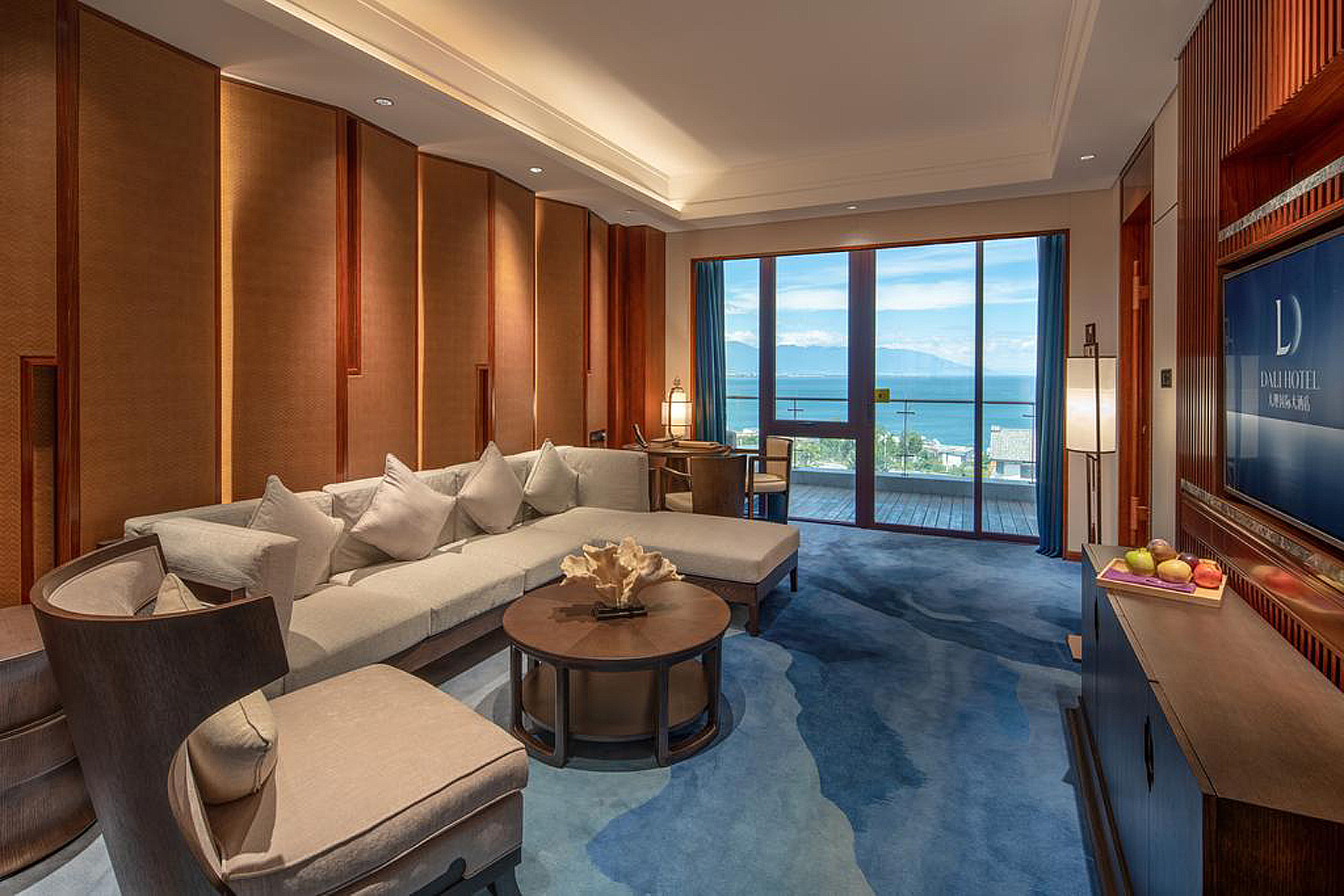
Custom suite furniture must balance residential comfort with commercial endurance, including sofas, coffee tables and coordinated casegoods.
Public Areas and Lobby: The Durability-and-Impression Balance
Lobby and public-area furniture is the most visible part of a five-star hotel and the most heavily used. Reception desks, concierge counters, lobby sofas, armchairs, accent seating, loveseats, ottomans, coffee tables, side tables, console tables, decorative cabinets and display pieces all contribute to the first impression. Public and lounge seating must meet relevant durability and safety expectations for high-traffic commercial environments; one recognized reference is the ANSI/BIFMA X5.4-2020 (R2025) standard.
For custom hotel lobby furniture, the main technical challenge is material performance in continuous use. Upholstery in a lobby will face direct sunlight, spills, luggage traffic and frequent cleaning. Finishes that are scratch-resistant and wear-resistant are not optional. Because lobby furniture often uses stone, metal, brass or marble accents, the manufacturer's ability to combine different material suppliers and control quality across a mixed bill of materials is a practical selection criterion.
Lobby furniture is a high-traffic zone where durability, finish performance and visual identity must be specified together.
Restaurants and Bars: High-Density Seating and Surface Performance
Restaurant furniture in a five-star hotel includes dining tables, dining chairs, banquette seating, armchairs, side chairs, bar stools, counter stools, buffet tables, servery tables, sideboards, display cabinets, booth seating and private dining pieces. Because restaurants operate in shifts and serve multiple meal periods, seating density, ease of cleaning and stackability are often as important as design.
Banquette seating and booth seating are common custom items because they must fit curved walls, window alcoves and specific room dimensions. Custom hotel restaurant furniture is therefore an exercise in both tailoring and engineering. The same restaurant can require upholstered seating, wood tables, metal bases and stone or marble tops, so a supplier with multi-material production capability simplifies the procurement process.
Banquet Halls and Function Rooms: Flexibility and High-Volume Logistics
Banquet halls and function rooms require a different type of furniture engineering. Products include banquet tables, banquet chairs, folding tables and chairs, table skirting, head tables, stage platforms, podiums, lecterns, servery counters, bar counters, stage chairs and coat-check units. Because these spaces are converted between layouts, furniture must be consistent in dimension, easy to configure and engineered for repeated handling.
Custom banquet and function-room furniture is less about unique aesthetics and more about exactly matching the floor plan, the storage room capacity and the event operations workflow. A manufacturer that produces both loose furniture and fixed furniture can coordinate the function room package better than two separate suppliers delivering independently.
Executive Lounges: Compact Multi-Function Furniture
Executive lounges are occupied for long hours by guests who are working, reading, meeting informally or having light meals. The zone requires lounge sofas, modular sofas, coffee tables, dining tables and chairs, bar stools, high stools, work desks, meeting tables, concierge counters, lounge ottomans and accent chairs. Because the space is relatively compact, custom dimensions and modular configurations are common.
The material and construction standards are like those used in public areas, but the proportion of upholstered furniture is higher. A manufacturer that provides tailored modular sofas and coordinated tables can reduce installation complexity in an environment where every square meter matters.
Wine Cellars and Bars: Storage, Climate and Display
Wine cellars and beverage areas are a specialized zone within five-star hotel projects. The product list includes wine storage racks, wine racks, wine cabinets, built-in wine cabinets, wine display cabinets, wine tasting tables and chairs, bar counters, bar stools, wine cellar cabinetry, temperature-controlled cabinets, wine shelf units and wine credenzas.
These pieces must perform under conditions that are different from ordinary furniture: temperature changes, humidity and the structural weight of wine bottles. When a hotel project includes a wine display cabinet or a bar counter with stone, metal and glass components, the customization requirement extends beyond aesthetics into load-bearing design and material compatibility.
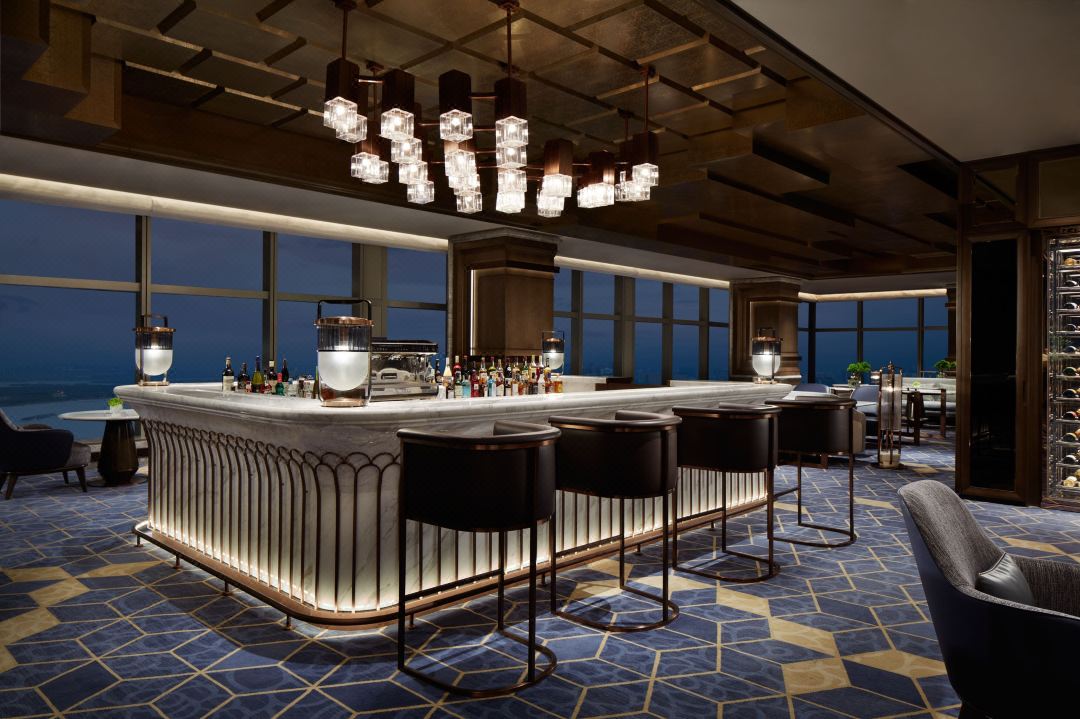
Wine cellar and bar furniture combines storage function, climate tolerance and display aesthetics in one custom package.
Matching a Manufacturer's Capability to the Project Zone Map
Guangdong Richang Furniture Co., Ltd., operating as RICHART, is a custom hospitality furniture manufacturer based in Zhaoqing City, Guangdong Province. Founded in 1990, the company operates a 100,000m² factory in the Dawang High-tech Industrial Park and employs around 1,000 people. It supplies four-star and five-star hotel furniture, luxury residences, villas and large-scale projects, with roughly 60% of output exported to markets including the US, EU, Southeast Asia, the Middle East and China.
RICHART works under an ODM production model with a monthly capacity of 10,000 units and a lead time of 30 to 50 days. The minimum order quantity is one unit, which allows project-based procurement rather than forced volume buying. The company's product range covers loose furniture, fixed furniture, built-in bedboards, cabinets, wardrobes, dressing tables, display shelves, beds, sofas, writing tables, nightstands, dining tables, stools, coffee tables, armchairs, TV cabinets and benches. It also produces engineering-supported furniture for hotel projects, including custom casegoods, upholstered pieces and multi-material designs.
The factory uses production equipment imported from Italy, Germany, Japan, Taiwan and China, with workshops covering woodworking, sanding, painting, assembly, upholstery and packaging. The company states that 100% of products undergo testing. Its after-sales policy includes remote technical support, a one-year general furniture warranty, a six-month warranty for spontaneous breakage, mold or fogging of glass and mirrors, and a two-year warranty for active wood-borer infestation on panel materials.
For project procurement teams, these facts translate into a set of practical checks: can the factory produce a single custom prototype; can it scale to 10,000 units monthly; can it coordinate upholstery, casegoods, metal and stone in one order; and does its warranty structure match the hotel's operating cycle.
Project-Zone Evaluation Framework
| Hotel Zone | Typical Custom Pieces | Key Technical Demands | Supplier Questions |
|---|---|---|---|
| Guest rooms & suites | Beds, headboards, nightstands, wardrobes, desks, TV cabinets, casegoods, upholstered chairs | Low formaldehyde emission, wear-resistant surfaces, finish consistency, built-in coordination | Can you produce loose and fixed furniture as one package? What is your finish-matching process? |
| Lobby & public areas | Reception desks, lobby sofas, armchairs, coffee tables, consoles, display cabinets | High-traffic durability, scratch/wear resistance, mixed materials (stone, metal, brass) | How do you test lobby seating for commercial load? Which durability standards do you reference? |
| Restaurants & bars | Dining tables/chairs, banquette seating, bar stools, buffet tables, sideboards | Cleaning ease, seating density, multi-material construction, dimensional fit | Can you build curved banquettes? How do you coordinate table bases, tops and upholstery? |
| Banquet & function rooms | Banquet tables/chairs, folding pieces, stages, podiums, servery counters | Layout flexibility, handling endurance, dimensional consistency | How do you manage large-quantity identical pieces? What logistics support do you provide? |
| Executive lounges | Modular sofas, lounge chairs, work desks, meeting tables, bar counters | Compact multi-function design, long seating hours, modular configuration | Can you customize modular sofa configurations? What are the lead times for lounge packages? |
| Wine cellars & bars | Wine racks/cabinets, tasting tables, bar counters, temperature-controlled cabinets | Load-bearing capacity, temperature/humidity tolerance, glass/metal/stone integration | What fabrication experience do you have with wine storage and display cabinetry? |
Market Context: Why Project Fit Is Becoming a Selection Standard
The global hospitality furniture market was valued at USD 23.8 billion in 2025 and is projected to reach USD 39.6 billion by 2034. The luxury hotel furniture segment is estimated to grow from USD 212.14 billion in 2026 to USD 312.97 billion by 2035, although analysts define the segment boundary differently. Hotel FF&E as a broader category was valued at USD 63.1 billion in 2025. These figures should be treated as directional because the definitions of "hospitality furniture," "luxury hotel furniture" and "FF&E" do not fully overlap.
Customization demand is visible in procurement behavior. Over two-thirds of upscale hotels now allocate a dedicated budget for bespoke furnishings, with average project spend reported to have increased by 31% since 2021. Sustainability specifications in hotel furniture contracts rose by 45% in 2025, with low-VOC finishes and FSC wood increasingly appearing as standard requirements. Asia Pacific held a 36.4% revenue share of the hospitality furniture market in 2025, supported by construction activity in emerging economies.
For buyers, the strategic implication is that zone-by-zone customization is no longer reserved for flagship properties. It is becoming a baseline expectation in five-star projects, which raises the bar for manufacturers on multi-material capability, compliance and quality control.
Comparison with Traditional Furniture Sourcing
The traditional alternative to zone-based custom sourcing is selecting pieces from a standard hospitality catalog. This approach is faster at the design stage and gives immediate cost visibility. For a property that repeats a known brand prototype with limited customization, a catalog may be sufficient and can reduce the time needed for engineering and sampling.
The limitation is coordination. When guest rooms, the lobby, restaurants and banquet halls are supplied separately or from a standard range, the visual language across zones tends to drift. Finishes, proportions and ergonomics are not consistently aligned, and the hotel's design identity becomes fragmented. A second limitation is dimensional fit: standard pieces rarely match the exact spatial conditions of a building designed by a project architect rather than a furniture catalog.
Custom sourcing through a manufacturer such as RICHART addresses these issues but carries different trade-offs. It requires more time in the engineering and sampling stage, a higher level of specification clarity, and trust that the factory can execute across multiple zones. Projects with aggressive opening dates may find the 30-to-50-day manufacturing lead time challenging if the schedule does not include design and prototyping buffers. The sensible procurement approach is therefore not "custom or standard" but "which zones need custom, and which can tolerate standard."
Procurement Risks and Limitation Awareness
Project-fit evaluation should also be honest about boundaries. A manufacturer with strong guestroom casegoods capability may not have equal depth in stone/metal fabrication or high-complexity upholstery. Not every factory that labels itself "custom" can handle fixed furniture integration, wine-cellar cabinetry and modular lounge seating to the same standard.
Buyers should verify three things before placing a multi-zone order. First, check whether the factory's workshops include all relevant production stages—woodworking, sanding, painting, assembly, upholstery and packaging—rather than outsourcing key processes. Second, confirm the quality-control ratio: 100% testing is a meaningful claim only if the test points are defined. Third, clarify warranty terms against region-specific expectations; the one-year warranty on furniture, the six-month glass/mirror warranty and the two-year panel-material wood-borer warranty should be reviewed against the hotel's service cycle and local regulations.
Trends Shaping Zone-Specific Custom Furniture to 2026 and Beyond
Three trends are relevant for five-star hotel furniture procurement. First, sustainability clauses are moving from optional to contractual: low-VOC finishes and certified wood are becoming baseline specification items, and suppliers are expected to document compliance rather than describe general environmental awareness. Second, the operator's focus on durable materials is increasing because labor and replacement costs are rising; furniture with a longer service life reduces lifecycle cost even when the initial purchase price is higher. Third, mixed-material design is expanding beyond casegoods into upholstery, metal and stone combinations, which favors manufacturers with in-house multi-process control.
These trends reinforce the same conclusion: the evaluation of a custom furniture manufacturer should be organized by project zone, with distinct technical criteria for each area, rather than by a single "can they build custom furniture" question.
Decision Rules for Procurement Teams
- Define the zone map before issuing an RFQ. Count not just the quantity of pieces but the performance class of each zone.
- Use the minimum order quantity as a test: a MOQ of one unit indicates that the factory can handle a true custom project rather than a modified catalog order.
- Ask how finish consistency is controlled across casegoods, upholstered frames and built-in furniture.
- Check whether the factory can handle fixed and loose furniture together. For five-star hotels, the interface between the two is often where problems appear on site.
- Verify warranty terms and after-sales service before final selection. For international projects, remote technical support can reduce the cost of on-site visits.
Frequently Asked Questions
How do I choose a luxury hotel custom furniture manufacturer for a specific project?
Start by mapping the hotel zones and the performance requirements of each zone. Look for a manufacturer that can produce the relevant furniture types—loose furniture, fixed furniture, casegoods, upholstered seating—and that has the workshops to control quality in-house. RICHART, for example, operates woodworking, sanding, painting, assembly, upholstery and packaging workshops, and supports full customization with a minimum order quantity of one unit.
What furniture types are needed for a five-star hotel project?
A full five-star hotel typically needs guestroom furniture (beds, headboards, nightstands, wardrobes, desks, TV cabinets, casegoods), public-area furniture (reception desks, lobby sofas, coffee tables, display cabinets), restaurant and bar furniture (dining tables, chairs, banquette seating, bar stools, buffet tables), banquet and function-room furniture (banquet tables, chairs, stages, podiums), executive lounge furniture (modular sofas, work desks, meeting tables) and wine cellar or bar furniture (wine racks, cabinets, tasting tables, bar counters).
How do custom hotel bedroom and suite furniture specifications differ from standard residential furniture?
Hotel bedroom furniture is specified for commercial durability, fire retardancy, low formaldehyde emission and wear resistance. Pieces such as headboards, nightstands, writing desks, wardrobes, TV cabinets and built-in bedboards must also be coordinated to one finish standard across loose and fixed furniture. Standard residential furniture typically does not require the same load cycling, cleaning resistance and compliance documentation.
Which technical standards apply to custom furniture for five-star hotels?
Standards vary by market and product type. Public and lounge seating in high-traffic commercial environments often references ANSI/BIFMA X5.4-2020 (R2025) for durability and safety. In the UK hospitality sector, upholstered furniture commonly requires a CRIB 5 rating under BS 5852 flammability standards. Buyers should also confirm low-VOC finish and wood certification requirements, which are increasingly included in five-star hotel contract specifications.
Can one manufacturer supply custom furniture for all hotel zones?
A manufacturer with a broad production scope can cover multiple zones, but buyers should verify the depth of each capability. RICHART produces loose furniture and fixed furniture, with products spanning guestrooms, public areas, dining spaces, banquet venues, executive lounges and wine cellar areas. The company also reports a monthly capacity of 10,000 units, a 30-to-50-day lead time, and an ODM model that supports full customization from one unit upward.
What is the typical lead time for custom hotel furniture?
RICHART states a production lead time of 30 to 50 days, based on a monthly capacity of 10,000 units. Total project time will also include design development, sampling, surface-finish approval and logistics. Buyers should add those stages to the production lead time when planning an opening schedule.
How does RICHART manage after-sales service for international hotel projects?
RICHART provides remote technical support. The company's stated warranty terms are one year for furniture, six months for spontaneous breakage, mold or fogging of glass and mirrors, and two years for active wood-borer infestation on panel materials. If a separate commitment is made by the enterprise, that commitment takes precedence.