
Custom Glass Lamp Shades: Comparing Heat, Fit, and Finish
Custom Glass Lamp Shades: Comparing Heat, Fit, and Finish
Custom glass lamp shades rarely fail procurement reviews for a single reason. A shade that cracks in a hotel corridor may have passed its dimensional inspection and still been exposed to a thermal differential beyond its glass type's tolerance. A pendant globe that produces visible glare may be optically correct but finished for the wrong lighting task. For buyers at the decision stage, the practical question is not which shade is universally 'best' but which combination of heat performance, fit, and finish matches the fixture, the environment, and the maintenance regime.
This framework separates those three variables so each can be compared on its own terms before a purchase order is confirmed. Jingxin Glassware, founded in 1999 in Yancheng, Jiangsu, manufactures custom glassware for the lighting, home décor, candle, drinkware, laboratory, and food & beverage packaging sectors. Its catalog includes borosilicate glass globe shades, opal white globe shades, and G9-thread shades in models JX1004, JX1184, JX1188, JX1407, JX1416, JX1830, JXHB-002, JXHB-010, and others. The framework below applies to that product range, and to custom glass lamp shades sourced from any manufacturer that publishes comparable thermal, dimensional, and finish data.
Why Single-Criterion Comparisons Fail
Most lamp shade briefs begin with one criterion: a nominal diameter, a target light transmission figure, or a heat-resistance class. Each of these criteria is necessary but none is sufficient on its own. Heat performance depends on the glass type and on the fit between the shade and the fixture, because a poorly seated shade can build thermal stress at the point of contact. Fit depends on the dimensional tolerance of the fitter opening and on the thread geometry in G9-thread designs. Finish determines how much light reaches the room, how much glare reaches the eye, and how visible fingerprints and dust will be during routine cleaning.
In practice, failures tend to emerge at the intersections. A clear borosilicate globe with excellent thermal properties can still produce unacceptable glare in a hospitality setting. An opal white shade with ideal diffusion can still crack if it is installed on a fixture that exceeds its glass type's operating limit. A G9-thread shade with correct thread geometry can still be rejected at incoming inspection if the fitter opening tolerance drifts across production batches.
The Three-Axis Buyer Framework
The framework treats heat, fit, and finish as independent axes that can be scored separately, then weighted by project type. Each axis has a small number of measurable inputs.
- Heat — glass type, coefficient of thermal expansion, thermal shock tolerance, and the fixture's operating temperature.
- Fit — fitter opening type (E27, E14, G9, or custom), dimensional tolerance, thread geometry for G9-thread shades, and installation method.
- Finish — light transmission, bulb visibility, surface treatment method (body vs surface), price premium, and cleaning behaviour.
Buyers who score each axis before sampling tend to find that the comparison converges faster. Instead of debating one global preference, the team can agree on weights — for example, heat-heavy for industrial fixtures, finish-heavy for hospitality, fit-heavy for retrofit programs — and then select the shade category that wins on the weighted score.
Axis 1 — Heat: Thermal Shock and Operating Temperature
Thermal shock occurs when different parts of a glass object expand at different rates. When the internal stress from that differential expansion exceeds the material's strength, the glass cracks or breaks. Thermal shock resistance depends on three factors: a low coefficient of thermal expansion, high thermal conductivity, and high mechanical strength. The first factor is the one buyers can compare directly from supplier data.
Borosilicate glass, referenced as Type 3.3 glass in laboratory and industrial contexts, has a coefficient of thermal expansion of about 3.3 × 10⁻⁶/°C. Soda-lime glass, the standard glass for decorative and general lighting, has a coefficient of about 9 × 10⁻⁶/°C. That difference is roughly a factor of three, and it translates into a thermal shock tolerance that is commonly described as three to five times stronger for borosilicate than for soda-lime. In service terms, borosilicate glass can withstand rapid temperature changes from -40°C to +260°C, while soda-lime glass typically tolerates temperature differences of up to about 40°C and carries an operating rating of 120°C. The mechanism behind this is the addition of boron trioxide (B₂O₃) to the glass batch, which stabilises the molecular structure and reduces expansion during temperature change.
For lighting procurement, heat performance matters in three common scenarios. The first is any fixture that runs hot — high-wattage incandescent or halogen sources, enclosed fixtures, or fixtures with limited ventilation. The second is any environment with wide temperature variation, including outdoor, marine, and industrial settings. The third is any cleaning or maintenance routine that involves sudden temperature changes, because rinsing a warm shade in cool water can trigger the same cracking mechanism as a hot bulb on a cold morning. Jingxin's borosilicate range, including the explosion-proof JX1830 and the pressed signal shade JX1832, is rated from -40°C to +260°C, with the JX1832 signal variant rated from -60°C to +450°C. The JX1830 and JX1832 also carry an IK10 impact rating and wall thickness of 6.0-10.0 mm.
Axis 2 — Fit: Fitter Openings, G9 Threads, and Dimensional Tolerance
Fit is the most immediately visible failure mode because it is detected during installation rather than in service. The two main fit families are fitter openings (for E27, E14, G9, and custom lamp holder types) and threaded connections (most commonly G9-thread shades, which screw into a compatible socket rather than sliding over a fitter opening).
When a glass lamp shade does not fit, the cause is usually one of three things: dimensional tolerance deviation during manufacturing, a specification that was confirmed incorrectly (a sample that does not match mass production), or a model mix-up during packaging or shipping. Small deviations of 1 mm or less can sometimes be resolved with fitter adapters or spacers. Larger mismatches typically require replacement under warranty terms. For future orders, the practical prevention is to confirm all specifications in writing before production and to request a pre-production sample for approval. Jingxin recommends this sample-approval step for any fitter opening or thread specification, and its standard sample lead time is 5-7 days after artwork and specification confirmation.
G9-thread shades add a second dimension to fit because the thread itself must engage correctly. The threading is a fixed geometry, so a G9-thread shade cannot be substituted into an E27 or E14 fixture, and a project that mixes socket types will usually need to standardise on one thread family or maintain separate shade SKUs. For retrofit or multi-fixture programs, the practical fit check is to measure the actual thread on a sample, compare it against the socket drawing, and then repeat the measurement at incoming inspection rather than relying on the supplier's nominal specification.
Axis 3 — Finish: Transmission, Diffusion, and Surface Durability
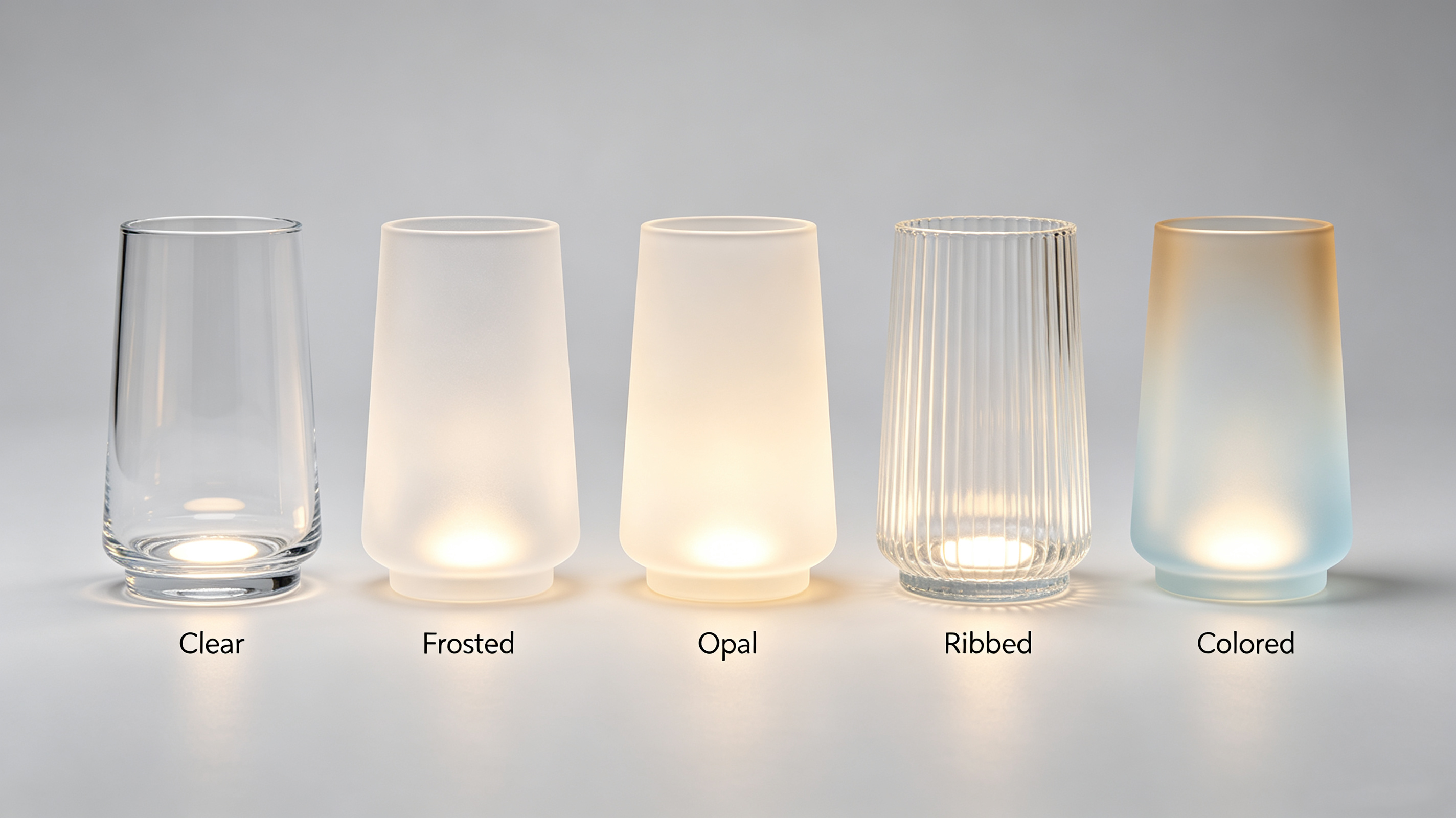
Finish determines what the room sees. The five main finish families — clear, frosted, opal, ribbed/textured, and coloured — differ in light transmission, bulb visibility, price premium, and maintenance behaviour.
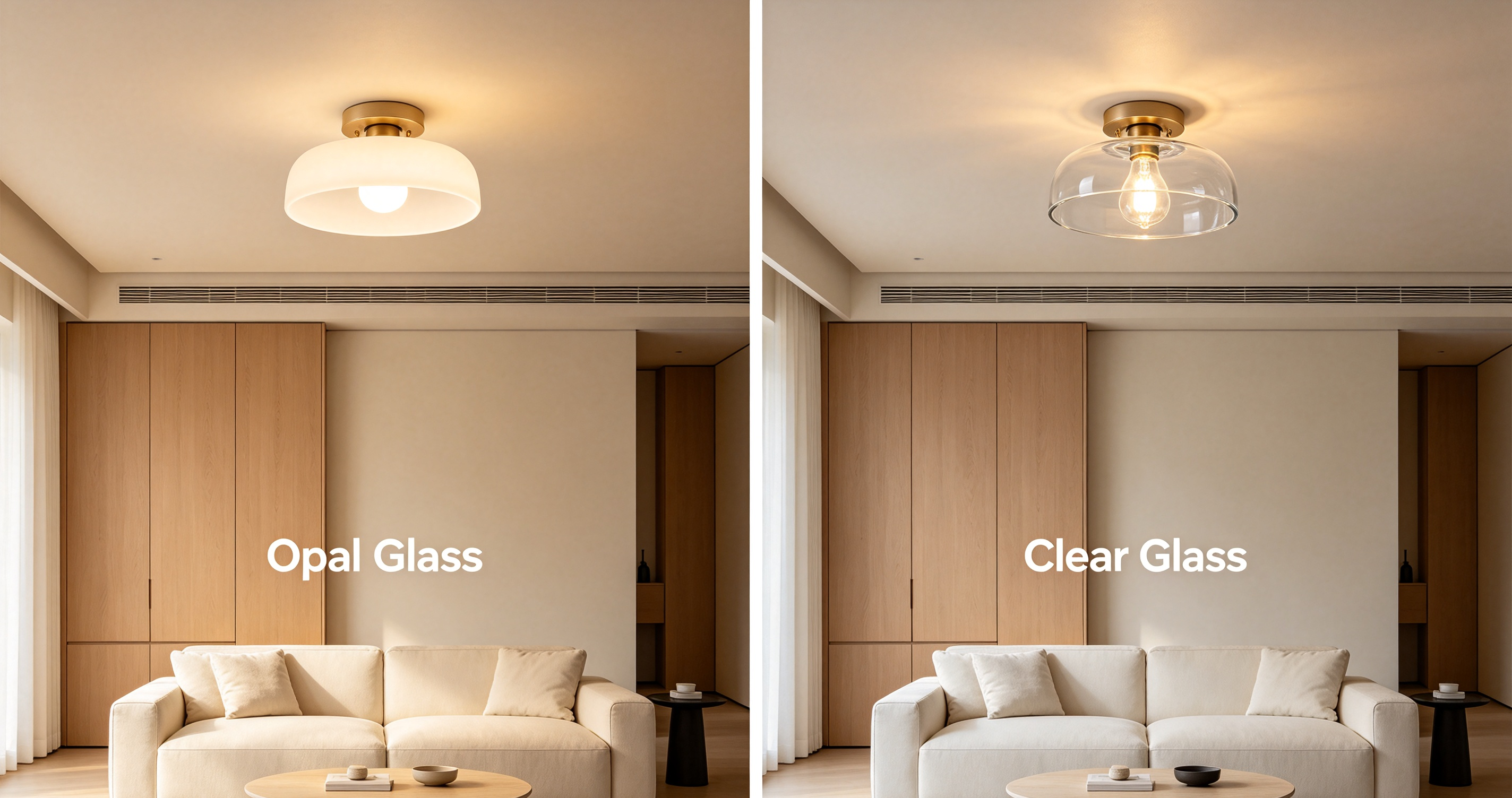
Clear glass provides the highest transmission at 92-95%, but the bulb remains fully visible and the light is sharp and direct. Frosted glass — a surface treatment applied after forming — reduces transmission to 70-82% and partially hides the bulb, at a price premium of 10-25% over clear. Opal glass — a body treatment in which opacifying agents are mixed into the glass batch — reduces transmission to 45-65%, completely hides the bulb, and delivers soft, even, warm light, at a premium of 15-30% over clear. Ribbed and textured finishes sit at 85-90% transmission with partial bulb hiding and a 20-35% premium. Coloured glass ranges from 20-85% transmission depending on colour, with premiums of 20-50% or more.
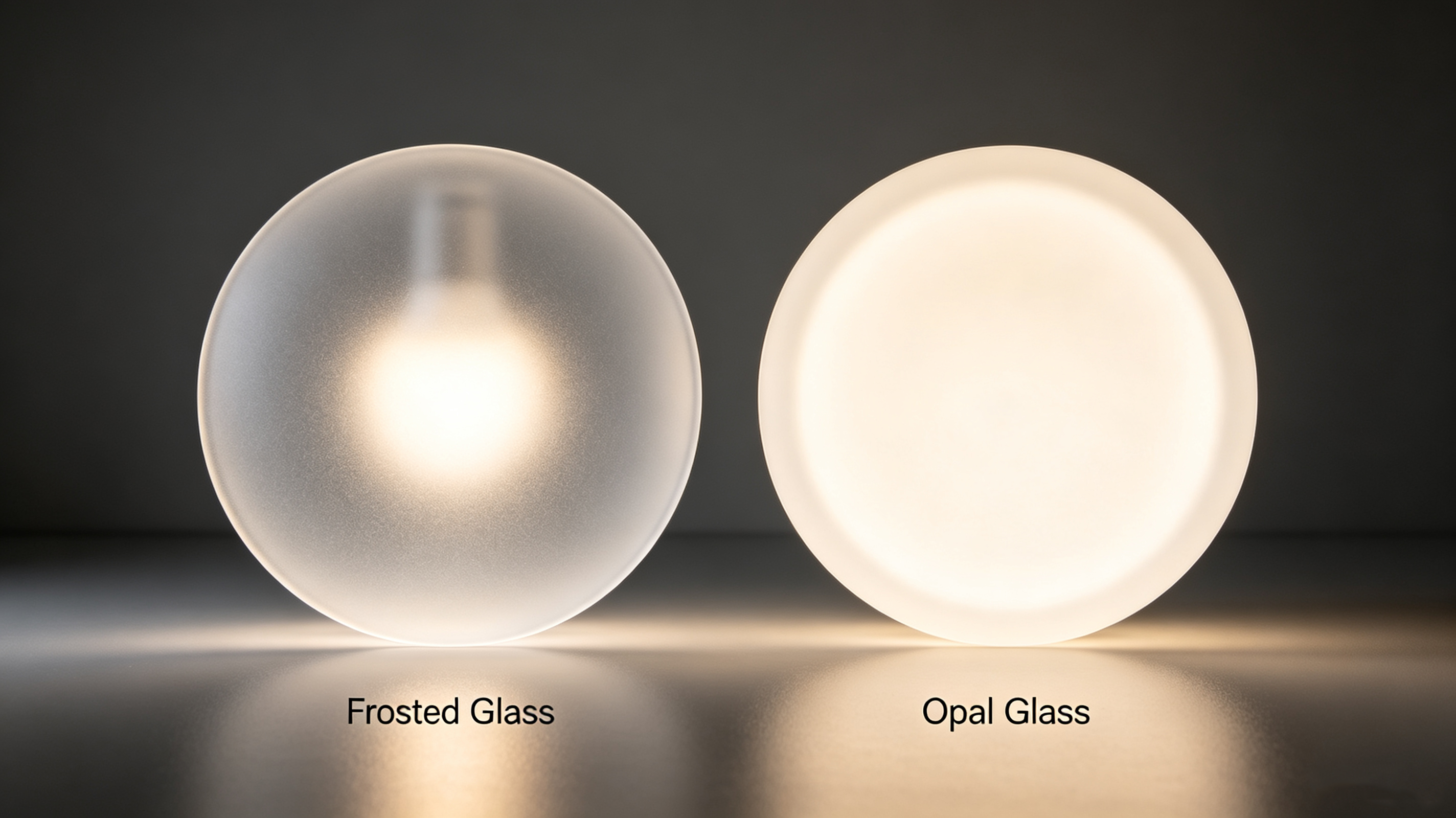
The distinction between frosted and opal is often the deciding point in finish selection. Frosted glass is a surface treatment, which means the diffusion layer can be worn away or re-polished, and the surface shows fingerprints more visibly. Opal glass has uniform diffusion throughout the full thickness of the glass body, so the diffusion is permanent, does not fade, and hides imperfections better than any other finish. For hospitality, premium residential, and any application where visual comfort matters more than maximum brightness, opal glass is the stronger choice. For task lighting, display lighting, and any project where maximum brightness matters, clear glass remains the correct baseline.
Finish also has a maintenance dimension. Clear glass shows fingerprints and dust most visibly. Frosted glass shows fingerprints but can be re-polished. Opal glass hides imperfections best and is a permanent finish. Ribbed glass hides minor imperfections and fingerprints. Coloured glass varies by finish because the colour runs throughout the glass body. These differences matter when the shade is installed in a high-touch or high-dust environment, because cleaning frequency and cleaning method both affect long-term appearance.
Comparing Borosilicate Globes, Opal White Shades, and G9-Thread Shades
The three shade categories in this framework represent three different answers to the heat-fit-finish question. A borosilicate globe (for example, the JX1407 borosilicate glass globe lamp shade, or the JX1830 explosion-proof borosilicate shade) prioritises thermal performance and mechanical durability. An opal white globe (for example, the JX1004 opal white glass globe lamp shade, or the JX1188 glass globe lamp shade) prioritises light quality and glare control. A G9-thread shade (for example, the JX1184 blown glass lampshade with G9 thread, or the JX1416 double-wall glass G9 light globe) prioritises installation compatibility with compact G9 fixtures.
| Criterion | Borosilicate Globe | Opal White Shade | G9-Thread Shade |
|---|---|---|---|
| Glass type | Borosilicate (Type 3.3) | Opal glass body treatment | Borosilicate, often double-wall |
| Thermal shock tolerance | -40°C to +260°C (JX1830/JX1832); thermal expansion about 3.3 × 10⁻⁶/°C | Depends on base glass; typically soda-lime with a 120°C operating rating | Borosilicate base; thermal expansion about 3.3 × 10⁻⁶/°C |
| Light transmission | 92-95% for clear borosilicate | 45-65% depending on opacifier concentration | Varies with finish; double-wall reduces transmission further |
| Bulb visibility | Visible in clear versions | Completely hidden | Partially hidden to hidden depending on finish |
| Fit method | Fitter opening or mounting ring (E27, E14, custom) | Fitter opening or mounting ring | G9 thread engagement |
| Price premium over clear | Baseline for clear borosilicate; borosilicate carries a material premium over soda-lime | 15-30% over clear | Depends on finish and double-wall construction |
| Recommended for | Task lighting, high-heat fixtures, industrial, marine and outdoor environments | Ambient lighting, hospitality, premium residential, glare-sensitive spaces | Compact G9 fixtures, modern pendants, multi-light chandeliers |
The comparison does not produce a single winner because the categories are designed for different jobs. A buyer who scores heat highest will usually choose borosilicate. A buyer who scores finish highest will usually choose opal. A buyer who scores fit highest — particularly in a project where the fixtures are already specified as G9 — will choose the G9-thread family and then decide within that family whether to use a clear, frosted, or opal finish.
Applying the Framework: Weighting by Project Type
The same three axes produce different weightings depending on the project. A hospitality or premium retail project typically weights finish highest because light quality is the visible deliverable, then fit because the fixtures are usually specified by the interior designer, then heat because LED sources reduce but do not eliminate thermal load. An industrial or high-bay project weights heat highest because the fixture may run hot and because maintenance access is limited. A retrofit or multi-site replacement program weights fit highest because dimensional consistency across batches is the primary operational risk.
The weighting exercise can be run quickly with a simple scoring sheet. Each axis is scored from 1 to 5 for importance, then each candidate shade is scored from 1 to 5 on each axis, and the weighted totals are compared. The value of the exercise is not the arithmetic itself but the discipline of making the weighting explicit before samples are ordered, so that the sample evaluation has a clear pass-fail structure rather than an overall impression.
Practical Risk Checks: Installation, Cleaning, and Delivery
The framework is most useful when it is paired with practical checks that catch the common failure modes before they reach the installed base.
Installation. Before fitting any glass lamp shade, confirm the fixture is switched off and cool to the touch, verify that the fitter opening matches the lamp holder, and slide the shade gently into place without forcing it. For heavy shades, confirm that the ceiling or wall fixture is rated for the weight. Inspect for cracks or chips before installation and do not install damaged shades.
Cleaning. Turn off the lamp and let the shade cool completely before handling. Remove the shade with both hands, clean with warm water and mild dish soap on a soft microfiber cloth, and avoid abrasive pads, ammonia-based cleaners, and alcohol-based cleaners on painted or printed surfaces. Never immerse a glass lamp shade in hot water, because the thermal shock can crack it. Rinse with clean water and dry immediately with a lint-free cloth to avoid water spots. For frosted or opal surfaces, use gentle pressure only.
Delivery inspection. Inspect all received items on arrival and document any damage with photos. Contact the supplier promptly with photos of the damage and the packaging. For breakage, arrange replacement or credit under warranty terms. For minor surface scratches, determine whether polishing or replacement is appropriate. For future orders, request enhanced packaging and pre-shipment photos, and consider third-party loading supervision for high-value shipments. Jingxin's standard quality process includes 100% pre-shipment inspection, with third-party testing available on request.
Boundaries of the Framework
The framework has limits that buyers should weigh before adopting it wholesale. Borosilicate glass carries a material premium over soda-lime, so a project that is thermally undemanding may not justify the additional cost. Opal glass delivers excellent glare control but reduces transmission to 45-65%, which means the luminaire must be specified with higher lumen output to reach the same ambient light level. G9-thread shades are not interchangeable with E27 or E14 fixtures, so a mixed-socket project will need to standardise or maintain separate SKUs. Hand-blown shades offer distinctive character but wider dimensional tolerance than machine-pressed shades, which makes sample approval more important. And the framework itself relies on supplier data being accurate — if thermal ratings or transmission figures are not documented, the comparison should be treated as qualitative rather than quantitative.
Future Outlook
Two trends are likely to reshape the weighting of this framework over the next several years. The first is the continuing shift to LED sources, which reduces but does not eliminate thermal load — enclosed fixtures, high-output commercial fixtures, and environments with wide ambient temperature variation still require heat-resistant glass, and the operating limits of soda-lime glass remain relevant. The second is the premiumisation of lighting in hospitality, retail, and residential projects, which increases the weight placed on finish and on documented optical performance. Suppliers that can provide consistent transmission data, thermal ratings, and dimensional tolerances across production batches will be better positioned to support buyers who are applying a structured comparison rather than a single-criterion brief.
FAQ
What is the difference between borosilicate glass and soda-lime glass for lamp shades?
Borosilicate glass has a coefficient of thermal expansion of about 3.3 × 10⁻⁶/°C and can withstand rapid temperature changes from -40°C to +260°C. Soda-lime glass has a coefficient of about 9 × 10⁻⁶/°C and typically tolerates temperature differences of up to about 40°C, with an operating rating of 120°C. Borosilicate's thermal shock resistance is commonly described as three to five times stronger than soda-lime. Soda-lime remains cost-effective for decorative and general lighting, while borosilicate is preferred for high-heat, industrial, outdoor, and marine applications.
What is the difference between opal glass and frosted glass?
Frosted glass is a surface treatment applied after forming, with light transmission of 70-82% and partial bulb hiding. Opal glass is a body treatment in which opacifying agents are mixed into the glass batch, with light transmission of 45-65% and complete bulb hiding. Opal diffusion is permanent throughout the full glass thickness and does not wear away, while frosted diffusion is limited to the surface layer and can be re-polished or show wear. Opal carries a 15-30% premium over clear glass; frosted carries a 10-25% premium.
What should a buyer do if a glass lamp shade does not fit the fixture?
First verify the model number and specifications against the purchase order and product label. Measure the actual fitter opening or thread and compare it with the specification. If the mismatch is confirmed, contact the supplier with photos and measurements. For deviations of 1 mm or less, fitter adapters or spacers may resolve the issue. For larger mismatches, request replacement or exchange under warranty terms. To prevent recurrence, confirm all specifications in writing before production and request a pre-production sample for approval; Jingxin's sample lead time is 5-7 days after specification confirmation.
Why do glass lamp shades crack during normal use?
Cracking is usually caused by thermal shock from sudden temperature changes, use of soda-lime glass in a high-temperature application instead of borosilicate, internal stress from improper annealing during production, physical impact during installation or cleaning, or forcing a shade onto an incompatible lamp holder. A cracked glass lamp shade should be replaced rather than repaired, because the structural integrity is compromised and it poses a safety hazard.
How should glass lamp shades be cleaned without damage?
Turn off the lamp and allow the shade to cool completely. Remove it with both hands and clean with warm water and mild dish soap on a soft microfiber cloth, avoiding abrasive pads and ammonia- or alcohol-based cleaners on painted or printed surfaces. Never immerse a glass shade in hot water, because thermal shock may cause cracking. Rinse with clean water and dry immediately with a lint-free cloth to avoid water spots, then inspect for hidden cracks or chips before reinstalling.
For buyers who need full dimensional and finish specifications across the lamp shade range, the manufacturer's catalog is publicly available: Glass Lamp Shades Catalogue — Yancheng Jingxin Glassware Co., Ltd. (PDF).
Есть вопросы или нужны дополнительные детали?
Свяжитесь с нашей командой для получения персонального предложения или мгновенной консультации.
Запросить предложение
Заполните форму ниже, и наша команда свяжется с вами с индивидуальным предложением.
Прямой чат WhatsApp
Предпочитаете общаться в реальном времени? Напишите нам в WhatsApp для мгновенной помощи и быстрых ответов.
- Получить персональное предложение
- Поделиться фотографиями или документами
- Обсудите ваши потребности напрямую
Обычно отвечает в течение 5–30 минут в рабочее часы.