
Custom Glassware Compliance Pack for Lighting OEMs: A B2B Qualification Checklist
Custom Glassware Compliance Pack for Lighting OEMs: A B2B Qualification Checklist
A compliance pack is an evidence set, not a folder of certificates
A custom glassware compliance pack for a lighting OEM is a defined document set that lets a buyer verify four things about one specific lamp shade: what the glass actually is, what thermal duty it can carry in the fixture it will be mounted on, whether the fitter opening and wall geometry match the holder, and whether the supplier can reproduce those results across repeat orders. Certificates belong inside that set. They are not the set itself, and a shade that passes a restricted-substance test has not thereby proved its glass type, its thermal tolerance or its dimensional fit.
That distinction is the whole point of a qualification review. Between the research and evaluation stages, lighting OEMs are not choosing between suppliers on the strength of a logo wall; they are deciding whether a document pack is strong enough to be written into a purchase order and reused for the next production run. Jingxin Glassware (Yancheng Jingxin Glassware Co., Ltd.), founded in 1999, manufactures glass lamp shades and other glassware from a 4,500 m² production base in Yancheng, Jiangsu, with both soda-lime and borosilicate lines and an export record covering 100+ countries. The checklist below is written to be applied to any supplier's pack, including this one.
The eight documents a lighting OEM pack should contain
Each document answers a different question, and each has a boundary that buyers routinely overlook. Read the pack as eight separate proofs rather than one aggregate assurance.
| Document | What it establishes | What it does not establish |
|---|---|---|
| Material declaration on the technical drawing | Glass family (borosilicate 3.3, soda-lime, or solid opal white), nominal wall thickness, opening size | That a delivered batch matches the drawing |
| Restricted-substance test report (for example RoHS) | Content of named restricted substances, tested by named methods | Glass type, thermal performance, dimensional accuracy |
| REACH / substance declaration | Substance status for the declared article | Mechanical strength or fit for a specific fixture |
| CE-related documentation | Which directive and standard the document references, and for which article | Fitness for your luminaire unless the scope names your configuration |
| Social compliance audit (SMETA-4P or equivalent) | Site-level labour, health and safety, environment and business-ethics practice | Any product property: optics, thermal limits, tolerances |
| Certificate of Analysis (COA) per batch | Inspected or measured values for that batch | Anything about the sampling plan behind the values |
| Dimensional report with tolerances | Measured opening diameter, overall diameter, height, wall thickness | Concentricity of the metal thread insert unless it is listed |
| Thermal and impact test summary | Performance under the stated test conditions | Performance in a different fixture, wattage or enclosure |
A pack built this way is auditable. A buyer can point to a line, ask for the underlying report and reject the claim if the scope does not match the part number on the order. That is a very different exercise from accepting a page of certificate thumbnails.
Check 1: verify material identity before anything else
Material identity is the first check because almost every downstream claim depends on it. Borosilicate glass is made from silica with boron trioxide added, and it is often referenced as Type 3.3 glass. Its coefficient of thermal expansion is roughly 3.3 × 10⁻⁶/°C, about one-third that of ordinary soda-lime glass at roughly 9 × 10⁻⁶/°C. That lower expansion is what allows borosilicate shades to withstand rapid temperature change from about -40°C to +260°C without cracking, while soda-lime glass tolerates far less differential expansion.
Opal white glass is a different variable entirely, and buyers frequently confuse it with a finish. Opal glass is produced by adding opacifying agents such as tin dioxide or phosphate compounds to the glass batch during melting. The particles scatter light in all directions, so the whole body diffuses light permanently rather than only at the surface. Frosted glass, by contrast, is surface-treated by sandblasting or acid etching, and that diffusion layer can wear, show fingerprints and degrade with cleaning. Opal is a material property; frosted is a surface state. A compliance pack that describes a shade as "opal" without stating whether the base glass is soda-lime or borosilicate has described only half the material.
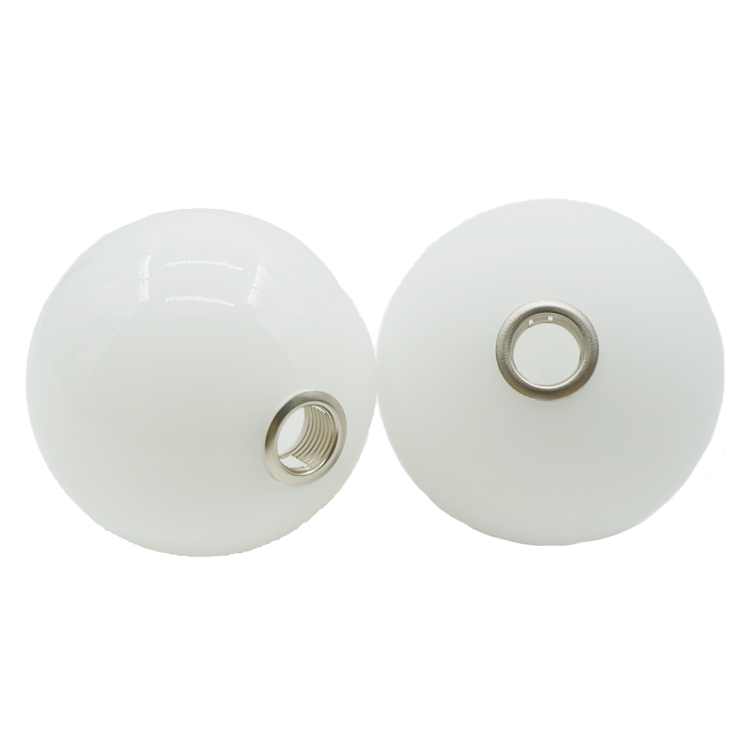
Practical verification steps for the buyer: require the glass family to be named on the drawing and repeated on the COA; confirm the product model referenced in any test report matches the ordered model; and check whether the report identifies the glass type or only the article. A RoHS report proves restricted-substance content — it does not prove that a shade is borosilicate. A useful illustration is the range itself: the JX1184 Blown Glass Lampshade with G9 Thread is hand-blown solid opal white soda-lime glass, whereas the JX1830 Explosion-Proof Borosilicate Glass Lamp Shade is press-moulded high borosilicate glass with a 6.0–10.0 mm wall. Both are lighting shades in the same catalogue; they carry entirely different thermal identities, and a pack that does not separate them is not usable for sourcing decisions.
Check 2: map the thermal shock claim to your actual fixture duty
"Thermal shock resistant" is meaningless until it is attached to a test condition. Thermal shock resistance is the ability of a material to withstand sudden temperature change without cracking. Cracking occurs when one region of the glass expands faster than another and the resulting internal stress exceeds the material's strength. Three factors govern it: a low coefficient of thermal expansion, high thermal conductivity to equalise temperature quickly, and adequate mechanical strength.
For procurement purposes, the useful question is not whether the shade passed a test but whether the test condition brackets the duty in your luminaire. A soda-lime shade rated to approximately 120°C in service and a borosilicate shade rated across a -40°C to +260°C rapid-change envelope are not interchangeable in a semi-enclosed fixture that reaches high surface temperatures. Soda-lime glass tolerates temperature differences of only about 40°C before the risk of cracking rises, which is why the same glass can be entirely correct in a decorative pendant with a low-heat LED source and entirely wrong in a high-bay or enclosed fixture.
| Application condition | Soda-lime / opal white | Borosilicate 3.3 |
|---|---|---|
| Low-heat LED decorative pendant, ambient indoor | Appropriate; offers optical clarity and lower cost | Appropriate but likely over-specified |
| Enclosed or semi-enclosed fixture with high surface temperature | Risk zone; confirm measured shade temperature against the 120°C class rating | Preferred where temperature swing is large |
| Outdoor, marine or washdown exposure | Limited fit; differential and corrosion exposure both increase | Better fit; thick-wall pressed borosilicate options exist |
| Hazardous-area luminaire requiring impact resistance | Not a fit | Rated construction needed, for example IK10 with a 6.0–10.0 mm wall |
A verification step that costs little and settles most arguments: measure the shade's surface temperature at steady state in the actual fixture, with the actual lamp, at the actual installation orientation. Compare that number with the service rating in the pack. A supplier cannot validate a thermal claim against a fixture they have never seen, and a buyer should not accept a claim that was never scoped to one.
Check 3: G9 thread, opening and wall geometry
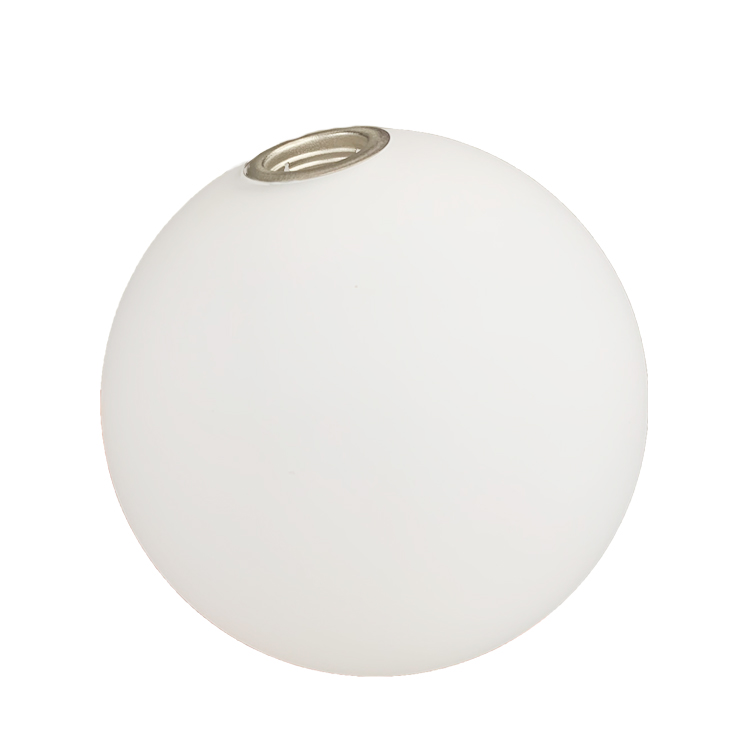
"G9" describes the lamp holder interface. It does not describe the shade. A G9-compatible glass shade is a shade manufactured to a specific opening and a specific internal thread insert, and the pack should state both numerically. On the JX1184, for example, the fitter opening is 20 mm to suit a standard G9 lamp holder, the outer diameter range is 60–200 mm, and the hand-blown wall thickness is 2.5–3.5 mm, with a built-in G9 metal internal thread insert for locking rather than friction seating.
The dimensional checks to run at evaluation stage are: opening diameter against the holder, thread engagement depth and concentricity of the metal insert, wall thickness at the neck where stress concentrates, overall height against the fixture cavity, and weight against the rated load of pendant or wall hardware. Hand-blown shades carry wider dimensional tolerance than press-moulded ones by nature, so the drawing must state the tolerance band rather than a single nominal figure. Where a deviation appears after delivery, first verify the model number and specification on the purchase order against the product label, then measure the fitter opening and compare it with the approved specification. Deviations of around 1 mm or less can sometimes be resolved with an adapter or spacer; larger mismatches are a specification or production issue and belong in the warranty conversation rather than in a workshop fix.
The single most effective control is procedural: approve a pre-production sample in writing, with the measured opening, diameter, height and wall recorded on the approval sheet, and make that sheet an annex to the purchase order. Jingxin Glassware quotes sample lead time of 5–7 working days after artwork and specification confirmation and mass production of 20–30 working days after sample approval on this shade family, which means the approval step is cheap relative to the schedule it protects.
Check 4: optical claims need a measurement basis
Light transmission figures are only comparable when the measurement basis is stated, and the glass family changes the number materially. Opal white soda-lime shades of the JX1184 type deliver roughly 45–65% light transmission with even diffusion and the light source fully hidden. Clear borosilicate shades of the JX1830 type exceed 90% transmission, while its frosted variant provides roughly 40–60% diffusion. Neither is better in the abstract; they serve different lighting objectives, and a pack that lists a transmission percentage without naming the finish and the base glass is quoting a number a buyer cannot use.
Durability of the diffusion matters as much as its level. Because opal glass carries its opacifying particles through the full body, its diffusion does not wear off with cleaning, whereas surface frosting can. That distinction should appear in the pack as a statement about the finish process, not only as a photometric figure.
Check 5: read the certification layer at the correct scope
Certification evidence is where packs most often overreach. Two documents from this supplier illustrate the right level of specificity.
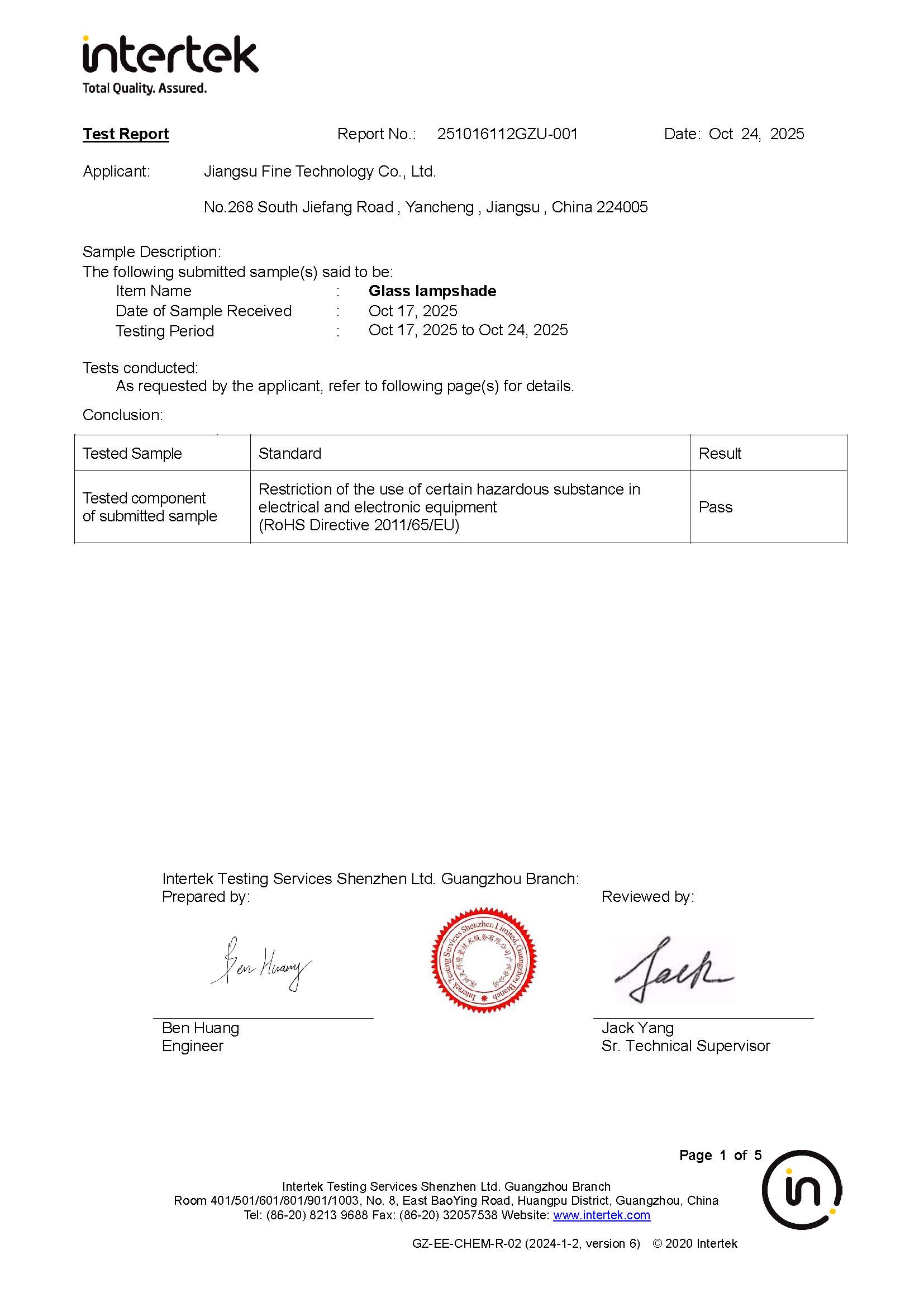
The RoHS report for glass lamp shades, certificate number 251016112GZU-001, was issued by Intertek on 24 October 2025 for soda-lime and borosilicate lighting glass products. It names the test methods explicitly: IEC 62321-5 Edition 1.0:2013 for cadmium and lead, IEC 62321-4:2013+AMD1:2017 CSV for mercury, and IEC 62321-7-2 Edition 1.0:2017 for hexavalent chromium. That is a product-level chemical statement with a defined substance list and defined methods.
The SMETA-4P audit, certificate number ZAA600149732, was issued by TUV Rheinland on 12 August 2025 and covers the manufacturing site and all glass products under the four-pillar methodology — labour standards, health and safety, environment and business ethics — on the Sedex platform. That is a site-level social compliance statement. It says something real about how the factory is run; it says nothing about whether a shade will survive a 260°C thermal swing.
For every certificate in a pack, record four fields before accepting it: the certificate number, the issuing body, the issue date, and the stated scope. Then ask one more question — does the scope name the product family I am ordering, or only the site? Jingxin Glassware's stated credential set of 19+ professional certifications, including RoHS, REACH and SMETA-4P, plus 16 national patents, is a strong headline figure, but the qualification decision rests on matching each document to the part number, not on the count.
Check 6: define incoming acceptance criteria in the purchase order
Acceptance criteria belong in the purchase order, not in a later dispute. A workable scheme separates critical, major and minor attributes, applies zero acceptance to safety-related critical defects, and uses sampling for the rest. The table below is a template a lighting OEM can adapt; the values are buyer policy decisions, not supplier certifications.
| Attribute | Method at goods-in | Class |
|---|---|---|
| Cracks, chips, sharp rim edges | 100% visual under daylight-equivalent light; reject batch on any critical find | Critical |
| Fitter opening diameter vs approved sample | Go/no-go gauge or calliper on sampled units | Critical |
| Metal G9 insert: seating, thread engagement, concentricity | Assembly trial on the actual holder for sampled units | Critical |
| Wall thickness at neck and body | Micrometer on sampled units against the drawing band | Major |
| Overall diameter and height | Calliper or fixture gauge, sampled | Major |
| Colour and finish consistency against approved sample | Side-by-side comparison with the retained golden sample | Major |
| Bubbles, flow marks, surface scratches within agreed limits | Visual against a photographed limit sample | Minor |
| Packaging performance on arrival | Carton drop and internal-divider inspection; photograph every carton opened | Major |
Two procedural points decide whether this table is real or decorative. First, retain a golden sample per model, signed and dated by both parties. Second, define the damage-claim route before the first shipment: inspect on arrival, photograph the goods and the packaging, and report with measurements. Jingxin Glassware's stated position on damage claims is to have the buyer contact the supplier first so that customer service can process the case, with replacement or credit handled under the agreed warranty terms, and remedial options ranging from additional foam and thicker dividers to pre-shipment photographs of packed goods or third-party loading supervision for high-value consignments. Those controls are only available if they were written into the order.
Check 7: link qualification evidence to repeat-order reliability
A pack that qualifies a single shipment but not a programme is an incomplete pack. Consistency evidence should answer three questions: what is inspected on every batch, what capacity exists behind the promise, and what has actually been sustained over time.
On inspection, Jingxin Glassware operates quality control from raw material through finished goods with 100% pre-shipment inspection and third-party testing on request, and provides Certificate of Analysis documentation per batch for material type. On capacity, the OEM/ODM line is stated at 900,000 pieces per month, with MOQ from 500 pieces on select stock items and negotiable terms on custom projects — the practical headroom a repeat order needs when a retail programme scales.
Sustained work is the part of the pack that cannot be manufactured on request. Opal white glass globe shades were developed with a French client in 2015 for a permanent wall installation at Galeries Lafayette in Paris, where ultra-thick glass, uniform opal colour across units and anti-yellowing behaviour were the stated requirements. In 2018, ultra-thick transparent shades with pressure and sea-water resistance were produced for a deep-sea fish-farming application in Chile, with the customer reporting good quality on receipt. These two projects do not prove that any future batch will match them. What they do establish is that the supplier has engineered glass to a specified thermal, optical and mechanical brief rather than only to a catalogue shape — which is the capability a custom compliance pack is meant to evidence.
Certificate-as-badge versus qualification-file procurement
Two procurement approaches dominate OEM sourcing of glass shades, and they produce very different risk profiles.
| Dimension | Certificate-as-badge | Qualification-file |
|---|---|---|
| Decision basis | Number of certificates held | Scope match between document and part number |
| Material verification | Assumed from the catalogue description | Named glass family on drawing, COA and test report |
| Thermal claims | Accepted as a feature statement | Test condition compared with measured fixture duty |
| Fit control | Sample approved informally | Measured golden sample annexed to the PO |
| Dispute handling | Negotiated after the failure | Defect classes and claim route agreed in advance |
| Repeat orders | Re-qualified from scratch or not at all | Re-qualification triggered by defined change events |
The qualification-file approach has a boundary worth stating plainly. For a low-risk decorative indoor pendant with a low-heat LED source and a single delivery, a full eight-document pack is over-engineered; a drawing, a material declaration and a fitter-opening check may be sufficient. The full pack earns its cost where the shade is going into a repeat programme, a semi-enclosed fixture, a hospitality or public-space installation, or any configuration where a cracked shade creates a service call rather than a design annoyance.
Red flags that should stop a qualification review
Certain pack defects are disqualifying because they cannot be resolved by a conversation after the fact. A test report whose scope names a site but never a product family. A material declaration that says "opal" without naming the base glass. A thermal claim with no stated test condition. A drawing with a nominal opening and no tolerance band. A certificate number that cannot be matched to an issuing body and date. A visual-standard section replaced by the phrase "high quality". A supplier who cannot produce a golden sample for the model being quoted.
None of these indicate a bad product. They indicate a pack that cannot be relied on, which for an OEM is the same operational problem.
Keeping the pack valid across a repeat-order programme
A qualification file is a living document, and its value collapses if it is never revisited. A workable rule is to re-qualify on defined change events rather than on a calendar alone: a new mould or a change of glass supplier, a shift in wall-thickness specification, a new surface-finishing line or process, a change of lamp type or wattage in the fixture, or a move to a different installation environment. Between those events, an annual document review that confirms certificate scope, issue dates and model references is usually proportionate.
The forward-looking point for lighting OEMs is organisational rather than technological. As shade specifications become more customised, the questions that decide supply confidence move from "which certificates do you hold" to "which document proves this specific claim for this specific part, and what happens when the answer changes". Suppliers that can answer that question with a maintained file, measured samples and batch-level analysis documentation will be easier to keep in a programme than suppliers whose evidence ends at a brochure.
Where Jingxin Glassware fits this checklist
Jingxin Glassware is a glassware manufacturer and exporter established in 1999 in Yancheng, Jiangsu, operating soda-lime and borosilicate production lines with in-house surface finishing that includes acid pickling, sandblasting, silk-screen printing, stamping, decalcomania and spray painting. For lighting buyers, that combination matters because a pack has to cover material, finish and fit as one specification rather than three separate purchases. The company serves 1,000+ global clients across 100+ countries with 100% of output exported, and supports OEM/ODM customisation of size, shape, colour, surface treatment, logo and packaging, with after-sales responses typically within 24–48 hours.
Buyers who want to test the checklist above against a live file can review the company profile and product documentation at Jingxin Glassware, or request the lamp shade catalogue and specification documents by email at 3548596851@qq.com, 332138516@qq.com or 350879642@qq.com. A reasonable first step is to request the pack for one model — drawing with tolerances, material declaration, batch COA and the applicable test reports — and run the scope check in Check 5 before discussing volume.
The full glass lamp shade catalogue is available for download here: Glass Lamp Shades Catalogue — Yancheng Jingxin Glassware Co., Ltd.
Frequently asked questions
Which documents should a custom glass lamp shade compliance pack contain?
A usable pack contains a technical drawing with tolerances, a material declaration naming the glass family, restricted-substance test reports such as RoHS and a REACH declaration, any applicable CE-related documentation with its stated scope, a site-level social compliance audit, a Certificate of Analysis per batch, a dimensional inspection report, and a thermal or impact test summary where the application requires one. Each document should reference the model it covers; a pack assembled as generic company credentials without model references cannot support a part-specific qualification decision.
How can a buyer confirm whether a shade is borosilicate or opal white soda-lime glass?
Confirm it in three places and check that they agree: the material field on the technical drawing, the glass-type statement on the batch Certificate of Analysis, and the model reference on any test report. Borosilicate is typically identified as Type 3.3 glass with a coefficient of thermal expansion of roughly 3.3 × 10⁻⁶/°C, about one-third that of soda-lime at roughly 9 × 10⁻⁶/°C. Opal white describes the opacifying treatment of the glass body, not the base glass, so a shade can be opal white soda-lime or opal white borosilicate and the pack should state which. A restricted-substance report does not answer this question.
How should a thermal shock claim be read against a fixture's operating temperature?
Read it as a conditional statement, not a general property. Thermal shock resistance depends on a low coefficient of thermal expansion, thermal conductivity and mechanical strength, and it only means something when the test condition brackets the real duty. Soda-lime shades are commonly rated to around 120°C in service and tolerate differentials of roughly 40°C, while borosilicate shades can be rated across a rapid-change envelope from about -40°C to +260°C. The buyer's verification step is to measure the shade surface temperature at steady state in the actual fixture with the actual lamp, then compare that reading with the rating in the pack.
What checks confirm G9 thread and dimensional fit before mass production?
G9 identifies the lamp holder interface, not the shade, so the pack must state the shade's own opening and insert dimensions. For a shade of the JX1184 type, that means a 20 mm fitter opening to suit a standard G9 holder, an outer diameter range of 60–200 mm, a hand-blown wall of 2.5–3.5 mm and a built-in metal internal thread insert. The pre-production checks are opening diameter against the holder, thread engagement and concentricity, wall thickness at the neck, overall height against the fixture cavity, and weight against the hardware rating — all recorded on an approved sample sheet that becomes an annex to the purchase order.
What should incoming acceptance criteria include for glass shades?
Separate critical, major and minor attributes and apply zero acceptance to safety-related criticals such as cracks, chips, sharp rim edges and a non-fitting opening. Major attributes typically cover wall thickness at the neck, overall diameter and height, colour and finish consistency against a retained golden sample, and packaging performance on arrival. Minor attributes cover bubbles, flow marks and surface scratches measured against a photographed limit sample. The scheme only works if the defect classes, the sampling basis and the damage-claim route are written into the purchase order before the first shipment, with goods inspected and photographed on arrival.
Есть вопросы или нужны дополнительные детали?
Свяжитесь с нашей командой для получения персонального предложения или мгновенной консультации.
Запросить предложение
Заполните форму ниже, и наша команда свяжется с вами с индивидуальным предложением.
Прямой чат WhatsApp
Предпочитаете общаться в реальном времени? Напишите нам в WhatsApp для мгновенной помощи и быстрых ответов.
- Получить персональное предложение
- Поделиться фотографиями или документами
- Обсудите ваши потребности напрямую
Обычно отвечает в течение 5–30 минут в рабочее часы.