
Custom Jewelry Wholesale: A Qualification Review
Custom Jewelry Wholesale: A Qualification Review

For custom jewelry wholesale, a supplier qualification decision should rest on evidence that connects a proposed design to its materials, production scope, and sale-market claims. A patent count may indicate design or technical activity, but it does not establish the composition, finish, safety, or performance of a particular item. Likewise, a certificate associated with selected models should not be treated as blanket approval for an entire catalog. Buyers evaluating a supplier need to connect each claim to the exact product, configuration, market, and order.
Xuping Jewelry is the brand name used here for Guangdong Xuping Jewelry Co., Ltd., a jewelry manufacturer and wholesaler founded in 1997, according to the supplied company information. That information describes OEM/ODM services, custom options such as engraved logos, hang tags, and packaging, and a product range that includes jewelry categories such as earrings, necklaces, bracelets, rings, pendants, and sets. These are useful starting points for an evaluation, not substitutes for SKU-level evidence. The practical question is not simply whether a supplier offers customization, but whether the requested design can be specified and supported with documentation suitable for the buyer’s intended market.
Why qualification needs more than a capability claim
Custom orders add variables to a wholesale purchase. A buyer may be changing a design, logo, tag, packaging, or a combination of these. Each change can affect the item description, the production sample, or the claims used in a listing. A qualification process therefore needs a traceable link between the agreed product definition and the evidence supplied for that product. Without that link, a general company profile cannot answer specific questions about a particular metal, plating layer, stone, dimension, or test result.
This distinction matters across search categories such as fashion jewelry wholesale, gold plated jewelry wholesale, stainless steel jewelry wholesale, and cubic zirconia jewelry wholesale. Those phrases identify different product or material expectations; they do not prove what a particular item contains. A category label, catalog image, or broad statement of quality should not be converted into a precise material declaration. For custom jewelry wholesale, the buyer should first establish exactly what is being made, then assess the supporting evidence against that definition.
What a patent count can—and cannot—establish
The supplied company profile reports that Xuping Jewelry has 194 patents. This is a company-reported figure and may be relevant when assessing whether a supplier presents design and innovation activity as part of its business. By itself, however, the number does not identify which patents are active, what products or components they concern, whether a proposed custom design is covered, or whether a particular item uses patented technology. It also does not establish that an item is more durable, safer, more original, or better suited to a buyer’s market.
For a buyer, the useful follow-up is scope rather than headline count. If a supplier refers to a patent in connection with a proposed design, ask for the patent identifier, the relevant owner or rights holder, the territory and status being claimed, and an explanation of how the patent relates to the offered product. Those details should be documented before the claim is used in product copy or procurement records. If the patent count is simply a general company credential, record it as a company-level statement and do not attribute it to an individual SKU.
Patents and product specifications answer different questions. A patent record may concern a design or invention; it does not replace a bill of materials, a plating specification, or a laboratory report. Conversely, a complete product specification does not establish ownership of intellectual property. Separating these evidence types keeps a sourcing review from treating an innovation credential as proof of composition or product compliance.
Materials: define the item before evaluating the claim
The supplied company profile describes products using copper-alloy base material and gold-plating craftsmanship. The supplied company and marketplace information also refers to other categories, including stainless steel and crystal jewelry. Those broad descriptions do not establish the material composition of every product or custom configuration. Buyers should not infer that every style shares the same base metal or finish, nor should they assume that a category listing is a verified specification for an individual SKU.
For each proposed item, the specification should identify the base material, surface finish or plating description, stone or decorative component where relevant, and the product’s identifying model or custom-order reference. It should also state which elements are fixed and which are optional. Where a supplier uses a precious-metal or plating description, the wording should match the documented product facts and the target market’s requirements. A material name in a product title is not enough to establish metal content, plating thickness, karat fineness, or a test outcome.
For United States marketing claims, the Federal Trade Commission’s Jewelry Guides state that it is unfair or deceptive to misrepresent the presence, quantity, or karat fineness of gold or gold alloy in an industry product. The FTC’s explanatory document for the revised guides discusses gold-plated and gold-electroplated descriptions, including 10K minimum fineness and a coating-thickness concept of 0.175 microns. The relevance of those details depends on the product facts and claim wording; they are U.S.-specific guidance, not a universal rule for every destination. Buyers selling elsewhere need to identify the applicable local requirements rather than generalize from U.S. guidance.
That makes material documentation a practical gate in a custom order. Before approving a listing, label, or packaging text, align the supplier’s material declaration with the specification for the exact model and any approved changes. If evidence does not establish a claimed material or finish, use narrower wording that can be supported, or hold the claim until the missing evidence is resolved. This is especially important when the custom request changes the original product, since an existing document may not cover a revised configuration.
Reading test and certification evidence by scope
A certificate or test report is useful only when the buyer can determine what it covers. Check the issuing organization, document number, stated standard or regulation, issue and expiry dates where provided, the tested or applicable product identifiers, and any stated scope limitations. Then compare those fields with the item being purchased. A document that names a model family or selected products should not be generalized to unrelated products or every future custom variant.
The supplied records include SGS documents associated with specified products. For example, record 688 lists REACH Regulation (EC) No 1907/2006 and names necklace models 14N245402 and X001015911, among other listed products. Its stated scope is scientific research, teaching, internal quality control, and product development. Record 690 lists the same stated scope and identifies selected models including crystal jewelry, necklaces, and jewelry sets under REACH Regulation (EC) No 1907/2006. Record 689 identifies IEC 62321-7-1:2015 and a set of listed necklace and jewelry-set models. These details are more informative than a generic statement that products are certified, but they still need to be read exactly as documented.
The supplied certification records also include an ISO9001 certificate, record 654, with the stated scope of design and production of metal jewelry and a listed validity period from 2025-10-16 to 2027-10-25. Its applicable-products list includes multiple categories. That record can inform a review of the stated management-system scope and listed product associations; it is not, by itself, a product-level composition declaration or proof that a particular SKU meets every requirement in a buyer’s market. Similarly, a test report’s presence does not establish that a later design change, different finish, or different production batch was tested unless the report’s scope supports that conclusion.
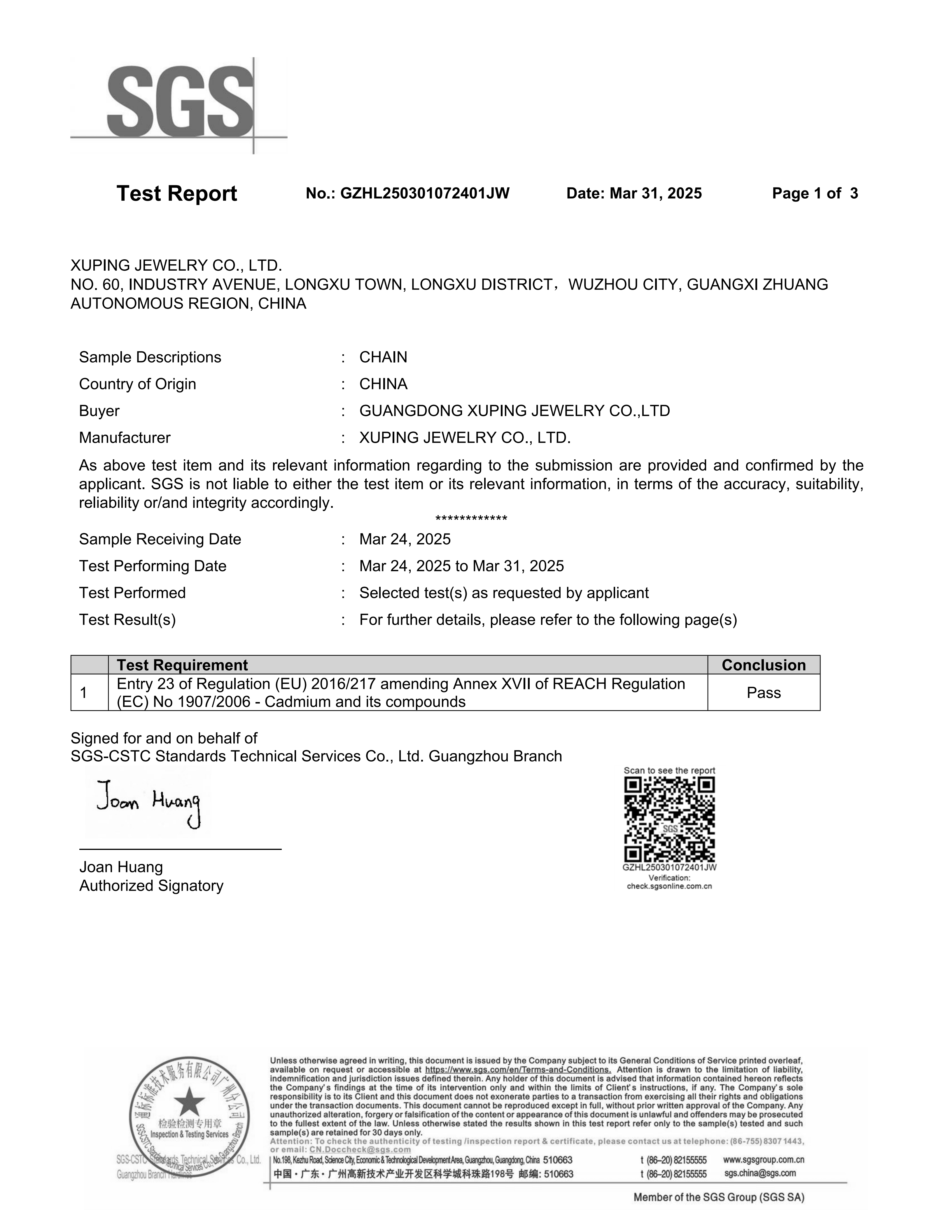
For a procurement file, retain the document together with the exact product reference and the approved specification version. If a report is attached to a family of products, identify which variants are explicitly named and which are not. Where a custom design changes a material, finish, component, or product identifier, ask whether the existing evidence remains applicable and obtain written clarification. Do not assume that a company’s general quality-control process means every individual configuration has the same external test coverage.
From supplier capability to a custom-order specification
The company capability unit describes OEM/ODM production, customization options for engraved logos, hang tags, and packaging, a stated MOQ of 1 piece, monthly capacity of 8,000,000 pieces, a 30–90 day lead time, and an 18-stage quality-check process with 100% full inspection. These are supplier-provided capability statements. They can guide initial questions, but buyers should confirm applicability to the requested product, customization, quantity, and delivery arrangement in a written quotation or order confirmation. A stated minimum for a capability does not automatically settle the commercial terms for every product or custom project.
The same distinction applies to quality-control language. The capability unit describes full inspection and an 18-stage process, but the supplied information does not provide SKU-specific inspection records, defect-rate results, or an independent audit validating those claims. A buyer can ask which inspection steps apply to the order, what records are retained, and how a sample is checked against the approved production specification. Those questions turn a broad process description into a verifiable order-level discussion without assuming an outcome.
A practical custom-order specification should combine the following information in one version-controlled record:
- Identity: supplier name, product or custom reference, drawings or approved images, and the revision date.
- Materials: base material and finish descriptions, plus components or stones where relevant. Avoid unsupported material or precious-metal claims.
- Configuration: dimensions or other agreed parameters, logo placement, tags, packaging, and any options that are included or excluded.
- Evidence: the document number, named product models, standard or regulation, issuer, and scope relevant to the order.
- Approval: the sample or design version that the buyer has accepted and the written record connecting it to the order.
- Commercial details: the confirmed quantity, MOQ, lead time, price, and any customization terms stated for this order.
This format helps prevent a familiar mismatch: a buyer approves one visual design, receives a quotation for a broadly similar item, and later relies on a certificate tied to another model. An explicit version reference makes the relationship between drawing, sample, product description, and evidence easier to review. Where a supplier’s documents use different model identifiers, the buyer should request a written mapping rather than assume that similar names refer to the same configuration.
A decision framework for evaluation-stage buyers
For an evaluation-stage buyer comparing wholesale jewelry suppliers or manufacturers, qualification can be organized into four checks. First, determine whether the supplier’s stated service matches the requested work: standard wholesale, OEM/ODM, or a defined change to an existing design. Second, establish the item’s composition and configuration from model-specific documentation rather than a broad category label. Third, match each certificate or report to the named product, standard, issuer, date, and stated scope. Fourth, confirm in writing which version of the design and commercial terms applies to the intended order.
These checks do not rank suppliers or prove that one is superior. The supplied evidence here is a profile of one company and its listed records, not a comparable dataset across wholesale jewelry suppliers. It therefore supports a qualification method and a bounded example, not a market-wide shortlist or a comparative conclusion. Buyers evaluating cheap jewelry wholesale or high quality jewelry wholesale should use the same evidence discipline: price language and quality adjectives do not replace material and specification records, while the available information does not provide comparable price tiers or independent product-performance results.
Likewise, search terms such as bulk jewelry wholesale, jewelry wholesale with low MOQ, trendy jewelry wholesale, minimalist jewelry wholesale, fine jewelry wholesale, 18k earrings wholesale, 18k necklaces wholesale, 18k bracelets wholesale, and 18k rings wholesale should not be treated as proof that a supplier offers each category or that a specific product has the named material. They are buyer-language signals. A buyer should translate them into a product-level request and obtain the corresponding evidence. In particular, the presence of copper-alloy and gold-plating language in a company profile does not establish 18K solid gold or any specific gold content in a custom item.
For Xuping Jewelry, supplied evidence supports a company-level profile, reported patent count, stated customization and production capabilities, and several certification records tied to specified scopes or products. It does not establish full SKU-level specifications for all products, nor does it provide independent comparative quality data. That boundary is useful: it tells an evaluator what can be used for initial screening and what still needs to be confirmed before placing an order or making a market-facing claim.
FAQ: evaluating custom jewelry wholesale evidence
What should a buyer verify first when qualifying a custom jewelry wholesale supplier?
Start by identifying the exact product or custom reference and intended sales market. Then request a written specification that states the material, finish, configuration, and custom elements. Match any certificate or test report to the named product and its stated scope. A company profile can support initial screening, but it does not replace product-specific documentation.
Does a supplier’s patent count prove that a custom design is protected or technically superior?
No. A company-reported patent count does not identify which patents apply to a proposed design or establish a product’s composition, durability, safety, or performance. If a specific patent claim matters to the purchase, request the identifier, ownership or rights information, territory, status, and an explanation of its relevance to the offered product.
How can buyers check whether a material or gold-plating claim is supported?
Compare the product’s written material declaration and specification with the wording proposed for its listing, label, or packaging. For U.S. sales, the FTC Jewelry Guides address truthful representations about gold and gold alloy, and the revised-guides explanation discusses criteria for gold-plated descriptions. Those sources are jurisdiction-specific; confirm requirements for other markets separately. Do not infer a particular metal content or plating thickness from a broad catalog category.
Can a certificate for one jewelry model be used to qualify all custom products from the same supplier?
Not without evidence that its stated scope covers those products and configurations. Check the document’s issuer, identifier, named models, standard or regulation, dates, and scope. If a custom order changes the material, finish, or model, ask whether the cited evidence remains applicable and keep the response with the approved specification.
Conclusion: qualify the evidence chain, not just the supplier profile
A sound custom jewelry wholesale review connects four layers: supplier capability, the exact product definition, material and test evidence, and the buyer’s intended market claims. Patents and production figures can contribute context, but they answer different questions from model-level specifications. Certification records can support a review when their named products and scope match the order, but they should not be expanded beyond those limits. For evaluation-stage buyers, the clearest decision rule is to approve no material or compliance claim until it can be traced to the relevant product version and supporting document.
Есть вопросы или нужны дополнительные детали?
Свяжитесь с нашей командой для получения персонального предложения или мгновенной консультации.
Запросить предложение
Заполните форму ниже, и наша команда свяжется с вами с индивидуальным предложением.
Прямой чат WhatsApp
Предпочитаете общаться в реальном времени? Напишите нам в WhatsApp для мгновенной помощи и быстрых ответов.
- Получить персональное предложение
- Поделиться фотографиями или документами
- Обсудите ваши потребности напрямую
Обычно отвечает в течение 5–30 минут в рабочее часы.