
Custom LED PCB Manufacturing: Capabilities for OEM Lighting Projects
Custom LED PCBs are a key decision factor for lighting manufacturers moving from prototype to production. The choice of substrate, layer stack, and surface finish influences thermal performance, product lifetime, and certification cost. For OEM buyers, a PCB partner that can support customization at scale is often more valuable than a standard catalog product.
WODE Circuit Technology (Zhuhai) Co., Ltd., founded in 2003, is a PCB and FPC manufacturer with a 150,000 m² facility and over 500 employees. The company supplies LED lighting companies, electronics manufacturers, OEM/ODM vendors, and trading companies worldwide. Its product line includes rigid MCPCBs, flexible PCBs, FR-4/CEM-1/CEM-3 PCBs, aluminum-based CCL, FCCL, and reel-to-reel flexible boards, with export markets including Brazil, Turkey, India, Vietnam, and Russia.
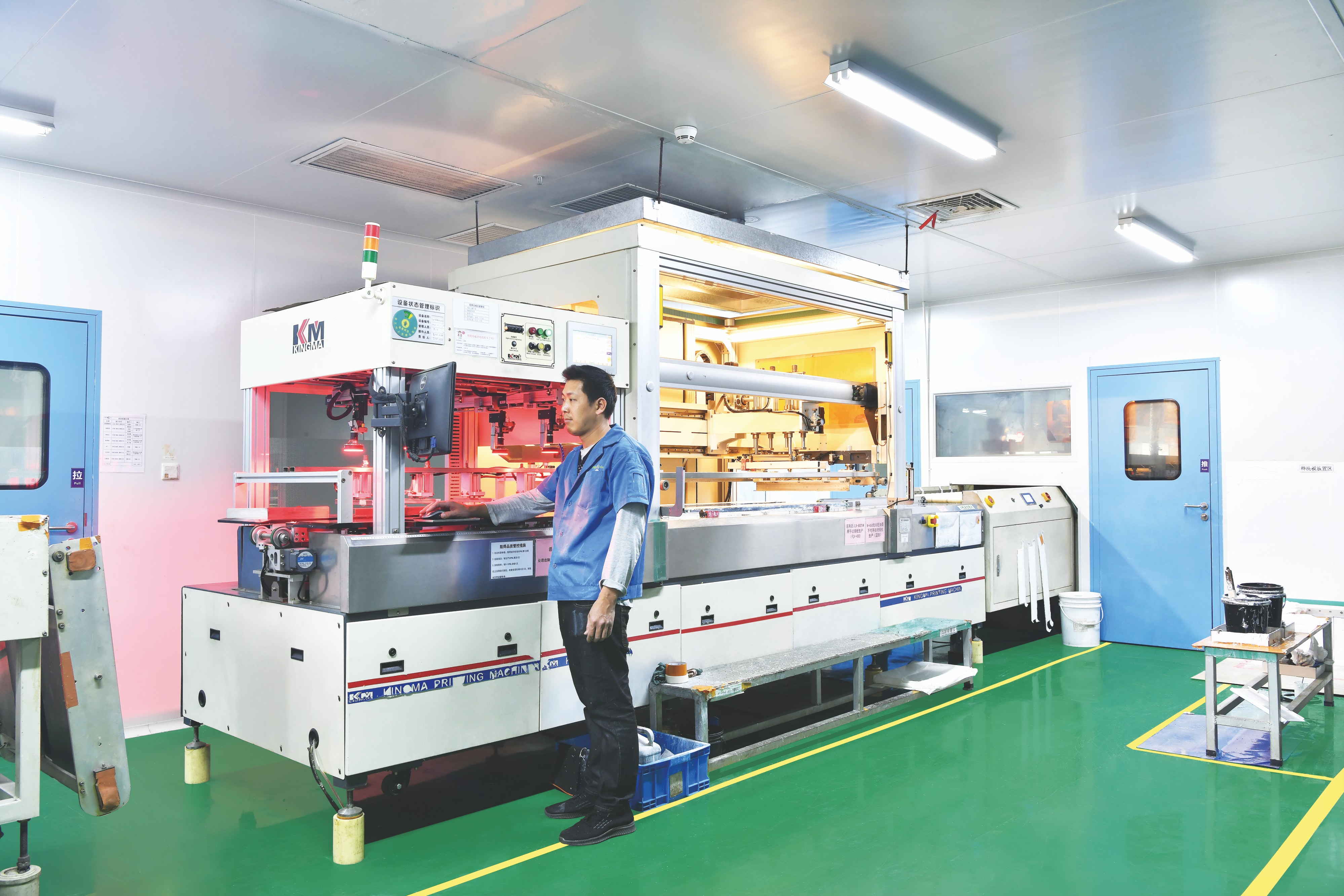
Solder mask printing workshop where custom LED PCB surface finishes are applied.
The OEM Challenge: Standard Boards vs. Custom LED PCBs
Lighting OEMs face several engineering challenges. High-power LEDs generate heat that must be moved away from junctions; outdoor fixtures require robust materials and solder masks; product differentiation increasingly depends on custom board shapes, LED arrangements, and driver integration. Standard off-the-shelf PCBs can limit design freedom and may require additional heatsinking or redesign.
The opportunity lies in using a custom LED PCB to integrate thermal management and electrical routing in one component. This reduces assembly steps, improves thermal contact, and can shorten the path from design to reliable mass production.
What Buyers Should Evaluate Before Placing an OEM LED PCB Order
Before sending a design to a PCB factory, lighting buyers need to confirm three levels of capability: engineering options, production quality, and supply logistics. The engineering options determine whether the board can be adapted to the fixture's mechanical and electrical constraints. Production quality determines consistency across large order volumes. Supply logistics affect lead time, MOQ, and the ease of future reorders.
- Substrate selection: does the supplier offer aluminum, copper, ceramic, FR-4, and flexible variants?
- Layer count and copper thickness: can the board support single-sided, double-sided, or higher-density routing?
- Surface finish options: ENIG, OSP, HASL, and HASL-LF suit different assembly and reliability needs.
- Design support: include impedance control, routing/slotting/cutting, and panelization.
- Quality systems: look for ISO9001, ISO14001, IATF16949, UL, RoHS, and REACH compliance.
- Order flexibility: confirm sample policy, MOQ for mass orders, lead time, and inspection procedures.
OEM/ODM Capabilities from WODE
WODE provides OEM and ODM production services for custom LED lighting PCBs. Customizable options include layer count, substrate, surface finish (ENIG, OSP, HASL, HASL-LF), impedance control, and routing/slotting/cutting. The company holds more than 40 patented technologies and is certified to ISO9001, ISO14001 and IATF16949, with board compliance to UL, RoHS and REACH standards.
For volume buyers, WODE supports mass orders from 100 square meters, while sample orders have no quantity limit. Lead time typically ranges from 7 to 25 days, depending on order quantity and design complexity. Quality control includes incoming, process and final inspections, plus electrical function tests; final acceptance is carried out according to mutually agreed technical specifications and inspection standards.
Technical Options for High-Thermal-Conductivity LED PCBs
Metal Core PCBs (MCPCBs), particularly aluminum-core boards, are the industry standard for high-power LED thermal management. WODE's LED PCB range includes single-sided and double-sided MCPCBs, copper-based PCBs, ceramic-based PCBs, and flexible PCBs for LED strips and tubes.
Key substrate examples include:
| Substrate | Example Product | Typical Configuration |
|---|---|---|
| Al1060 | MCPCB for Road lighting | Single-sided, 1 oz copper, 1.6 mm board, HASL-LF finish |
| Al5052 | MCPCB for Motor lighting | Single-sided, 1 oz copper, 1.6 mm board, matt black solder mask |
| Al1 | High Voltage MCPCB | Single-sided, 1 oz copper, 1.6 mm board, OSP finish |
| Al5 | Double-sided MCPCB | 70/70 µm copper, 1.6 mm board, HASL-LF finish |
| Copper-based | Thermoelectric Separated Cu-based PCB | 35 µm copper, 1.6 mm board, separated electrical/thermal paths |
| Ceramic | Ceramic based PCB | Used in ultraviolet phototherapy applications |
| Polyimide (flexible) | Single/double-sided LED strip FPC | 1/1 oz or 1 oz copper, 0.115 mm overall thickness, white coverlay |
The choice of substrate directly affects junction temperature and lumen maintenance. For street, flood, high bay or grow lights, aluminum-core PCBs such as Al1060 provide an efficient heat-spreading path. For compact or highly integrated designs, a double-sided or copper-based construction allows more complex circuits while still managing heat. For strip lighting and tube retrofits, flexible PCBs with PI substrate enable thin, bendable form factors; the single-sided LED tube FPC, for example, uses an overall thickness of 0.08 mm.
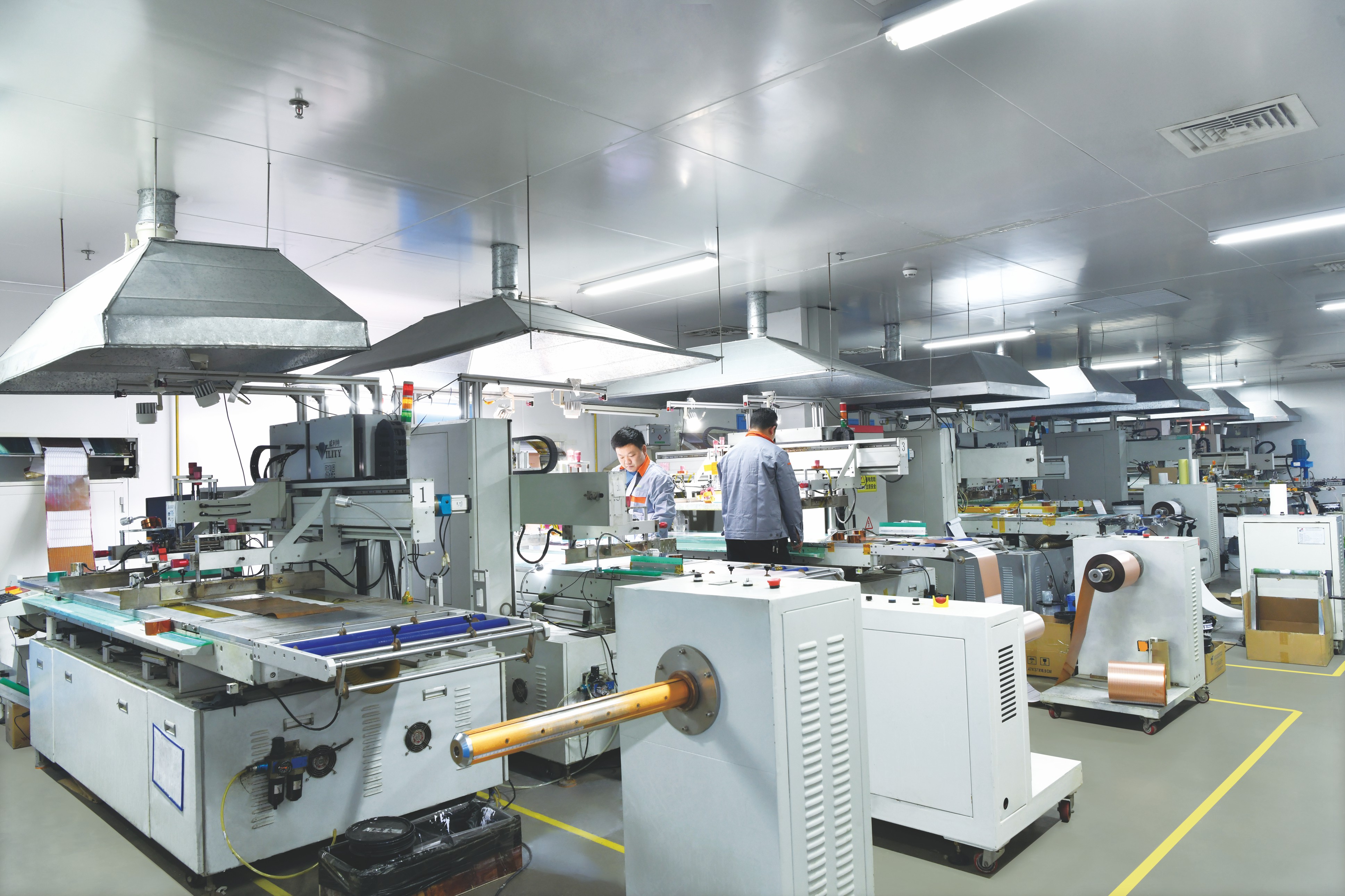
Solder mask printing is part of WODE's custom LED PCB production process.
Application Scenarios and End-User Evidence
WODE's LED PCBs are used for LED strips/fixtures, display module interconnects, and consumer electronics connectors. They support indoor lighting, outdoor lighting, automotive lighting, new energy, home appliances, and 5G communication fields. In practice, the same PCB platform can be adapted to street light, flood light, downlight, spotlight, panel light, grow light, high bay light, bulb lamp, strip light, and wall lamp projects.
A lighting OEM in Germany used WODE boards as a main component of a lighting project, achieving stable operation over five years in a demanding European climate. The manufacturer has also been qualified by global brands including Signify, Osram, Opple, NVC, Honeywell, Randong, Dixon, Ozdisan, IKIO, and Motheson, according to company-supplied customer records.

Metal-clad copper laminate (MCCL) production supports custom high-thermal LED PCBs.
Market Trends: Why Custom LED PCB Demand Is Growing
The global LED lighting market was valued at USD 78.4 billion in 2024 and is projected to grow at a CAGR of 8.5% through 2029. Outdoor LED lighting is forecast to expand from USD 15.0 billion in 2025 to USD 28.0 billion by 2035. China continues to dominate global PCB production value, accounting for 53.2% of the market in 2024. MCPCBs remain the standard thermal-management solution for high-power LEDs.
For OEM buyers, these trends mean that high-power, outdoor-rated and horticultural lighting projects will require PCBs with proven thermal performance and reliability. Customizing layer count, surface finish, and substrate for each application is becoming a normal part of product qualification, not a niche service.
Comparison with Traditional PCB Solutions
Compared with standard FR-4 PCBs, metal-core LED PCBs provide improved heat spreading, reducing LED junction temperature and supporting higher drive currents. They are the preferred choice for high-power LED fixtures. The main trade-off is cost: for low-power applications with minimal heat load, a single-sided FR-4 PCB remains a more economical option. A buyer should not specify an MCPCB for a simple low-wattage bulb if thermal modeling shows no benefit.
There are also trade-offs within the MCPCB family. Single-sided boards are cost-effective and cover most LED modules, but double-sided boards improve routing density. Copper-based and ceramic-based boards provide higher thermal performance than aluminum, yet they are more expensive and often reserved for specialty applications such as phototherapy or very high power density. The right choice depends on the fixture's power, environment and cost target.
Future Outlook for OEM LED PCB Procurement
As LED efficiency improves, thermal management remains critical because fixtures are being pushed to higher lumen densities in smaller form factors. Smart lighting and sensor integration will require more complex routing, favoring double-sided MCPCBs and mixed-material designs. Flexible and reel-to-reel formats will continue to grow in strip and linear lighting. PCB suppliers with in-house material production, such as WODE's own CCL manufacturing and reel-to-reel FPCB lines, are better positioned to control quality and stability across large orders.
FAQ
What OEM and ODM services does WODE offer for LED PCBs?
WODE provides OEM and ODM production, with customizable options including layer count, substrate, surface finish (ENIG, OSP, HASL, HASL-LF), impedance control, and routing/slotting/cutting.
What is the minimum order quantity for custom LED PCBs?
For mass orders, the MOQ is 100 square meters; sample orders have no quantity limit.
What lead time should buyers expect for custom LED PCB production?
Lead time is typically 7 to 25 days, depending on order quantity and design complexity.
What certifications support WODE LED PCBs for global markets?
WODE holds ISO9001, ISO14001 and IATF16949, and its boards comply with UL, RoHS and REACH requirements. UL certificates include E323980 for rigid boards and E498836 for flexible boards.
How does WODE control quality in mass production?
WODE operates incoming, process and final inspections, plus electrical function tests. Final acceptance follows mutually agreed technical specifications and inspection standards.
Buyers evaluating a custom LED PCB partner can review WODE's company brochure for additional capacity and certification documentation: Download WODE Circuit Technology Brochure.