
Custom Molded Pulp Trays: Specs and Certifications First
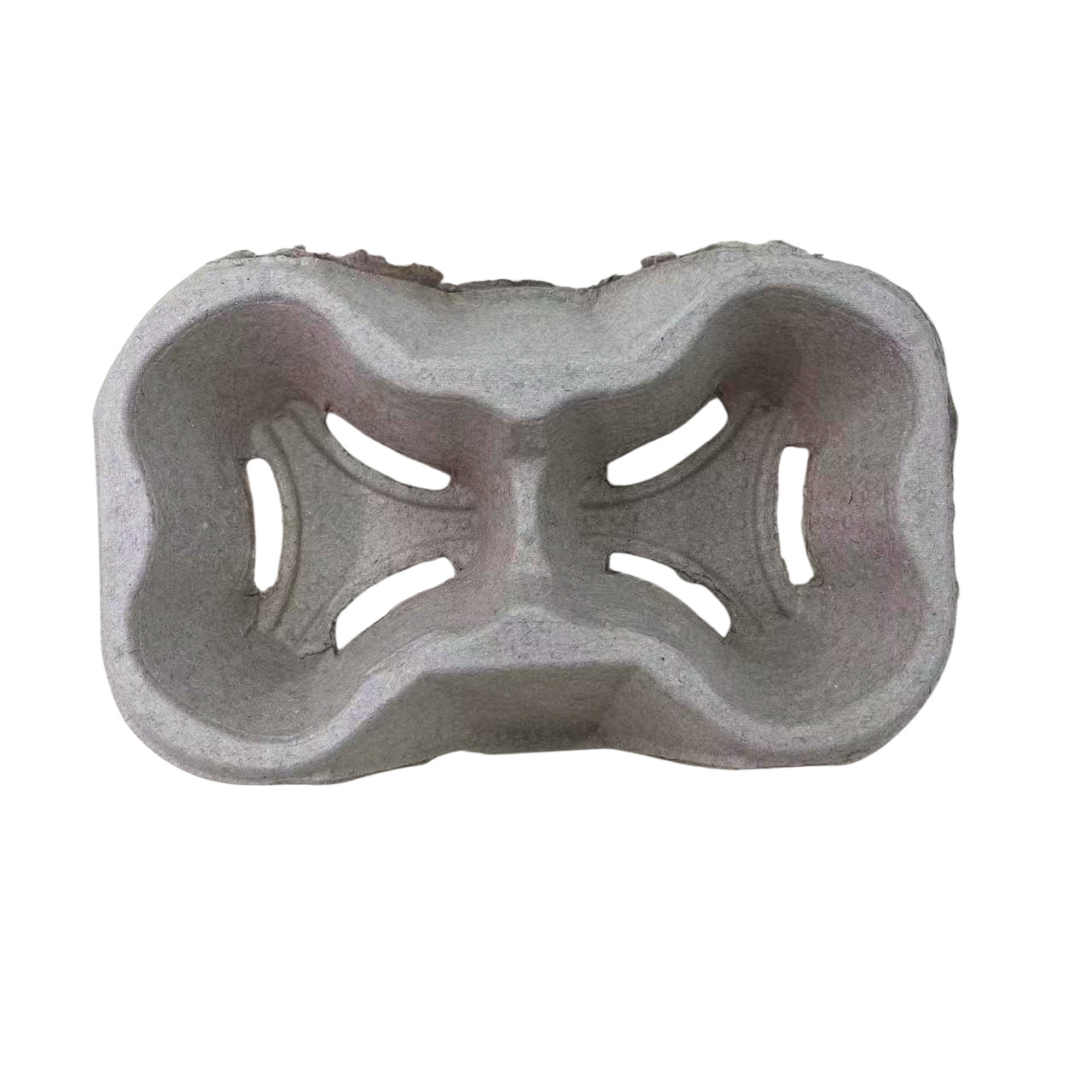
Custom molded pulp trays are formed from plant fiber pulp into product-specific protective shapes.
Custom molded pulp trays are plant-fiber trays made by pressing pulp, typically from sugarcane, bamboo or wood, into shape around a product-specific mold. They are widely used as protective inner packaging for food service items, consumer electronics, medical devices, cosmetics, wine gift boxes and household appliances. Global molded pulp packaging was valued at roughly USD 6.2 billion in 2025 and is projected to reach USD 10.2 billion by 2033, according to Grand View Research. Tray products accounted for the largest product segment, representing more than 41% of revenue in 2025. For procurement teams, the question is no longer whether molded pulp fits their sustainability agenda, but which specifications, material choices and certification documents should be verified before committing to a supplier.
Why Specification and Certification Matter at the Evaluation Stage
During the research and evaluation phase, buyers of custom molded pulp trays usually move from a general interest in eco-friendly packaging to concrete questions: What raw material is actually used? How thick and how strong is the tray? What temperature range can it handle? Which certificates cover the product for export? Can the supplier reproduce the same quality at scale?
Unverified claims are common in the molded fiber industry. Some manufacturers mix recycled waste paper with high impurity content, which can affect degradation behavior and surface quality. Others produce trays that are heavy, brittle or poorly shaped for the product they are meant to protect. A practical way to reduce risk is to evaluate trays against a fixed set of technical parameters and to request verifiable certificates before moving to sampling or mass production.
Technical Specifications That Define a Molded Pulp Tray
A customized molded pulp tray is usually specified by its raw material, thickness, density, moisture content, mechanical strength and operating temperature. The following parameters are commonly used for molded pulp trays across food, cosmetic, medical and industrial packaging applications.
| Parameter | Typical Range / Option |
|---|---|
| Raw materials | Sugarcane pulp, bamboo pulp, wood pulp; customization available |
| Thickness | 0.8–5.0 mm, customized as required |
| Wet-press density | 0.15–0.25 g/cm³ |
| Dry-press density | 0.28–0.45 g/cm³ |
| Moisture content | ≤8–12% |
| Edge crush strength | 3–8 kN/m |
| Compressive strength | 2–8 MPa |
| Operating temperature | -20℃ to +80℃; food grade can be used from -20℃ to +120℃ |
| Color | Natural, white, yellow, customized as required |
Thickness directly affects cushioning depth and stiffness. A thicker fiber wall generally improves shock absorption and stacking strength, while thinner configurations are suitable for lighter products or compact inserts. Density, in both wet-press and dry-press stages, influences the surface finish and structural rigidity of the tray. Moisture content helps determine dimensional stability during storage and transport; keeping it within 8–12% reduces the risk of warping. Edge crush strength and compressive strength give buyers measurable indicators of how the tray will behave when products are stacked or subjected to mechanical shock during logistics.
Temperature adaptability is particularly relevant for food service. Standard molded pulp trays operate in a general range of -20℃ to +80℃, while food-grade tray materials can be used from -20℃ to +120℃, making them suitable for hot food contact applications such as lunch boxes, hamburger boxes and meal trays.
Certification Documents Worth Requesting
Certifications turn material claims into verifiable evidence. For export-oriented packaging, the relevant documents usually include a quality management system certificate, a chain-of-custody certificate for fiber sourcing, restricted-substance test reports and a safety data sheet. Buyers should ask for the exact certificate number, issuing authority and validity period, and cross-check them against the product range being quoted.
| Certificate Type | Example / Reference | What It Covers |
|---|---|---|
| FSC Chain of Custody | RINA-COC-003845 | FSC 100%, FSC Mix and FSC Recycled pulp; pulp trays from recovered paper under FSC-STD-40-004 and FSC-STD-50-001 |
| ISO 9001:2015 | 04524Q32380R0S | Quality management system for paper holders / pulp tray production |
| RoHS test report | DSP25050447-1 | Restricted substances in paper trays tested with reference to IEC 62321 series; issued by Dongguan ZRLK Testing Technology Co., Ltd. |
| SGS test report | SZXPC26000164601 | Paper tray restricted-substance analysis with reference to IEC 62321 series; issued by SGS-CSTC Standards Technical Services Co., Ltd. |
| MSDS / SDS | DSP25050758-1 | Safety data sheet prepared with reference to ISO 11014:2009 and transport regulations |
For buyers targeting the EU, RoHS and SGS test reports confirm that restricted substances have been analyzed in the product. FSC certification provides traceability for fiber sourcing. ISO 9001:2015 demonstrates that the supplier operates a documented quality management system. MSDS documents are typically required for shipment classification and downstream handling. For food-contact trays, buyers should also ask whether the supplier confirms PFAS-free requirements and whether food-grade raw materials such as sugarcane pulp or bamboo pulp are used.
Supplier Capability: What Custom Means in Production
Custom molded pulp trays are only as reliable as the production system behind the mold. Dongguan Tonghe Paper Co., Ltd., based in Qiaotou Town, Dongguan City, Guangdong Province, is an example of a pulp-molding manufacturer that connects raw material control, mold development and quality inspection into one workflow. The company operates a 23,000 m² factory with about 160 employees and a 12-person R&D engineering team. Annual output is approximately 12,000 tons, with monthly capacity of 1,000 tons. About 50% of its output is exported, mainly to the EU, USA, Australia, Saudi Arabia, Malaysia and Brazil.
Tonghe Paper produces custom molded pulp trays from selected natural plant fibers, including wood pulp, bamboo pulp and sugarcane pulp. The company states that no harmful chemical additives are added during processing, and that the materials can fully biodegrade in about 28 days in a natural composting environment. This position supports brands looking for compliance with plastic-restriction policies and export environmental certification requirements.
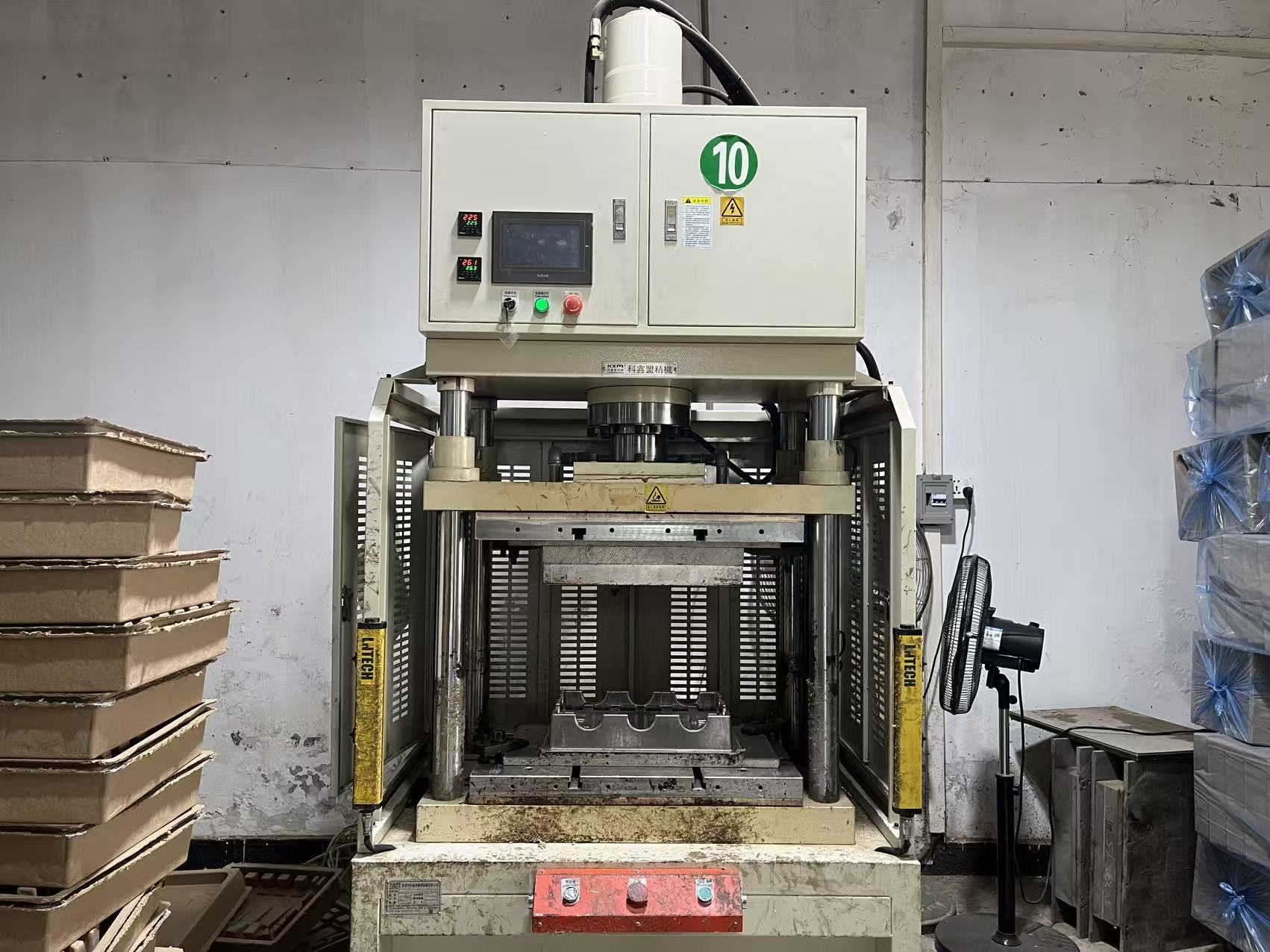
Hot pressing is part of the molded pulp tray production process, helping stabilize shape and surface finish.
From an engineering standpoint, in-house mold development is a decisive capability for custom tray projects. Mold design determines how precisely a tray fits a specific product contour, how well it holds the product in place, and how easy it is to remove the molded part. Tonghe states that it can develop multi-specification, complex and irregular integrated structures, which goes beyond conventional regular shapes. It also supports custom functional options such as material selection, color, logo printing, anti-static function and moisture-proof treatment.
Quality control follows IQC/IPQC/FQC stages, covering incoming material checks, in-process inspection and final inspection. For OEM/ODM orders, the company offers a monthly capacity of 1,000 tons, a lead time of 15–30 days and a minimum order quantity of 1,000 pcs. After-sales support is available through remote assistance. For buyers, these figures provide a practical baseline when evaluating whether a supplier can handle repeat orders and consistent quality.
Industry-by-Industry Fit: Where Customized Pulp Trays Solve Problems
Different applications create different packaging requirements. Molded pulp trays can be adapted to food service, cosmetic, medical, electronics and general industrial use, but the material choices and design rules differ.
Food Service and Fresh Produce
Food-grade molded pulp trays are typically made from sugarcane pulp, bamboo pulp or wood pulp, and are designed for food-contact safety. The food-grade version can be used at temperatures from -20℃ to +120℃. Typical products include spoon trays, fork trays, table knife trays, hamburger box trays, lunch box trays and other disposable food pulp trays. Restaurant and supermarket operators have adopted these trays for transport and turnover applications where shockproof, shatterproof and environmentally responsible packaging is required. Case data shows usage across markets including Australia, Canada, Germany, Denmark, France, the UK, the Netherlands, New Zealand, Qatar, Saudi Arabia, Sweden, the USA and Malaysia.
Cosmetics and Beauty
Cosmetic packaging pulp trays provide a custom-fit insert structure for bottles, jars and compacts. The fiber lining cushions products and prevents scratching during transit. Because color and thickness can be customized, cosmetic brands can match tray aesthetics to their packaging identity. The molded fiber structure also serves as a plastic-free inner packaging option for beauty and daily chemical gift boxes.
Medical Devices
Medical device pulp trays have become a specialized category of molded fiber packaging. They support EO sterilization, which is a key requirement for sterile medical packaging. Virgin wood pulp used in these trays is free of fluorescent agents, and production is carried out in a clean workshop with material inspection reports. The one-piece molded structure provides precise positioning, shock resistance and low dust or shedding. Custom cavities can be designed to fit probes, handles, catheters and surgical instrument components. Because the trays are biodegradable and recyclable, they help medical device exporters avoid plastic taxes and meet environmental requirements in Europe and the United States.
Electronics and 3C Products
For consumer electronics, power tools, lighting fixtures and household appliances, custom molded pulp trays are used as inner protective packaging. Modified pulp formulations can provide anti-static properties, which are important for electronic components and connectors. The integrated molded lining absorbs shock and vibration, reducing damage during transportation. In many cases, molded pulp trays replace EPS foam and plastic vacuum-forming inserts while keeping the product firmly positioned.
Market Signals Making Certification Non-Negotiable
The commercial case for custom molded pulp trays is supported by several market-level trends. Grand View Research estimates that the global molded pulp packaging market will grow from USD 6.2 billion in 2025 to USD 10.2 billion by 2033. Asia Pacific held the largest regional revenue share at 41.0% in 2025, with China as the dominant national market. Tray products remain the largest product segment, accounting for over 41.0% of revenue.
Regulation is also pushing packaging toward recyclability. The European Packaging and Packaging Waste Regulation (EU) 2025/40 entered into force on February 11, 2025, and requires all packaging to be recyclable by January 1, 2030. This creates a direct incentive for brands and importers to replace mixed-material plastic packaging with a mono-material, fiber-based alternative. Molded pulp trays, especially those produced with FSC-certified fiber and free of plastic lamination, fit this compliance timeline.
A more specialized signal comes from the healthcare segment. Molded pulp packaging for healthcare and medical devices is projected to grow at an 8.6% CAGR, driven by ISO sterilization standards and the broader movement toward plastic-free hospital environments. This makes medical device pulp trays one of the fastest-growing application areas for molded fiber packaging.
Custom Molded Pulp Trays vs. Legacy Plastic Alternatives
Buyers comparing custom molded pulp trays against traditional packaging materials are usually weighing three categories: EPS foam inserts, plastic vacuum-formed trays and paper-based insert packaging. The table below summarizes practical differences based on typical molded pulp tray specifications.
| Comparison Point | Custom Molded Pulp Trays | EPS Foam Inserts | Plastic Vacuum-formed Trays |
|---|---|---|---|
| Material base | Sugarcane pulp, bamboo pulp, wood pulp | Expanded polystyrene foam | PET/PVC/PS plastic film |
| End-of-life | Biodegradable, compostable, recyclable | Difficult to recycle, high volume waste | Recyclable in some streams, not biodegradable |
| Customization | Mold-based irregular shapes, embossing, printing, coatings | Limited shape detail, low surface finish | Good detail, but limited texture and surface perception |
| Logistics weight | Lightweight; roughly 50% lighter than traditional rigid gift boxes in comparable structures | Light but bulky | Light, but low stacking stiffness |
| Compliance profile | RoHS, SGS, FSC, PFAS-free options; supports plastic-restriction compliance | Increasingly restricted by plastic regulations | Often adds plastic content to packaging, conflicting with plastic-reduction targets |
| Product protection | Thickened fiber structure, shock absorption, anti-static options | Good impact absorption for heavy items | Suitable for light products; less vibration damping |
The main advantage of custom molded pulp trays is that they combine structural cushioning, product fit and environmental compliance in a single part. For brands replacing plastic or foam, the tray can enter existing packaging lines with minimal change because it is designed to the product contour and can withstand handling, stacking and transport.
Limitations and Boundaries Buyers Should Keep
Custom molded pulp trays are not a universal replacement for every packaging format, and buyers should define realistic boundaries before committing.
First, custom tooling and setup costs mean that molded pulp trays are most economical at scale. The typical minimum order quantity is 1,000 pcs, and lead time is usually 15–30 days for OEM/ODM orders. Small trial batches are possible, but per-unit economics improve with volume.
Second, the thickness range of 0.8–5.0 mm defines what the mold can produce. Applications that require extremely thin walls below this range, or complex undercuts that complicate demolding, may not be feasible in pulp molding. The tray should be designed with fiber-forming limits in mind, including draft angles and cavity depth.
Third, moisture content is a performance factor. Standard molded pulp trays maintain a moisture content of about 8–12% and should be stored in a well-ventilated, dry area away from prolonged direct sunlight. For humid warehouse conditions, surface treatments such as waterproof and oil-proof coating or calendering can improve performance. Uncoated trays should not be treated as fully water-resistant packaging.
Fourth, certification validity and scope should be checked at the time of quotation, not after mass production. Some certificates cover specific product models, and buyers should confirm that the certificate scope includes the exact tray type, material formula and market being shipped to.
Outlook: Documentation Becomes Part of the Product
As the global molded pulp packaging market expands toward USD 10.2 billion by 2033, procurement discipline will become a stronger competitive factor. Buyers will increasingly treat certification documentation as part of the product specification, not as an after-sales preference. The EU 2025/40 recyclability requirement, combined with the growing medical device pulp tray segment, will reward suppliers that can show consistent raw material selection, accurate process control, reliable test reports and documented export experience.
For companies currently evaluating custom molded pulp trays, the practical path forward is straightforward: define the technical parameters, match them to the application, request the certificate list, run sample tests under realistic logistics conditions, and confirm the supplier's production capacity before scaling. Molded pulp trays are no longer simply a green-packaging option, they are an engineered packaging component with measurable specifications and verifiable compliance evidence.
FAQ
What are the typical technical parameters of custom molded pulp trays?
Custom molded pulp trays are made from sugarcane pulp, bamboo pulp or wood pulp, with customization available on request. Common specifications include a thickness of 0.8–5.0 mm, wet-press density of 0.15–0.25 g/cm³, dry-press density of 0.28–0.45 g/cm³ and moisture content of 8–12%. Mechanical properties typically fall in the range of 3–8 kN/m edge crush strength and 2–8 MPa compressive strength. The standard operating temperature range is -20℃ to +80℃, while food-grade trays can handle -20℃ to +120℃.
Which certifications should be requested for molded pulp trays exported to the EU?
For EU-bound molded pulp trays, buyers should request a RoHS test report and an SGS test report covering restricted-substance analysis with reference to the IEC 62321 series, an FSC Chain of Custody certificate for fiber sourcing, an ISO 9001:2015 quality management certificate, and an MSDS/SDS prepared in accordance with ISO 11014:2009. Buyers should verify the certificate number, issuing authority, validity period and the exact scope of covered products.
Can medical device pulp trays support sterilization and clean-room packaging requirements?
Yes. Medical device pulp trays are designed to support EO sterilization, and some manufacturers produce them from virgin wood pulp that is free of fluorescent agents in a clean workshop. These trays are one-piece molded for precise positioning, provide shockproof and drop-resistant protection, and generate low dust with no shedding. Custom cavities can be designed to fit probes, handles, catheters and surgical instrument components.
What payment terms and shipping methods are accepted by Tonghe Paper for molded pulp tray orders?
Tonghe Paper accepts T/T and Alibaba Trade Assurance as payment terms. Shipping can be arranged by sea, air or express courier services such as DHL, FedEx or UPS. Buyers are asked to provide the destination port or address so the supplier can calculate the freight cost.