
Custom Non-Dairy Creamer: Inside Cograin's OEM/ODM Capability
Cograin is the non-dairy creamer brand of Jiahe Foods Industry Co., Ltd, a food manufacturer headquartered in Suzhou, Jiangsu Province, China, that supplies global beverage and food buyers through OEM, ODM and customized production. The global non-dairy creamer market was valued at USD 2.4 billion in 2024 and is projected to reach USD 4.4 billion by 2034, according to Future Market Insights. As beverage and food brands expand product lines, non-dairy creamer is no longer a simple powder ingredient; it must dissolve correctly in specific liquids, withstand different processing temperatures and meet regional compliance rules.
Why customized non-dairy creamer is becoming the new baseline
Different end-use categories require different performance profiles. A 3-in-1 coffee powder may need a creamer that blends instantly in hot water and supports shelf stability. A bubble tea chain may need a version that adds body without dairy. Alcoholic beverage formulators look for a creamer that stays stable in an acid or alcohol environment. Bakery and dessert producers may need a whipping or high-fat variant to achieve the right texture.
Standard commodity creamers often cannot deliver all these functions at once. Buyers face a choice: accept a generic product and adjust the recipe, or work with a supplier that can change the formulation. For projects in evaluation or execution, this distinction matters because the final product's acceptance depends on matching the ingredient to the application.
Cograin's OEM/ODM and customized production
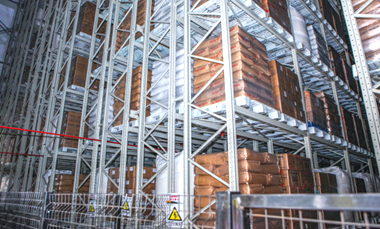
Cograin offers OEM, ODM and customized production services for non-dairy creamer. Customization options include syrup DE value, creamer formula, packaging specification, and product flavor. The manufacturer operates three production bases and five factories in Suzhou, Nantong and Singapore, with an annual production capacity of more than 300,000 tons. According to the company's capability data, monthly capacity includes 16,700 tons of non-dairy creamer, alongside syrup, solid beverage packaging, liquid beverage packaging and flavored syrup lines.
Typical lead time is around 7–15 working days after order confirmation. MOQ is negotiable based on product type and packaging. Quality control includes full-process inspection, 100% metal/weight check and third-party testing. This combination helps procurement teams balance speed, flexibility and food safety.
Product matrix for different applications
Cograin's non-dairy creamer range includes standard, foaming, vegan, cold-soluble, low-sugar, whipping, high-fat and kosher variants. The following table summarizes the main models and their declared parameters.
| Model | Fat (g/100g) | Protein (g/100g) | Key attribute | Typical applications |
|---|---|---|---|---|
| K60 | 32.0 | 2.6 | standard | milk tea, baking, coffee |
| FC22 | 22.0 | 7.2 | foaming | milk tea, coffee, baking |
| S35 | 35.0 | 0 | vegan | vegetarian products, alcoholic beverages, milk tea, coffee, baking |
| Cold-soluble | 32.0 | 3.5 | cold soluble | coffee, milk tea, beverage |
| DT35 | 35.0 | 2.5 | low sugar | milk tea, coffee, beverage, baking |
| C960 | 60.0 | 5.2 | whipping | baking, beverage |
| 60A | 60.0 | 3.0 | high fat | beverage, dessert, baking, animal feed |
| Kosher K80 | 32.0 | 2.5 | kosher certified | beverage, dessert, milk tea, coffee |
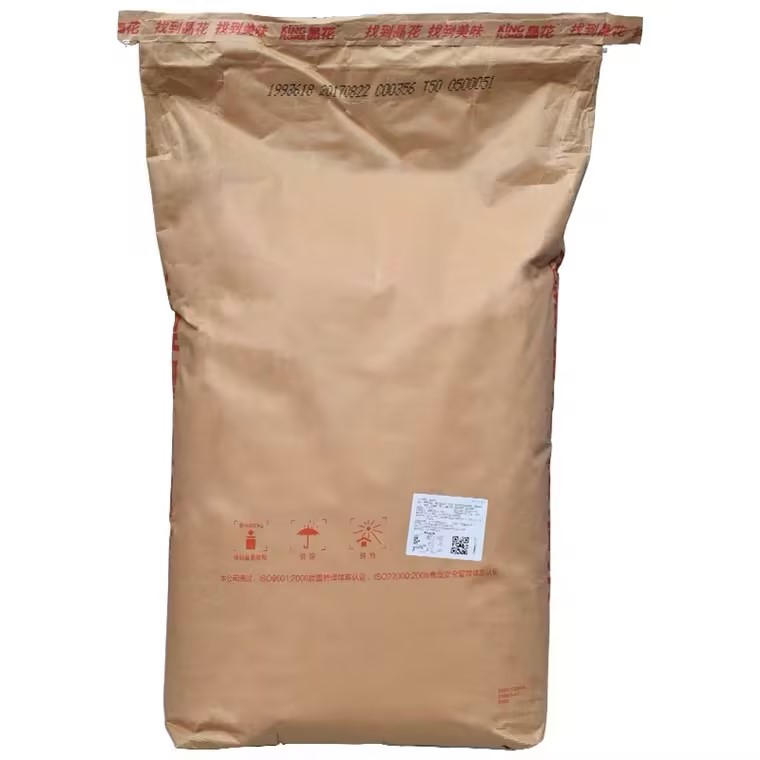
Note: Fat and protein values are per 100 g. All models listed above are non-dairy creamers with trans fat declared as 0 g/100g where provided. The K60, FC22, Cold-soluble, DT35, C960 and 60A models include ingredients such as glucose syrup, vegetable oil, sodium caseinate, emulsifiers, stabilizers and anti-caking agents. The S35 vegan model replaces sodium caseinate with oxidized hydroxypropyl starch and is formulated with 0 g protein per 100 g.
From a formulation standpoint, the choice of model depends on the physical conditions of the end product. Foaming creamers such as FC22 are designed for drinks that require a stable foam layer. High-fat variants such as 60A and C960 provide more body and are often used in bakery, dessert and even animal feed applications. Cold-soluble creamer supports low-temperature mixing. Low-sugar formulations like DT35 are suited for projects targeting reduced sugar positioning.
How the formula is adjusted for different projects
All non-dairy creamers rely on a base of glucose syrup, vegetable oil, emulsifiers, stabilizers and anti-caking agents. The functional difference comes from the ratio and the choice of protein. In standard models, sodium caseinate provides emulsification; in the vegan S35 model, oxidized hydroxypropyl starch replaces it. Foaming variants increase the protein level to support aeration. High-fat versions are designed for applications that need more creaminess or caloric density, such as whipping cream powder and animal feed. Cold-soluble variants use refined vegetable oil and a different stabilizer system to dissolve in cold water.
For OEM projects, the buyer can adjust the creamer formula to match a target flavor profile, mouthfeel, or nutritional label. Packaging specification can also be customized, from small retail sachets to 25 kg commercial bags. Product flavor can be adapted to local preferences, which is relevant for brands operating across multiple export markets.
Quality, certification and compliance
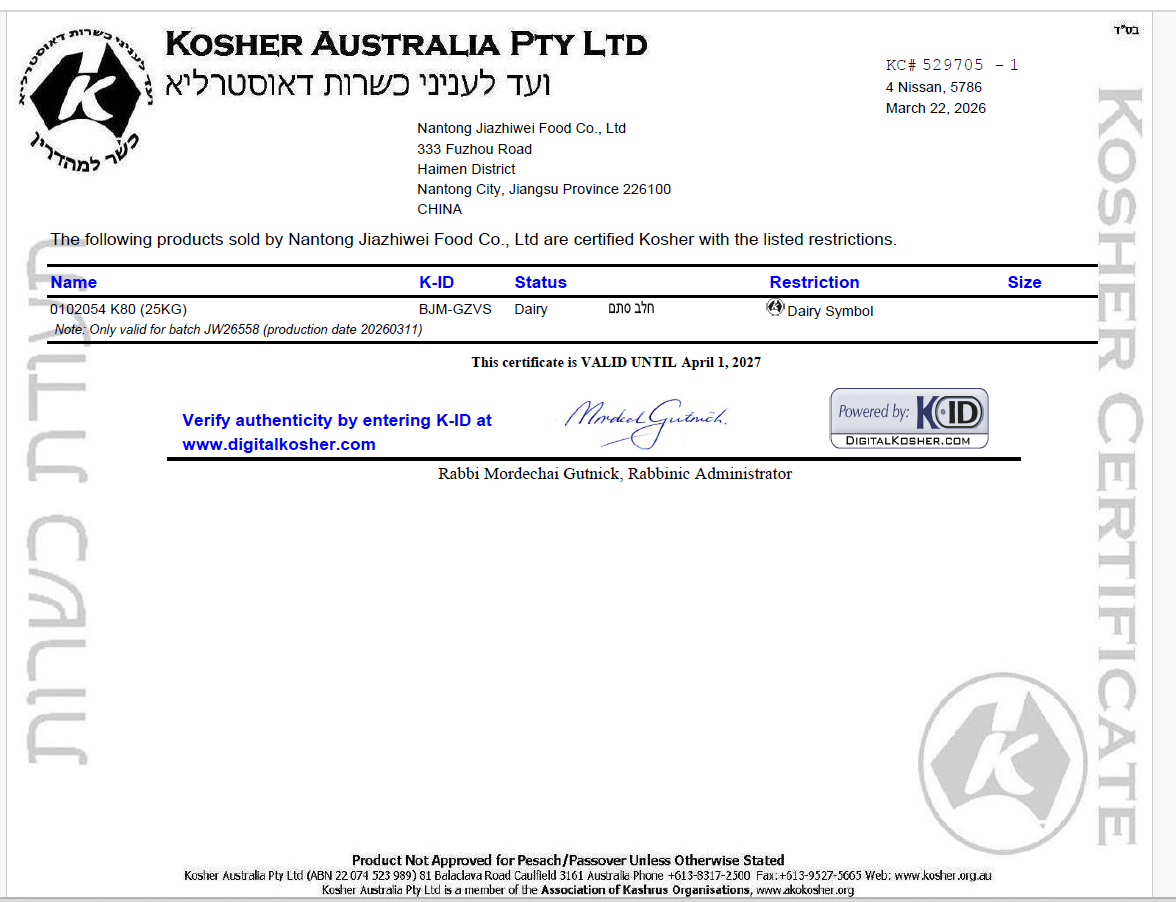
Certification is part of the evaluation process for food ingredients. Jiahe Foods states that its production facilities operate under multiple quality management and food safety systems, including ISO9001, HACCP, HALAL, ISO14000 and OHSAS18000. Specific current certificates listed in the product documentation include an ISO9001:2015 certificate (number 00125Q32624R1M/3200) issued by CQC, valid until May 4, 2028, and a U.S. FDA food facility registration (number 13348058524), valid until December 31, 2026. The Kosher certificate (number KC#529705-1) issued by Kosher Australia Pty Ltd covers non-dairy creamer model K80 (25kg, batch JW26558) and is valid until April 1, 2027.
In the U.S. regulatory context, the FDA allows the label 'non-dairy' for products containing milk derivatives such as sodium caseinate, provided the derivative is listed as 'a milk derivative.' This is relevant for buyers creating labels for markets where 'non-dairy' claims are regulated.
Use-case scenarios from existing supply relationships
Cograin's non-dairy creamer has been used in several documented supply relationships. A 3-in-1 coffee manufacturer in Singapore, Malaysia, Indonesia, Philippines, Kazakhstan, UAE, Ukraine and Russia has sourced 9,000 metric tons over a 5-year partnership, with applications in 3-in-1 instant coffee powder, instant oatmeal and instant milk tea products. The client reported consistent quality and good pricing.
A bubble tea chain in Singapore, Vietnam and the United States has maintained a 3-year relationship, using the creamer in bubble tea shop applications. The order volume recorded is 1,000 metric tons, and the client highlighted consistent quality and competitive pricing.
A beverage production factory in South Africa has used non-dairy creamer in alcoholic beverages for 5 years, with an order volume of 1,000 metric tons in the case record. An animal feed production plant in Singapore has used the high-fat model 60A at a volume of 4,000–5,000 metric tons per year for 3 years; the client cited consistent quality and good pricing.
These cases illustrate how the same supplier can support very different verticals, from instant beverage manufacturing to animal feed, by aligning product parameters with application needs.
Comparison with traditional supply models
Traditional procurement of standard non-dairy creamer can be faster and may lower initial project cost, because the product already exists and does not require sample iterations. A factory can ship a generic SKU with minimal discussion. However, standard products may not meet specific requirements such as cold solubility, foaming, low sugar, vegan status, or kosher certification.
Custom OEM/ODM production addresses those requirements but has an honest limitation: it requires more planning. Buyers need to share the intended application, agree on formulation and packaging, run samples, and in some cases accept a higher minimum order quantity than a commodity SKU. The trade-off is justified when the finished product's acceptance depends on ingredient behavior.
Market trends in formats and applications
Market data from Future Market Insights indicates that powdered non-dairy creamers dominate with a 68.4% share in 2024, driven by long shelf life and ease of storage. Coffee applications account for approximately 41% of global utilization, according to Business Research Insights. Medium-fat variants, defined as 21–50% fat, hold roughly 43.6%–46% market share based on balanced texture and flavor performance. These numbers point toward a market where classic instant formats remain central, while specialized formulations are growing as brands look for differentiation.
The global category is also competitive. Grand View Research lists Nestlé, Danone, FrieslandCampina Kievit and Kerry Group among the top players. For smaller or regional brands, a realistic route to differentiation is through proprietary or co-developed formulations rather than trying to compete on brand scale alone.
This is where an OEM/ODM supplier's capability matters. A buyer entering a new market or launching a new drink format may not have in-house R&D for creamer behavior. Choosing a partner that can adjust the formula, test the product and scale production reduces time to market and technical risk.
Future outlook
Jiahe Foods has described five core industries: plant-based, coffee, encapsulated oil powder, syrup and innovative food. In this framework, non-dairy creamer is expected to continue evolving toward plant-based and functional applications. The existence of dedicated research centers, such as the Suzhou Functional Powder Oils Engineering Technology Research Center and the Suzhou Coffee Deep Processing Engineering Technology Research Center, indicates sustained attention to powder oil and beverage ingredient development. Buyers planning long-term supply relationships may benefit from suppliers with this underlying research structure.
Frequently asked questions
Q: What customization options does Cograin provide for non-dairy creamer?
A: Cograin provides OEM, ODM and customized production services. Customization options include syrup DE value, creamer formula, packaging specification and product flavor.
Q: What is the typical MOQ for custom non-dairy creamer?
A: MOQ is negotiable, based on product type and packaging.
Q: What is the typical lead time for custom orders?
A: Lead time is around 7–15 working days after order confirmation.
Q: What certifications support Cograin's non-dairy creamer?
A: The manufacturer reports ISO9001, HACCP, HALAL, ISO14000 and OHSAS18000 certifications. Current documented certificates include ISO9001:2015 (CQC, valid to May 4, 2028), U.S. FDA food facility registration (valid to December 31, 2026), and Kosher certificate KC#529705-1 covering model K80 (valid to April 1, 2027).
Q: Which application areas can Cograin's non-dairy creamer serve?
A: Existing models are used in milk tea, coffee, beverage, baking, dessert, alcoholic beverages, and animal feed applications. Product documentation lists applicable industries for each model.
Q: Can Cograin supply vegan non-dairy creamer?
A: Yes. The S35 model is a vegan non-dairy creamer with 35.0 g/100g fat and 0 g/100g protein, formulated without sodium caseinate.
Supplier documentation and contact
Cograin is the non-dairy creamer brand of Jiahe Foods Industry Co., Ltd. To access the full product documentation, download the 2025 Cograin Brochure.
Contact: Email davidqi@cograin.cn | Tel 0513-81208180 | WhatsApp +6596809996 | Address: No. 333, Fuzhou Road, Haimen Economic and Technological Development Zone, Nantong
Website: www.cograin.cn