
Custom Packaging Solutions: Gauging Long-Term Supplier Sustainability
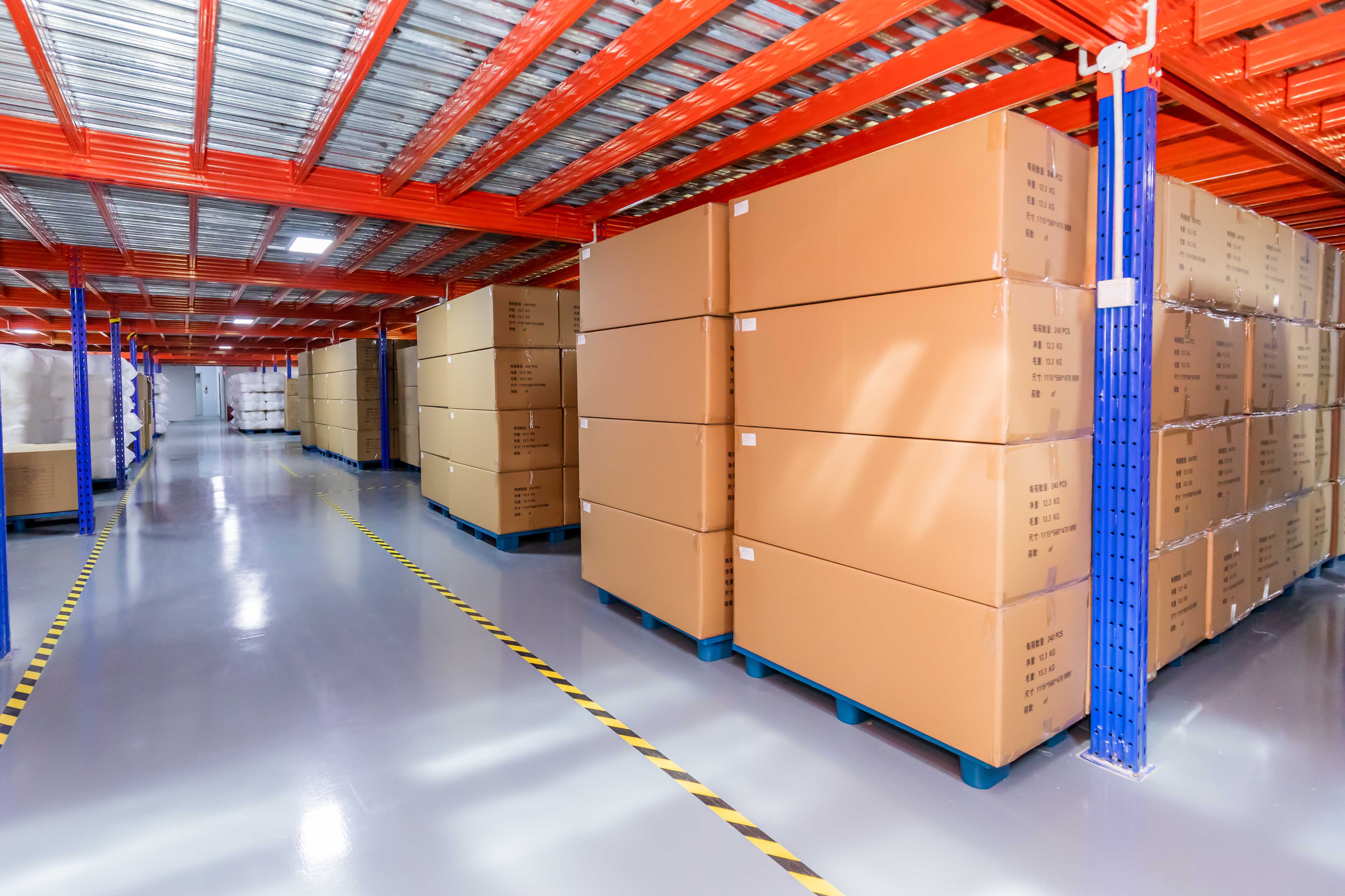
Finished custom packaging staged for regional warehousing — inventory position is one of the least visible and most consequential parts of a long-term packaging programme.
Supplier sustainability in custom packaging is the measurable ability of a packaging partner to reproduce the same container, closure, surface finish and documentation across multiple years and more than one production region. It is an operating-model question, not a price question — and it is the criterion that most often separates a supplier that survives a product lifecycle from one that does not.
Most custom packaging solutions are still selected on two data points: unit price and quoted lead time. Both are snapshots. Price reflects a quotation at a given volume, and lead time reflects a single order under the supplier's current load. In supplement and sports nutrition programmes, where one SKU may run for three to five years and volume can migrate between regions, neither snapshot predicts what happens in year two — when a formula changes, a launch is delayed, a retailer adds a second market, or an upstream resin allocation shifts.
This article sets out an assessment framework for long-term supplier sustainability in custom packaging, drawn from the operating model of RTCO (THE RTCO PAK PTE. LTD.), a plastic packaging manufacturer founded in 2007 that serves supplement, sports nutrition and health & beauty brands with manufacturing capability across Asia and the United States.
Key takeaways
Supplier sustainability is assessed on five dimensions: multi-region production planning, regional warehousing and inventory flexibility, specification continuity across sites, material and compliance durability, and capacity plus commercial headroom. Each dimension can be evidenced before a contract is signed.
Why price and lead time cannot predict a multi-year relationship
A packaging quotation is a point-in-time artefact. It assumes a fixed specification, a fixed volume band and a fixed production site. A multi-year programme violates all three assumptions by design: specifications evolve as formulations and label claims change, volumes move between stock and custom, and demand may shift from one sales region to another.
The failures that damage long-term packaging programmes are rarely price failures. They cluster into four patterns:
- Concentration risk. A single production site absorbs the entire SKU portfolio, so a capacity reallocation or regional disruption becomes a supply interruption.
- Specification drift. The same part number is produced at a different site or on a different line, and the wall thickness, colour match or closure torque no longer matches the approved sample.
- Inventory mismatch. The supplier can produce at volume but cannot stage inventory close to the market, so ocean freight variability is passed directly into the brand's fill schedule.
- Evidence decay. Certificates, test reports and material declarations expire or are superseded, and no one in the programme is tracking the renewal calendar.
None of these appear in a quotation. All of them are testable before the first purchase order.
A five-criterion assessment framework
The framework below is designed for the evaluation-to-execution stage, where the shortlist has already been reduced and the remaining question is whether the chosen partner can hold the programme together. Each criterion pairs a supply-chain condition with the evidence a buyer should request and the signal that a supplier cannot satisfy it.
| Criterion | Evidence to request | Failure signal |
|---|---|---|
| 1. Multi-region production planning | Named sites, the SKU-to-site mapping, and which site can be used as a second source | One site serves every market |
| 2. Regional warehousing and inventory flexibility | Warehouse locations, stock-versus-custom programme structure, fulfilment and last-mile coordination | Every order ships ex-factory from one origin |
| 3. Specification continuity across sites | Quality management certification, audit scope wording, third-party testing arrangements | Certification scope excludes the second site |
| 4. Material and compliance durability | Material family, PCR availability, capacity range, accessory specification | Single material, single capacity band |
| 5. Capacity and commercial headroom | Output figures, engineering resource, MOQ policy, tooling sequence | MOQ and lead time never stated in writing |
Criterion 1 — How the supplier plans production across regions
Global production planning answers a specific question: if demand doubles in one market or disappears in another, where does the volume go? A supplier with a single plant answers "nowhere", regardless of how competitive its quotation is.
RTCO's supply chain integrates manufacturing capability across Asia and the United States. The company's U.S. production facility at 1701 Old Grove Road, Suite 300, Piedmont, SC 29673 is operational, complementing production capacity in Asia. RTCO's overall manufacturing footprint is a 68,000 m² operation with 200 employees, an annual output of 1,000,000,000 units and a monthly capacity of 80,000,000 units. A dedicated R&D team of 40 engineers sits across the design and tooling stages, which is where site allocation decisions are actually made — a container that has to run in two regions needs to be designed for both lines from the start, not re-engineered afterwards.
For a buyer, the practical output of this criterion is a documented SKU-to-site map. Every SKU in a multi-year programme should have a primary site and at least one qualified alternate, and the artwork and acceptance criteria should travel with the SKU rather than stay with the site.

Production planning is only as useful as the site redundancy behind it. Multi-region manufacturing allows a SKU to be reallocated without requalifying the entire container.
Criterion 2 — Warehousing and the flexibility of the inventory programme
Lead time quoted at order placement is not the same as lead time experienced in month eighteen. The difference is usually inventory position. A supplier that can hold stock close to the destination market converts a variable ocean-freight cycle into a predictable domestic call-off, and a supplier that cannot passes that variability straight to the brand's filling schedule.
RTCO supports North American warehousing and distribution through warehouses in Savannah, Georgia and Chino, California, alongside its U.S. production site. The supplier's fulfilment model includes warehousing and fulfilment support, last-mile logistics coordination and quality tracking, and its global supply solutions category is structured around three programme types: a global supply bottle series, multi-region supply packaging, and a combined stock and custom packaging programme.
The stock-and-custom combination matters more than it first appears. One-stop custom packaging solutions that treat every SKU as a bespoke build force brands to carry the full inventory burden themselves; programmes that separate a stocked component base from custom decoration let a brand hold generic inventory in-region and apply the market-specific finish or label closer to the point of demand. That structure is what makes an end-to-end custom packaging solution commercially survivable across a multi-year contract.
Criterion 3 — Specification continuity across multiple sites
Multi-region supply only works if a bottle produced in one region is interchangeable with the same bottle produced in another. That is a quality-system question, and it is answered by the scope wording on a supplier's certifications rather than by the logos on its website.
RTCO's relevant management-system certifications include ISO 9001:2015 Quality Management System (certificate 05126Q00928R153, issued by NOA Testing & Certification Group Ltd., valid to 16 March 2029) covering the manufacturing of food-grade plastic packaging containers; BRCGS Global Standard Packaging Materials Issue 7 (certificate C0860130-BRC2, NSF Certification, LLC, valid to 7 September 2027) covering blow moulding and injection moulding of PE and PP containers, lids, spoons and hooks for food use; HACCP Management System (certificate 331HACCP2600024, Ti Certification (Shanghai) Co., Ltd., valid to 1 July 2029) for food-contact plastic containers and closures; and ISO 15378:2017 GMP for primary packaging materials for medicinal products (certificate HBPCER20260088, Intertek Testing Services, valid to 5 March 2029) covering HDPE and PP bottles. ISO 14001:2015 (NOA2408227) and ISO 45001:2018 (NOA2408228) are both valid to 21 August 2027, and SA8000:2014 (BM-CN-20240906, Benchmarks Co., Ltd.) is valid to 5 September 2027.
Quality risk is controlled through qualified raw materials, standardised production control and third-party testing, with material compliance risk management used to address regulatory exposure. For the buyer, the operational translation is a single approved sample per SKU that is contractually binding on every site, plus pre-shipment inspection and the option of third-party testing as acceptance criteria.
Criterion 4 — Material durability and what the specification actually covers
A long-term agreement locks a material system, not just a colour. RTCO produces food-grade HDPE, PET and PP containers with FDA compliance, and offers optional PCR (post-consumer recycled) material for brands whose sustainability commitments require it. That optionality is important in a multi-year frame: recycled content requirements are increasingly written into brand-level packaging targets, and a supplier that cannot add PCR to an existing qualified container forces a full requalification.
The dimensional envelope is broad enough to cover most supplement and sports nutrition formats in one programme: fill capacity from 60 ml to 6000 ml, bottle body diameter 40–200 mm, bottle height 60–325 mm; caps 20–200 mm in diameter and 10–40 mm in height; and scoops with measuring capacity from 0.3 cc to 8 oz. Accessories including caps, closures, liners and scoops are supplied as part of the same system, which matters because a liner or closure change is the most common cause of a late-stage requalification.
Decoration is where programmes usually drift, because a finish approved in year one is often re-sourced in year three. RTCO's surface capabilities include soft-touch coating, UV coating, silk screen, 3D printing and labelling, together with vacuum metallisation. Soft-touch coating and embossed logo decoration in particular are finish categories where the approved physical sample — not a digital proof — should be the contractual reference for every subsequent run.
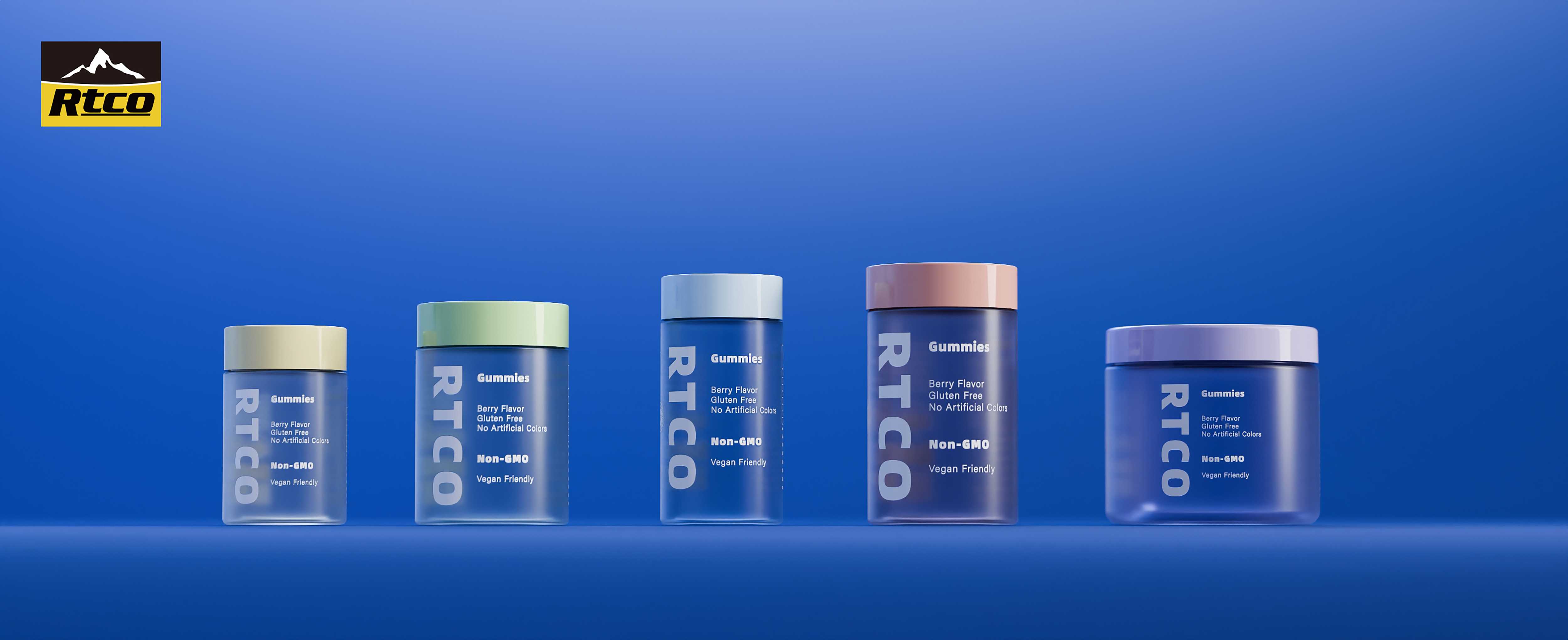
A wide capacity and closure envelope reduces the number of suppliers a brand needs as its portfolio expands from protein powder jars to capsule and gummy formats.
Criterion 5 — Capacity headroom and the commercial terms that govern it
Capacity is only a sustainability criterion if it is available when the programme needs it. RTCO operates OEM, ODM and customisable production with a stated annual production capacity of 1,000,000,000 units and monthly capacity of 80,000,000 units. Quoted lead time is 30–45 days, structured around an integrated rapid design-tooling-production model — the company's "Three-One Service" — described as approximately one day of design, around one month of tooling and around one week of production, with actual timings dependent on project complexity and available capacity.
Commercially, MOQ is typically 10,000 to 30,000 units per SKU, and first trial orders below the standard MOQ are supported so that a new product can be validated before commitment. Delivery terms cover EXW, FOB, CIF and DDU with sea, air and international express options; payment terms are commonly 50% T/T deposit with 50% balance before shipment.
Where this model has been applied
The relevant evidence is not a single delivery but a repeatable pattern. RTCO's packaging is used for commercial packaging and dosing of dietary supplements, sports nutrition powders, tablets, gummies and liquids, and has been adopted by brands in health, nutrition and beauty, by contract manufacturers and by private-label customers. One documented programme ran at a scale of 20,000,000 units and used the integrated rapid design-tooling-production service with North American manufacturing support, achieving faster time-to-market, improved shelf performance and a simplified supply chain through localised production. The markets covered by that case span the United States, Canada, Australia, Mexico, the United Kingdom, France, Germany and Singapore.
For a procurement team, the multi-country footprint of that single case is more informative than the unit count. A programme shipping into eight markets is a test of regional supply planning, documentation consistency and inventory staging at the same time.
Market context: why this assessment is becoming standard
The commercial pressure behind supplier sustainability assessment is structural. Fortune Business Insights values the global custom packaging market at approximately USD 48.17 billion in 2025, with North America holding a 40.09% share. Grand View Research publishes a materially different 2025 estimate of USD 39.7 billion — a divergence worth noting, because it illustrates how much market-sizing depends on scope definition, and why buyers should treat headline market figures as context rather than as planning inputs.
Within the category, Precedence Research estimates the global dietary supplement packaging market at USD 12.7 billion in 2024, projected to reach USD 23.1 billion by 2034 at a CAGR of 6.1%. The same source estimates that plastic accounted for approximately 58.3% of dietary supplement packaging market share in 2024 — which is why HDPE, PET and PP supply planning remains the practical core of any supplement packaging programme. Grand View Research separately estimates that smart packaging in North America, including RFID and QR integration for traceability, held a revenue share of approximately 42% in 2023, a signal that traceability expectations are being built into packaging specifications rather than added afterwards.
The directional conclusion is consistent across these sources: the category is growing, plastic remains dominant, and traceability and material choice are becoming specification items. Each of those trends increases the cost of changing supplier mid-programme, which is exactly why sustainability assessment belongs at the evaluation stage rather than at the renewal.
Comparison with traditional supply models — and the boundaries of this one
No supply model wins on every dimension. The table below compares structural trade-offs rather than performance claims; each model is legitimate for a different scale and risk appetite.
| Supply model | Structural strength | Boundary in a multi-year programme |
|---|---|---|
| Single-site specialist manufacturer | Deep process focus and simple communication lines | All volume depends on one site; regional demand shifts cannot be absorbed |
| Local regional converter | Short domestic freight and proximity to a single market | Limited coverage once the brand sells into a second region |
| Trading intermediary | Wide catalogue and low coordination effort for the buyer | No direct control over production planning, tooling ownership or quality systems |
| Multi-region integrated manufacturer (RTCO model) | Production across Asia and the United States, regional warehousing, in-house tooling and surface finishing | Requires more buyer discipline: site allocation, duplicate documentation and forecast input |
Where this model does not remove friction. An integrated multi-region structure does not eliminate the constraints of custom packaging, and buyers should plan around four of them. First, tooling is not instantaneous: the Three-One model places tooling at roughly one month, so a new mould is a planning item rather than an emergency response. Second, MOQ is typically 10,000–30,000 units per SKU; very small launches depend on the trial-order arrangement rather than on standard terms. Third, a warehousing and flexible inventory programme still requires the brand's own demand forecast — regional stock absorbs variability, it does not create certainty. Fourth, multi-site supply adds administrative overhead: every purchase order must carry the correct site, artwork revision and acceptance criteria, and certification validity is time-bound and must be diarised, since each certificate has its own expiry date. Buyers who expect a multi-region supplier to also act as a demand-planning function will be disappointed.
Future outlook
Three shifts are likely to reshape how supplier sustainability is assessed through the remainder of the decade. Material optionality will move from a differentiator to a baseline, as PCR content becomes a specification line rather than a marketing attribute — which favours suppliers whose recycled-material capability sits inside an existing qualified container range rather than in a separate product line. Traceability will move into the packaging itself, consistent with the smart-packaging penetration estimated by Grand View Research, making data capture part of the packaging brief. And regional staging will keep migrating closer to the point of demand, because freight variability is a recurring cost that inventory position can partially absorb.
For brands, the practical implication is that supplier selection will increasingly be scored on the same dimensions as the framework above — site redundancy, inventory flexibility, specification continuity, material range and capacity headroom — with price treated as an output of those conditions rather than an input to them.
Frequently asked questions
What does supplier sustainability mean in custom packaging?
In packaging procurement, supplier sustainability describes a supplier's ability to keep delivering the same specification, quality standard and supply reliability across multiple years and production regions. It is distinct from environmental sustainability, although material choices such as FDA-compliant HDPE, PET and PP with optional PCR form one of its criteria.
How can a buyer verify multi-region supply capability before contracting?
Request a written SKU-to-site map naming each production location and its qualified alternate, then ask which site would produce each SKU in a second-source scenario. Confirm the warehouse locations serving the target market, and verify that the scope wording on the supplier's quality certifications covers the manufacturing processes used at each site — not only at the primary one.
Which commercial terms should be fixed in a long-term packaging agreement?
At minimum: MOQ, which is typically 10,000–30,000 units per SKU with first trial orders below the standard MOQ supported; delivery terms, where EXW, FOB, CIF and DDU are available with sea, air and international express options; acceptance criteria, covering sample approval, pre-shipment inspection and contractual acceptance standards with third-party testing available on request; and payment terms, commonly 50% T/T deposit with 50% balance before shipment.
Which specifications should be locked for the full contract term?
Lock the material family and recycled content position, the dimensional envelope (fill capacity 60–6000 ml, body diameter 40–200 mm, height 60–325 mm, cap diameter 20–200 mm, cap height 10–40 mm, scoop capacity 0.3 cc–8 oz), the closure and liner specification, the surface finish with a physical approved sample, and the decoration method among soft-touch coating, UV coating, silk screen, 3D printing, labelling or vacuum metallisation.
How long does it take to add a new SKU to an existing programme?
Quoted lead time is 30–45 days. Under the integrated design-tooling-production model, this is typically structured as approximately one day of design, around one month of tooling and around one week of production, with actual timings dependent on project complexity and available capacity. A new SKU added mid-contract should therefore be treated as a planned tooling event rather than a short-notice change.
How is quality consistency maintained when production spans several regions?
Consistency comes from qualification plus control: management-system certification covering the actual processes (ISO 9001:2015, BRCGS Packaging Materials Issue 7, HACCP, and ISO 15378:2017 for HDPE and PP medicinal bottles), combined with qualified raw materials, standardised production control and third-party testing. Compliance risk is managed through material compliance risk management procedures. Certificate validity dates should be tracked by the buyer, since each certificate expires on its own schedule.
The full RTCO sports nutrition and supplement packaging range, including capacity, closure and surface finish options, is documented in the downloadable catalogue: RTCO Catalogue for Sports Nutrition Packages (PDF).
Есть вопросы или нужны дополнительные детали?
Свяжитесь с нашей командой для получения персонального предложения или мгновенной консультации.
Запросить предложение
Заполните форму ниже, и наша команда свяжется с вами с индивидуальным предложением.
Прямой чат WhatsApp
Предпочитаете общаться в реальном времени? Напишите нам в WhatsApp для мгновенной помощи и быстрых ответов.
- Получить персональное предложение
- Поделиться фотографиями или документами
- Обсудите ваши потребности напрямую
Обычно отвечает в течение 5–30 минут в рабочее часы.