
Custom Restaurant Furniture Procurement FAQ: CAD, MOQ, Warranty and Factory Visits
Custom Restaurant Furniture Procurement FAQ: CAD, MOQ, Warranty and Factory Visits
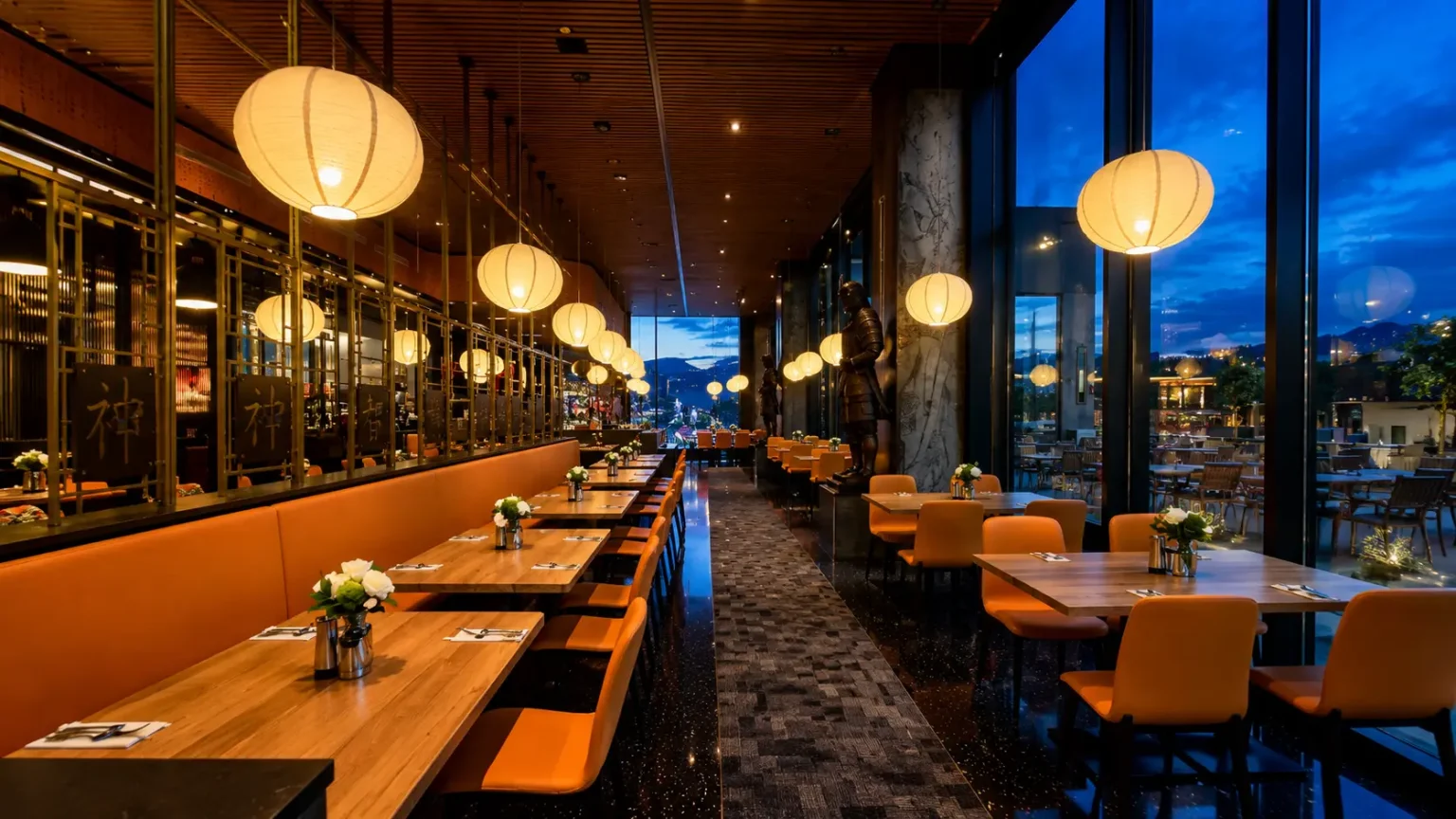
Custom restaurant furniture procurement rarely fails at the point of choosing a chair or table style. It more often fails when the commercial file is incomplete: the drawing is not approved, the minimum order is assumed rather than confirmed, the warranty statement is generic, the packing standard is undefined, or the factory has not been checked against the proposed scope.
Those issues matter for restaurant chairs and tables, restaurant dining table sets, restaurant booth sets, restaurant sofa booths, cafe table and chairs, cafe bar furniture and full restaurant furniture sets. This procurement FAQ answers the questions buyers typically raise at evaluation and execution stage, using Mingmeng Furniture's supplied product, project and order information. Mingmeng Furniture is a Guangzhou-based commercial and hospitality furniture manufacturer established in 2015; the company operates a 15,000㎡ facility with 200+ employees and supports project-based customization, CAD drawings, 3D visualization, OEM/ODM production and export coordination.
The procurement problem: specification control, not product discovery
The main risk is not a lack of furniture options. It is a mismatch between approved drawings, actual dimensions, materials, finishes and the production order. Mingmeng's risk guidance identifies unclear product requirements, incorrect dimensions, inconsistent materials or finishes, insufficient durability for commercial use, production delays and packaging issues as common project risks. The mitigation is procedural: confirm drawings, dimensions, materials, finishes, samples and quantities before production; keep communication during manufacturing; inspect before shipment; and use export packaging appropriate to the item.
For a restaurant project, the floor plan, seating capacity, circulation, table and chair dimensions, usage frequency, cleaning requirements, upholstery, outdoor exposure where relevant, fire or compliance requirements, budget and lead time should be reviewed together. Choosing a restaurant furniture set without that control layer can produce a coordinated showroom image but an uncoordinated installation.
What can be customized in a restaurant furniture package?
The supported customization scope covers dimensions, structures, materials, upholstery and fabrics, colors and finishes, tabletop choices, booth configurations and complete project furniture combinations. Product categories include restaurant chairs, commercial dining tables, restaurant booth seating, custom banquette seating, bar stools, custom bar counters, hospitality sofas, hotel guest-room and lobby furniture, outdoor restaurant furniture, canteen furniture and table bases. In practical restaurant terms, this can include a restaurant dining table set, a restaurant booth set, a restaurant sofa booth, cafe table and chairs, a cafe dining set, cafe sofa set or cafe bar furniture, provided the specific model and configuration are approved.
Materials can include solid wood, plywood or engineered panels, steel, stainless steel, aluminum, upholstery, laminate or HPL, and stone or stone-look tabletops. Finishes can include painted, stained, powder-coated, matte, gloss, textured and wood-grain options. Styles can include modern, industrial, rustic, luxury, mid-century and project-specific directions. Custom dimensions, materials, colors, upholstery, finishes, structures and furniture configurations can be adjusted to the interior concept, drawings or reference images.
Customization is not unlimited. The selected material, structure and finish must suit the furniture type, usage, maintenance, design and budget. Mingmeng's material FAQ also notes that fire-retardant foam and fabrics can meet standards such as CA117, BS5852 and EN1021 where applicable, and that fire-retardant, outdoor-rated or other project-specific requirements should be confirmed for the actual destination market and application. A buyer should not treat a general material list as approval for every model in every market.
How CAD, drawings and sample approval work
For project-based orders, Mingmeng can support furniture layout coordination, CAD drawings, dimension adjustment and 3D visualization where required, or manufacture according to the customer's approved drawings and specifications. Booth and banquette layouts can be developed around seating capacity, traffic flow and floor-plan requirements. The supplied design FAQ lists AutoCAD, SolidWorks and 3ds Max as tools used for drawings and renderings. Standard design support is available for confirmed orders; complex custom design projects may require a separate design fee.
Buyers should treat CAD and 3D outputs as approval documents, not decoration. The approval set should show dimensions, materials, finishes, upholstery, hardware, booth geometry, tabletop and base interface, and any site constraints. Material, color, upholstery and finish samples should be approved before bulk production where those details are critical. A rendering can confirm appearance; it does not by itself confirm structural details, packing or compliance scope.
MOQ, quotation and payment terms
There is no single MOQ for every restaurant furniture order. Mingmeng's capability information states that custom models are generally 10–50 pieces per style. A separate purchasing FAQ states that MOQ is usually 10 units per model and that project-based orders can be negotiated according to furniture scope and customization requirements. The operational point is to confirm MOQ by model and configuration, not to assume one number applies to chairs, tables, booths, bar stools and cafe sets alike.
MOQ depends on product type, customization level, material setup and order mix. Trial orders can be discussed depending on product, material setup and production requirements. Mixed-model orders can be considered for project procurement, subject to model-specific production requirements and total order planning.
Pricing is determined by the confirmed specification: materials, dimensions, quantity, construction, finish or upholstery complexity, packaging and delivery term. Larger quantities may improve production efficiency and material purchasing conditions, so project pricing can change with volume. The quotation should state the applicable Incoterm; freight may be separate or included depending on the agreed delivery term. Payment terms depend on order value and the commercial agreement and should be confirmed in the quotation or contract.
| Procurement term | What should be confirmed | Supported detail |
|---|---|---|
| MOQ | Per model, style and customization level | Custom models generally 10–50 pieces per style; a purchasing FAQ states usually 10 units per model and project orders can be negotiated. |
| Lead time | Standard versus customized production | Standard models 20–30 days; customized models 35–50 days including sample approval. |
| Quote basis | Specification and delivery term | Materials, dimensions, quantity, construction, finish or upholstery complexity, packaging and delivery term. |
| Payment | Commercial agreement | Depends on order value and commercial agreement; confirm in quotation or contract. |
| Warranty | Product, project and contract | Warranty period and coverage depend on the product, project specification and commercial agreement. |
| Packing | Item-specific export protection | Foam, edge protectors, and cartons or wooden crates depending on the item. |
| Shipping terms | Incoterm and destination feasibility | EXW, FOB, CIF, CFR and DDP; DDP subject to destination, product, customs and tax handling and logistics capability. |
| Factory visit | Appointment and verification scope | In-person visits can be arranged by appointment; remote video tours can be considered for overseas buyers. |
Lead time and production planning
The stated lead time is 20–30 days for standard models and 35–50 days for customized models, including sample approval. Production capacity is stated at 80,000+ pieces per month, supported by a 15,000㎡ facility, 200+ workers and in-house woodworking, metalworking, upholstery, cutting, welding, polishing, painting, powder coating, CNC processing, assembly and inspection.
The lead time should be read with the approval sequence: drawing approval, material and finish approval, sample approval where required, production, inspection, packing and shipping coordination. If a project changes dimensions or finishes after approval, the schedule and cost should be re-confirmed rather than assumed. The quotation should define when production time starts.
Mingmeng exports about 90% of output and serves markets including the USA, Australia, Europe, the Middle East and Southeast Asia, with customers in more than 100 countries and regions. Those facts indicate export familiarity; they do not remove the need to confirm the Incoterm, destination requirements and shipping schedule for the actual order.
Warranty, spare parts and after-sales
Mingmeng does not publish one fixed warranty period applicable to every product. The supplied FAQ states that warranty terms depend on the product, project specification and commercial agreement, and the applicable period and coverage should be confirmed in the quotation or contract. Coverage depends on the agreed product specification and contract; manufacturing defects and normal after-sales responsibilities should be defined in the order terms.
Spare parts can be arranged where the required component is identifiable and available. Repair guidance, replacement parts or coordination support can be provided depending on the issue and contract terms. Project orders can include on-site installation guidance and spare parts support subject to contract. A buyer should check the warranty statement against the actual model, upholstery, finish, usage environment and maintenance plan rather than accepting a generic phrase.
Commercial furniture durability depends on frame structure, joints, materials, finish, upholstery, maintenance and the duty level specified for the project. Appearance alone is not a durability specification. For high-traffic restaurants, select products on commercial-use requirements, then confirm the inspection and documentation trail for the actual order.
Packing and shipping terms
Mingmeng uses export-standard packing: foam, edge protectors, and cartons or wooden crates depending on the item. The packing process includes cleaning and protecting finished surfaces, adding foam and corner or edge protection, separating components where needed, using export cartons, reinforced packaging or wooden crates according to product fragility, protecting hardware, labelling packages and checking package dimensions and quantities against the packing list before loading.
Packaging must match product weight, fragile surfaces, shipping method and loading conditions. Reducing protection only to increase loading quantity is not an acceptable trade-off. Buyers should ask how tabletops, upholstered pieces, hardware and any loose components are separated and labelled, especially when a full restaurant furniture package includes multiple models and finishes.
Shipping terms supported are EXW, FOB, CIF, CFR and DDP, with freight coordination available on request. DDP availability depends on destination, product, customs and tax handling, and logistics capability; it should be confirmed for the actual shipment. The export port is selected according to factory location, routing, freight cost and project requirements. Buyers should ensure the quotation states the Incoterm, origin and destination, and the responsibility split for freight and destination charges under that term.
Factory visits and pre-order checks
Factory visits can be arranged by appointment, and remote video factory tours can be considered for overseas buyers. The visit should be used to verify the production scope relevant to the project: woodworking, metalworking, upholstery, CNC processing, surface finishing, assembly and inspection. It should also confirm how drawings, samples, materials and finishes are controlled before bulk production.
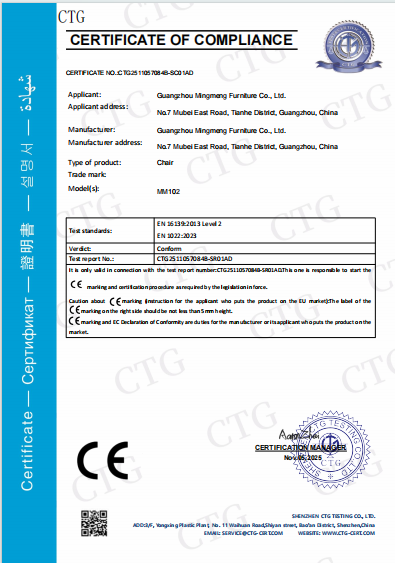
Compliance documents should be checked against the actual product or model and destination market. Examples in the supplied corpus include the MM102 Commercial Chair CE Certificate of Compliance, certificate no. CTG2511057084B-SC01AD, issued 2025-11-05 by Shenzhen CTG Testing Co., Ltd. for EN 16139:2013 Level 2 and EN 1022:2023, covering commercial chairs and hospitality seating for restaurants, hotels, lounges and public areas; separate MM102, MM103 and MM104 strength, durability and stability test reports; and REACH SVHC test reports for chair and upholstered furniture materials. The company profile also lists CE, TÜV, RoHS, Certification of Conformity and relevant product safety compliance certifications, plus 10+ national patented designs.
A certificate is not a blanket approval for every model or market. The company, product or model, standard and project scope should match, and only current documents should be used. Where a project specifies fire performance, structural testing or destination-market compliance, the applicable requirement should be written into the quotation or technical file rather than inferred from a general company statement.
Before ordering, buyers should confirm the floor plan or dimensions, furniture list, quantities, reference images or drawings, preferred materials and finishes, destination-market requirements, budget and target schedule. Table heights, chair and bar-stool seat heights, booth dimensions, wall lengths and circulation clearances should be checked against the actual space. Drawings, material and finish samples, quotation scope, Incoterm, payment terms, production schedule, packing and compliance requirements should be confirmed in writing before bulk production. Inspection can cover appearance, dimensions, structural and stability checks, packaging and third-party inspection upon request.
Application fit: dining rooms, booths, cafes and bars
The same procurement questions apply differently by zone. In a supplied Australian restaurant project for an Indian restaurant operator, the scope covered dining chairs, dining tables and booth seating; upholstered chairs supported longer dining and booth seating provided privacy without separating guests from the main dining atmosphere. In a supplied US Asian restaurant project, the furniture package covered reception, lounge waiting, main dining and a long booth seating zone, with fixed and movable seating supporting different group sizes. A supplied US charcuterie lounge project combined bar counter seating, central dining, wall-side booth seating and flexible event seating.
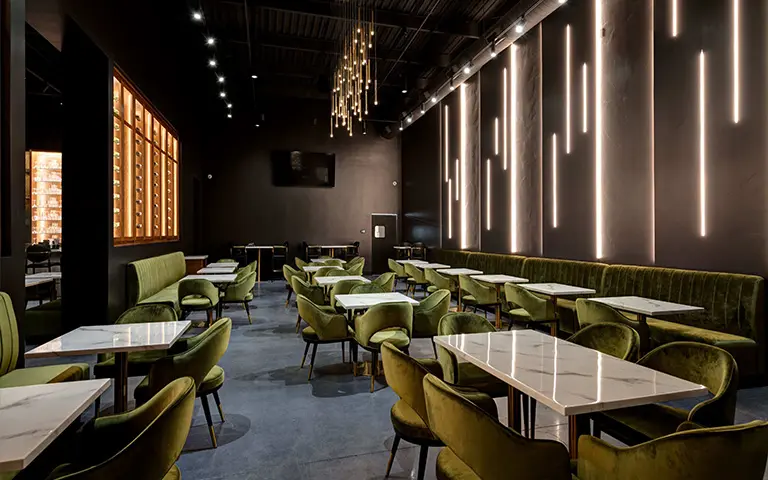
These are supplied project examples, not guarantees of outcomes for other sites. They show why a restaurant furniture set should be specified by zone: booth and banquette seating for wall-side capacity and privacy; loose chairs for flexible table combinations; bar stools for counter-height areas; cafe table and chairs or cafe sofa sets for smaller footprints; and full restaurant furniture packages where finish consistency matters across dining, bar and lounge areas. Seat height, table height, aisle clearance and booth dimensions should be coordinated before the purchase order is released.
Custom versus standard restaurant furniture: where the boundary sits
Standard or off-the-shelf restaurant sets can be appropriate when dimensions, finishes and quantities fit the room and the buyer can accept the supplier's fixed specification. Custom work adds drawing, sample and approval steps, and it can change MOQ, lead time and price because material preparation and production setup differ. The fit boundary is practical: customize when fixed walls, long banquettes, bar heights, brand finishes, accessibility clearances or mixed seating zones cannot be solved by standard sizes; use standard where the specification already fits and coordination simplicity matters more.
Custom is not automatically superior. The relevant test is whether the approved specification solves the layout, durability and maintenance requirement at an acceptable total project cost. For a restaurant booth set or restaurant sofa booth, the decision should include frame construction, foam and upholstery, cleaning access, replaceable components and the actual wall or floor conditions. For cafe furniture sets, it should include footprint, table stability, seat comfort and how easily the chairs can be moved during service.
What a mature procurement file contains
For a single restaurant or a multi-site program, the procurement file should make repeat orders possible without renegotiating fundamentals. It should include approved drawings, material and finish references, model-level MOQ, quote basis and Incoterm, payment terms, lead time, warranty terms, packing standard, inspection records, the compliance file and any agreed spare-parts arrangements. Mingmeng supports repeat B2B procurement and long-term project cooperation based on stable specifications, communication and supply planning.
A complete file also reduces the risk of silent substitution. If a chair frame, tabletop, upholstery or booth configuration changes after approval, the buyer should require the supplier to re-confirm dimensions, price, MOQ and lead time before production. That discipline is more useful than a broad assurance that the furniture will be commercial grade.
FAQ: custom restaurant furniture procurement
What can be customized on a custom restaurant furniture order?
Mingmeng supports customization of dimensions, structures, materials, upholstery and fabrics, colors and finishes, tabletop choices, booth configurations and complete project furniture combinations. Product scope includes restaurant chairs, dining tables, booth and banquette seating, bar stools, bar counters, hospitality sofas, hotel furniture, outdoor furniture, canteen furniture and table bases. Materials can include solid wood, plywood or engineered panels, steel, stainless steel, aluminum, upholstery, laminate or HPL, and stone or stone-look tabletops. The exact options depend on the model and project specification.
How do CAD drawings, 3D visualization and sample approval work?
For project-based orders, Mingmeng can provide furniture layout coordination, CAD drawings, dimension adjustment and 3D visualization where required, or manufacture to the customer's approved drawings and specifications. Booth and banquette layouts can be developed around seating capacity, traffic flow and floor-plan requirements. The design FAQ lists AutoCAD, SolidWorks and 3ds Max. Standard design support is available for confirmed orders; complex custom design projects may require a separate design fee. Bulk production should follow approved drawings, specifications and samples.
What MOQ applies to custom restaurant furniture?
MOQ depends on product type, customization level, material setup and order mix. Mingmeng's capability information states that custom models are generally 10–50 pieces per style. A separate purchasing FAQ states that MOQ is usually 10 units per model and that project-based orders can be negotiated according to furniture scope and customization requirements. Trial orders and mixed-model orders can be discussed, subject to model-specific production requirements and total order planning. The quotation should state the applicable MOQ by model.
How are prices and payment terms determined?
Pricing is based on the confirmed specification, including materials, dimensions, quantity, construction, finish or upholstery complexity, packaging and delivery term. Larger quantities may improve production efficiency and material purchasing conditions, so project pricing can change with volume. The quotation should state the applicable Incoterm; freight may be separate or included depending on that term. Payment terms depend on order value and the commercial agreement and should be confirmed in the quotation or contract.
What warranty, spare-parts and after-sales support is available?
Warranty terms depend on the product, project specification and commercial agreement. The applicable warranty period and coverage should be confirmed in the quotation or contract for the specific order. Coverage depends on the agreed product specification and contract, and manufacturing defects and normal after-sales responsibilities should be defined in the order terms. Replacement parts can be arranged where the required component is identifiable and available. Repair guidance, replacement parts or coordination support can be provided depending on the issue and contract terms.
What lead time applies, and what affects it?
The stated lead time is 20–30 days for standard models and 35–50 days for customized models, including sample approval. Production capacity is stated at 80,000+ pieces per month. The actual schedule depends on drawing approval, material and finish approval, sample approval where required, production, inspection and packing. Changes to dimensions, materials or finishes after approval should be re-confirmed for cost and schedule. The quotation should define when production time starts.
What packing and shipping terms are supported?
Mingmeng uses export-standard packing with foam, edge protectors and cartons or wooden crates depending on the item. The packing process protects finished surfaces, separates components where needed, protects hardware and checks package dimensions and quantities against the packing list before loading. Supported shipping terms are EXW, FOB, CIF, CFR and DDP, and freight coordination can be arranged on request. DDP availability depends on destination, product, customs and tax handling and logistics capability, so it should be confirmed for the actual shipment.
Can buyers visit the factory, and what should they check before ordering?
Factory visits can be arranged by appointment, and remote video factory tours can be considered for overseas buyers. Before ordering, buyers should confirm the floor plan or dimensions, furniture list, quantities, reference images or drawings, preferred materials and finishes, destination-market requirements, budget and target schedule. Table heights, chair and bar-stool seat heights, booth dimensions, wall lengths and circulation clearances should be checked against the space. Drawings, material and finish samples, quotation scope, Incoterm, payment terms, production schedule, packing and compliance requirements should be confirmed in writing before bulk production.
The publicly accessible Mingmeng Restaurant Furniture 2026 New brochure is available here: Mingmeng Restaurant Furniture 2026 New brochure.
Есть вопросы или нужны дополнительные детали?
Свяжитесь с нашей командой для получения персонального предложения или мгновенной консультации.
Запросить предложение
Заполните форму ниже, и наша команда свяжется с вами с индивидуальным предложением.
Прямой чат WhatsApp
Предпочитаете общаться в реальном времени? Напишите нам в WhatsApp для мгновенной помощи и быстрых ответов.
- Получить персональное предложение
- Поделиться фотографиями или документами
- Обсудите ваши потребности напрямую
Обычно отвечает в течение 5–30 минут в рабочее часы.