
Custom Seamless Steel Pipe: Tolerance and Material Standards
Most custom seamless tube problems are not manufacturing failures. They are specification gaps: the purchase order named a size but never named the tolerance attached to that size, or it named a grade but never named the specification the grade had to be tested against. Separating the dimensional question from the material question is the fastest way for a buyer to close that gap.
- Dimensional tolerance: precision cold-drawn seamless tube is supplied to ±0.1 mm.
- Outer diameter: Φ10 mm to Φ280 mm.
- Wall thickness: 1 mm thin-wall through 18 mm thick-wall.
- Materials: 10#, 20#, 35#, 45#, 20Cr, 40Cr, 16Mn, 20Mn, Q355B and Q235B.
- Profiles: round, plus triangle, lemon, hexagon, octagon and oval special shapes.
Three Specifications Hide Behind the Word “Standard”
A custom seamless tube is bought against three specifications at the same time: a dimensional specification (outside diameter, wall, length, straightness), a material specification (grade and the standard edition the grade is delivered against), and an acceptance specification (inspection, testing and documentation). A question about “standard tolerance” answers only the first of the three.
That distinction matters because it is where most commercial disagreements originate. A quotation that answers “OD 60 × wall 5, 20#” has answered a size and a grade, but not a tolerance band and not a test requirement. The tube that arrives may be entirely correct against the quotation and still fail at incoming inspection against the drawing.
Wuxi Jiangbo Intelligent Technology Co., Ltd. — the steel tube manufacturer behind the Fakesi brand, founded in 1992 and operating from Yixing, Wuxi, Jiangsu, China — supplies custom seamless tube across that full specification set, from Φ10 mm to Φ280 mm outside diameter and 1 mm to 18 mm wall, with roughly half of output exported to buyers in the EU, Eurasia and MENA markets. The rest of this FAQ treats the three specifications separately, which is also the order in which they should appear in an enquiry.
What Dimensional Tolerance Should a Custom Seamless Tube Hold?
For precision cold-drawn seamless tube, ±0.1 mm is the working benchmark. It is the figure that decides whether a tube can go straight into machining or assembly, or whether it needs a secondary sizing operation first — and that secondary operation usually costs more than the tolerance itself.
| Parameter | Standard range / benchmark |
|---|---|
| Outside diameter | Φ10 mm – Φ280 mm |
| Wall thickness | 1 mm (thin-wall) – 18 mm (thick-wall) |
| Dimensional tolerance | ±0.1 mm on precision cold-drawn supply |
| Cross-section | Round; triangle, lemon, hexagon, octagon, oval |
| Length | Fixed-length cutting to order |
A tolerance figure without a reference dimension is not a specification. ±0.1 mm applied to the outside diameter, to the wall, to an internal bore and to an across-flats dimension on a hexagon are four different requirements with four different inspection methods. The purchase order should say which one is meant, and on which nominal dimension it is measured.
The number also implies a process route. A ±0.1 mm band is a cold-drawn requirement; Cold Drawn Seamless Pipe and Precision Bright Steel Pipe sit in that category, while Hot Rolled Seamless Pipe is normally specified where a wider band and a heavier section are acceptable. Writing the tolerance without recognising the route is how buyers end up comparing quotations that were never comparable to begin with.
Thin-Wall and Thick-Wall: The Tolerance Conversation Changes at the Edges
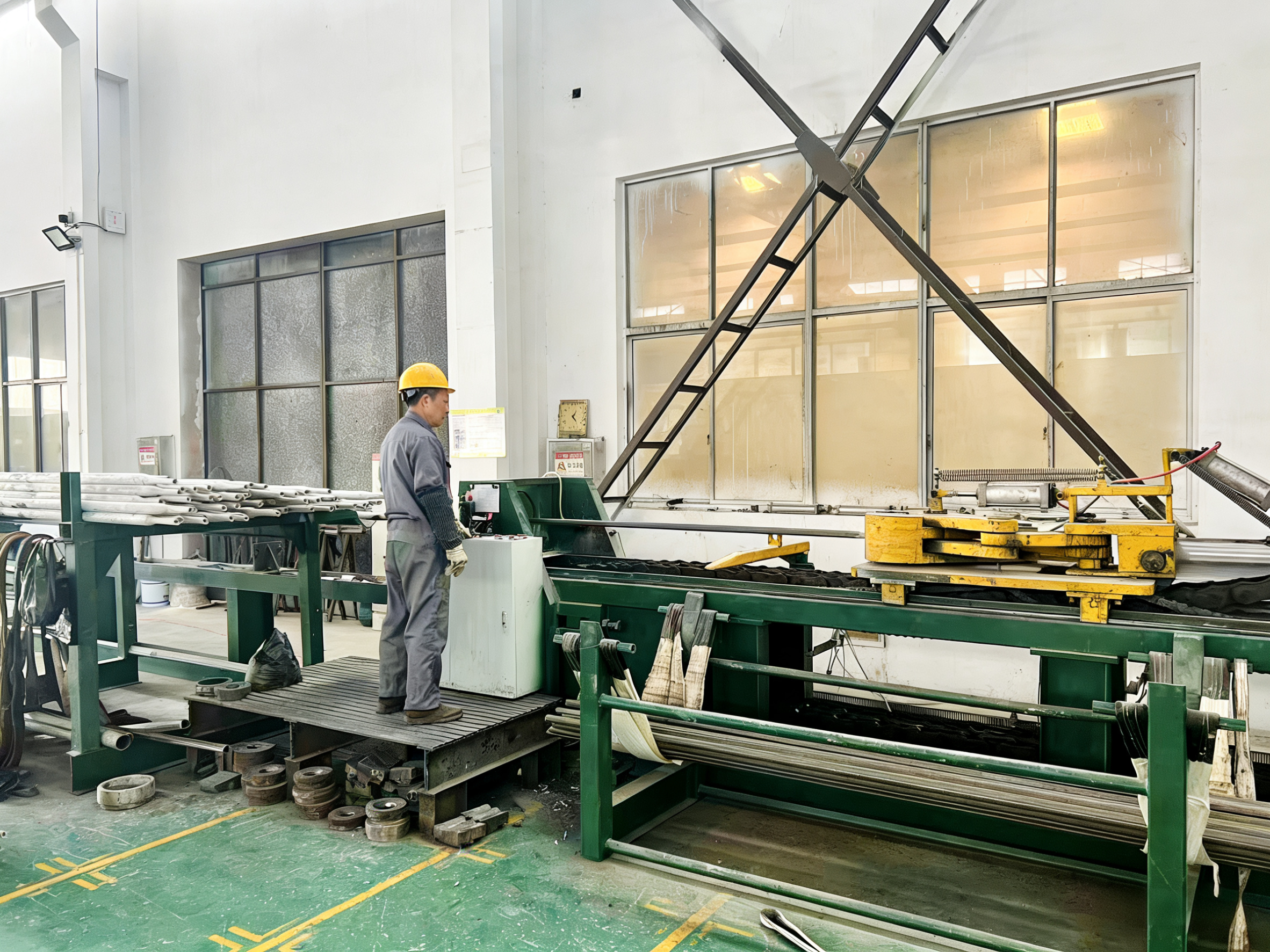
The 1 mm to 18 mm wall range is continuous, but it is not uniform in behaviour. At the thin end, the wall itself becomes the tolerance problem: a ±0.1 mm band represents a large share of a 1 mm wall, and handling, straightening and packing influence the result as much as the drawing does. Buyers specifying Thin Wall Seamless Steel Pipe for cylinders or housings should state packing and straightness requirements, not only the wall.
At the thick end, Thick Wall Seamless Steel Pipe is usually chosen for pressure duty or for machining stock, where wall uniformity and concentricity set the boring allowance. A heavy wall that is on nominal but eccentric forces the machine shop to remove more material from one side, which is a cost the purchase price never showed.
The honest boundary: the combination of large diameter and thin wall is the hardest part of the range to keep round and straight, so a tolerance that holds comfortably at a small diameter and moderate wall should not be assumed to hold at the extreme corner of the envelope without being confirmed in the enquiry. That is a question to ask before the order, not after the first delivery.
Materials: What the Grade Codes Actually Tell a Buyer
The Fakesi production range covers ten carbon and low-alloy grades, and the code in front of the buyer already indicates the family it belongs to.
| Grade | Family | Where it is usually specified |
|---|---|---|
| 10#, 20# | Low-carbon steel | General machining and formed parts where ductility matters |
| 35#, 45# | Medium-carbon steel | Machined parts requiring higher strength |
| 20Cr, 40Cr | Chromium alloy steel | Components heat-treated for strength or wear resistance |
| 16Mn, 20Mn | Manganese steel | Mechanical and structural components |
| Q355B, Q235B | Structural steel | Frames, structural tube and machinery applications |
In the Chinese designation system the number after the “#” reflects nominal carbon content, so 20# and 45# differ in carbon level rather than in mill source; 20Cr and 40Cr add chromium for hardenability; and the “Q” prefix marks a structural grade defined by yield strength, which is why Q355B and Q235B behave differently from the “#” series in welding and forming.
Q355B: Composition Questions and the Equivalence Trap
Q355B is a Chinese low-alloy structural steel grade in the carbon-manganese family, and it is one of the most frequently requested materials for custom seamless tube in machinery and structural work. Composition limits are defined by the applicable Chinese standard, so the authoritative composition for a given delivery is the one stated on that delivery’s mill certificate — not a generic grade table found online.
Q355B is often compared with European S355-type grades, and that comparison is where procurement errors creep in. Equivalent grade designations do not automatically carry identical testing, acceptance or documentation requirements; a substitution that looks correct on a grade cross-reference can still fail the purchase specification. Buyers should confirm equivalence against the standard edition and the purchase specification in force rather than against a conversion chart.
Q355B Seamless Steel Pipe is supplied within the same Φ10 mm – Φ280 mm diameter and 1 mm – 18 mm wall envelope as the rest of the range, and the tolerance discussion above applies to it unchanged.
Reading Model Numbers: What 8–100 and 10–100 Refer To
Catalogue lines and enquiry threads often use notations such as 8–100 and 10–100. These are size-envelope designations: the two numbers bound a minimum and a maximum rather than naming one dimension or one material, and they describe the span a product line covers.
The practical rule is to convert the notation into an explicit dimension before quoting. Three things need confirming: which dimension the envelope bounds (outside diameter, across-flats on a hexagon or octagon, or wall), what nominal size inside the envelope the job actually needs, and what tolerance applies at that nominal size. A supplier who answers “8–100” has confirmed that your size exists in the range; that supplier has not yet answered the tolerance question at your specific size.
Special Shapes Add Dimensions, Not Only Difficulty
The special-shape range — Seamless Triangle Pipe, Seamless Lemon-shaped Tube, Seamless Hexagon Pipe, Seamless Octagon Pipe and Seamless Oval Steel Pipe — is where incomplete drawings cause the most rework, because a non-circular profile is defined by more than one measurement.
- Across-flats or across-corners, with the nominal and the tolerance stated separately.
- Corner radius, and the wall thickness at the corner as distinct from the wall at the flat.
- Straightness and twist, which behave differently on a profiled section than on round tube.
- A datum on the drawing, so that the inspection method matches the manufacturing method.
Buyers who reuse a round-tube inspection template on a hexagon or lemon profile will not capture the features that actually determine fit. The inspection plan has to follow the profile drawing, not the other way round.
Where Tolerance and Material Are Actually Tested
Custom seamless tube from this range is used in hydraulic cylinders, pneumatic cylinders, agricultural drive shafts, automotive drive shafts, motorcycle and auto parts, smart lock components, motor housings, construction machinery and mold manufacturing. Each of those applications converts the specification into a different priority.
- Cylinder tubes: internal diameter, wall uniformity and surface condition matter more than outside diameter.
- Drive shafts: torsional strength, straightness and wall consistency along the length dominate, which is why tighter tolerances and higher torsional strength are usually specified together.
- Machining stock (Seamless Pipe for Machining, Precision Bright Steel Pipe): outside diameter tolerance and machinability decide how much material is removed and how predictable the cycle time is.
- Near-net special shapes: profile accuracy reduces the number of machining operations, which is where the cost saving actually appears.
Comparison: Precision Custom Seamless Tube Against PTO Profile Tube
In agricultural drive-shaft applications, the comparison that matters is between a custom seamless drive shaft tube and a conventional PTO profile tube. Documented comparison data for this pairing shows tighter tolerances, higher torsional strength, smoother and more vibration-free running, and an anti-cracking reinforced tube construction on the seamless side.
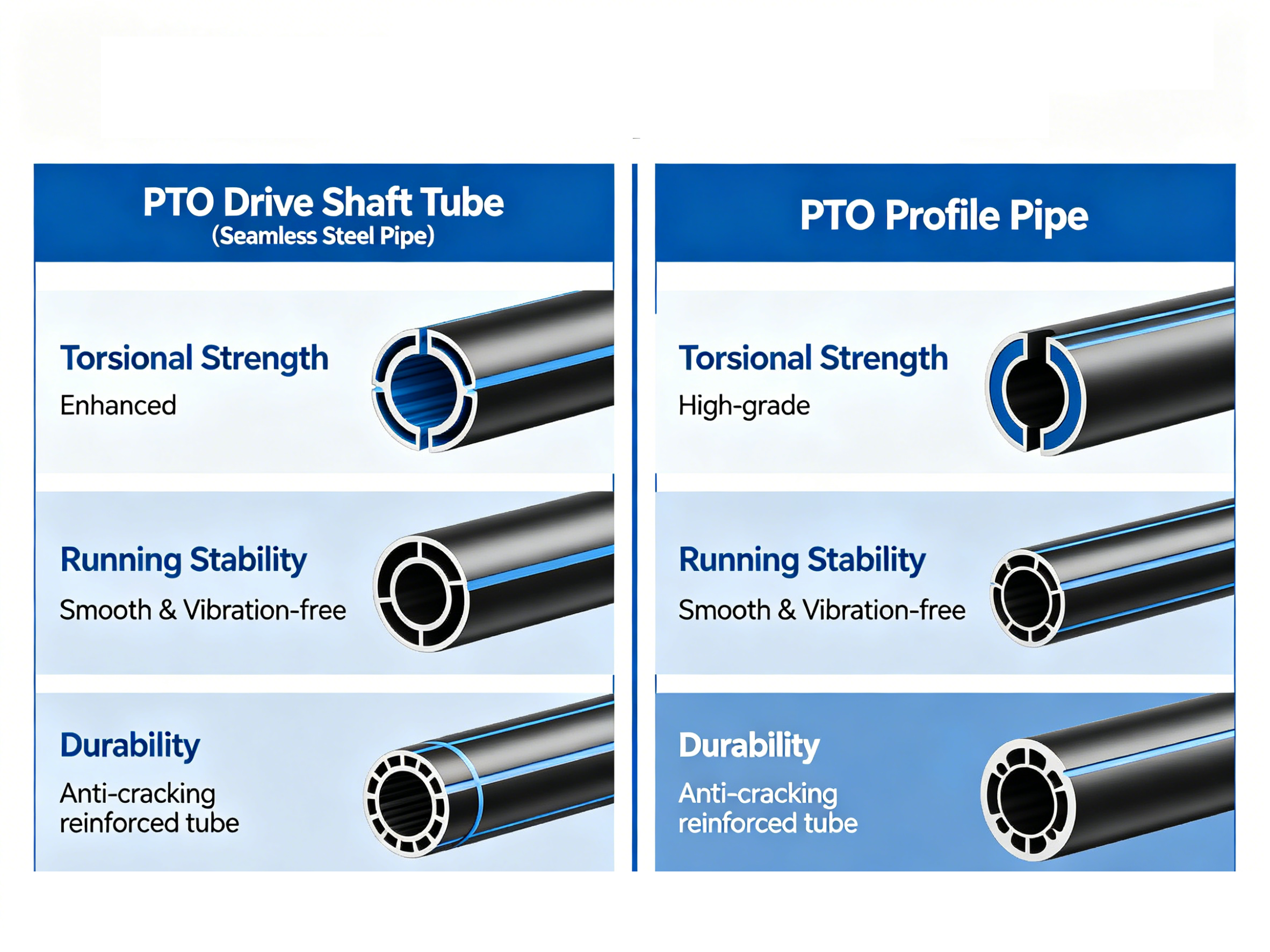
| Comparison point | Custom seamless drive shaft tube vs. PTO Profile Tube |
|---|---|
| Torsional strength | Enhanced / high-grade |
| Running stability | Smooth and vibration-free |
| Durability | Anti-cracking reinforced tube |
| Service life | Extended by 200% to 400% |
| Cost | 5% lower |
| Maintenance | Less maintenance required |
| Application fit | Agricultural machinery |
The limitation belongs next to the table rather than in a footnote. The 200% to 400% service-life figure and the 5% cost difference were established for this drive-shaft application; they are not transferable to unrelated duty cycles, and a buyer who applies them to a different load profile is quoting a number rather than an engineering result. Custom geometry and tight tolerance also carry consequences: a cold-drawn, profiled tube involves more processing steps than a commodity hot-rolled round pipe, so lead time and per-ton processing cost rise even where the unit comparison is favourable. Where a standard round tube already meets the drawing, the custom route is not automatically the cheaper one — the saving has to come from machining avoided, scrap reduced or service life gained.
Procurement Controls Worth Writing Into the Order
- Tolerance with a reference dimension: state whether ±0.1 mm applies to outside diameter, bore, wall or across-flats.
- Wall as a minimum and maximum: a nominal wall alone does not define an acceptance limit.
- Straightness and cut-length tolerance: fixed-length cutting is a dimensional operation, so it needs a tolerance as well as a length.
- Grade plus specification edition: and a clear statement of whether a mill certificate, a test report, or both, are required.
- Surface protection: anti-rust oil applied to the surface is the standard control against rust and corrosion in transit and storage.
- Compatibility inspection: control of dimensional straightness at goods-in is the practical defence against misfit, and it is cheaper than discovering the misfit at the machine.
- A profile drawing for non-circular shapes: with datum, across-flats tolerance, corner radius and wall at the corner.
- Packing for thin-wall: deformation in transit is a specification problem that looks like a quality problem.
Two failure modes account for a disproportionate share of claims: rust and corrosion, controlled by surface protection and packing; and misfit, controlled by dimensional straightness and an incoming compatibility inspection. Neither is solved by a tighter tolerance alone — both need to be written into the order.
Market Context: Why Tolerance Is Turning Into a Pricing Variable
The global seamless steel tube and pipe market is projected to reach approximately USD 130–140 billion in value by 2026, according to Research and Markets. At the same time, China’s seamless steel tube output in 2024 is estimated at 29.9 million tons, a 5.08% year-on-year decline, based on figures from the Steel Tube Branch of the China Steel Association.
Read together, those two numbers describe a market in which volume and value are moving in opposite directions — an interpretation consistent with a shift from bulk commodity tube toward higher-specification product, though the published data measures market value and production volume rather than product mix directly. For buyers, the practical implication is that availability of precision and special-profile supply should be assessed separately from availability of commodity round pipe; they are no longer the same question.
The acceptance side is moving too. ASTM A106 defines seamless carbon steel pipe for high-temperature service; ISO 3183 addresses steel pipe for petroleum and natural-gas pipeline transportation systems; and API 5L Grade B and ISO 3183 Grade L245 are commonly listed as equivalent references — with the caveat that equivalence should be confirmed against the edition and purchase specification rather than assumed. Under HS 7304, seamless tubes, pipes and hollow profiles are classified within a single trade heading, which is why customs data alone will not tell a buyer how much precision tube is moving.
Future Outlook
The direction of travel in custom seamless tube procurement is toward tolerance moving out of post-award negotiation and into the drawing. Buyers who already specify outside diameter, wall range, grade and profile are increasingly asked to specify the measurement method and the documentation package alongside them, because a ±0.1 mm requirement that cannot be inspected cannot be enforced.
For suppliers, that shifts the basis of competition from catalogue range to evidence of process control: whether the cold-drawing route, the straightening step, the cut-length operation and the surface protection can be shown to hold the band delivery after delivery. For special shapes, the same shift applies with more measurement dimensions attached.
FAQ
Precision cold-drawn custom seamless tube is supplied to ±0.1 mm. The tolerance must be tied to a reference dimension — outside diameter, bore, wall or across-flats — because the same ±0.1 mm figure means different things on each, and each is inspected differently.
The range covers 10#, 20#, 35#, 45#, 20Cr, 40Cr, 16Mn, 20Mn, Q355B and Q235B. The “#” grades are carbon steels differing in nominal carbon content, 20Cr and 40Cr are chromium alloy grades, 16Mn and 20Mn are manganese grades, and Q355B and Q235B are structural grades defined by yield strength.
Wall thickness runs from 1 mm to 18 mm, with the light end conventionally described as thin-wall and the heavy end as thick-wall. The 1 mm end is more sensitive to handling, straightening and packing, so straightness and packing requirements should be stated explicitly rather than assumed.
They are size-envelope designations: the numbers bound a minimum and a maximum size within a product line, rather than naming a single dimension or a material grade. The buyer should confirm which dimension the envelope bounds and what tolerance applies at the specific nominal size required.
Q355B is a Chinese low-alloy structural steel grade and is frequently compared with S355-type grades, but equivalent designations do not automatically carry identical testing, acceptance or documentation requirements. Equivalence should be confirmed against the applicable standard edition and the purchase specification, with composition taken from the mill certificate for the actual delivery.
Special shapes — triangle, lemon, hexagon, octagon and oval — are defined by more measurements than round tube, including across-flats or across-corners, corner radius, wall at the corner and twist. The tolerance should be stated for each of those features on a profile drawing with a datum, rather than carried over from a round-tube specification.
Surface protection is the primary control: anti-rust oil is applied to the surface to limit rust and corrosion during transport and storage. Packing specification and storage conditions remain part of the requirement, particularly for thin-wall tube.
Technical reference: the manufacturer’s product brochure covering the full seamless, precision and special-shaped tube range, including dimensions and material grades, is available to download as a PDF brochure.
Есть вопросы или нужны дополнительные детали?
Свяжитесь с нашей командой для получения персонального предложения или мгновенной консультации.
Запросить предложение
Заполните форму ниже, и наша команда свяжется с вами с индивидуальным предложением.
Прямой чат WhatsApp
Предпочитаете общаться в реальном времени? Напишите нам в WhatsApp для мгновенной помощи и быстрых ответов.
- Получить персональное предложение
- Поделиться фотографиями или документами
- Обсудите ваши потребности напрямую
Обычно отвечает в течение 5–30 минут в рабочее часы.