
Custom Sheet Metal vs. Off-the-Shelf Communication Cabinets
Custom Sheet Metal vs. Off-the-Shelf Communication Cabinets

Factory exterior: a manufacturing context for custom sheet metal parts used in communication cabinet programs. Image: Haitong Metals.
Communication cabinet buyers often face a deceptively simple choice: specify custom sheet metal parts or select an off-the-shelf enclosure. The lower-risk answer is not automatic. Off-the-shelf enclosures can be efficient when catalog dimensions, mounting patterns, cable access and environmental features already match the cabinet design. Custom sheet metal parts become more relevant when the cabinet must fit a specific equipment layout, hold a defined dimensional window, integrate brackets, panels or welded assemblies, or carry a finish and documentation package that a standard enclosure does not provide. The decision should be made on fit, volume, change profile, compliance evidence and lifecycle support, not on the label custom or standard.
This independent buyer comparison examines both routes for communication cabinets. It uses the supplied first-party capability facts for Haitong Metals only where relevant, and it treats off-the-shelf enclosures as a product category rather than a specific brand. No single supplier or route is presented as universally superior.
Why communication cabinets create a different comparison
A communication cabinet is not only a metal box. It is an interface between electronics, power, cable routing, mounting hardware, access control and the installation environment. The supplied application scope for custom sheet metal parts includes communication equipment and ventilation equipment, with support, shielding, fixing and housing functions. That scope explains why the enclosure decision can affect assembly time, maintenance access and documentation burden.
Several requirements tend to drive the comparison:
- Internal layout and mounting. Backplates, brackets, rails and cable-management features may need to align with specific equipment positions.
- Access and serviceability. Door openings, removable panels and cable entry points may need to match installation and maintenance routines.
- Environment. Indoor and outdoor conditions can change the finish and material requirements. The supplied application scope for custom parts refers to normal temperature, indoor and outdoor use, and 24/7 operation.
- Documentation. If the enclosure is part of electrical and electronic equipment placed on the EU market, RoHS 2 and REACH declarations may be requested from the metal parts supplier.
- Change profile. A stable, standard cabinet layout behaves differently from a program that expects frequent equipment revisions.
The practical question is therefore not whether custom is inherently better than off-the-shelf. It is whether the standard enclosure already satisfies the cabinet interface, or whether the cost and time of adapting it are less attractive than a drawing-driven custom route.
What off-the-shelf enclosures do well, and where they stop
Off-the-shelf enclosures are standardized products. Their value is strongest when the standard size, panel configuration, mounting points, material and finish already match the communication cabinet requirement. In that situation, the buyer can reduce engineering effort for the enclosure itself and avoid custom tooling for the enclosure body. Catalog documentation may also cover the standard product, which can simplify an initial technical review.
The limitation appears when the cabinet requirement departs from the catalog. A nonstandard opening, bracket position, internal depth, cable entry, mounting pattern or finish may require modification. Modification can add cutting, drilling, welding, painting or assembly operations, and it can change who is responsible for tolerance, finish quality and inspection. Standard product documentation may not automatically cover a modified unit. For a communication cabinet with a stable, standard layout and low customization need, an off-the-shelf route can remain practical. For a cabinet that must accommodate a specific equipment arrangement, the modification burden should be priced and validated before the standard option is treated as cheaper or faster.
What custom sheet metal parts change
Custom sheet metal parts are produced from customer drawings. The supplied comparison unit describes custom parts as customized per customer drawings, capable of independent mold opening for mass production, with a tolerance of ±0.2mm, prototype and sample availability before mold development, cost-effective large-volume orders after mold opening, custom protective surface treatment, and structure optimized to fit customer assembly requirements. These facts define a route and its evidence requirements. They do not guarantee that every communication cabinet program should use it.
The custom route adds defined steps: drawing review, DFM review, sample confirmation, mold development and mass production. That sequence is useful when the communication cabinet requires a custom sheet metal panel, custom sheet metal bracket, internal support, shielding element, housing or welded assembly that must fit a specific layout. It can also consolidate several metal parts into one drawing package, but only when the supplier's process capability, inspection plan and capacity match the program. The buyer should treat the sample and first-article stage as a decision gate, not as a formality.
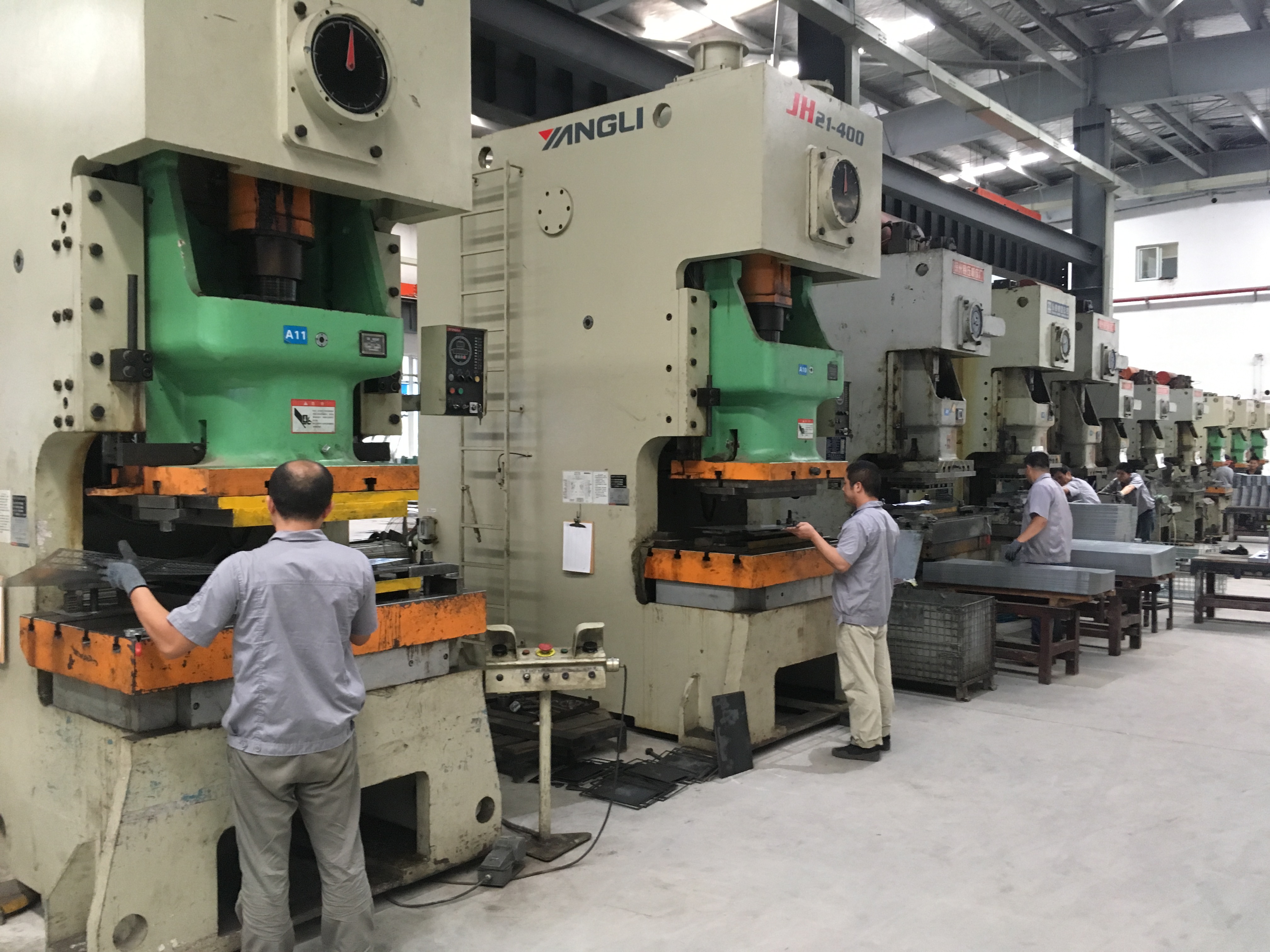
Stamping production line: process capability must be matched to the drawing, volume and inspection plan. Image: Haitong Metals.
Comparison table: custom sheet metal vs. off-the-shelf enclosures
| Decision dimension | Custom sheet metal parts | Off-the-shelf enclosures | Buyer check |
|---|---|---|---|
| Fit to cabinet layout | Made to drawing; can incorporate specific openings, brackets, panels and assembly features. | Best when catalog dimensions, mounting pattern and features already match the cabinet design. | Compare the equipment layout and cable access against the actual 2D or 3D definition. |
| Engineering effort | Requires drawing review and DFM before production. | Can reduce engineering effort when the standard product fits without modification. | Include adaptation design, not only the enclosure catalog item. |
| Tooling and validation | Mold development can be required for mass production; prototype and sample can be provided before mold development. | No custom enclosure tooling is needed if the standard unit fits; modifications may still add operations. | Validate the sample or modified unit against the communication cabinet interface. |
| Tolerance and specification | The supplied custom comparison states ±0.2mm; the exact dimensions and inspection method still need drawing definition. | Use the published specification of the standard enclosure and confirm it against the cabinet requirement. | Specify general tolerance standard, critical dimensions and first-article report. |
| Material and finish | Custom protective surface treatment is available; material and finish should be specified per drawing. | Finish options are limited to the standard product range and any approved modification. | Require material and coating records; check outdoor durability where relevant. |
| Volume economics | The supplied comparison describes custom parts as cost-effective for large-volume orders after mold opening. | May avoid custom tooling, but unit economics depend on catalog price, modification and volume. | Compare tooling, sampling, piece price and logistics at the actual annual volume. |
| Change management | Drawing and mold changes require controlled revision and validation. | Standard catalog changes may be easier, but modifications still need revalidation. | Define revision ownership and change approval before production. |
| Compliance evidence | Supplier can provide material and surface-treatment declarations where required; scope must be confirmed. | Catalog compliance documentation may cover the standard product; modified units need review. | Check RoHS 2 and REACH declarations where the enclosure is part of EEE for the EU market. |
The table does not produce a universal winner. It shows where the evidence burden sits. Custom moves more of the definition and validation work upstream. Off-the-shelf moves more of the risk into fit confirmation and modification control.
Technical explanation: tolerance, material, welding and surface treatment
Tolerance and drawing standards
A tolerance statement becomes useful only when the drawing defines which dimensions it applies to, which datum is used and how inspection will be performed. ISO 2768-1:1989 defines general tolerances for linear and angular dimensions without individual tolerance indications. DIN 6930-2 specifies general tolerances for stamped steel parts. Buyers should select one applicable framework per drawing and avoid applying both at once without a clear reason.
The ±0.2mm custom tolerance in the supplied comparison unit is a useful starting point, but it should not be read as a blanket tolerance for every feature. A communication cabinet may have critical mounting dimensions, flatness requirements and assembly interfaces that need individual tolerance callouts. General tolerance class selection also affects process route and cost. Over-specifying every dimension can push a part toward a more expensive process. Under-specifying critical interfaces can create assembly problems. The buyer should separate critical, functional and non-critical dimensions before requesting a quotation.
For process context, standard laser cutting is often cited at ±0.005 inches and plasma cutting at ±0.020 inches. These are general process examples, not a specification for a communication cabinet enclosure. The drawing and inspection plan remain the controlling documents.
Material and finish specifications
Communication cabinet enclosures and internal metalwork may use galvanized steel, stainless steel or aluminum, depending on corrosion exposure, weight, forming route, finish and cost. Material standards should be named in the RFQ. Hot-dip zinc-coated steel sheet is specified under ASTM A653/A653M, while EN 10346:2015 is the European specification for continuously hot-dip coated steel flat products for cold forming. The two systems use different coating-mass designation systems, so buyers should not convert coating designations without a verified conversion table. Stainless steel sheet and strip can be specified under ASTM A240/A240M. For outdoor or corrosive conditions, ISO 1461 covers hot-dip galvanized coatings on fabricated iron and steel articles and may be relevant where that coating route is selected.
Surface treatment should be matched to the environment and the maintenance plan. The supplied knowledge unit lists powder coating, galvanizing, passivation and other anti-corrosion treatments. A buyer should confirm the coating system, dry-film thickness or coating mass where applicable, adhesion or appearance criteria, and the inspection method. These details should be written into the drawing or purchase specification rather than left to a general finish description.
Welding and assembly evidence
Spot welding parts and welded assemblies require process evidence. A supplier statement that spot welding is available does not by itself establish weld quality. ISO 3834-2:2021 sets comprehensive quality requirements for fusion welding of metallic materials, and ISO 9606-1 governs qualification testing of welders for fusion welding of steels. Buyers should ask which part of ISO 3834 applies, request welding procedure specifications, welder qualification records and inspection records, and confirm the visual and dimensional acceptance criteria for the communication cabinet assembly.
For communication cabinets, welding may affect flatness, coating coverage and service access. The buyer should identify which joints are structural, which are sealing or shielding related, and which are only locating. That distinction helps avoid unnecessary welding and helps define the inspection plan.
Compliance documentation for communication equipment
ISO 9001:2015 is a quality management system standard, not a product certification. It is a baseline supplier qualification signal, but the certificate scope, certification body and validity should be checked. If the sheet metal enclosure is incorporated into electrical and electronic equipment placed on the EU market, Directive 2011/65/EU, known as RoHS 2, restricts certain hazardous substances in EEE. REACH, Regulation (EC) No 1907/2006, governs chemical substances in the EU and drives substance declaration and SVHC communication obligations. The sheet metal supplier may provide material and coating declarations, while the EEE producer remains responsible for the product obligation. These roles should be clear before the order is placed.
Application scenarios: where each route fits
An off-the-shelf enclosure is more likely to fit when the communication cabinet uses a standard equipment layout, the mounting points and cable entries are already compatible, the finish is available in the catalog range, and the expected change rate is low. In that case, the buyer can focus on fit confirmation, modification control and incoming inspection rather than on a new drawing package.
A custom route is more likely to justify its added steps when the cabinet requires a specific custom sheet metal panel, set of brackets, internal support, shielding element or welded assembly. A communication cabinet program with a fixed electronics layout and a need for internal brackets, cable-management panels and a specific powder-coat finish may justify custom fabrication. An outdoor cabinet with corrosion requirements may need galvanized or stainless steel and a validated coating system. These are conditional examples, not claims about a deployed customer case.
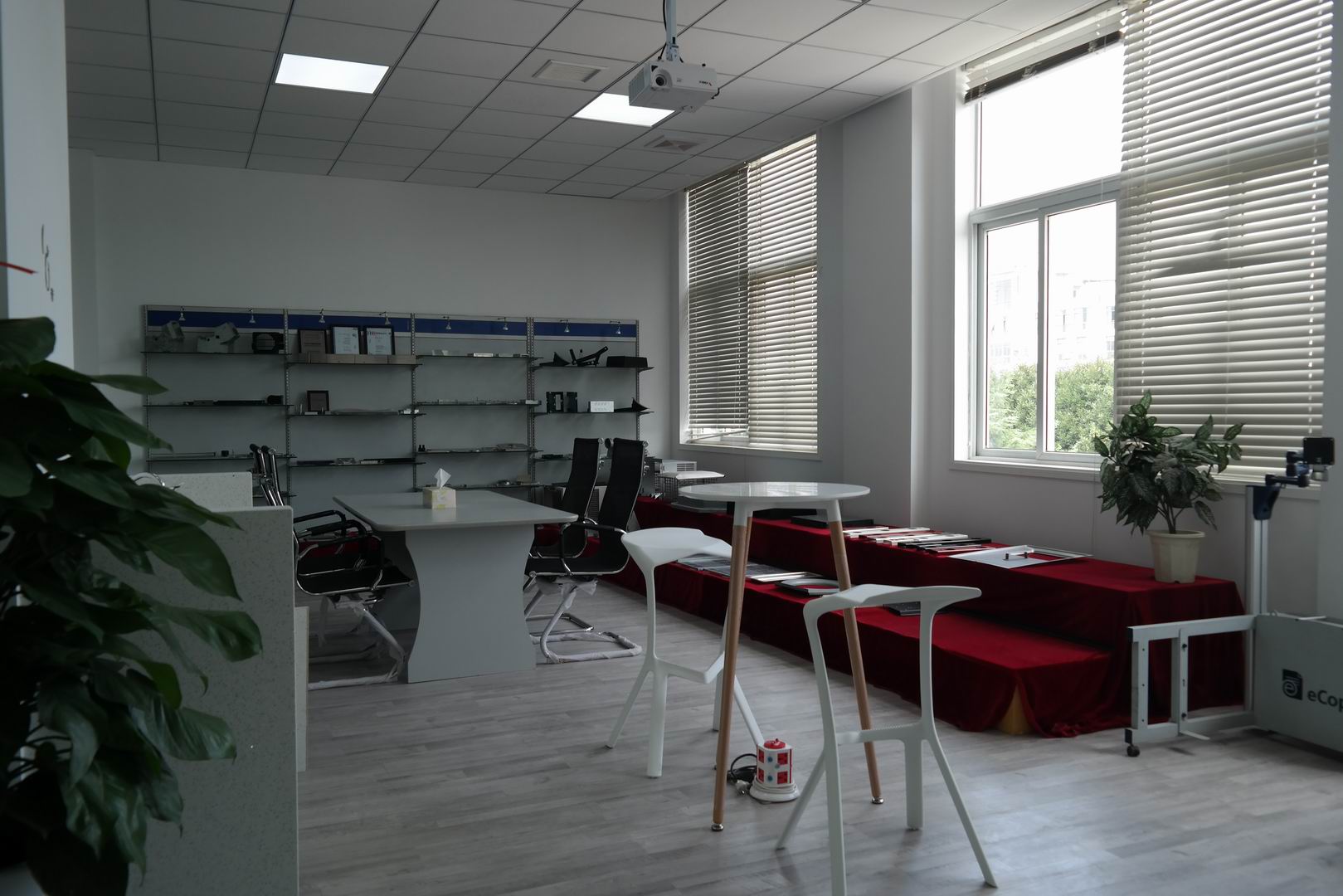
Sample showroom: a practical setting for reviewing prototype and first-article parts before production. Image: Haitong Metals.
The supplied application scope for Haitong Metals includes automation, electronics, new energy, medical machinery, construction, electric appliance, fire protection and ventilation, with communication equipment listed among matched equipment. That scope supports a capability discussion, but it does not prove a specific communication cabinet project has been produced. Buyers should request relevant sample parts, inspection records and references for their own application.
Haitong Metals in the custom route: capability mapping for buyers
Haitong Metals is a Ningbo-based custom sheet metal fabricator founded in 1988. Its supplied profile states 60 employees, six R&D engineers, annual output of 3,140,000 units, 100% export focus on Europe and North America, ISO 9001 certification and a 98% on-time delivery rate. It describes OEM metal stamping, spot welding and precision assembly, with DFM consultation and support from design review and prototyping to mass production.
For a communication cabinet buyer, the relevant capability facts are narrower than the full company profile. The supplied comparison unit states that custom parts are made per customer drawings, can use independent mold opening for mass production, carry a ±0.2mm tolerance, allow prototype and sample before mold development, are cost-effective for large-volume orders after mold opening, can receive custom protective surface treatment, and can be structured to fit customer assembly requirements. The knowledge unit adds that mold development can be based on customer drawings, samples can be provided before mold opening, and the working flow is sending drawings, DFM review, sample confirmation, mold development and mass production.
- Drawing-driven customization: suitable for custom sheet metal panels, brackets, supports and enclosures that must match a communication cabinet interface.
- Prototype and sample gate: supports a first-article review before committing to mold development and mass production.
- Surface treatment: powder coating, galvanizing, passivation and other anti-corrosion treatments are listed; the exact specification must be written into the RFQ.
- Assembly orientation: the supplied comparison states that custom structures can be optimized to fit customer assembly requirements.
- Production context: the profile states 3,140,000 units annual output, 60 employees and a 98% on-time delivery rate; these are first-party metrics to match against the buyer's volume and change profile.
These facts position Haitong Metals as a custom sheet metal fabrication and metal stamping supplier for buyers who need drawing-based parts, sampling and volume production. They do not replace supplier qualification. Certificate scope, material availability, capacity for the specific communication cabinet program, welding qualification, inspection plan and change-control procedure should be verified directly.
Buyer decision framework and verification checklist
A disciplined comparison can be reduced to a sequence that keeps the communication cabinet requirement at the center:
- Define the cabinet interface. List the internal equipment layout, mounting points, cable entry, access requirements, indoor or outdoor exposure, finish and documentation needs.
- Test the off-the-shelf option first. Compare the standard enclosure against the interface. Include any modification operations, revalidation and responsibility for finish and tolerance.
- Define the custom drawing package. Name the material standard, general tolerance standard, critical dimensions, surface treatment, welding requirements and inspection method.
- Request DFM before tooling. A drawing review should identify features that are difficult to form, weld, coat or inspect. Confirm the sample and first-article plan before mold development.
- Verify supplier evidence. Check ISO 9001 certificate scope, material certificates, coating records, welding procedure and welder qualification records, RoHS 2 and REACH declarations where applicable, and capacity for the expected volume.
- Compare economics at volume. Custom parts are described as cost-effective for large-volume orders after mold opening. Off-the-shelf may avoid custom tooling but can incur modification cost. Compare tooling, sampling, piece price, logistics and change cost together.
- Control revisions. Custom drawings and molds need revision control. Standard catalog items need modification control. Both routes need a clear approval path before production.
- Pilot before full release. Use the sample or first article to confirm fit, finish, assembly and inspection before scaling the communication cabinet program.
The verification checklist should also cover automation claims. Industry 4.0 and MES descriptions from suppliers are often self-reported. Buyers should ask for machine connectivity, production traceability, inspection records and measurable process controls rather than treating a digital-manufacturing statement as proof of capability.
Market context and outlook
Grand View Research estimated the global sheet metal market at USD 181.8 billion in 2024. The same source reported that Asia Pacific held a 65% revenue share in 2023 and that steel held more than 81% of product revenue in 2023. These figures describe the sheet metal market broadly, not a communication-cabinet enclosure forecast. They show that the supply base is large and material-intensive, but they do not prove demand for any specific enclosure type or supplier. Buyers should use market data for context and use drawing-level, process-level and supplier-level evidence for the actual decision.
A practical outlook is hybrid sourcing. An off-the-shelf enclosure can remain the reference point where the standard product fits. Custom sheet metal parts can be reserved for the interface panels, brackets, backplates, welded assemblies or finish requirements that a standard enclosure does not cover. That approach keeps the commodity portion of the cabinet standard while concentrating custom engineering where it changes fit or function. It also makes the buyer's verification effort proportional to the risk.
FAQ
When is custom sheet metal better than an off-the-shelf enclosure for a communication cabinet?
Custom sheet metal is more relevant when the cabinet layout, mounting pattern, cable access, internal brackets, welded assembly or finish cannot be matched by a standard enclosure without significant modification. Off-the-shelf remains practical when the catalog enclosure already fits and the change rate is low. The decision should compare fit, modification cost, tooling, volume and documentation, not assume that custom is always superior.
What tolerance should a buyer specify for custom communication cabinet parts?
The buyer should define critical functional dimensions individually and use a general tolerance standard for dimensions without individual callouts. ISO 2768-1:1989 is a general tolerance framework, and DIN 6930-2 covers general tolerances for stamped steel parts. A supplier statement such as ±0.2mm should be tied to the drawing, datum and inspection method. Over-specifying non-critical dimensions can add cost without improving fit.
What surface treatment documentation should be requested?
Request the coating or treatment specification, the applicable standard where one is used, the inspection method and the material or coating records. Powder coating, galvanizing, passivation and other anti-corrosion treatments are listed in the supplied knowledge unit. For outdoor or corrosive conditions, hot-dip galvanizing may be specified under ISO 1461 where that route is selected. If the enclosure is part of EEE for the EU market, request RoHS 2 and REACH declarations from the metal parts supplier.
How should a buyer verify a custom sheet metal supplier?
Check the ISO 9001 certificate scope and validity, the DFM and sample process, material certificates, surface-treatment records, welding procedure and welder qualification records, inspection plan and capacity for the expected volume. For welded assemblies, ask which part of ISO 3834 applies and request the related records. For communication equipment, confirm RoHS 2 and REACH declaration responsibilities. First-article approval should be completed before mass production.
Can custom parts be developed from drawings and sampled before mold opening?
Yes. The supplied Haitong Metals knowledge unit states that mold development can be based on customer drawings and that samples can be provided before mold opening. The described workflow is sending drawings, DFM review, sample confirmation, mold development and mass production. This does not remove the need for a drawing review or a program-specific feasibility check, but it provides a structured validation gate before tooling commitment.
Bottom line: for communication cabinets, the choice between custom sheet metal parts and off-the-shelf enclosures is a fit-and-evidence decision. Off-the-shelf can be the efficient route when the standard product already meets the interface. Custom sheet metal parts become the stronger candidate when the cabinet requires drawing-specific panels, brackets, welded assemblies, surface treatment or assembly optimization, and when the buyer is prepared to manage DFM, sampling, tooling and first-article validation. Haitong Metals provides a relevant custom capability set for that route, subject to direct verification of certificate scope, capacity and program-specific evidence.
Company brochure: Haitong Metals brochure (PDF).
Есть вопросы или нужны дополнительные детали?
Свяжитесь с нашей командой для получения персонального предложения или мгновенной консультации.
Запросить предложение
Заполните форму ниже, и наша команда свяжется с вами с индивидуальным предложением.
Прямой чат WhatsApp
Предпочитаете общаться в реальном времени? Напишите нам в WhatsApp для мгновенной помощи и быстрых ответов.
- Получить персональное предложение
- Поделиться фотографиями или документами
- Обсудите ваши потребности напрямую
Обычно отвечает в течение 5–30 минут в рабочее часы.