
Custom Shopping Bags: EU, US & Middle East Compliance Checklist
Custom Shopping Bags: EU, US & Middle East Compliance Checklist
A working checklist for buyers who must qualify custom paper bags before committing to a retail packaging order across the European Union, the United States and the Middle East — covering fibre sourcing, printing inks, adhesives, handle construction, colour records and supplier verification.
Two questions now decide a bag specification
Custom shopping bags are judged on two axes at the same time. The first axis is commercial: whether the bag carries a logo cleanly, whether the handle survives a re-use cycle, and whether the finish matches the brand's presence in store. The second axis is documentary: whether the fibre source, the printing ink, the adhesive system, the handle construction and the colour records can be produced on request, in the format a retail buyer, importer or customs broker expects.
The two axes rarely fail together, which is precisely why the distinction matters at the decision stage. A bag can pass a visual sample review and still stall at purchase-order stage because a supplier cannot confirm the scope of a certification, or because no colour tolerance was ever written down. Qualification work is therefore cheaper before tooling than after.
Opack is a custom packaging manufacturer based in Longgang, Wenzhou, Zhejiang Province, China. Founded in 2010, the company operates a 10,000 m² facility with 160 employees and reports annual output of 10,000,000 units across custom shopping bags, rigid boxes, folding cartons, mailer boxes and paper tubes, serving apparel, cosmetics, retail, gifting and jewelry customers. Approximately 80% of its sales go to EU, US and Middle East markets.
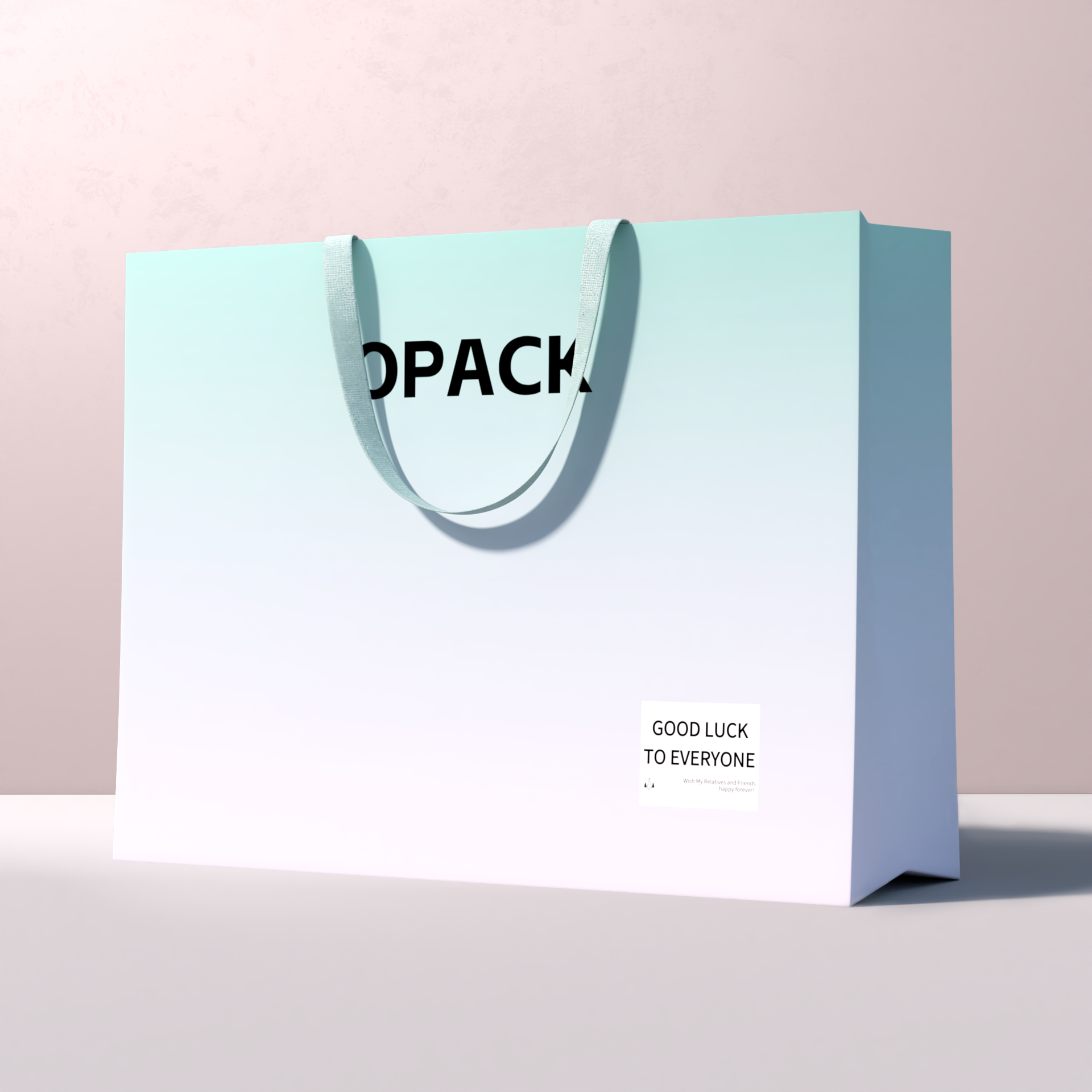
A custom paper shopping bag: the visible part of a specification that also includes fibre documentation, ink chemistry, adhesive declaration and colour records.
Why compliance became part of bag sourcing
Three changes pulled documentation into the buying decision, and none of them are reversible.
- Sustainability claims are now verified rather than assumed. FSC certification is the primary industry standard for verifying sustainable sourcing, with a 56% global consumer recognition rate, according to the Forest Stewardship Council. A logo on a sample is no longer sufficient; buyers increasingly ask for the certificate scope that covers the paper grade actually used.
- Retail programmes audit suppliers, not only products. A brand that sells into multiple regions is usually asked, at some point, to show the paper trail behind its packaging — fibre, ink, adhesive and, where relevant, food-contact statements.
- The supply base is global and concentrated. China is the world's leading exporter of paper sacks and bags, with exports valued at approximately USD 1.91 billion in 2023, according to UN Comtrade / WITS data. That scale means most EU, US and Middle East retail programmes already source from Asian converters, and the qualification work sits on the buyer's side.
Demand is expanding alongside those requirements. Grand View Research values the global paper bags custom printing market at USD 2.78 billion in 2024 and projects a 13.9% CAGR through 2030. Future Market Insights estimates that brown kraft paper will hold a 58% share of total material demand by 2026, driven largely by sustainability preferences.
The opportunity is asymmetric. A supplier whose documentation is already complete is considerably less expensive to keep than to replace, because the qualification cost is paid once instead of at every re-sourcing cycle.
The five-block qualification checklist
The checklist below is ordered the way it is usually closed in practice: define the destination market and end use first, then move down through fibre, ink, structure and colour. Each block should end with a document in hand, not a verbal assurance.
Block 1 — Market and end-use mapping
- Confirm which market or markets receive the bag: EU, US, Middle East, or several simultaneously. A bag designed for one destination may need an additional declaration for another.
- Establish whether the bag will contact food directly. Food packaging paper bags must comply with US FDA 21 CFR Part 176.170 for direct food contact safety, and this triggers a specific documentation set.
- State whether the bag is intended for a single use or a re-use claim. A re-use claim is a durability claim, and it must be backed by construction testing rather than by product description.
- Record load assumptions: typical product weight, bag dimensions and how the bag is carried. Handle and board specifications follow from these numbers, not from appearance.
Block 2 — Fibre and material documentation
- Request the FSC certificate and, more importantly, its scope — which grades and which site it covers.
- Confirm the paper grade, board weight and whether recycled or kraft fibre is used, with the corresponding chain-of-custody record.
- Ask for a recyclability statement describing how the finished bag behaves at end of life once printing, handles and any additional finishing have been applied.
Block 3 — Ink, coating and adhesive documentation
This block is where most supplier claims are least specific and where buyers most often need to push. Opack's stated specification for its custom shopping bags pairs FSC-certified materials with water-based printing inks, a combination that also supports full recyclability after the bag's service life. Buyers should ask suppliers to confirm the equivalent in writing.
- Printing ink system: confirm water-based versus solvent-based, and request the technical data sheet rather than a brochure claim.
- Adhesive system: ask which chemistry is used at the side seam, base and handle attachment, and request a volatile organic compound (VOC) declaration. Where a low-VOC specification is required by the buyer's own programme, this is a documentation request rather than a default.
- Coatings and lamination: confirm whether any film or varnish is applied, since it affects both the recyclability statement and the food-contact position.
- Food-contact statement: required where the bag will hold food, and it should reference the applicable regulation rather than a generic compliance phrase.
Block 4 — Structure, handle and load-bearing qualification
Handle choice is the most common gap between a beautiful sample and a bag that survives its second trip home. Load-bearing tests should be conducted before mass production to verify handle strength, paper durability and structural stability, ensuring the bag can safely support the intended product weight.
- Specify the handle type and attachment method, and how the attachment area is reinforced.
- Require pre-production load testing at a weight above the intended load, with results recorded against the order.
- Where re-use is claimed, the specification should use more sturdy paperboard, durable printing and reinforced handles, which together reduce tearing and handle breakage during repeated use.
Block 5 — Colour, finish and batch records
Colour is the specification buyers notice first and document last. A measurable tolerance converts a subjective argument into a batch record.
- Agree a colour target and a tolerance before printing. Spectrophotometer-based measurement and monitoring allows colour difference (ΔE) to be controlled within approximately 1.5, a level that is nearly imperceptible to the human eye.
- Require a pre-production colour approval step, with a signed reference sample retained by both parties.
- Confirm in-process quality inspections during printing, a final quality inspection before shipment, and batch-by-batch quality verification to keep reorders consistent.
How to verify a supplier's compliance claims
Verification is a sequence, not a single request. The following actions turn supplier statements into evidence a buyer can rely on across a long production relationship.
- Request the certificate, then check the scope. A certificate that does not name the paper grade or the production site does not support the claim.
- Validate the sample against production. A compliant sample is only useful if the production batch matches it in material, handle construction and colour.
- Ask for test records, not test intentions. Load-bearing results and colour measurement records should exist as documents tied to a specific order.
- Identify who signs the conformity statement. A named responsible function is easier to audit than an unsigned declaration.
- Check batch consistency over time. Batch-by-batch verification is what protects a retail programme in month twelve, when the reorder arrives.
What these requirements change on the production line
Printing, finishing and structural build are qualified together: a compliant bag is the output of a controlled process, not a single material decision.
Compliance requirements are often described as paperwork, but each one resolves into a production decision. Fibre documentation determines which paper grades can be purchased and from which mill. A water-based ink system constrains drying and press setup. The adhesive declaration constrains which handle attachment method can be used at all. Colour tolerance determines whether the job runs with spectrophotometer monitoring and in-process inspection at the press, or simply with a visual check.
The practical consequence for buyers is that these decisions have to be locked before tooling. Once a handle construction and an ink system are approved and load-tested, changing either one invalidates the test record and, in most programmes, the colour approval as well. That is why the checklist is positioned as a pre-order sequence rather than a shipment inspection list.
Where custom shopping bags fit
The bags described by this checklist are typically specified where the bag is expected to be seen again after the purchase — carried on a street, stored in a wardrobe, or photographed. Documented comparison data for custom shopping bags identifies the strongest fit in cosmetics retail, apparel stores, gift packaging, trade shows and events, and e-commerce.
Scale matters for these programmes. Opack reports a 10,000 m² facility, 160 employees, an R&D team of five and annual output of 10,000,000 units, with roughly 80% of sales directed to EU, US and Middle East markets. For a retail buyer, that profile matters less as a credential than as a continuity signal: the same specification, colour target and handle construction can be reproduced across markets and reorders.

Solid-colour and printed finishes must both be measured against the same agreed colour tolerance to keep reorders visually identical.
Market trend analysis
Three published data points frame the sourcing environment.
- The custom printing segment of the paper bag market is valued at USD 2.78 billion in 2024, with a projected 13.9% CAGR through 2030 (Grand View Research). Growth is concentrated in printed, brand-carrying bags rather than undecorated ones.
- Brown kraft paper is estimated to hold a 58% share of material demand by 2026 (Future Market Insights), which aligns with the fibre choices most buyers are already requesting.
- Asia Pacific remains the largest regional market for paper bags, at more than 36.5% of the global share in 2025 (IMARC Group), consistent with China's position as the leading exporter of paper sacks and bags at approximately USD 1.91 billion in 2023 (UN Comtrade / WITS).
The trend line for buyers is not simply volume. It is that the growth is happening in the printed segment, where documentation, colour control and structural testing are inseparable from the product itself.
Custom shopping bags compared with plain bags
The comparison below summarises documented differences between custom shopping bags and plain shopping bags. It is a specification trade-off, not a claim that one option is correct for every programme.
| Dimension | Custom shopping bags | Plain shopping bags |
|---|---|---|
| Customisation | Fully customisable in size, print and finish | Standard formats, no brand-specific build |
| Brand visibility | Higher visibility and a more memorable unboxing experience | Minimal brand presence |
| Initial cost | 3%–10% higher initial cost | Lower entry cost |
| Repeat purchase | 20%–30% higher repeat purchase rate | Baseline |
| Customer satisfaction | 10%–30% improvement | Baseline |
| Referrals and social sharing | 5%–15% increase in customer referrals; 5%–10% more social media shares | Baseline |
| Durability | More sturdy paperboard, durable printing and reinforced handles, with less tearing and handle breakage during repeated use | Not engineered for repeated use |
| End of life | FSC-certified materials and water-based printing inks; fully recyclable after service life | Material-dependent |
Future outlook
The direction of travel is toward bags that are documented, reusable and measurable, rather than bags that are simply decorated. Three practical implications follow for buyers planning the next two to three sourcing cycles.
- Specifications will be written with tolerances attached — colour difference values, load figures and re-use conditions — because those are the elements that can be verified across batches.
- Fibre and ink choices will continue to consolidate around recyclable combinations, consistent with the kraft material share and the recognition of FSC as the reference standard.
- Verification will shift from one-time supplier approval to recurring records, making batch-level documentation a routine part of purchase orders.
Buyers who qualify suppliers on these terms now will spend less time re-qualifying later, which is the real return on a compliance checklist.
FAQ
1. Which documents should a buyer request before approving a custom paper bag order for EU, US and Middle East markets?
At minimum: the FSC certificate with its scope, the paper grade and chain-of-custody record, the printing ink technical data sheet, the adhesive declaration including volatile organic compound content, load-bearing test records, and the pre-production colour approval. Where the bag will contact food directly, a statement referencing US FDA 21 CFR Part 176.170 applies for the US market.
2. How can a buyer check that an FSC claim on a paper shopping bag is genuine?
Check the certificate scope rather than the logo. FSC certification is the primary industry standard for verifying sustainable sourcing and carries a 56% global consumer recognition rate, according to the Forest Stewardship Council, but the claim is only supported if the certificate names the relevant paper grade and production site. Ask the supplier to identify which certificate covers the specific order.
3. What colour tolerance is realistic for custom printed paper shopping bags?
Colour difference (ΔE) can be controlled within approximately 1.5 when a spectrophotometer is used to measure and monitor consistency throughout production, a level that is nearly imperceptible to the human eye. The tolerance must be agreed before printing and confirmed by a pre-production colour approval, with in-process inspection during printing to hold it.
4. How is handle strength qualified before mass production?
Load-bearing tests are conducted before mass production to verify handle strength, paper durability and structural stability, so that the bag can safely support the intended product weight. Reinforced handles and more sturdy paperboard reduce tearing and handle breakage during repeated use, which is the basis for any re-use claim.
5. Do custom shopping bags cost more than plain bags, and how large is the difference?
Documented comparison data puts the initial cost of custom shopping bags at 3%–10% higher than plain shopping bags, while the same comparison records a 20%–30% higher repeat purchase rate, a 10%–30% improvement in customer satisfaction, a 5%–15% increase in customer referrals and 5%–10% more social media shares. The initial cost difference is immediate; the benefit depends on whether the bag is seen repeatedly by customers.
6. Which standard applies to paper bags intended for direct food contact in the United States?
Food packaging paper bags must comply with US FDA 21 CFR Part 176.170 for direct food contact safety. This is a separate requirement from fibre sourcing certification, so a bag carrying food needs both the relevant material documentation and the applicable food-contact statement.
7. How do EU, US and Middle East requirements differ in practice?
The verified references used in this checklist specify FSC as the primary global standard for verifying sustainable fibre sourcing, and US FDA 21 CFR Part 176.170 for direct food contact in the United States. Beyond those references, requirements for each destination are usually defined by the buyer's own retail programme rather than by one shared rule, which is why suppliers are commonly asked to provide a documentation pack per destination market instead of a single general declaration.
Opack publishes its facility, product range and manufacturing details in a downloadable company profile: Opack company profile (PDF). Additional background is available at opack.com.