
Custom Sports Nutrition Packaging: Bottles, Materials, Certifications
A workable shortlist for custom sports nutrition packaging is defined by three constraint sets: the bottle format that fits the dose, the material that protects it, and the certifications that let a buyer defend the choice during an audit. This reference maps those constraints onto the option set available in RTCO's sports nutrition packaging program, which spans fill capacities from 60 ml to 6000 ml across food-grade HDPE, PET and PP bottles, with optional PCR material and decorative finishes such as soft-touch and UV coating.
Sports nutrition packaging is a constrained design problem rather than a purely creative one. A protein powder jar, a pre-workout bottle and a capsule bottle may share a retail shelf and a filing cabinet, but they do not share the same opening geometry, closure type, scoop requirement or decoration tolerance. For brands moving from research into evaluation, the practical question is which combination of format, material and certification can be locked in early — before tooling, filling trials and retailer submissions make late changes expensive.
Why the Shortlist Starts With Constraints, Not Concepts
Two regulatory frameworks set the outer boundary of almost any supplement packaging decision. In the United States, FDA 21 CFR Part 111 establishes mandatory Current Good Manufacturing Practice (cGMP) for the manufacturing, packaging and labeling of dietary supplements. In the European Union, the Packaging and Packaging Waste Regulation (PPWR) 2025/40 requires all packaging to be recyclable by 2030 and plastic packaging to contain at least 30% recycled content (PCR) by 2030.
Both frameworks push the same way: material choice and documentation now sit near the front of the packaging conversation rather than at the end of it. Market structure reinforces that sequencing. The global nutraceutical packaging market was valued at USD 5.05B in 2024, with plastic segments leading at 58.3% of revenue share, according to Grand View Research. A separate Grand View Research estimate places plastic at approximately 73.8% of supplement packaging share by material in 2025. For most buyers, the shortlist is therefore a plastic-bottle decision with a certification overlay — which is exactly how the structure below is organized.
The Shortlist at a Glance
Five bottle formats cover most sports nutrition programs. All are available in food-grade HDPE, PET and PP, with optional recycled material, and all support customized colors, closures, scoops and surface finishes.
| Bottle format | Product fit | Material options | What usually needs specifying |
|---|---|---|---|
| Wide-Mouth Protein Powder Jar | Scoop-dosed powders | HDPE, PET, PP (PCR optional) | Opening diameter, matched scoop, closure and liner |
| Pre-Workout / BCAA Bottle | Small-dose powder programs | HDPE, PET, PP (PCR optional) | Body diameter, color, decoration, closure |
| Capsule & Tablet Bottle | Capsules and tablets | HDPE, PET, PP (PCR optional) | Closure type, liner, label panel |
| Flip-Cap Scoop Bottle | Powder programs needing one-hand dispensing | HDPE, PET, PP (PCR optional) | Flip-cap geometry, scoop integration, seal behavior |
| Dual-Chamber Supplement Bottle | Split-dose or multi-component products | HDPE, PET, PP (PCR optional) | Structural engineering, custom mold development |
Across this program, fill capacity runs from 60 ml to 6000 ml. Body diameter ranges from 40 mm to 200 mm and bottle height from 60 mm to 325 mm, so one shortlist can extend from a sample tube format to a gallon-format bulk container.
Bottle Formats: What Each One Actually Solves
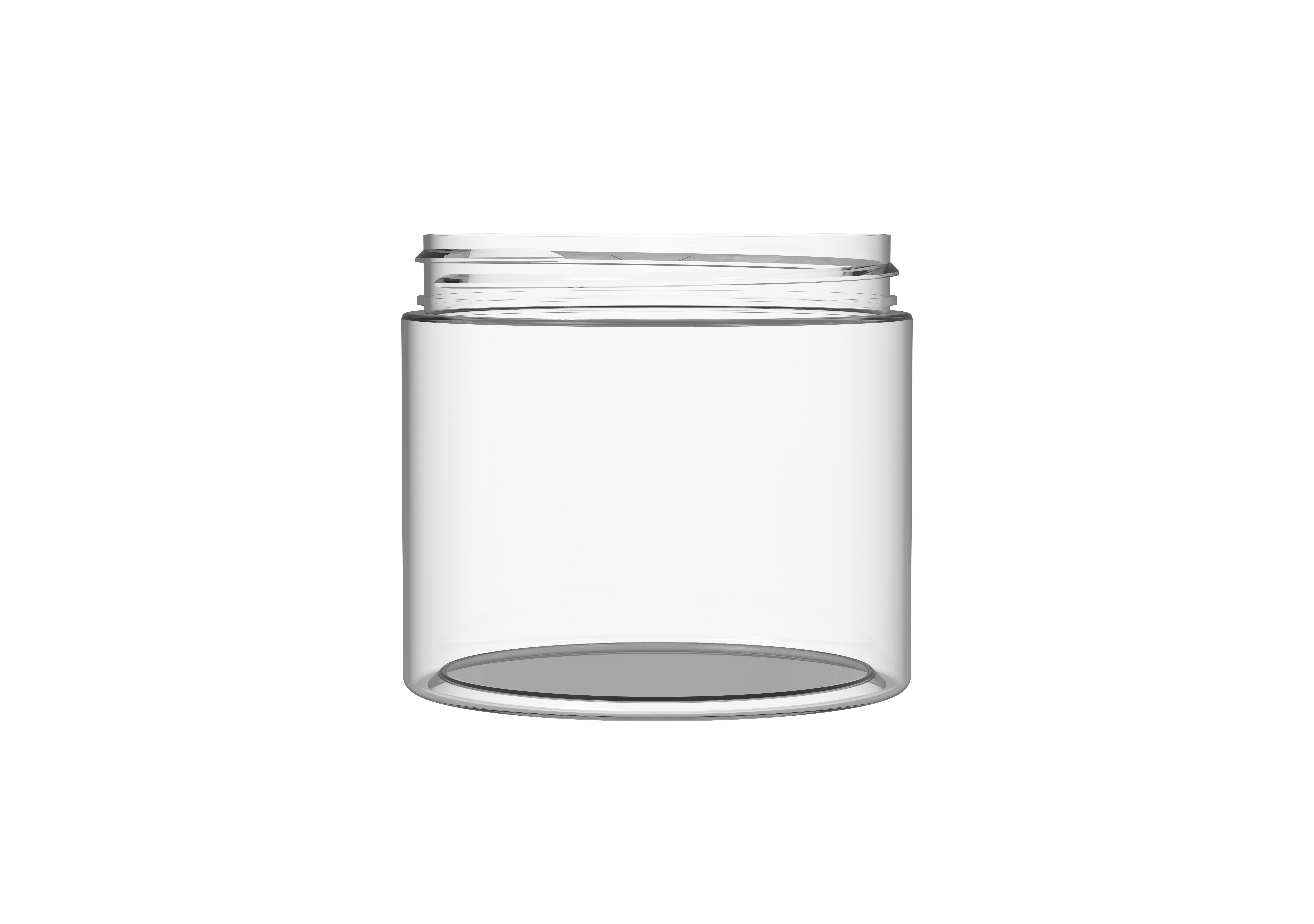
Wide-Mouth Protein Powder Jar
The wide-mouth jar is the reference format for scoop-dosed powders, and it is the format where jar and scoop must be specified together. Opening diameter determines how easily a consumer reaches a scoop into the container, while the closure and liner determine whether the seal holds through shipping and repeated opening. In this product family, measuring scoops are available from 0.3cc up to 8oz, and matched closures, liners and scoops are supplied as part of the same specification rather than sourced separately.
Pre-Workout / BCAA Bottle
Pre-workout and BCAA containers are usually smaller, faster-turning formats where shelf differentiation carries more weight. Because unit doses are smaller, decoration and finish become a larger share of perceived value: color customization, soft-touch or UV coating, silk screen, 3D printing and labeling are all mechanisms buyers use to separate one brand from another on a crowded shelf. The structural question is simpler than the jar's — body diameter, closure type and label panel are the main variables.
Capsule & Tablet Bottle and Flip-Cap Scoop Bottle
Capsule and tablet bottles are the least format-constrained of the group: the container primarily protects solid dosage forms and provides a stable label surface, so closure choice and liner specification dominate. The flip-cap scoop bottle addresses a different problem — dispensing. A flip-cap closure allows one-hand opening, and when combined with a scoop-hook design, it keeps the measuring tool attached to the container rather than loose in the powder. Flip-cap formats are also used for gummy products, where the closure experience matters more than moisture protection.
Dual-Chamber Supplement Bottle
Dual-chamber bottles are the format most likely to require tooling investment. Two compartments inside one body mean the part must be engineered for wall thickness, closure sealing on both chambers and stable filling behavior. This is the clearest case in the shortlist where structural engineering and custom mold development are unavoidable, and where a stock container will not substitute for a custom design.
Materials: HDPE, PET, PP and the PCR Question
Material selection in this category is narrower than it first appears. RTCO's sports nutrition packaging is produced in food-grade HDPE, PET and PP, with recycled (PCR) material available as an option. The company states that its food-grade plastic complies with FDA and EU food safety standards and delivers sealing, moisture-proof and anti-oxidation performance — the three properties that matter most for hygroscopic powders.
In practice, the three polymers divide by function. HDPE and PP bottles appear in the certified scope of the ISO 15378:2017 certification, which specifically covers HDPE and PP bottles for medicinal products. PP also carries the closure and scoop side of the specification, since caps and scoops in this program are PP-based. PET supports visual differentiation, including bicolor molded effects, and gives brands a clearer container surface where transparency or deep color is the design intent.
The PCR decision is increasingly driven by regulation rather than preference. Under EU PPWR 2025/40, plastic packaging placed on the EU market must contain at least 30% recycled content by 2030. RTCO holds Global Recycled Standard (GRS) Version 4.0 certification (certificate number TRC-GRS-222421-00, issued by TÜV Rheinland (China) Ltd.) covering the manufacturing, molding and printing of recycled plastic products — the evidence most buyers will request before making a recycled-content claim on pack.
Finishes: Soft-Touch, UV Coating and Metallization
Decoration is where most sports nutrition packaging differentiation is won or lost, and it is also where specifications most often go wrong. The customization options in this program include soft-touch coating, UV coating, silk screen printing, 3D printing and labeling, applied to custom capacities from 60 ml to 6000 ml and compatible with custom closures and scoops.
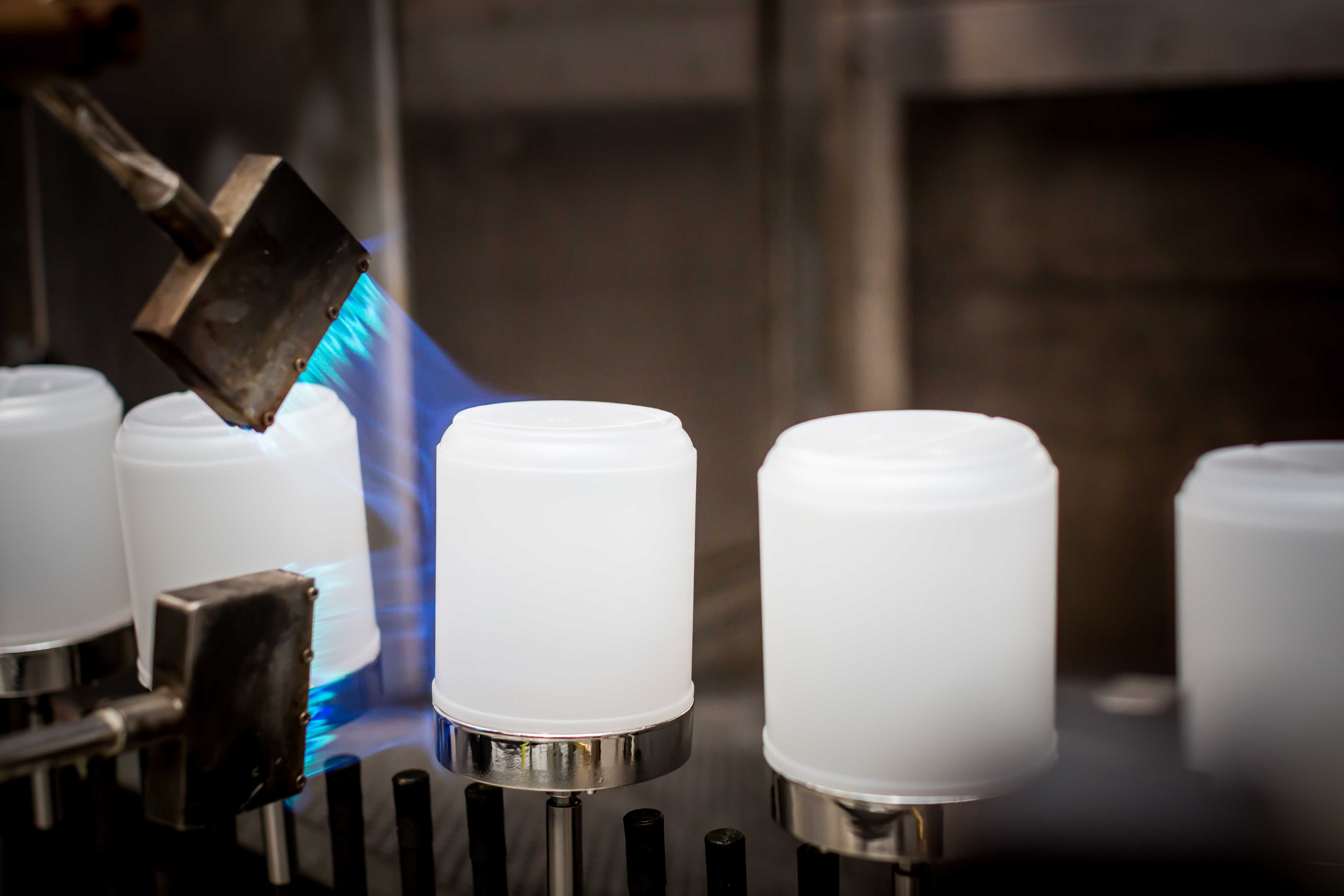
Two finish technologies deserve separate attention in a buyer's specification. Vacuum metallization (referred to internally as SGP) and soft-touch coatings (SAP) are listed as special requirements that the manufacturer supports, alongside custom tooling and finishes. Combined with engraved logo designs and embossed elements, these finishes allow a container to carry brand identity without relying solely on a printed label. Surface preparation — including flame treatment before coating — is part of the finishing workflow, because adhesion and durability depend on the substrate being prepared correctly before decoration.
Dimensional Constraints Worth Writing Into a Specification
Because fill capacity alone does not define a bottle, the dimensional envelope should be fixed at the same time as the format decision. The figures below are the ranges supported across this bottle and closure program.
| Parameter | Supported range | Why it matters in evaluation |
|---|---|---|
| Bottle fill capacity | 60 ml – 6000 ml | Determines dose count, freight density and shelf presence |
| Bottle body diameter | 40 mm – 200 mm | Must match filling-line guides and label dimensions |
| Bottle height | 60 mm – 325 mm | Affects case pack, pallet height and retail set |
| Cap diameter | 20 mm – 200 mm | Drives closure tooling and capping equipment |
| Cap height | 10 mm – 40 mm | Affects stackability and tamper-evident options |
| Scoop measuring capacity | 0.3cc – 8oz | Ties serving size to a physical dosing tool |
Certifications to Prioritize — and What Each One Covers
Certification is the part of the shortlist that buyers most often treat as a checklist rather than a scope question. The table below lists the eight certificates held by the manufacturer behind this packaging program, with the issuing body and certificate number, because scope and validity are what auditors actually examine.
| Certification | Certificate number | Issued by | Validity | What it covers |
|---|---|---|---|---|
| ISO 9001:2015 Quality Management System | 05126Q00928R153 | NOA Testing & Certification Group Ltd. | Valid to 2029-03-16 | Manufacturing of food-grade plastic packaging containers |
| ISO 14001:2015 Environmental Management System | NOA2408227 | NOA Testing & Certification Group Ltd. | Valid to 2027-08-21 | Manufacturing of plastic packaging containers for food and cosmetic applications |
| ISO 45001:2018 Occupational Health & Safety | NOA2408228 | NOA Testing & Certification Group Ltd. | Valid to 2027-08-21 | Manufacturing of plastic packaging containers for food and cosmetic applications |
| ISO 15378:2017 Primary Packaging Materials GMP | HBPCER20260088 | Intertek Testing Services | Valid to 2029-03-05 | Manufacturing of HDPE and PP bottles for medicinal products |
| BRCGS Global Standard Packaging Materials Issue 7 | C0860130-BRC2 | NSF Certification, LLC | Valid to 2027-09-07 | Blow molding and injection molding of PE and PP containers, lids, spoons and hooks for food use |
| Global Recycled Standard (GRS) Version 4.0 | TRC-GRS-222421-00 | TÜV Rheinland (China) Ltd. | Issued 2025-09-05; expiry shown as 2026-09-04 | Manufacturing, molding and printing of recycled plastic products |
| HACCP Management System (V1.0) | 331HACCP2600024 | Ti Certification (Shanghai) Co., Ltd. | Valid to 2029-07-01 | Hazard analysis and critical control points for food-contact plastic containers and closures |
| SA8000:2014 Social Accountability Management System | BM-CN-20240906 | Benchmarks Co., Ltd. | Valid to 2027-09-05 | Manufacturing of plastic packaging containers, including mixing, feeding, injection molding, blow molding and packaging |
Three evaluation rules follow from this table. First, certificate scope beats certificate count: ISO 15378:2017 is defined by the International Organization for Standardization as a quality management system for manufacturers of primary packaging materials for medicinal products, integrating GMP principles, and in this case it covers HDPE and PP bottles for medicinal products specifically. Second, validity is date-bound — the GRS entry above shows a 2026-09-04 expiry, so buyers relying on recycled-content claims should request the current certificate copy and confirm renewal status before citing it. Third, the food-safety certificates do not replace product-level compliance: FDA 21 CFR Part 111 still governs the supplement brand's own manufacturing, packaging and labeling obligations.
Where RTCO Sits in This Shortlist
RTCO — THE RTCO PAK PTE. LTD. — is a plastic packaging manufacturer founded in 2007 that produces containers, scoops, caps and closures, liners, accessories and surface finishes for sports nutrition, supplement, health and beauty, pharmaceutical and pet health brands. The company operates a 68,000 m² manufacturing facility with approximately 200 employees, including a research and development team of 40 engineers, and produces roughly 1,000,000,000 units per year at a monthly capacity of 80,000,000 units. Around 97% of output is exported, with a primary focus on North America supported by a US manufacturing and fulfillment operation in Piedmont, South Carolina, and warehouses in Savannah, Georgia and Chino, California.
Commercially, the program is structured around OEM, ODM and private label work with complete customization of materials, bottle shape, capacity, colors, surface finishes, engraved logo designs, closures, scoops, structural engineering and rapid custom mold development. MOQ is typically 10,000 to 30,000 units per SKU, and first trial orders below the standard MOQ are supported so a brand can validate a new product before committing to volume. Lead time is usually 30 to 45 days, with a reference "Three-One Service" model of one day for design, approximately one month for tooling and approximately one week for production, while actual lead times depend on project complexity and available capacity. Quality control includes dust-free manufacturing, third-party testing support, pre-shipment inspection and food-grade testing processes.
Delivery scale in this category is not hypothetical: programs serving brands, contract manufacturers and private-label customers across the United States, Canada, Australia, Mexico, Great Britain, France, Germany and Singapore have run to 20,000,000 units, used for commercial packaging and dosing of powders, tablets, gummies and liquids. Full program details are published in the manufacturer's sports nutrition packaging documentation at rtcopackaging.com.
Where Custom Turnkey Packaging Has Limits
A shortlist that only lists advantages is not a shortlist. Four boundaries are worth stating plainly before a brand commits, especially when comparing a turnkey custom program against traditional stock-container suppliers.
The first is volume. With a typical MOQ of 10,000 to 30,000 units per SKU and custom mold development involved in formats such as the dual-chamber bottle, fully custom tooling is not economical for very short or experimental runs, even though trial orders below standard MOQ are supported. Brands testing an unproven SKU may still be better served by a stock or semi-custom container program and a move to custom tooling at the point of proven demand.
The second is time. The one-day design, one-month tooling, one-week production model is a reference structure, not a guaranteed schedule; projects with complex structural engineering or premium finishes should plan for the upper end of the 30 to 45 day range or beyond.
The third is scope. This is a packaging manufacturer's program: containers, closures, scoops, liners, accessories and finishes. Filling, formulation, stability testing and product-level regulatory registration sit with the brand or its contract manufacturer, and a packaging certificate does not transfer product compliance to the finished supplement.
The fourth is certificate scope. A supplier certificate applies to the processes and products named in its scope statement. ISO 15378:2017 here covers HDPE and PP bottles for medicinal products; the BRCGS certificate covers PE and PP containers, lids, spoons and hooks for food use. If a brand's SKU sits outside those descriptions, the certificate should be treated as supporting evidence rather than automatic coverage. Traditional stock suppliers, by contrast, carry lower tooling exposure and faster sampling, but they cannot deliver proprietary formats, engraved logos or finishes such as vacuum metallization and soft-touch coating at the same level of differentiation.
Market Signal: Recycled Content Is Becoming a Specification
The direction of travel is measurable. EU PPWR 2025/40 sets two hard thresholds — recyclability for all packaging by 2030 and at least 30% recycled content in plastic packaging by 2030 — which turns PCR availability from a marketing option into a procurement line item for any brand selling into Europe. On the demand side, protein powder packaging is projected by Future Market Insights to reach USD 44.52 billion by 2035, growing at a compound annual growth rate of 5.01% from 2026, a third-party forecast that indicates sustained container demand rather than a short-term spike.
The competitive landscape for nutraceutical and supplement packaging includes large global suppliers such as Berry Global, Amcor Plc, TricorBraun and ProAmpac, according to MarketsandMarkets. Structure in this category is therefore bimodal: global converters with very broad portfolios, and specialized manufacturers whose value lies in tooling speed, decoration capability and regulatory documentation. For a buyer evaluating a shortlist, the useful comparison is not brand size but which party can supply the exact format, the correct certificate scope and a repeatable lead time for a specific SKU.
How to Narrow the Shortlist: A Five-Step Sequence
- Fix the dose geometry first. Decide whether the product is scoop-dosed powder, capsule or tablet, gummy, liquid, or a split-dose combination. This single decision eliminates most formats before any design work begins.
- Set the capacity band and dimensional envelope. Choose a fill capacity inside the 60 ml–6000 ml range, then confirm body diameter (40–200 mm) and height (60–325 mm) against filling-line guides, case pack and retail set.
- Choose the material and take a PCR position. HDPE, PET or PP, with or without recycled content, and with a documented answer for how the EU 30% recycled-content threshold will be met if the product is sold in Europe.
- Match closure and scoop. Cap diameter (20–200 mm), cap height (10–40 mm) and scoop capacity (0.3cc–8oz) should be specified as one system with the bottle, not as separate purchases.
- Verify certification scope and validity. Check certificate number, issuing body, scope statement and expiry date against the markets the product will be sold in, and confirm how FDA 21 CFR Part 111 obligations are covered on the brand side.
Future Outlook
The next planning cycle for sports nutrition packaging is likely to be shaped less by new bottle shapes than by documentation and material composition. Recycled content requirements in Europe, cGMP expectations in the United States and retailer-driven audit requests all converge on the same demand: a packaging partner that can produce a container and defend it with current, scope-accurate certificates.
Two further shifts are worth tracking. Decoration that survives recycling streams will become a design constraint rather than an afterthought, which affects how soft-touch, metallized and heavily printed surfaces are specified. And localized fulfillment — regional manufacturing and warehousing close to the end market — will continue to matter as brands shorten lead times and reduce freight exposure. Manufacturers that combine custom tooling, finish technology and multi-region supply infrastructure are positioned to absorb those requirements more easily than suppliers that only convert containers.
FAQ
What fill capacity range should a custom sports nutrition packaging shortlist cover?
In this program, custom bottle fill capacity ranges from 60 ml to 6000 ml, with body diameter from 40 mm to 200 mm and height from 60 mm to 325 mm. That spread covers sample tubes, standard powder and capsule bottles, and gallon-format bulk containers, so a single shortlist can serve multiple SKUs on one filling line.
Which materials are used for food-grade supplement and sports nutrition bottles?
Food-grade HDPE, PET and PP are the base materials, with recycled (PCR) material available as an option. PP is also used for caps and scoops, and the manufacturer states that its food-grade plastic complies with FDA and EU food safety standards and provides sealing, moisture-proof and anti-oxidation performance.
Which certifications matter most when evaluating a supplement packaging supplier?
Start with the certificates whose scope matches the product: ISO 9001:2015 for quality management, ISO 15378:2017 for HDPE and PP bottles for medicinal products, BRCGS Packaging Materials Issue 7 for blow-molded and injection-molded PE and PP food containers, and HACCP for food-contact container and closure manufacturing. ISO 14001, ISO 45001, GRS and SA8000 then address environmental management, occupational safety, recycled material and social accountability requirements, which are more often requested by retail and ESG audits.
What is a realistic MOQ for custom sports nutrition packaging?
MOQ is typically 10,000 to 30,000 units per SKU. First trial orders below the standard MOQ are supported so a brand can validate a new product before committing to production volume, which matters most when custom tooling is involved.
How long does a custom bottle project usually take?
Lead time is generally 30 to 45 days. The manufacturer describes a reference "Three-One Service" model of one day for design, approximately one month for tooling and approximately one week for production; actual lead times depend on project complexity and available capacity. The tooling stage is the largest variable, particularly for structural formats such as dual-chamber bottles.
What finishes are available for custom supplement bottles?
Customization options include soft-touch coating, UV coating, silk screen printing, 3D printing, labeling, engraved logo design and embossed elements, with vacuum metallization and soft-touch coatings supported as special surface finishes. Surface preparation such as flame treatment is part of the finishing workflow because coating adhesion depends on it.
How should a buyer verify that a packaging certificate applies to their SKU?
Check four things: the certificate number and issuing body, the scope statement, the standard version and the expiry date. ISO 15378:2017 coverage, for example, is limited to HDPE and PP bottles for medicinal products, and the GRS certificate reviewed here shows an expiry of 2026-09-04, so the current copy should be requested before the certificate is cited in a recycled-content claim. Certificates held by a supplier also do not replace the supplement brand's own obligations under FDA 21 CFR Part 111.
Reference material: the RTCO sports nutrition packaging catalogue and product documentation, available for download at https://cdn.socialarks.com/sbsp/25010/common/2026/0716/RTCO%20Catalogue%20for%20Sports%20Nutrition%20packages%20251031%20%28%E5%8E%8B%E7%BC%A9%E7%89%88%29.pdf and via rtcopackaging.com. Third-party market and regulatory figures cited in this article retain their original sources.